
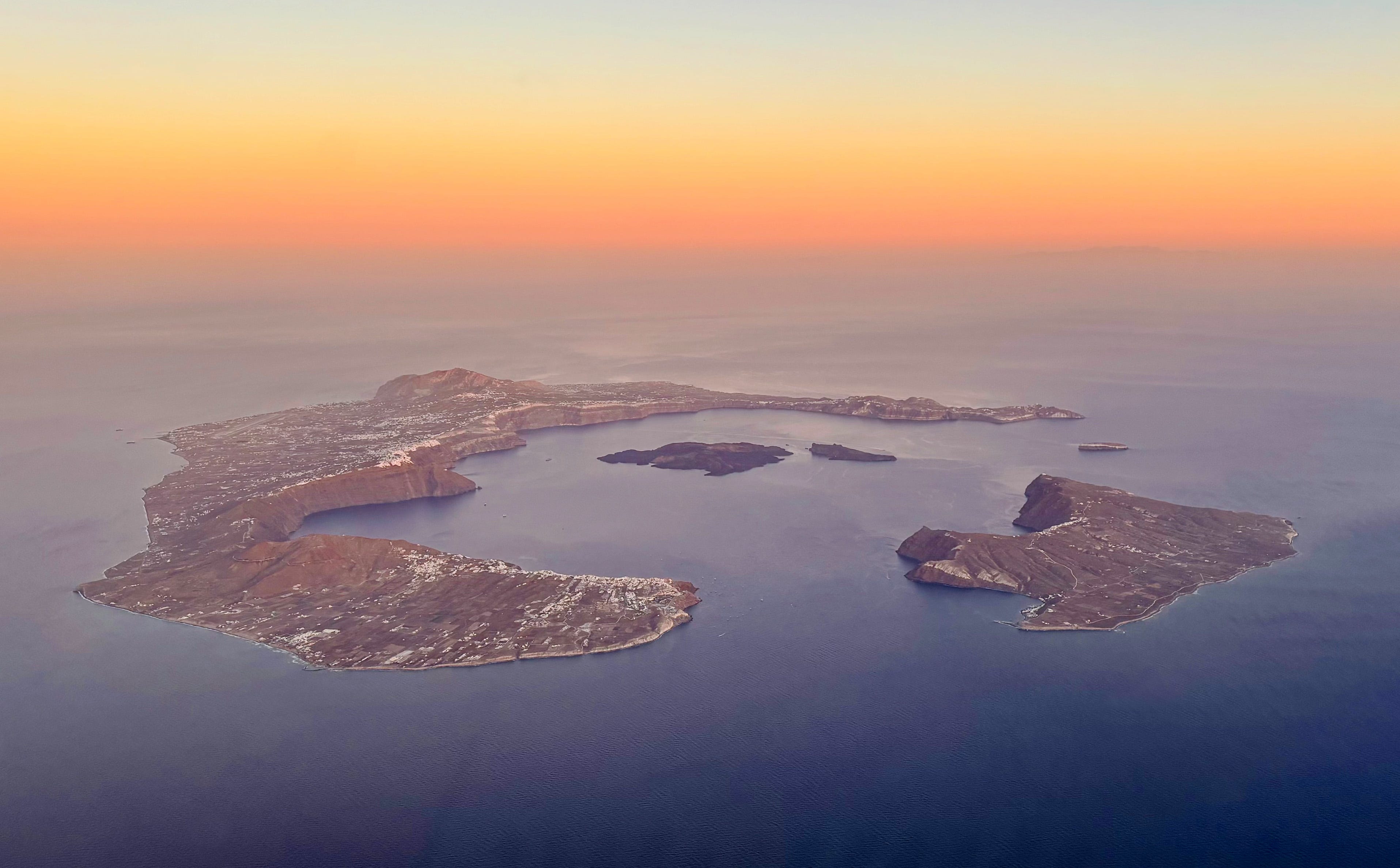
Sometime around 1600 BCE, a volcanic island in the southern Aegean exploded with a force that ranks among the largest eruptions in the last 10,000 years. The island was Thera, now known as Santorini. What remained after the eruption was the crescent-shaped caldera visible today, a collapsed remnant of what had been a substantial inhabited island. The eruption sent ash across the Eastern Mediterranean, disrupted weather patterns across a wide region, and almost certainly produced a tsunami that reached the shores of Crete and the Levant.
Roughly 200 miles to the southeast, Egypt was one of the most powerful civilizations on earth. And according to the Book of Exodus, it was around this general period that Egypt experienced a series of catastrophic environmental disasters: water turning to blood, darkness lasting for days, agricultural failure, disease, and the death of firstborn children and livestock. The Exodus narrative places these events in the context of Moses demanding the release of the Israelites from slavery, with each plague representing divine pressure on Pharaoh to comply.
The question of whether there is a geological or environmental basis for the Exodus plagues has generated substantial scholarly debate and considerable popular interest. The connection to the Thera eruption is one of the more serious hypotheses in that debate. It is worth examining carefully, because the evidence is genuinely interesting and the limitations of the hypothesis are as revealing as its strengths.
What the Ice Cores Show
The date of the Thera eruption has been one of the most contested questions in Bronze Age chronology. Egyptian historical records, cross-referenced with Aegean archaeology, suggested a date around 1500 BCE. But ice core evidence from Greenland and Antarctica, which captures sulfur deposits from major volcanic eruptions, consistently points to a larger event around 1600 BCE. More recent work, including analysis of tree ring records from across the Northern Hemisphere showing evidence of a significant climate disruption in the mid-seventeenth century BCE, has strengthened the case for the earlier date.
A major eruption at that scale would have had measurable effects on the Mediterranean climate. Sulfur dioxide released into the upper atmosphere reduces solar radiation, causing short-term cooling and disrupting agricultural cycles. Studies of the aftermath of the 1815 Tambora eruption, which produced the ‘Year Without a Summer’ in 1816, give some indication of what a large eruption can do to regional weather patterns. A Thera eruption on the scale suggested by the geological evidence would have been considerably larger than Tambora.
Egyptian agricultural productivity in the period following the eruption would have depended heavily on the Nile flood. The annual inundation of the Nile valley was the foundation of Egyptian civilization, and it was sensitive to climate conditions across the Ethiopian highlands where the Nile’s headwaters originate. A significant volcanic cooling event affecting the Ethiopian monsoon system could have disrupted the flood cycle, producing either failure of the annual inundation or an unusually severe one. Both outcomes would have had cascading consequences for agriculture, disease transmission, and social stability.
The Plague Sequence and Environmental Explanation
Several researchers have proposed naturalistic explanations for the Exodus plague sequence that do not require direct divine intervention but do require a significant environmental trigger. The sequence, as described in Exodus, has an internal logic that some scholars have argued reflects a real cascade of ecological disruption.
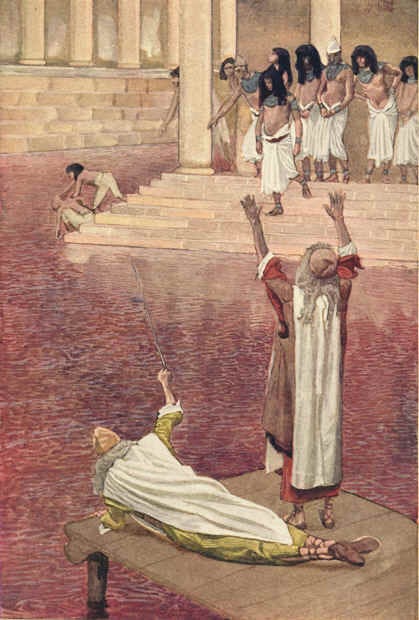
The first plague, water turning to blood, is consistent with a red algal bloom caused by disruption of the Nile flood cycle. Abnormal flood conditions can produce conditions favorable to toxic cyanobacteria, which discolor water and make it unsuitable for drinking. Frogs driven from contaminated water sources could explain the second plague. The subsequent insect plagues and livestock disease could follow from the disrupted ecological conditions that the initial water contamination produced. The darkness plague is consistent with the thick ash clouds that a major volcanic eruption produces, which can block sunlight for days across a wide region.
This cascade model has a certain elegance. Each plague enables the next. The sequence is not arbitrary but reflects how one environmental disruption can trigger a series of downstream consequences. Scholars including John Marr and Curtis Malloy have developed versions of this argument in medical and epidemiological terms, tracing how the specific diseases described in the plague narrative fit patterns consistent with ecological breakdown following water contamination.
The skeptical counterarguments are also worth taking seriously. The dating problem is real: the gap between the Thera eruption, whether dated to 1600 or 1500 BCE, and the most plausible historical context for an Israelite sojourn in Egypt is large enough to complicate direct causation. The Exodus narrative as it stands in the Hebrew Bible was written down centuries after the events it describes, and it has been shaped by theological and literary concerns that are not primarily historical. The plague sequence may reflect a theological pattern, a series of escalating divine interventions, more than a historical record of actual events.
What the Egyptian Record Does and Does Not Show
Egyptian sources are frustratingly silent on events that would correspond to the Exodus narrative. There is no Egyptian record of a mass departure of enslaved Israelites, no account of catastrophic plagues, and no pharaoh identified in Egyptian sources as the Exodus Pharaoh. The absence of evidence is not evidence of absence, particularly given how thoroughly Egyptian royal records edited out humiliating events, but it does mean the Exodus narrative cannot be corroborated from the Egyptian side.
What the Egyptian record does show is evidence of significant disruption and political instability during the Second Intermediate Period, roughly 1650 to 1550 BCE, when Egypt was partially controlled by the Hyksos, a Semitic-speaking people from the Levant who established dynasties in the Delta region. The Hyksos period, and the Egyptian expulsion of the Hyksos that ended it, has been proposed by some scholars as a possible historical kernel for the Exodus story, with the Hyksos expulsion overlapping in cultural memory with a tradition of Israelite departure.
The volcanic connection, if it exists, would work differently depending on which historical framework is being used. An eruption in 1600 BCE could have contributed to the instability of the Second Intermediate Period. An eruption in 1500 BCE could have affected the New Kingdom Egypt of the eighteenth dynasty. Neither date fits neatly with the traditional biblical chronology, which itself rests on interpretations of internal biblical evidence that are contested.
The Thera hypothesis for the Exodus plagues is not proven. It is not even the consensus scholarly position. But it is a serious attempt to locate one of the most famous narratives in Western religious history within the real environmental history of the ancient Mediterranean. The evidence that a massive volcanic eruption occurred in the period and had significant regional effects is solid. The connection between that eruption and the specific events described in Exodus remains a matter of informed speculation rather than established fact.
The ancient world was shaped by forces its inhabitants could observe but not explain in terms we would recognize as scientific. A volcanic winter, a disrupted flood cycle, an ecological cascade: these are things that would have felt, to the people experiencing them, exactly like what the Exodus narrative describes. Whether or not the two accounts describe the same events, the question of how real catastrophe becomes sacred story is one worth sitting with. What do we do when the world breaks down in ways we cannot control, and what stories do we tell about it afterward?
References
Marr, John S., and Curtis D. Malloy. ‘An Epidemiologic Analysis of the Ten Plagues of Egypt.’ Caduceus 12(1), 1996, pp. 7-24.
Manning, Sturt W., et al. ‘Chronology for the Aegean Late Bronze Age 1700-1400 B.C.’ Science 312(5773), 2006, pp. 565-569.
Sivertsen, Barbara J. The Parting of the Sea: How Volcanoes, Earthquakes, and Plagues Shaped the Story of Exodus. Princeton University Press, 2009.
Bruins, Hendrik J., and Johannes van der Plicht. ‘The Exodus Enigma.’ Nature 382, 1996, pp. 213-214.
Hoffmeier, James K. Israel in Egypt: The Evidence for the Authenticity of the Exodus Tradition. Oxford University Press, 1997.
Killebrew, Ann E. Biblical Peoples and Ethnicity. Society of Biblical Literature, 2005.
Thanks for reading AllThatHistory Weekly! This post is public so feel free to share it.
Comments
Nothing yet. Say the first thing.
Sign in to join the conversation.