
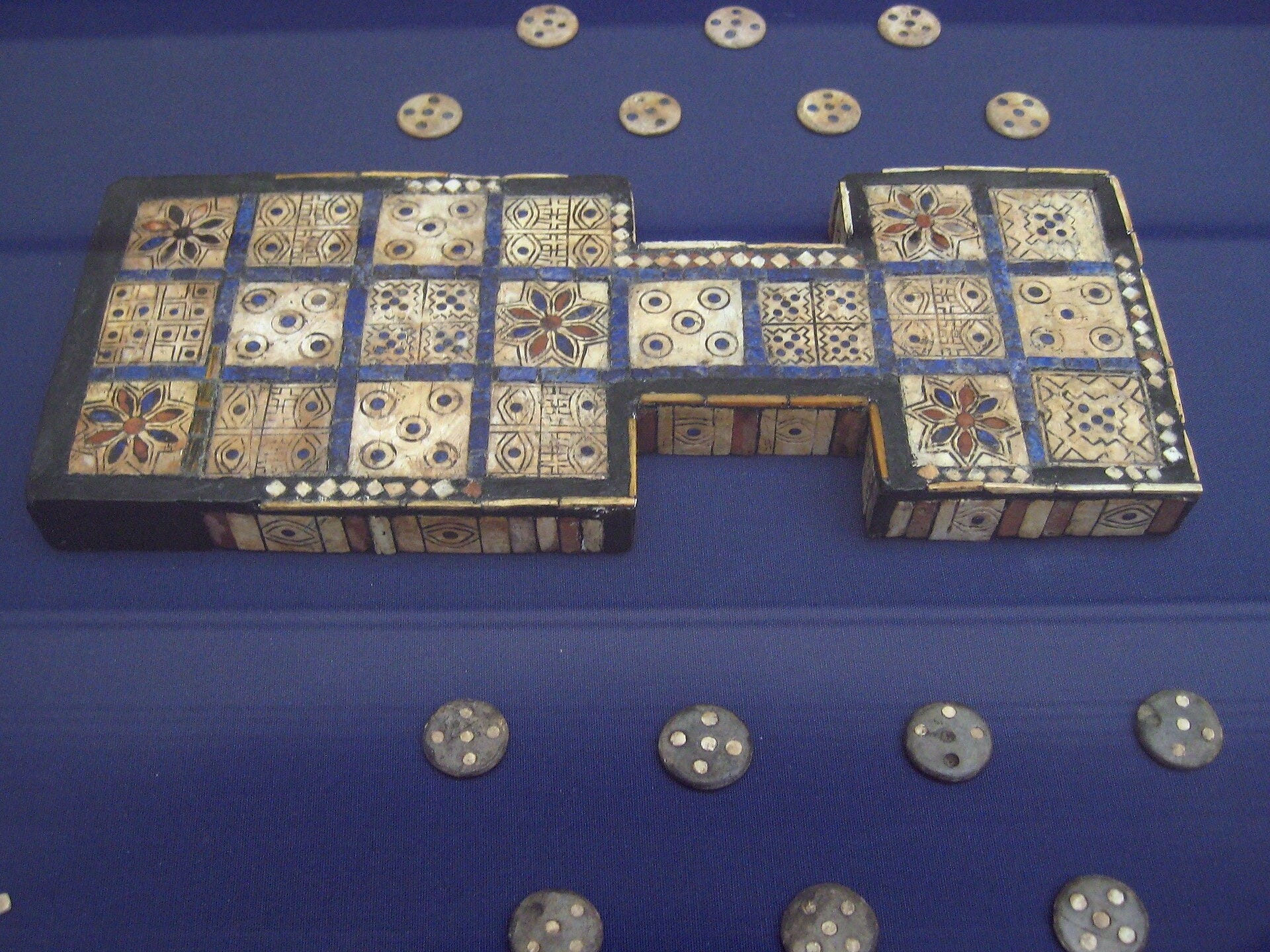
In 1926, Leonard Woolley was excavating the Royal Cemetery of Ur in what is now southern Iraq when his team uncovered something that had no obvious parallel in the ancient world. Nestled among gold headdresses, ceremonial lyres, and the remains of court attendants buried alongside their rulers was a small wooden board, roughly the size of a large book, inlaid with shell, red limestone, and lapis lazuli. The surface was decorated with five-pointed rosettes and geometric patterns. The wood was worn smooth in places. At some point during its working life, someone had repaired it.
The board dates to roughly 2600 to 2400 BCE. It is one of the oldest complete board games ever recovered. And for most of the twentieth century, nobody knew how it was played.
The board went to the British Museum after Woolley’s excavation, where it was studied, catalogued, and displayed. For decades it was treated as an artifact of uncertain function, a beautiful object whose purpose could only be guessed at. Then, in 1983, Irving Finkel, a curator at the museum specializing in ancient Mesopotamian cuneiform, was working through a collection of clay tablets when he identified something unexpected. A Babylonian tablet dated to 177 BCE contained a written description of how to play a board game. The tablet had been in the museum’s collection for years. No one had connected it to the board.
Finkel decoded the rules and the game, silent for roughly four millennia, could be played again. It turned out to be a two-player race game. Each player moves pieces along a shared track from start to finish, with tetrahedral dice determining movement. Certain squares offer safe haven. Others are contested. Landing on a rosette square earns an extra throw. The structural logic is recognizable to anyone who has played Parcheesi or backgammon, which is not a coincidence. A video of Finkel explaining and playing the game has been watched millions of times since it was posted, and it shows just how strategically rich the game remains after 4,600 years.
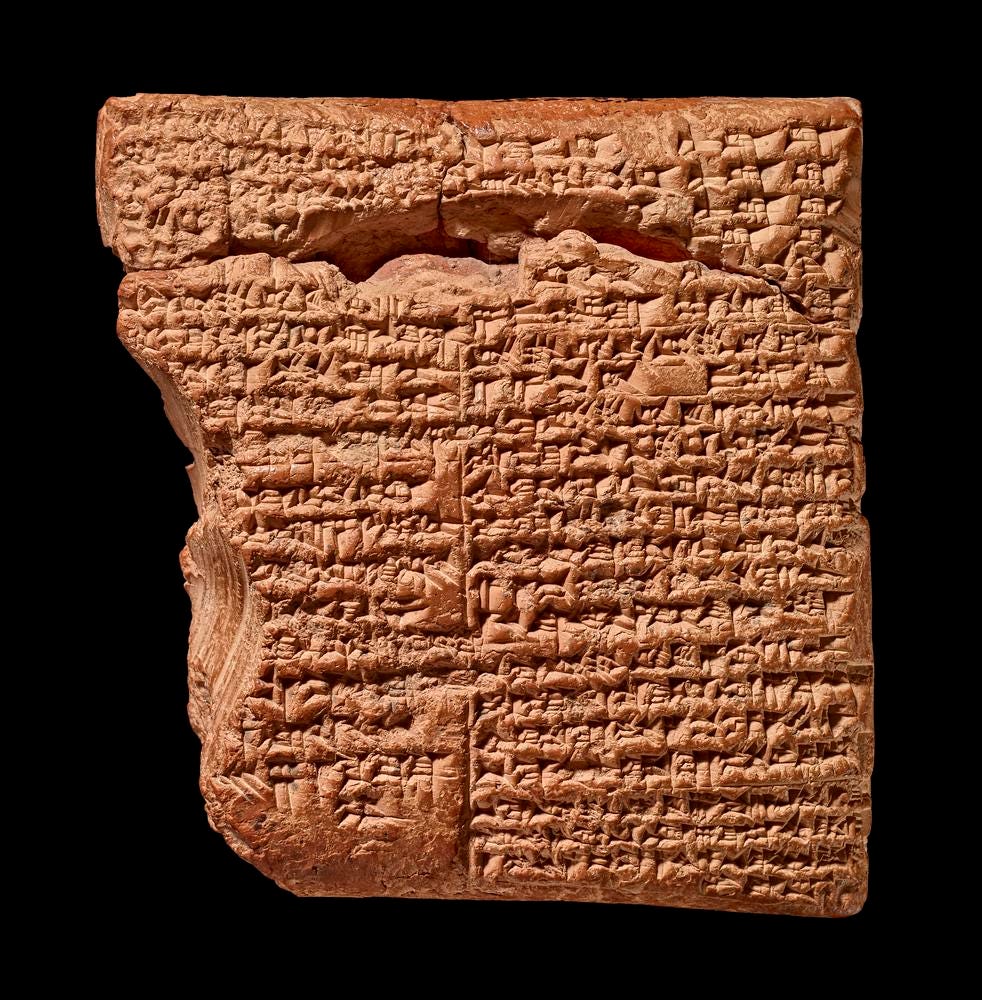
The Royal Game of Ur was not a rare luxury item played only by kings. Versions of the board have been found across a remarkable geographic range: Egypt, Cyprus, Sri Lanka, Crete. Simpler versions, scratched into fired clay or carved from cheaper stone, appear in ordinary domestic and military contexts. One version was found among the grave goods of Tutankhamun. Another was scratched into the steps of a temple in Jerusalem. The game appears to have been played continuously from roughly 2600 BCE until at least the first century CE, a lifespan that puts chess, invented around 600 CE, in perspective.
The distribution of the game along trade routes tells us something meaningful about how Sumerian culture traveled. When Babylonian merchants moved through the ancient Mediterranean and into Asia, the game went with them. It crossed linguistic boundaries, political boundaries, and cultural ones. Whatever made it compelling was apparently universal enough to take root wherever it landed.
The dice are worth a closer look. The tetrahedral design, with two marked corners out of four, produces a specific probability distribution across throws. This is not a primitive approximation of randomness. It is a considered design that creates a particular range of outcomes, balancing luck with the strategic choices available to each player. Whoever designed the original game understood, in practical terms, what they were doing mathematically. The result is a game that rewards skill as well as chance, which is almost certainly a significant reason it survived as long as it did.
Several game boards and related objects from Ur passed through the Iraq Museum in Baghdad, which suffered extensive looting following the 2003 invasion. Renewed cataloguing efforts in subsequent years have identified previously undocumented game-related material, though the full scope of what was lost or displaced remains unclear. It is a reminder that these objects carry cultural memory in a concrete way. The board Woolley found had been repaired during its working life. Someone valued it enough to fix it rather than replace it.
The Royal Game of Ur is 4,600 years old. Its rules were lost, then found again on a clay tablet that had been sitting in a museum drawer for over a century before anyone connected it to the board in the next room. When Finkel finally decoded those rules and sat down to play, the game worked. It was balanced. It was genuinely engaging.
Which raises a question worth thinking about: what does it mean that a Sumerian in a tavern in 2400 BCE was playing something structurally similar to games people still play today? Is that continuity evidence of something consistent in how human minds engage with structured chance and competition? Or is it simply that a well-designed game, once it exists, tends to persist? And if games travel across millennia in ways that languages and empires cannot, what else might we be carrying forward from the ancient world without realizing it?
Finkel, Irving. ‘On the Rules for the Royal Game of Ur.’ In Ancient Board Games in Perspective, edited by Irving Finkel. British Museum Press, 2007, pp. 16-32.
Woolley, Leonard. Ur of the Chaldees. Ernest Benn, 1929.
Bell, R.C. Board and Table Games from Many Civilizations. Oxford University Press, 1960.
Crist, Walter, Anne-Elizabeth Dunn-Vaturi, and Alex de Voogt. Ancient Egyptians at Play: Board Games Across Borders. Bloomsbury Academic, 2016.
British Museum. ‘How to Play the Royal Game of Ur.’ britishmuseum.org/blog/how-play-royal-game-ur. Accessed June 2026.
Thanks for reading AllThatHistory Weekly! This post is public so feel free to share it.
Comments
Nothing yet. Say the first thing.
Sign in to join the conversation.