
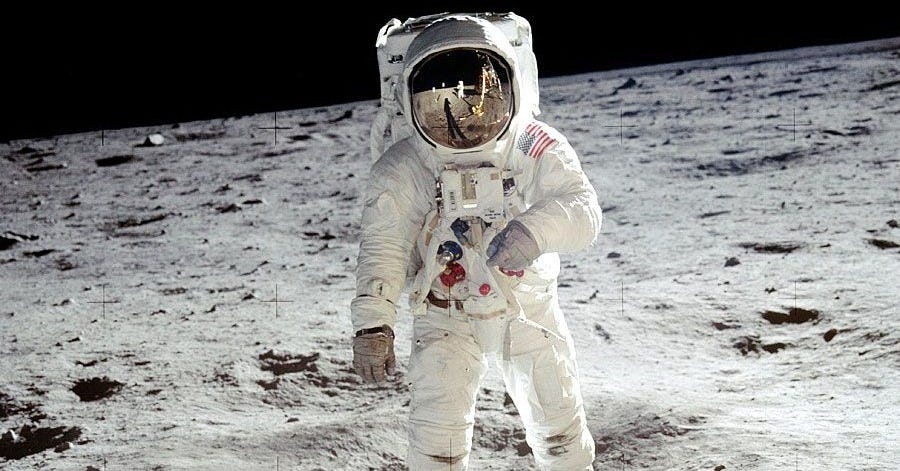
July 20, 1969. Neil Armstrong steps onto the Moon. Roughly 600 million people watch it live, about one in five humans alive at the time. It remains one of the most documented events in human history. And a persistent theory holds that all of it was staged in a film studio because NASA couldn’t actually get there during the Cold War.
Specific claims drive this theory: the flag appears to wave in a vacuum, no stars are visible in the photographs, and the Van Allen radiation belts should have been lethal. Each has a straightforward answer. A horizontal rod sewn into the flag kept it extended since it wouldn’t unfurl in a vacuum on its own. It moved when the astronauts handled it, then stopped the moment they let go. No air means no continued movement. Stars aren’t visible because the lunar surface in daylight requires camera exposure settings that don’t capture faint background stars, same as taking a photo outside on Earth. Radiation during the transit was real, calculated, and within survivable limits.
Physical evidence is harder to dismiss than photograph analysis. NASA placed retroreflectors on the lunar surface during Apollo. Observatories around the world, including in countries with no reason to support American propaganda, have bounced lasers off these panels to measure the Moon’s distance to millimeter precision. Scientists still use them today.
Over 400,000 people worked on Apollo across thousands of companies and institutions. Physicist David Robert Grimes calculated in 2016 that a conspiracy involving that many people would statistically be exposed within four years. Nobody credible has come forward in over 50 years. More importantly, the Soviet Union tracked every Apollo mission in real time with its own equipment and never once disputed any of it. They had every reason to, if there was something to dispute.
Skepticism of U.S. government institutions in the 1960s is completely reasonable given what those institutions were actually doing. MKUltra, COINTELPRO, the Gulf of Tonkin. Healthy distrust is warranted. Just not here.
Thanks for reading AllThatHistory Weekly! This post is public so feel free to share it.
Comments
Nothing yet. Say the first thing.
Sign in to join the conversation.