
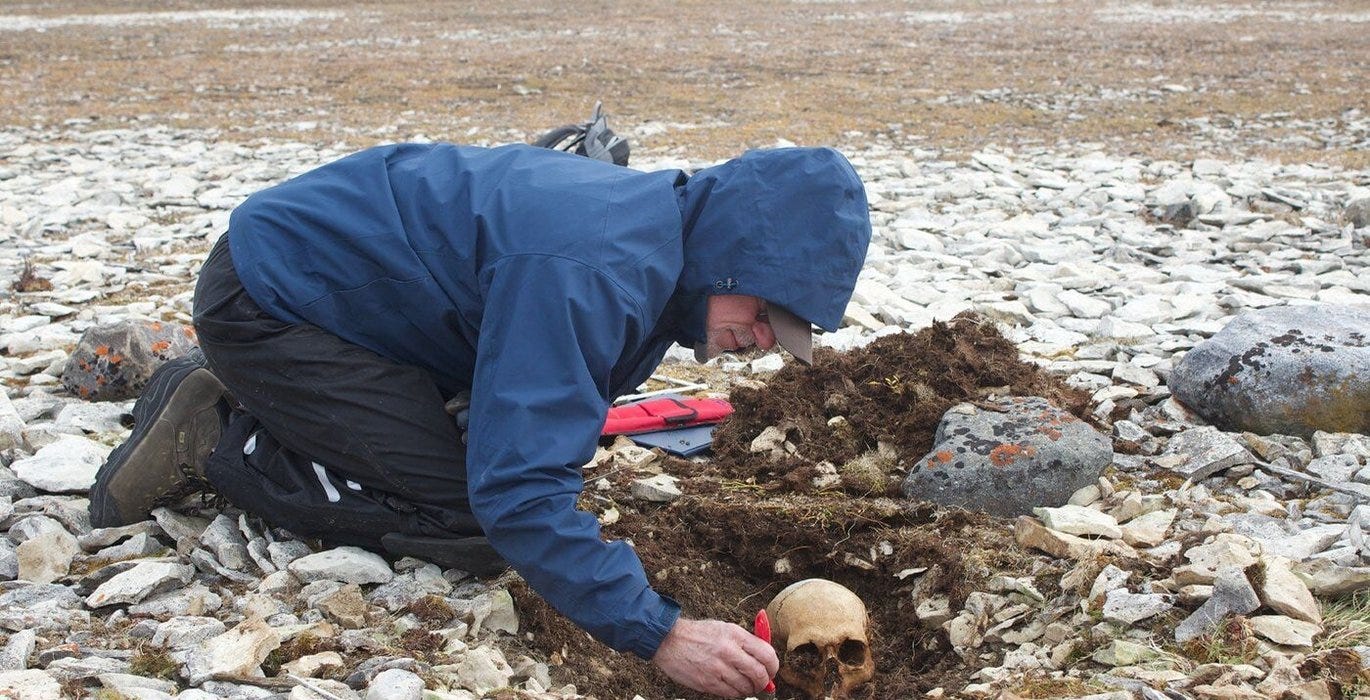
In May 1845, two Royal Navy ships, HMS Erebus and HMS Terror, sailed from England carrying 129 men under the command of Sir John Franklin, tasked with charting the final unmapped stretch of the Northwest Passage, a sea route connecting the Atlantic and Pacific through Arctic Canada that European nations had been chasing for three centuries. Whalers spotted the ships anchored in Baffin Bay that summer, waiting for good ice conditions. Nobody European ever saw them again. Both ships, and every single man aboard them, vanished into the Arctic so completely that the expedition became one of the defining unsolved mysteries of nineteenth century exploration.
More than 175 years later, that mystery is finally being solved one identity at a time. A long-running DNA identification project has now confirmed the specific names of six individual sailors recovered from skeletal remains scattered across the Arctic islands where the crew died, four of them announced in 2026 alone. Each confirmed name turns an anonymous statistic, one death among 129, into a specific, documented person, while quietly validating testimony that Victorian Britain had spent more than a century refusing to take seriously.
Franklin was 59 years old and already a veteran Arctic explorer when he took command of the expedition, chosen partly for his experience and partly because the Admiralty considered the Northwest Passage search largely a formality by 1845, a final mapping exercise rather than a genuinely dangerous unknown. Both ships carried reinforced hulls, steam engines for auxiliary power, and provisions calculated to last three years, reflecting real confidence the voyage would succeed without major incident. That confidence proved catastrophically wrong. The ships became trapped in pack ice near King William Island in September 1846 and never broke free again. Franklin himself died in June 1847, and by April 1848, the 105 men still alive abandoned both ships and set out on foot across the ice toward the Canadian mainland, hauling lifeboats loaded with supplies across terrain that offered no realistic path to safety. Not one of them survived the attempt.
A working Northwest Passage promised enormous strategic and commercial value to whichever nation mapped it first, a shortcut connecting European and Asian trade without the long voyage around South America or Africa. Britain had already funded multiple expeditions across the preceding decades chasing that prize, and by 1845 the search had become as much a matter of national prestige as practical navigation, which helps explain why the Admiralty invested so heavily in outfitting Franklin’s ships with the most advanced equipment available at the time, and why the country’s reaction to their disappearance eventually became a matter of wounded pride as much as genuine grief.
Ships in the fleet carried an estimated eight thousand tin cans of preserved food among their supplies, along with libraries, fine china, and other comforts reflecting Victorian assumptions about how a well-organized expedition ought to travel, even into some of the most hostile terrain on the planet. That same tinned food supply, produced under a rushed contract shortly before departure, is part of what later researchers examined for lead contamination possibly introduced through hasty soldering. Search expeditions, several of them funded and organized by Franklin’s wife Lady Jane Franklin after the Admiralty’s official efforts stalled, combed the Arctic for years afterward, recovering scattered notes, relics, and skeletal remains, but never definitively answering what had actually happened.
Comments
Nothing yet. Say the first thing.
Sign in to join the conversation.