
Women stay stuck in bad marriages for many reasons: They’re financially dependent on their spouse. They worry about the impact of divorce on their kids. The idea of re-entering the dating market makes them break out in hives.
But I hear most often about a different fear: that parenting and housekeeping by yourself would be even worse than parenting and housekeeping with a minimally helpful partner.

If he1 is doing anything more than zero, this makes intuitive sense. How could losing one household adult lead to anything but more work for the one who remains?
And yet, this is one case where research contradicts intuition. As Corinne Low writes in her new book (citing research she’s done with coauthors Kyle Hancock and Jeanne Lafortune), women’s housework time decreases upon divorce. Meanwhile, the opposite happens for men: their housework time increases after a divorce.
‘But specialization!’ I imagine some commenters crying. ‘She’s doing more housework in marriage because he is contributing more financially. It’s just economics!’
Low (herself an economist) bursts that bubble pretty quickly: men’s housework time is extremely unresponsive to their wife’s earnings. Even when she’s the primary breadwinner, she does much more housework.
This chart shows the average housework time for the higher- and lower-earning partner in 4 different kinds of couples: a straight couple where she earns more; a straight couple where he earns more; a gay couple; and a lesbian couple.
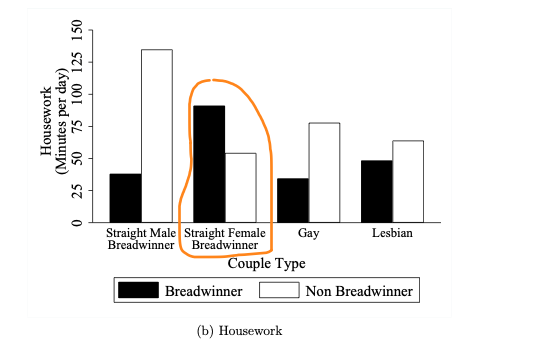
The latter three follow the pattern we’d expect if economics carried the day: the primary breadwinner does less housework than their partner. But look at the “Straight Female Breadwinner” category, and you’ll see that the pattern reverses: she’s spending roughly 100 minutes per day on housework, whereas her lower-earning partner is spending roughly 50!
Another study, this one by Joanna Pepin and co., looked at time-use patterns among never-married, cohabiting, married, and divorced mothers. They, too, discovered something surprising: married moms spend more time on housework and less time sleeping than divorced moms. The authors nod to the possibility of specialization (e.g., if there are two partners, he can focus on paid work and she can focus on unpaid work) before offering the equivalent of an academic burn. Moms who lived with an extended family member (an adult child, a parent, a sibling, etc.) spent less time on housework and childcare than other mothers. It’s just the moms who live with a male romantic partner who end up doing more housework. Thus, they conclude, “our findings suggest that it is not just an additional pair of hands that is important; to whom those hands belong also matters.” (Boom!)
So perhaps divorce won’t increase your physical labor load – and might even net you a bit more sleep. But what about your mental load?
Alas, because this is an emerging area of research, the data are pretty limited. The one research paper I found on the topic is a small study based on interviews with 31 separated parents in the UK. The results make intuitive sense – but, as we saw above, intuition can lead us astray. So take this with a grain of salt.
The authors, Renee Reichl Luthra and Tina Haux, find quite a bit of variation in what happens to the mental load post-separation. For some couples, what happens after divorce is more or less the same as what happened before divorce: if she was carrying most of the load before, she continues carrying it in their new normal. If they shared the load before, they continue sharing it.
Luthra and Haux report that continuity was most common when the split was amicable and partners’ employment stayed broadly the same pre- and post-divorce. For example, couples who’d been in a neotraditional arrangement (where both work but she is in a part-time or less intense career) used the same narratives post-split to justify her greater cognitive labor load: “she’s just better at it;” “her work is more flexible;” etc. Whereas couples who had established a more equitable arrangement during their marriage – perhaps because they had non-overlapping work shifts, so he spent a fair bit of time on his own and “in charge” of the kids – didn’t see a reason to change that post-divorce.
But for other couples divorce did lead to a marked shift in their cognitive labor allocation. Sometimes that was a function of employment changes: she started working more hours to make up the lost income; he cut his work hours back to make room for the increased parenting required of him under their custody arrangement. In turn, their cognitive labor arrangement shifted toward more balance.
And sometimes, less pleasantly, it was the vicious nature of the divorce that catalyzed change. Less communication between exes meant their households operated more or less independently, and/or she was no longer willing to take things off his plate.
For these high-conflict couples, the mental load was sometimes reframed as a source of power rather than a burden. In the process, it morphed into one more asset to fight over. He was no longer willing to defer to her, and she attempted to edge him out of shared decision-making about their kids. The load might be more equitable, but it’s a Pyrrhic victory at best.
Because all of this is a bit abstract, I wanted to talk to someone who’s been through it personally. Gail Cornwall is a journalist who writes about a range of issues impacting “current and former children” (don’t you love that??). More relevant for today’s topic, she’s also a divorced (now remarried) mom. Cornwall was kind enough to take an informal poll of her divorced-mom network’s experiences with mental load.
Sometimes, mom remains the manager.
One of Cornwall’s connections, let’s call her Lucy, is emblematic of many others. Her ex cooks for the kids when they’re at his place, and he’s hired someone to do the laundry over there, but Lucy handles all of the kid-related logistics. She sets up the camps, arranges the playdates – including on days when he has custody of the kids. Lucy makes sure the kids have appropriately sized seasonal clothing at his place, while he ignores emails from their schools, knowing Lucy will let him know if there’s something he needs to do. She handles the scheduling of doctors’ appointments, prompts the kids to send thank you notes to his family, and so on. Part of that is habit, and part of that is the gendered assumptions other people make: people come to Lucy to ask about play dates and birthday parties, and it’s less work for her to just make a plan than to reroute a request to him and wait for his, ahem, “less efficient” response process to unfold.
Coordination work ramps up.
When you go from a family living in one household to one spread across multiple households—sometimes with new members added on—Cornwall said there’s just more to organize, and more complexity:
“If band is on Tuesday, and Tuesday is a Dad day, but Monday is a Mom day, you have to remember that the clarinet is going to need to sleep at one house Monday night, but then it’s going to go home to the other house on Tuesday after school, so then it has to make its way back over to Mom’s during the week so it’s ready for school again next Tuesday.”
Confused? Me too. Cornwall explains that this is an area where financial resources can go a long way: clarinets are too expensive for almost everyone, but a lot of the families she polled have bought two soccer uniforms, a pair of identical favorite stuffies, multiple lunchboxes, and more to save themselves the hassle of transporting them back and forth.
But, it doesn’t feel as bad as it did when they were married.
I assumed that all this cognitive labor would be crazy-making: you’re not even married anymore, and you’re still handling his shit?!? But Cornwall told me that for many moms she knows, there’s less resentment. Now, all of this work is for their kids, not for him. Sure, they wish they lived in a world that produced dads equally poised to take on more cognitive labor, but it feels less personal post-split. Many of these women say they have extra energy for this sort of thing, now that they’ve exited a draining relationship. Cornwall has a highly collaborative, flexible coparenting arrangement that has all hands on deck most days, but for many of the women she knows in California (which defaults to 50/50 custody), regular breaks from the physical labor of parenting make the cognitive load easier to bear.
Dynamics change when exes remarry.
Candace represents a bunch of Cornwall’s friends whose logistical load was lightened when a new woman came on the scene. When Candace’s ex remarried, someone else was suddenly paying attention to whether seven sweatshirts had piled up at one house, leaving just one at the other. The two women now text frequently about things like switching to a hypoallergenic laundry detergent and whether slipping grades might require an extra parent-teacher conference. Frantic “Jonny needs his clarinet!” phone calls decreased, and “Dad days” became relaxing for Candace. (Cornwall said some men also enlist their parents: When Julia’s ex has the kids, her former mother-in-law comes over and handles the housework.) For her part, Cornwall said she, her first husband, and her second one now parent as a trio, and many hands—and minds—can make for lighter work.
Overall, Cornwall emphasized that there’s no single story: “The differences in co-parenting [post-separation] are as varied as the differences in parenting. It totally depends on who these individual people are.”
In other words, your mileage may vary.
I don’t want to come across as an unequivocal divorce booster. (Not least because this would be hypocritical of me as a happily-married-and-hoping-to-stay-that-way person.) Time and brainpower expended on household labor are pieces of a much bigger puzzle. Divorce is not, typically, a good deal for women economically. And the process of divorcing is usually not great for anyone’s well-being, even if most eventually recover.
To counter some of those potential downsides, the economist Low—herself a remarried mom—advises women to start planning for divorce as soon as they get married, including by making financial decisions with the possibility of future separation in mind. While this is probably good advice, I suspect readers in a good (or even merely good-enough) marriage will cringe at the thought, as I did.
But if any of you find yourself in a not-so-good marriage, I recommend Low’s book. While not exactly a pro-divorce text, it is much more frank about the “exit” possibility than most books in its genre. And after all, as Low points out, it’s when we believe we have no good options that we get locked into the worst deals.
To be clear, there are cases where the minimally helpful partner is a “she.” But the research and stories I’m focusing on today discuss the more common scenario for different-gender couples, where she’s doing most of the unpaid labor pre-divorce, so I’ve adopted the corresponding pronouns.
Comments
Nothing yet. Say the first thing.
Sign in to join the conversation.