
Next week I’ll be live with the incomparable Gemma Hartley for a discussion about What’s On Her Mind. We’ll be speaking on Wednesday, October 15th, at 3pm ET! I’d be thrilled to see you there.
Wisconsinites: On Sunday, October 26th at Noon, I’ll be at the Wisconsin Book Festival, in conversation with Emily Callaci (whose work I’ve written about) and Pernille Ipsen. I’m excited about this one!
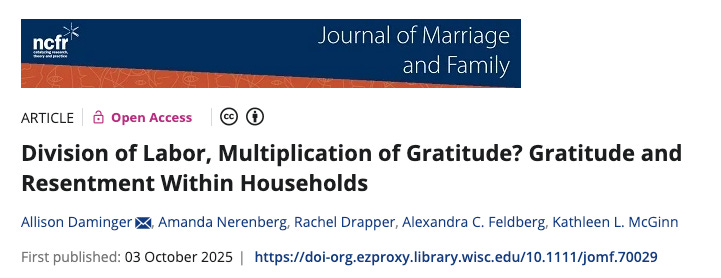
Something big dropped on October 3rd. I’m speaking, of course, about the article I wrote with the fabulous all-woman team of Mandi Nerenberg, Rachel Drapper, Allie Feldberg, and Kathleen McGinn. (Though I’d forgive you if you were distracted by that other thing.) It’s open-access, so you’re welcome to read the paper in full. But for the folks who’d rather get the tl;dr, I’m also going to break it down here.
When the world shut down in March 2020, many work-family scholars scrambled to get new research up and running. Times were bad—but they were bad in an unusual way that researchers hoped would be theoretically generative! Lucky for me, Allie and Kathleen were among this prescient group. They fielded a mixed-method, multi-year study featuring 3+ waves of surveys and in-depth interviews with employed, married (and/or cohabiting) parents across the US. For this paper, we focused on the 209 interviews their team conducted with 78 men and women who sat for multiple interviews (at least two, and in most cases three) over the course of two years.
When I joined the research team in 2022, our brief was rather broad: write a paper about the role of household labor in the participants’ lives. To narrow down to a more specific question, we read and reread the interview transcripts, taking notes all the while on what was interesting or surprising in the data. One surprise was just how positive many respondents were about their spouse. They gushed about their partner’s good qualities, how the pandemic experience had strengthened their relationship, and how strong they now felt as a couple. These sentiments stood out because they clashed with the generally doom-and-gloom mainstream media coverage of family life under Covid. And as I read through all these statements of appreciation, I was reminded of Arlie Hochschild’s idea that every marriage has an “economy of gratitude” comprised of metaphorical gifts offered, received (and sometimes rejected) by one partner or another.

Hochschild’s core insight (as I’ve previously written) was that gratitude acts as a window: when you know what someone is grateful for, you can work backward to infer their initial expectations. We feel grateful when our partner exceeds our expectations. We feel resentful when our partner fails to live up to our expectations.
What the research team wanted to know was: what are the primary sources of men’s and women’s household labor-related gratitude and resentment? And what do those emotions tell us about what they expect of each other? Finally, because we had longitudinal data (i.e., data collected at multiple points over the course of months to years), we were also curious about when and how emotions shifted: what factors nudged a couple toward more gratitude and less resentment?
We broke our findings down into three parts: one on gratitude, one on resentment, and one on change over time. And within each of those, we reported separately on the patterns we observed among women and among men – because they were often quite different.
Women: One group of women was grateful for their husband’s “help” with housework and childcare. By simply chipping in on tasks like cooking or laundry without complaint, he exceeded her expectations. Other women, though, had a higher bar: they were grateful when he stepped up to contribute without being asked. As Jennifer said of her husband, “He was able to just jump right into it. I didn’t have to say, ‘Okay, I need you to do this.’”
On the flip side, women’s resentments also clustered into two groups. One group expected a co-manager and was disappointed that she instead had a willing helper. He offered to cook dinner but failed to think through the timing. He faithfully completed his “assigned” duties but didn’t keep the bigger picture in mind. The other group expected a helper and grew resentful only when he was so preoccupied by his paid work that he failed to remember they had a household to run.
Men: There was less variation among men than there was among women. Men were, by and large, grateful for the way their wife’s unpaid labor paved the way for them to do more paid labor. Daniel summed it up nicely: “I get a lot of support from my spouse in being able to do what I need to do at work to be successful. I can stay late when I need to; I know that the kids have been well taken care of.” Men also appreciated that their wife took care of things without complaining. “She’s just kind of absorbing” all of the household admin, said Tyler. Implicitly, these men expected to have to help with housework, or for their wife to be annoyed when they were focused on paid work, and they were pleasantly surprised when she took over at home.
Whereas women were mostly resentful about what men did or didn’t do housework-wise, men got resentful when they felt like their wife didn’t appreciate the contributions they made, or that she was blaming them for tasks they didn’t know about. In the former group, Jacob talked about how his wife nitpicked his cleaning, telling him he wasn’t doing it right. In the latter group, Michael was resentful when his wife got annoyed by her heavy housework load but hadn’t explicitly delegated tasks to him.
One major disconnect—and, in turn, source of friction—was that (some) women and men had very different cognitive labor expectations. Women resented “having to ask” him to do something; men resented “having to guess” what she wanted him to do. These resentments point to very different mental models: she more often saw household management as a shared responsibility; he more often saw it as a function of her preferences or needs.
What we saw among the couples who moved toward gratitude and away from resentment over time was some combination of him stepping up to be more proactive (we refer to this as greater attunement in the paper) and her giving up and lowering her expectations (we call this, more positively, increased willingness to delegate).
Extrapolating a bit, we conclude the paper by pointing to a well-known puzzle: why do so many people say they want an “equal” or “fair” relationship and yet divide housework so patently unequally? Our research suggests that what people mean by “equal” and “fair” may be way more nuanced than current surveys are equipped to pick up on. As we write, “‘Sharing’ household labor may simply mean something different to the average woman than to the average man.”
No posts
Comments
Nothing yet. Say the first thing.
Sign in to join the conversation.