
In chemistry terms, a flashpoint is the lowest temperature at which a liquid gives off enough vapor to catch fire if a spark comes near. (Gasoline has a pretty low flashpoint; this is why smoking at gas stations is generally frowned upon.) But those of us who don’t work with flammable chemicals are much more likely to encounter metaphorical flashpoints: tipping points where invisible tensions explode into angry protest and heated conflict.
In her new book Gender Flashpoints, UCLA sociologist Abigail Saguy argues that these days, it’s “difficult to find a gender-related issue that does not spark such intensity.” Heck, the current administration doesn’t believe gender is a thing, arguing instead that biological sex is the only real or important marker of identity. At the other end of the spectrum, I have professional colleagues who argue that even biological sex is a social construct.
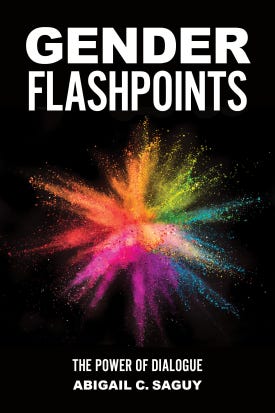
These ideological differences aren’t new, but they are newly prominent (and vitriolic) in our national discourse. Conveniently, for almost a decade now Saguy has been conducting interviews with gender and LGBTQ+ activists across the political spectrum, trying to understand how they think about sex and gender—and what implications their varied ideas might have for policy and practice in sports, medicine, law, and other arenas.
The resulting book reads like a thoughtful guided tour of the debates and faultlines that frequently lead to sparks. ‘Look to your left, please, and notice the gender-critical feminists – don’t call them TERFs, they don’t like that—who argue that sexism is bad but that only biological females count as women.’ ‘Coming up on the right, you’ll see a small but vocal group of gender-creative parents – please, no guessing about the sex of their children.’ I came away from Gender Flashpoints both clearer about where I stand on these issues and better able to comprehend the previously incomprehensible positions of those who appear to stand somewhere quite different.
I will admit that parts of today’s interview might seem a bit jargon-y, but stick with it! If you are confused about the partisan gender (sex?) wars raging on the national news each election cycle, if you are unsure how to raise a boy or a girl in today’s world, if you are concerned about the deterioration of what used to be called civil discourse: this is for you. (Also, I convinced Abigail to create a custom quiz to help you figure out your gender parenting style – you’re welcome.)

Somewhat unusually for a work of sociology, Gender Flashpoints is about biological sex as well as gender. You even make the case that sociologists “overreach when they argue that biology has no bearing on gender identity, on gender expression, or on gender inequality.” This claim will likely read as provocative to many of my fellow gender scholars. But most people I know wouldn’t bat an eye to hear you say biology should have some bearing on discussions about gender. Like, boys and girls are different? No duh!
If you agree with my premise that there’s a large gap between how “regular people” think about gender and how scholars and activists think about it, where does that gap come from? Is this new, or are academics and activists always a bit disconnected from mainstream thought?
I agree that most “regular people” recognize that human behavior is shaped by biology as well as social factors—and so do many scholars. But sociologists of gender typically emphasize social factors at the expense of biology. I think there are two main reasons for this. One is disciplinary: we’re trained to focus on the social, not the biological. The other is political. Male scholars have long cited women’s biological differences from men as grounds for excluding them from public life. The philosopher Auguste Comte, for instance, argued that women’s “natural inferiority” made their subjugation permanent. Simone de Beauvoir’s famous claim that “one is not born, but rather becomes, a woman,” was a response to people like Comte: women’s subordination isn’t written in their genes. It’s socially imposed and can be undone through social and political change. That is a founding insight of the field, but it has made many feminist scholars wary of any biological argument about sex differences—to the point of dismissing whole subfields rather than engaging with them.
I noticed this same tendency in myself as a young assistant professor. My own view shifted when I co-taught an interdisciplinary class on sex and gender with colleagues in human genetics, physiology, and evolutionary psychology, from about 2006–2016. From my co-instructors, I learned about the genetics and physiology of sex differentiation and about divergences of sex development (DSDs), or intersex. I also learned how to have robust interdisciplinary dialogue—a central theme of the book.
My take now: most sex differences are relatively small and often socially exaggerated. But they are larger and matter more in some domains (e.g., sexuality, reproduction, health, and sports) than in others (i.e., education and employment).
You identify (correctly, I think) a tendency on the Left to avoid talking about biological sex, at best because it’s seen as irrelevant and at worst because talking about biological sex could cause harm to marginalized groups (e.g., trans and nonbinary individuals). And yet, after interviewing dozens of activists on both sides of the political spectrum and studying the political/cultural shifts of recent years, you’ve concluded that sex isn’t irrelevant in all contexts and that those same marginalized groups might actually be harmed more by avoidance of the topic. How did you get to that conclusion? If you’re up for it, I’d love if you’d use the case of women’s sports to illustrate.
In September of 2023, the American Anthropological Association and the Canadian Anthropology Society canceled a panel titled “Let’s Talk About Sex, Baby: Why Biological Sex Remains a Necessary Category in Anthropology,” on the grounds that it “relied on assumptions that run contrary to the settled science in our discipline, framed in ways that do harm to vulnerable members of our community.” That claim is the jumping-off point for Chapter 7 of my book. I ask: Is it actually “settled science” that sex is an irrelevant category of analysis? (I define sex, following West and Zimmerman [1987] as a designation made by medical professionals based on biological criteria about whether someone is male or female.) And does refusing to discuss it protect marginalized people, or harm them? I look at three domains—law and social science, medicine, and sports—and conclude that we need more data, not less. We can’t measure discrimination against transgender people, for instance, without being able to separately track sex and gender identity. And in medicine, a person’s birth sex sometimes determines if they will get certain illnesses and has implications for drug dosing.
You asked me to focus on sports, so let me do that. This debate has turned into a hostile shouting match—harming trans women athletes, athletes with XY DSDs, and female athletes. Instead, I argue that, when it comes to sports, we need to evaluate what the science tells us not only about the physiological differences between females and males, but also between people with various XY DSDs, trans women who have undergone male puberty, and those who have not. Female sports categories exist for competitive athletics because male levels of testosterone confer a large, systematic athletic advantage. Testosterone surges at three points in male development—in utero, in infancy, and especially at puberty—and each contributes to that advantage, although puberty matters most. This is why the one XY DSD long permitted in women’s sports is Complete Androgen Insensitivity Syndrome. These athletes have testes that produce male-range testosterone, but their bodies cannot respond to it, so they never get the advantages associated with male levels of testosterone. In contrast, athletes with 5-alpha reductase deficiency type 2 (5-ARD), a different XY DSD, lack an enzyme necessary for masculinizing the genitalia in utero and are often identified as female at birth. But they do process testosterone and during puberty, their voice deepens, they develop an Adam’s apple, and, crucially for sports, their upper body widens and becomes more muscular. In terms of the factors that account for the bulk of the male advantage—bioavailable testosterone—adults with 5-ARD are indistinguishable from males without a DSD.
In my book, I argue that eligibility for competitive women’s sports should be decided based on such physiological considerations. I also argue that we should not treat eligibility for women’s sports as a referendum on who should count as a woman in other social contexts, including non-competitive sports, where physiology is less central.
I’m very much on board with the goal of making social life more inclusive for trans and nonbinary folks. But at the same time, I’ve sometimes felt misgivings about things like adding my pronouns to my email signature or starting my classes with a pronouns go-round. I don’t always want my gender identity to be made more salient than it has to be! I thought that was a ‘me’ thing until Gender Flashpoints gave me language for my ambivalence, which is really about whether we should “mark” or “unmark” gender. Can you talk about what that means, and why decisions about whether and when to (un)mark sex or gender point to “tensions among different liberation projects”?
By “marking,” I mean emphasizing, drawing attention to, or affirming sex or gender; “unmarking” means downplaying, obscuring, or setting it aside. Activists disagree not just about whether to mark or unmark, but about which—sex or gender—to mark or unmark. They also use the term gender differently, sometimes designating sex stereotypes and other times referring to gender identity (one’s internal sense of being a man, woman, both, or neither). This produces at least four distinct positions, including:
Marking sex and gender (stereotypes), e.g., right-leaning activists but also difference feminists;
Unmarking sex and gender (stereotypes), e.g., “sameness” feminists;
Unmarking gender (stereotypes) while marking sex, e.g., gender-critical feminists, who call for the abolishment of gender stereotypes but insist that criteria for women’s sports and women-only spaces be based on sex; and
Unmarking sex while marking gender (identity), e.g., progressive activists who emphasize gender identity while denying the relevance of birth sex.
The practice of adding pronouns to email signatures and doing pronoun go-rounds in class marks gender identity, whereas your discomfort reflects an impulse to unmark gender. Your discomfort reveals a conflict between the project of affirming trans identities and that of advancing women’s equality with men. Marking gender identity affirms trans and nonbinary people by making their identities visible and legitimate. But when you put “she/her” on your email signature, you are also calling attention to your status as a woman professor when you may just want to be a professor. This may have a negative impact on how others perceive you, and it may also trigger these same stereotypes in you, making you feel less confident or authoritative. This is a real tension within left-leaning politics!
As both the parent of a young child and a parenting researcher, I found your chapter on gender flashpoints in the parenting realm doubly fascinating. It turns out that there are at least four different schools of thought re: how to handle gender with kids! To illustrate, let’s imagine a hypothetical four-year-old girl and her twin brother both insist on dressing up as Elsa from Frozen for Halloween. Full-length gown, blond wig, the works. How might a quintessential assimilationist or nonsexist parent respond? What about a gender-affirmative or gender-creative parent? I kind of want you to create a Buzzfeed-style quiz to help parents figure out where they fall on this spectrum!

Which Gender-Parenting Philosophy Are You? Take the Quiz!
Your four-year-old twins—a girl and a boy—both want to be Elsa for Halloween. Full gown, blond wig, the works. What do you do?
A) You tell your daughter that of course she can be Elsa and make her a stunning Elsa gown. You try to convince your son that he really wants to be Kristoff or Olaf the snowman.
B) You tell both kids: “Of course you can be princesses, but in our family, we have practical princesses. You make your own bed, you don’t have servants.” You make both kids a wonderful Audrey Hepburn style dress with a cone hat, instead of a classic Disney princess costume.
C) You make both twins an Elsa full gown and wig, no questions asked. You remind your son: “Just because you have a penis, doesn’t mean you’re a boy. You get to choose!”
D) No one but you, your partner, and a few other caregivers know that one of your twins is a girl and the other is a boy because you intentionally have not told them. You have named one child Zoomer and the other River, and you refer to them both as they/them. You think this is the only way to prevent people from projecting sex stereotypes onto them. You also like the idea of waiting until your kids are old enough to tell you how they identify and which pronoun they prefer. Of course, you tell Zoomer and River that if they both want to dress up as Elsa this year, no problem!
Answer Key
If you picked A: You’re an assimilationist parent. You believe your kids’ biological sex shapes their interests and behavior and that your job is setting kids up for success in the world as it is.
If you picked B: You’re a nonsexist parent. You value gender equality, and for you that means challenging sex stereotypes and being skeptical of the passive, beauty-focused version of femininity Elsa represents for either child.
If you picked C: You’re a gender-affirmative parent. You believe that it is your job to listen to your kids and affirm whatever interests and gender identity they express.
If you picked D: You are a gender-creative parent. You believe that the only way to prevent people from projecting sex stereotypes onto your kids is to conceal their birth sex. You also believe that children should be able to choose, when ready, their gender identity, rather than having one hoisted on them.
In our era of extreme political polarization, I see competing impulses on the Left (perhaps on the Right, too, I’m just less familiar). One group sees vehement public disagreement about issues like whether sex and gender are distinct and thinks the only way to heal division is to come to understand the other side’s perspective. The other group looks at that same disagreement and thinks (I’m paraphrasing), f&%# understanding, there are certain issues that just cannot be up for debate.
Given the subtitle of Gender Flashpoints is “the power of dialogue,” I’m guessing you align more with the former camp. Can you make the case that encouraging dialogue about sex and gender isn’t just a feel-good kumbaya thing, but actually a viable path forward? And for those of us who are convinced, any tips for having more productive conversations with different-thinking folks in our lives?
You’re right! Part of my goal in this book is to help people have dialogue with people who disagree. Having dialogue about sex and gender is tough, but the refuse-to-debate strategy has been a disaster. Under Obama and Biden, the US saw major policy shifts on passport sex markers, trans girls’ inclusion in school sports, and gender-affirming care for minors—enacted with remarkably little public debate, and with people who raised questions often dismissed as bigots. Those gains didn’t stick. The Trump administration reversed nearly all of them within its first days back in office, and public opinion moved further right over the same period: support for banning gender-affirming care for minors rose from 46 to 56 percent among Americans overall and from 26 to 35 percent among Democrats between 2022 and 2024. Refusing to make the case to skeptics didn’t protect the policies—it elicited backlash. In contrast, there is some evidence that people who listen to opposing views, and show they’re genuinely open to being persuaded, are themselves more persuasive. Understanding what’s in someone else’s head turns out to be a precondition for changing it, not a distraction from doing so.
One simple tip, for readers longing for more productive conversations with different-thinking people in their lives, is to approach conversations differently. Rather than seeing a conversation as an opportunity to explain why the other person is misguided, enter the conversation with curiosity. Ask follow-up questions designed to clarify why they see things how they do. When you think you understand their position, before sharing yours, you can say something like, “Before sharing my view, I’d like to be sure I understand what you’re saying. Am I right that, for you, it’s X?” You might find that they have very different reasons for seeing things as they do than you thought. Only when you fully understand them and have communicated your desire to do so, do you then offer your own perspective. You may find that, once you have shown your interest in understanding their view, they will show you the same consideration. Of course, there are no guarantees, but you may be surprised! Those of us who conduct research interviews already have practice with this sort of listening. When we conduct interviews, we know that our job is to understand the interviewee’s perspective, not share our own. This can help us shift how we have conversations with Uncle David at Thanksgiving.
One tool I’ve used to promote dialogue in my own classroom is an AI-facilitated chat platform called Sway, built by philosophers Simon Cullen and Nick DiBella. Each week, I write statements designed to split the class, such as “Designating babies as male or female at birth is arbitrary and potentially harmful.” After students complete the “opinion survey,” the software pairs students who disagree for a 30-minute, anonymous, one-on-one text chat. An AI “Guide” asks follow-up questions and steps in when things get heated. If a student drafts something inflammatory, Guide suggests a more constructive rephrasing that keeps their point but drops the antagonism (hateful content gets blocked outright). The students love it! In follow-up surveys, ninety percent said they felt comfortable sharing honest opinions, 83 percent said their partner was really trying to understand them, and 58 percent said their partner had better reasons than they’d expected. On some topics, views shifted significantly. On others, including eligibility for trans women and athletes with XY DSDs in women’s sports, positions barely moved, but students were able to have respectful dialogue and left with a clearer sense of exactly where the disagreement lay.
Thanks, Abigail! If you’re intrigued, get yourself a copy of Gender Flashpoints – Amazon, Bookshop, and the publisher would all be happy to send it your way.
Comments
Nothing yet. Say the first thing.
Sign in to join the conversation.