
Earlier this week, I was at a conference in Chicago. Midway through, my RA (Research Assistant) texted me a picture of herself, holding my book! Needless to say, I hustled down to the Exhibit Hall to see for myself.
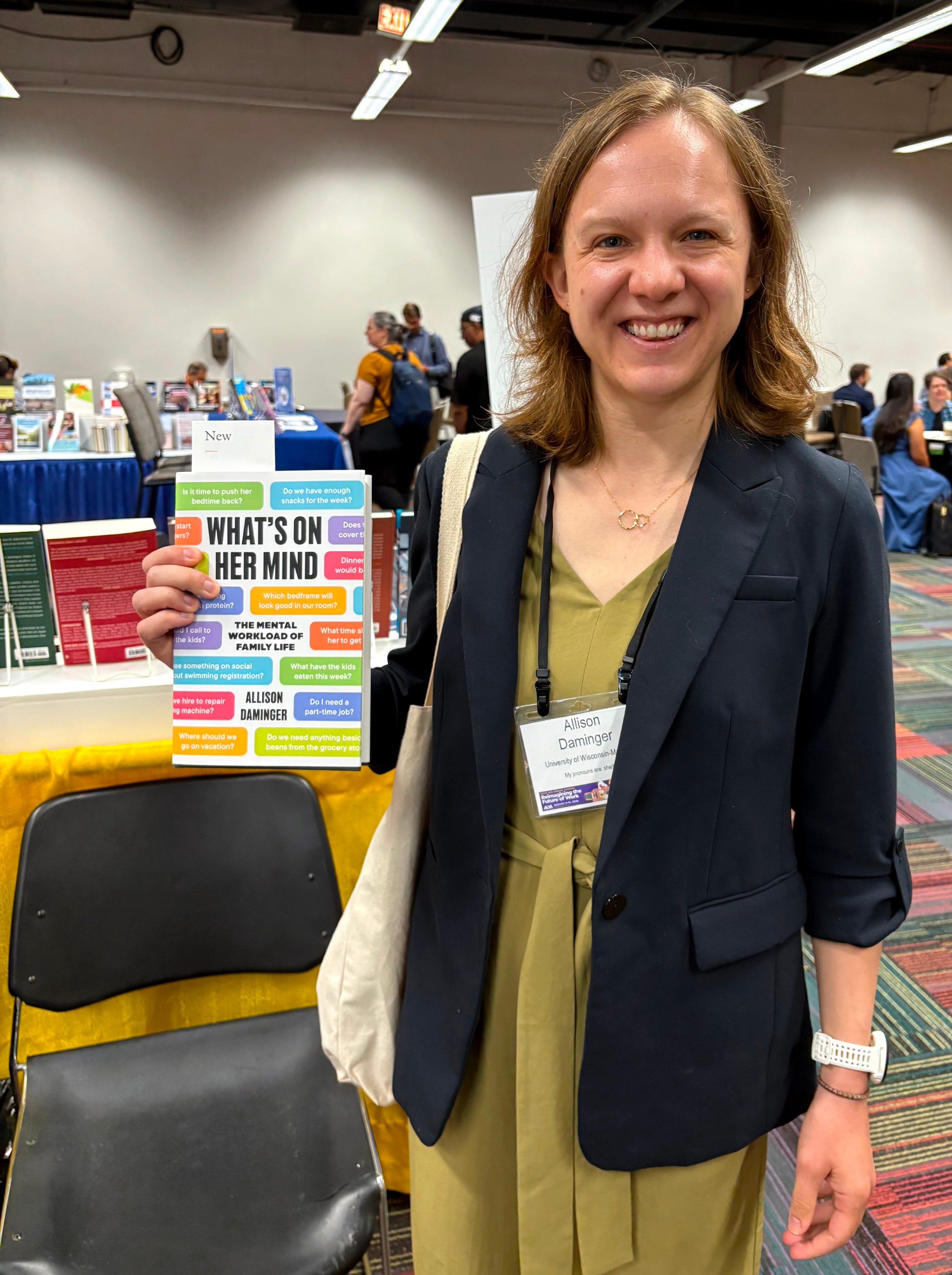
I can now confirm that What’s On Her Mind exists as a physical object - and a beautiful one (imho) at that. (If you’re not as into physical books as I am, you can also preorder the ebook or audiobook - narrated by the same person who reads Elin Hilderbrand’s books(!!!), so you know she’s good.)
What’s on Her Mind is based on eight years of research and nearly 200 interviews with parents. It’s been peer-reviewed by experts and contains A LOT of footnotes for the academics who like that sort of thing.
But as I was writing it, I mostly thought about my friends from college. I thought about the moms (and a few dads!) who’ve emailed me over the years to thank me for giving them new words to describe their experiences. I thought about the therapists who draw on my research to help stressed-out moms and high-conflict couples.
When I published my first article on cognitive labor back in 2019, my goal was to change the conversation about housework. I wanted to show how our focus on physical chores meant we were underestimating just how much women were holding for their families.
Six years later, I hope What’s on Her Mind changes the conversation about housework again. People are way more cognizant of mental and emotional labor than they were back then.1 (That’s thanks to a whole lot of people, not just me!)
But our collective discussion about the mental load is too small. We’re focused on individuals and couples. We’re talking about how men can step up and how women can step back. Those are important conversations, but they often miss the broader context. I hope What’s on Her Mind gets us talking about the social forces limiting couples’ options in new ways.
If you follow a lot of writers, you already know the drill. But if you haven’t yet heard the preorder spiel, keep reading! Preorders matter. A lot. The exact mechanics are a bit opaque, but I’m told preorders send an important signal to all sorts of players in the book industry:
Retailers look at preorders when deciding whether to stock the book in stores
Publishers look at preorders when deciding how many copies of the book to print
The algorithm looks (?) at preorders when deciding where to position the book in searches
Yes, preorders are good for authors. But even more importantly, preorders help a book connect with more readers. In this case, preordering What’s on Her Mind means more people will be thinking and talking about mental labor and gender inequality. (And unless you are hate-reading TDD, you presumably think that’s a good thing!)
Where you preorder doesn’t matter a ton. You can find the book on Amazon, Bookshop, Barnes & Noble, or via Princeton University Press. Lots of local bookshops offer preorders, too!
If buying the book isn’t in your budget, consider recommending the book to your local library. (Here’s an example from the Madison Public Library system.)
As a sign of my gratitude, everyone who preorders the book will get a six-month paid subscription to The Daminger Dispatch. Simply fill out this form by 11:59pm September 8th, and on pub day I’ll add you to the paid subscriber list! (Note: the form requires Google sign-in. If that’s a problem, just email me and I can add you manually!)
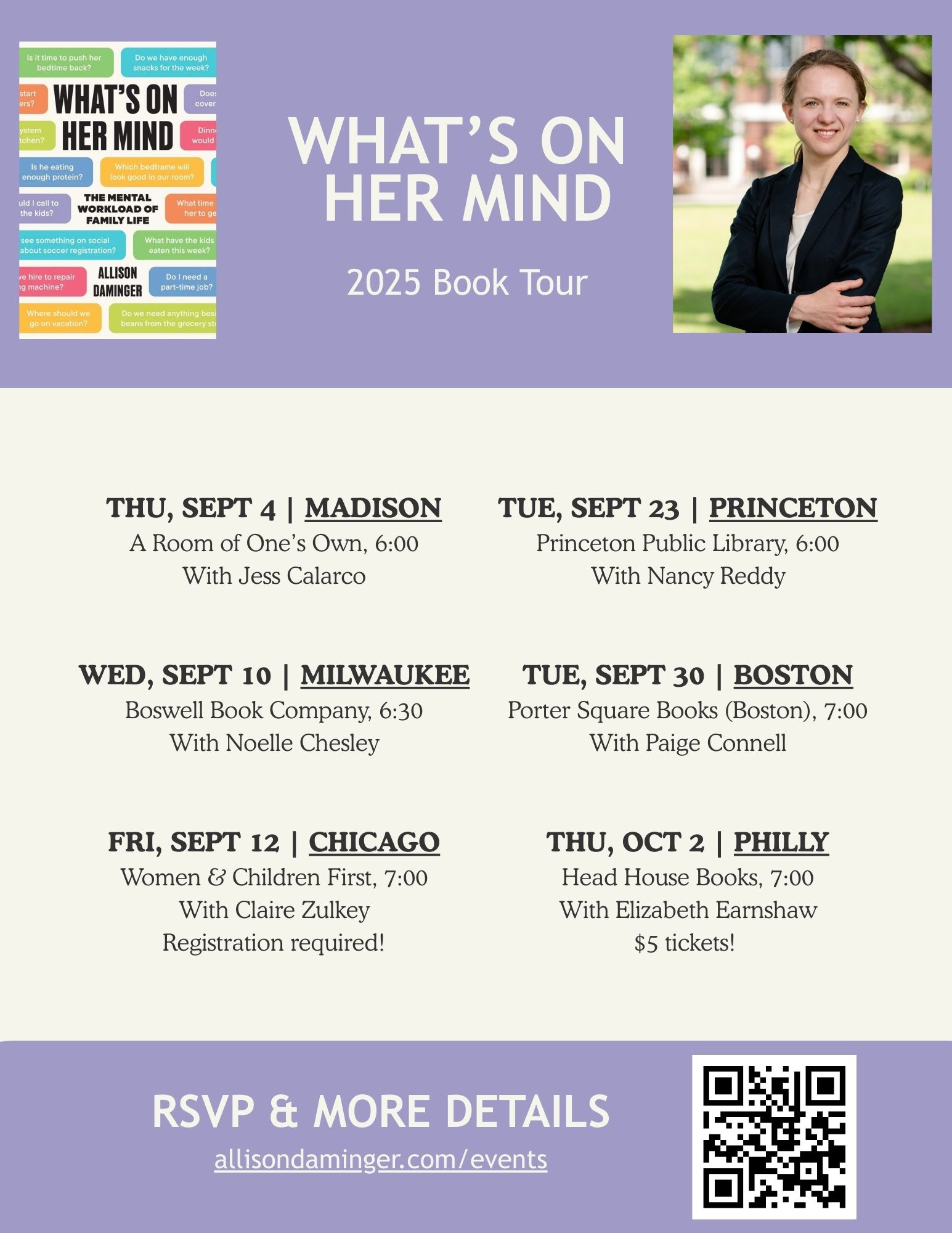
I would be absolutely delighted to meet TDD readers this Fall. If you live in or near Madison, Milwaukee, Chicago, Boston, Philly, or Princeton, come to an event and introduce yourself! (And if you know people in those places who would be interested, spread the word!)
I’ll be honest, self-promotion is not my favorite. I have a strong desire to “let the work speak for itself.” But a mentor reframed this weird publicity phase for me: “So many people took the time to share their stories with you. You owe it to them to get the word out.”
To quote Taylor Swift, this is me trying! My sincere thanks in advance for all of your support along the way.
I just saw a Grammarly commercial about mental load. They totally misrepresented the concept, but still.
No posts
Comments
Nothing yet. Say the first thing.
Sign in to join the conversation.