
Lately I’ve been watching something interesting happen across the wellness and spiritual world.
Woman after woman returning to Christ.
Oracle decks thrown in the garbage.
Programs that once made them hundreds of thousands quietly disappearing from their websites.
Posts about how the practices that once defined their work were actually sinful all along.
And I understand the impulse.
Most conscious women who have even a loose pulse on the industry have watched this shift happen between 2022 and now. It’s become almost a genre of testimony.
But what’s interesting is that I had my own version of this long before it became a trend.
Back in 2020 I went through a quieter recalibration.
Not a dramatic renunciation.
Not a public declaration that everything I had once practiced was wrong.
But a pause.
I stopped outsourcing my inner knowing to astrology charts and oracle cards. I stopped looking outside myself for the final word on what was already alive in my own body and spirit.
And the thing is, my journey wasn’t about coming back to Christ.
Because Christ, prayer, God—those were never absent from my life.
They were always there.
What changed was the orientation.
Prayer moved from the margins to the center.
Not as a performance.
Not as a brand identity.
But as a living relationship.
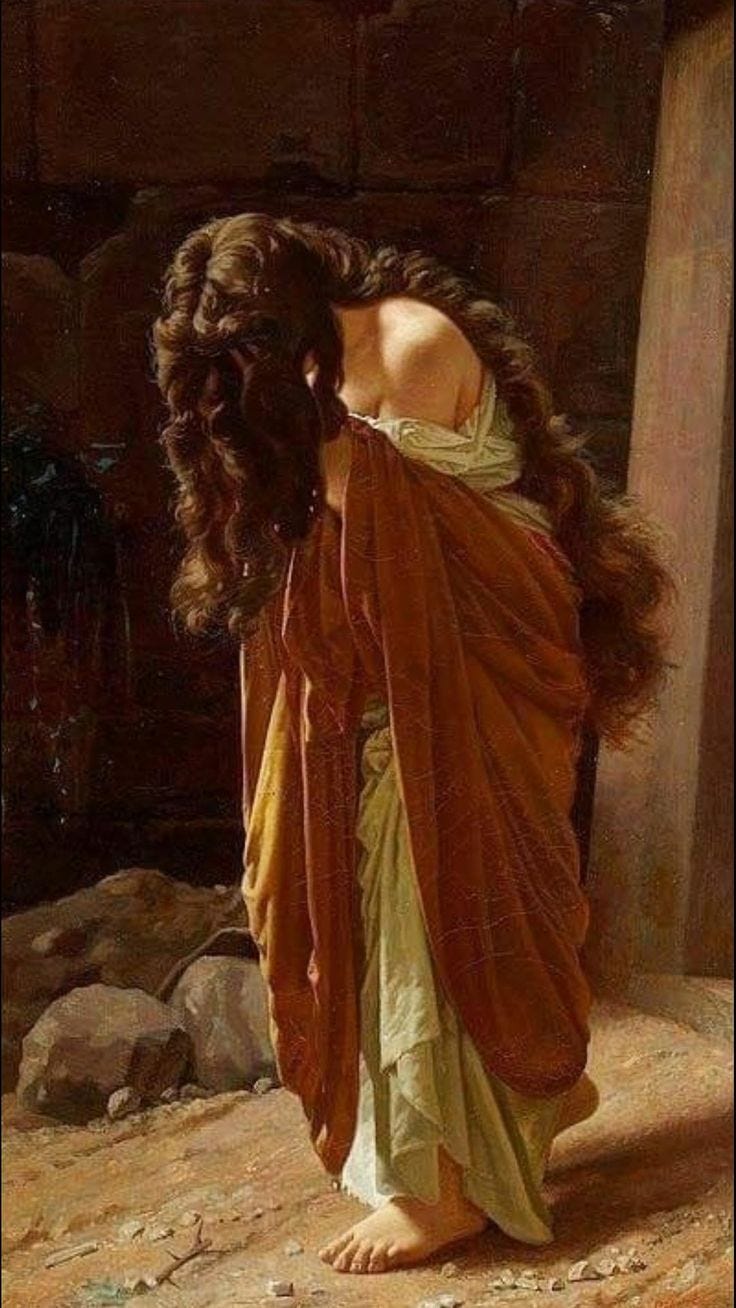
And watching the current wave of spiritual “returns” has been… complicated.
Because I’ve also watched women who once called themselves witches, priestesses, or oracles suddenly speak about those identities with embarrassment or shame. As if the only way to come back to God is to throw away every mystical language that once shaped their spirituality.
Now their bios hold a tidy Bible verse.
And I know, for many of them, the story is deeper than that.
But what saddens me is the pendulum swing.
From one extreme to the other.
From devotion to the mystical feminine… to a rigid hierarchy of what a relationship with God is supposed to look like.
As if intimacy with the divine now requires a specific aesthetic, vocabulary, or moral posture.
For the last two and a half years I’ve been quietly studying in a Gnosis ministry program, repairing and deepening my own relationship with God.
And it’s an interesting place to stand.
To love prayer deeply.
To feel moved by the presence of God.
And also to still practice things that people now label as “new age.”
Practices that, if we’re being historically honest, existed in many of our ancestral lineages long before colonization reframed them as heresy.
So when my friend Kim posted about her reimagined version of Lent—Slutty Lent—I laughed and immediately knew I wanted to participate.
Not because I need irreverence for the sake of it.
But because something about it felt honest.
One of the journal prompts asked:
Where have you talked yourself out of something that actually matters to you?
And immediately I knew the answer.
My relationship with God.
Not because the love isn’t there.
But because the cultural conversation around faith right now feels suffocating.
The “coming back to Christ” movement has, in many corners, started to carry the familiar scent of purity culture. Of moral hierarchy. Of spiritual superiority disguised as liberation.
And it has made me hesitant to speak about the most intimate thing in my life.
Prayer.
My love for prayer is loud.
It’s intimate.
It’s deeply embodied.
But it doesn’t follow a script.
It doesn’t need a Bible verse in my bio.
It doesn’t need a “faith-led entrepreneur” label in my Instagram name.
It doesn’t need to publicly condemn practices I once loved in order to prove my devotion.
And I think, in some quiet way, I’ve talked myself out of claiming that relationship openly.
Because I’m afraid the moment I say it out loud, people will assume they understand what it means.
That I’m suddenly Christian in a very particular way.
That I’m religious in a very particular way.
But intimacy with God has never felt tidy to me.
It feels alive.
Messy.
Personal.
More like a conversation than a doctrine.
More like a lover than a rulebook.
And maybe the real work right now isn’t choosing between mysticism and faith.
Maybe it’s refusing the demand that we collapse our spiritual lives into something easily categorized.
Maybe devotion can still be wild.
Maybe prayer can still be erotic.
Maybe God is big enough to meet us in both.
Maybe God was never asking us to choose between mysticism and devotion.
Maybe that demand came from somewhere else.
Because the God I know doesn’t feel threatened by curiosity, embodiment, or mystery.
If anything, those are the very places I’ve felt closest.
And after all the pendulum swings, that’s the relationship I’m still interested in keeping.
Comments
Nothing yet. Say the first thing.
Sign in to join the conversation.