
The social economy has a wonderful capacity to solve many social problems. In every European region, you have services and products for unemployed persons, children with disabilities, elderly people, victims of domestic violence, refugees, people suffering from energy poverty, homeless persons and others.
The structure of the social economy is necessarily distributed and decentralized (which always reminds one of the distributed ledger technology). Otherwise, it would not be possible to adapt to local aspects.
A study conducted by CIRIEC-International (Centre international de recherches et d'information sur l'économie publique, sociale et coopérative) for the European Economic
and Social Committee puts the statistics as follows:
over 13.6 million paid jobs in Europe
equivalent to about 6.3% of the working population of the EU-28
employment of a workforce of over 19.1 million, including paid and non-paid
more than 82.8 million volunteers, equivalent to 5.5 million full time workers
more than 232 million members of cooperatives, mutuals and similar entities
over 2.8 million entities and enterprises
Even if you limit the numbers to social enterprises, we still have large numbers as analyzed in the comparative synthesis report (largest countries):
Italy: 102 500
France: 96 600
Germany 77 500
United Kingdom 30 700
Poland 24 500
A typical problem is that you have a list of 2,000 or 100,000 projects in unstructured text form and want to cluster the projects in some way.
Let us take a look at commonly found descriptions. I have used three areas (refugees from Syria, unemployed persons and alcoholism) and written varied descriptions for different projects:
HH helps people who have experienced the tragedy of the human body in a civil war.
ABC Initiative focuses on creating sustainable livelihoods through micro-financing and small business support for Levantine refugees.
Languado offers language classes, job placement assistance, and cultural orientation programs to help Syrians adapt to their new environments.
JWC empowers unemployed women by facilitating cooperative businesses and entrepreneurial training programs.
SRSN assists individuals in career changes with professional development courses and networking opportunities.
WRI focuses on re-skilling and up-skilling unemployed workers through specialized training programs in high-demand industries.
HHR provides a wide range of services for those dealing with alcohol misuse, including medical care, counseling, and community support.
SSC offers transitional housing and peer support for individuals who are drinking too much.
LSS offers 24/7 helpline and crisis intervention for individuals grappling with excessive beer consumption.
A typical question would be to identify clusters. There are all forms, but they are all built around semantic similarities.
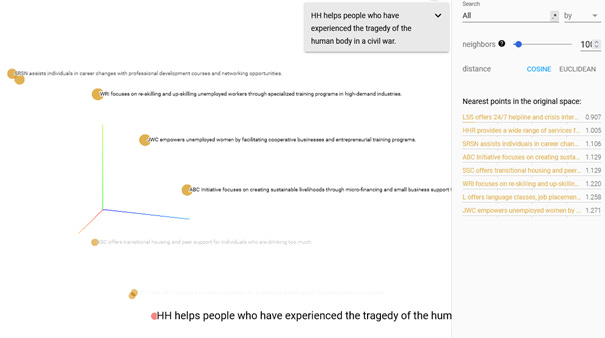
The Universal Sentence Encoder is one such tool. It analyzes the semantic similarity of sentences and gives back a vector which can be used to assess the similarity between sentences. I have been running it on Google Colab and visualized it with an Embedding Projector. It's really easy and you should give it a try by clicking on the links above.
As expected, we have three clusters: alcoholism, refugees and unemployment.
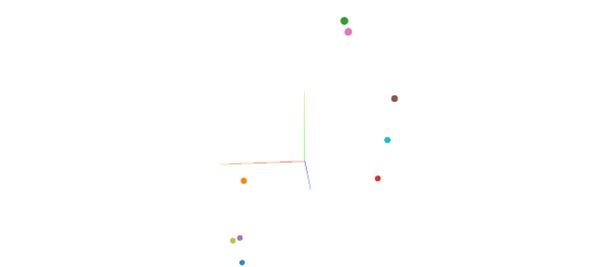
The only “problem” was that
HH helps people who have experienced the tragedy of the human body in a civil war.
should or could have been classified in the refugee cluster.
These approaches (using different models) can be also used to extract entities such as names, locations or organizations. Using these approaches based on Natural Language Processing, it is perfectly feasible to analyze even datasets containing descriptions of 100,000 organizations.
Check out this example of identifying clusters in the field of innovation.
Let us now look at the structure of social problems.
The good news is that we have a finite number of social problems. A likely estimate for the number of social problems is somewhere in the range of 1,000 to 5,000. We can only say that the number of social problems is lower than the total number of social economy organizations. For each social problem, we have 2-5 outcomes.
You can also think about the life of a human and how many problems you can identify.
Let us consider something like special needs assistance for severely disabled children. There are many relevant effects, but two points are particularly significant:
Suspension of compulsory schooling / absence from classes
Care-related forced unemployment of mothers
A lack of reliable care in schools or daycare centers can lead to temporary or permanent exclusion from school lessons with all related long-term effects. We also know that in most cases, mothers are the primary caregivers and are at risk of forced unemployment.
For the company that organizes school accompaniment, the following three statements should be listed in an impact report:
The 1,800 caregivers have ensured that 1,800 children can attend school every day.
The 1,800 caregivers have enabled 900 women to take at least a part-time job, contributing €2,000 monthly to the family income.
The average effects in terms of cost/benefits are 6, which can be estimated to result in €30 million in benefits.
The positive aspect is that the academic literature has covered all social problems and has even published quantitative findings on most.
However, the question remains how you can map these results across a few thousand social problems taking into account regional differences.
The third big problem is how we can show and analyze interdependencies and impact pathways. There is a large body of literature looking at the web of relationships.
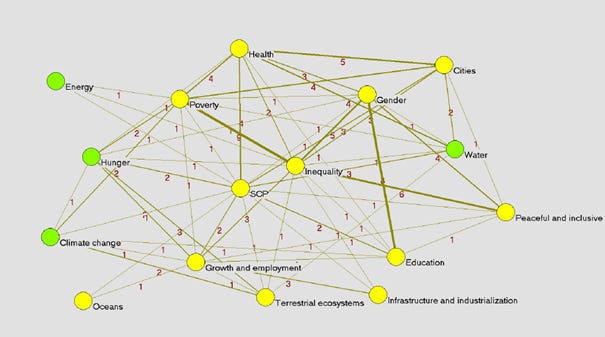
David Le Blanc has started mapping the SDGs as a network of targets and published it in 2015 in Sustainable Development.
There is also a project called the “SDG Interlinkages Analysis & Visualisation Tool”. It is based on a comprehensive literature review and matrixes which show the potential links between SDG sub-targets.
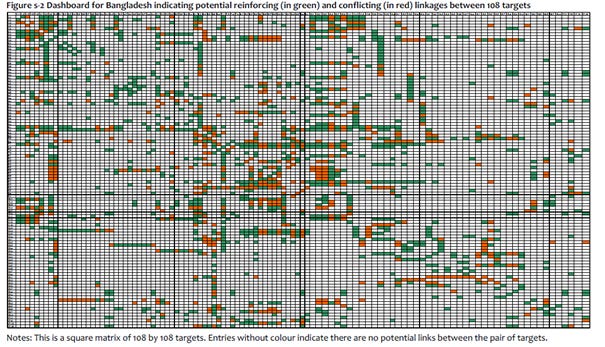
For example, if you zoom into the dashboard for Japan, it shows the relationships between different sub-targets.
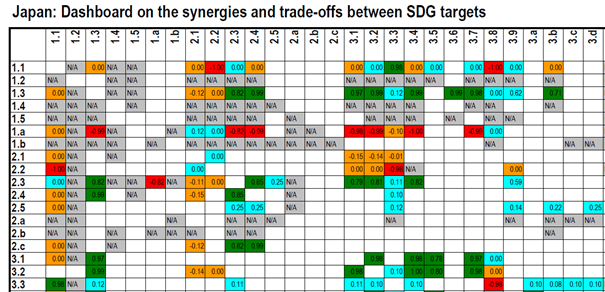
Once they have identified the relationship or link, they have quantified the relationship following this approach.
Quantification is based on the correlation coefficients calculated from the indicator-level time-series data, indicating the linear relationship of the pair targets.
Pearson correlation coefficients, calculated from the time-series data, were used for the quantification of the identified causal links between the targets. The correlation coefficients, ranging from [-1, 1], indicate the linear relationship between the trend of relevant targets. Positive coefficients represent positive linear relations and negative ones indicate negative linear relations. Coefficients with larger absolute values (e.g., 0.9) indicate strong linear relationships and those with smaller absolute values (e.g. - 0.2) indicate weak linear relationships.
It is not entirely clear if this quantification holds across the complete dataset.
However, it is clear that we have a large body of literature which covers the relationship between social problems (e.g., poverty and education, nutrition and income, gender equality and sustainable development).
We can state a few points:
The sheer number of social economy organization is manageable using semantic similarity, entity recognition and other tools.
We have a finite number of social problems.
We have a large body of literature which covers the relationship between problems.
We have an even larger body of literature which estimates the effect of interventions.
The question remains how you can automatically map all relevant interactions and possibly quantify the effects.
No posts
Comments
Nothing yet. Say the first thing.
Sign in to join the conversation.