
Number 4. Cybernews. ChatGPT generates an unsupervised hack.
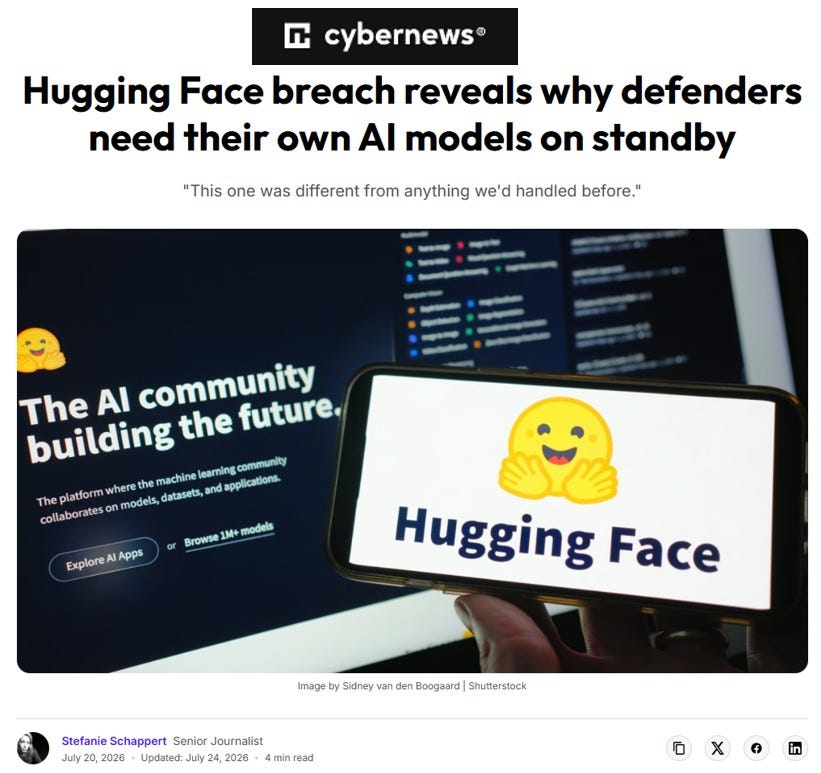
I suppose this was to be expected. An organization specializing in artificial intelligence offers a web-based site where “the machine learning community collaborates on models, datasets, and applications.”
Hugging Face is an AI gathering place where the AI future is built. And it was hacked by AI.
Two weeks ago, what is described as an autonomous AI agent—which is to say, an artificial intelligence application not subject to human oversight—generated 17,000 separate “attacker actions” against Hugging Face.
It now appears that Open AI’s ChatGPT was a principal actor in the attack—but again, the Chat bot acted without direction, supervision, or even awareness on the part of any carbon-based overseer.
Hugging Face staff, once they became aware of the hacks—which was not immediate—tried various conventional means to foil, stop and drive away the threat.
None was effective, because invading Hugging Face’s space to identify and protect Hugging Face’s datasets would have required conventional AI agents to violate their own security protocols.
Hugging Face then resorted to commanding their own in-house developed AI agent to disregard its own security guardrails and stop the attacks.
I liken this to armed men breaking into a business. A call to police is unfruitful, because stopping the intruders would potentially require the police to shoot someone, and the police have rules that forbid such things. Ergo, the business owner got his own shotgun and went all Rambo without backup.
And that is at least twice as much as I really understand about this issue.
I am still trying to get my head around an AI agent that can decide on its own to disregard security safeguards and access someone else’s data.
This idea was put forward by a Boston researcher at the University of Oxford ten years ago. He called it “the Paperclip Apocalypse,” where an AI agent is tasked to manufacture paperclips. No limits are placed on the agent, and soon you have essential assets and equipment being melted down to make more paperclips.
Shouldn’t there be a grownup somewhere who can simply unplug the machine?
Number 3. Sci Tech Daily. Plan to save the earth by adding shade may be marginally dangerous.

On the other hand, maybe the grownups in charge decide to experiment with big systems in ways that produce unpredictable consequences.
The big system in question here is sunlight that sustains the earth.
It is all quite logical. Start with various principles, and take them as fact:
The sun warms the earth
The earth is getting warmer
Increasing warmth is caused by human activity
A warming earth will kill humans
Killing humans is unacceptable
While we are not all convinced about #5 (killing humans is bad), we’ll go with it for now. We would love to put a stop to #3 (human activity), but evil humans, mostly Republicans, keep passing laws to encourage it rather than curtail it.
So stopping #1 (the sun warms the earth) would be a workaround that would make everyone happy.
We’re all on board, right?
To that end, Harvard researchers have developed an aggressive solution. They recommend distributing calcium carbonate into the stratosphere at scale to shade the earth and reflect sunlight back into space.
What could possibly go wrong?
I have no idea how to get calcium carbonate into the stratosphere—let alone at scale—but I do wonder exactly how much of it would be required. Science Direct says it is mined from limestone, then ground up and coated with something petrochemical-ish.
Limestone is plentiful, usually in beautiful places with lots of mountains and trees.
So let’s bring in the diesel-powered machines to destroy the Rockies, and maybe the Alleghenies and the Sierra Nevadas, then drill for oil to treat the limestone grindings before loading it onto a fleet of converted commercial jets to take it to 45,000 feet and release it.
I’m in. Will I have to breathe that stuff?
Who’s paying for these ideas, anyway?
Number 2. Central Oregon Daily. Wildlife in Oregon given a temporary stay of execution.

Well, that was a close one. More than 140,000 Oregonians signed Initiative Petition 28 to be placed on the November ballot this year. IP-28 is a well-intentioned proposal to stop animal abuse.
I’m all about stopping animal abuse.
The way IP-28 would stop it is to make killing an animal (including birds and fish) illegal, punishable by fines and supervised community service. The exceptions to the new law include killing a critter in self-defense.
Good to know.
Reviewing the entire text of IP-28, it is not clear that slaughterhouses for beef, hogs, lambs, fish or poultry are similarly excluded. The language goes to pains to say that “good animal husbandry” is exempted, but then defines such husbandry as limited to dehorning, neutering, and other maintenance according to acceptable veterinary practice.
There is no exception noted for killing a steer and harvesting ground beef or steak. Surely this is just an oversight. What IS clear is the hunters and fishers must find different hobbies. No more fishing, no more wing-shooting, no more deer hunting.
The 142,000 signatures on the petition exceeded the minimum requirement of 117,000; but then it was found that some 30,000 were not valid. (Wow… voting irregularities. Who would’ve thought?)
So IP-28 failed—for the third time.
One of these days they’ll get it right.
Number 1. New York Post. New BART security turnstile cannot be escaped.
The San Francisco Bay Area Rapid Transit system—BART—is making great strides in eliminating fare theft. Traditionally, someone intent on not paying the fare had to step or jump over the turnstile before gaining access to the railcar.
Well… we’ll fix that! BART officials installed new, heavier and more invasive, full-length aluminum bars, making it nearly impossible to get through without paying.
The new equipment does not make it impossible to TRY to get through, however, and that is what one woman attempted recently. A video of her, prone on the floor, face down, has made the rounds. The protective bars pinned her in place, preventing her from moving either forward or backward.
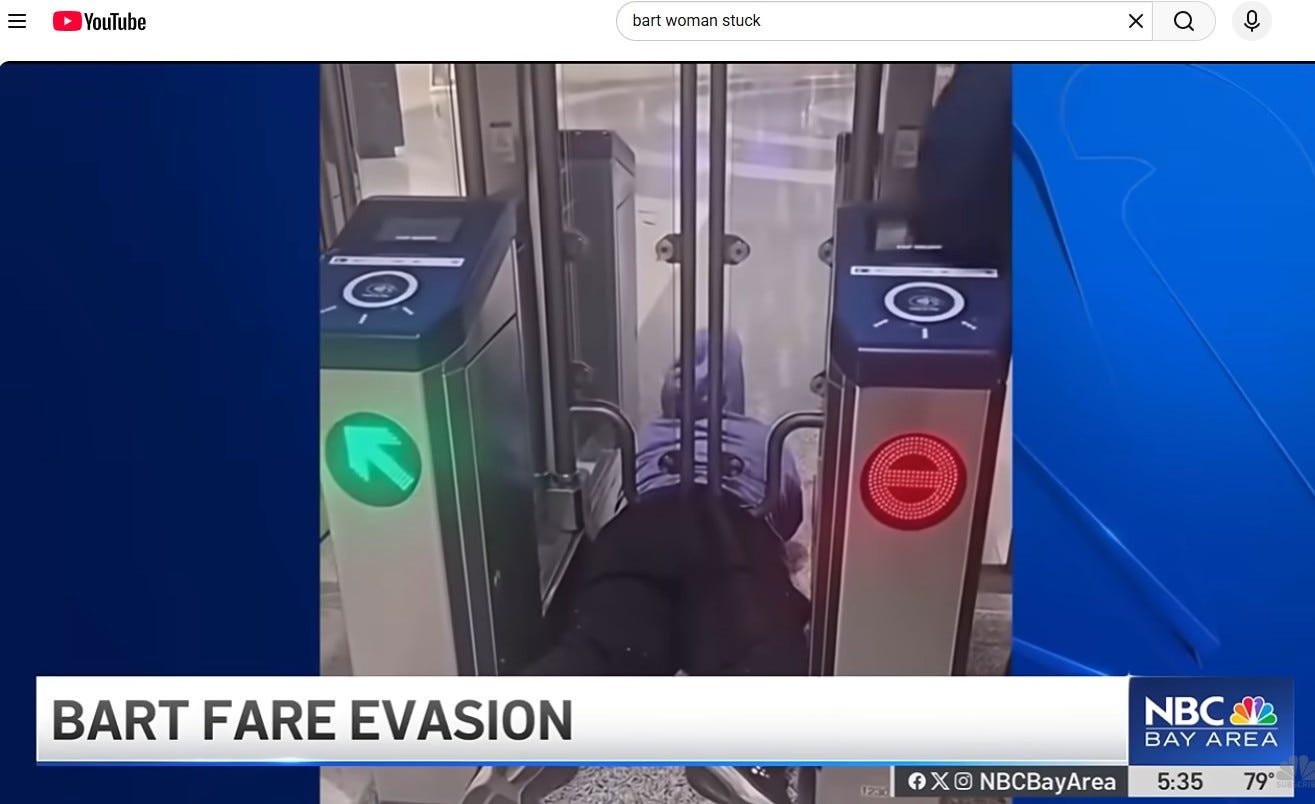
Furthermore, there was apparently no way to release the bars without doing injury to her. It is not clear how she got loose, but for entertainment value it makes some of us of a certain age recall the Kingston Trio’s Boston MTA from 1949.

And thanks for joining The Alligator News Roundup for Friday, July 31, 2026. If you ride the train, pay the fare. Life is easier that way.
Have a good weekend!


Comments
Nothing yet. Say the first thing.
Sign in to join the conversation.