
By Leah Martin
Seattle is hurting. By most accounts it’s the worst housing crisis Seattle has ever endured. While some residents may be lucky enough to not feel the pinch directly, the signs are everywhere. Tent encampments, people sleeping on stoops, and the proliferation of tiny home villages are visible symptoms and its getting worse.
At Allied8, we believe that to truly address the housing crisis, we must understand the root cause. Through years of data analysis, design innovation, and policy engagement, we believe the biggest force behind this crisis has been exclusionary zoning, otherwise known as single-family zoning.
We’re not the only ones saying this. Policy makers and housing analysts have also been sounding this alarm for the last 10 years. But acknowledging that the policy has to change does not mean the right housing is getting built. There’s a big gap between these two realities: policy changes vs actual solutions. And then add urgency to the matter. How do we build actual solutions quickly?
Let’s start with the data first because we believe it’s the best way to explain the magnitude of the crisis. It helps build the case for urgency.
The average cost of a home in Seattle is approximately $850,000. To afford such a home without spending more than 30% of one’s income on housing, a household would need to earn $220,000 annually. The area median income (AMI) in Seattle is $121,000.
This nearly $100,000 gap is precisely where Seattle’s affordability crisis lies. If you’re thinking this doesn’t seem that bad, consider that 220 is 180% more than 121, that means homes cost nearly double what they should.
For those earning $121k annually, the maximum affordable home price is around $425,000, which requires a $85,000 down payment. How many Seattle renters have that kind of savings? Slim to none. But let’s play a game. Let’s say plenty of renters did have that kind of savings. Let’s look for detached houses, town houses, or row houses on the market for $425k or less. Why only search for ground related housing? Because that’s where people generally want to buy houses due to the preponderance of light and air and proximity to yards, trees, parks, schools, etc. What does an MLS search yield today? THREE, yes 3, properties under $425k in Seattle proper!
There are roughly 360,000 renters in Seattle. Seattle is now a majority renter city for the first time in a century, with 51% of residents renting. Let’s play a game - let’s say 10% of renters would buy if they could afford it (sources suggest this % is much higher). Continuing with our game - that means 36,000 renters would have 3 houses to compete over. A balanced housing market is one where the housing supply equals the number of buyers, which in turn maintains affordability.
Remember that $100K gap that might not have seemed so alarming? In reality, it reflects a homeownership market so distorted that less than a fraction of 1% of prospective buyers are being served.
Also consider that the most common way to build wealth is to first build credit by renting, then build equity by purchasing a starter home, and then build wealth by upgrading to larger homes over the course of one’s life. In Seattle, our bloated renter pool is symptomatic of a broken housing ladder. Renters are stuck on the first rung of the ladder, unable to transition to the ownership rung due to lack of affordable inventory.
That’s it, right there! This is the problem that Allied8 is hyper focused on – it’s the nut we’re trying to crack.
While tech industry growth and the absence of a state income tax have accelerated housing demand, these factors alone don’t explain the scale of the crisis. The deeper issue lies in how land has been zoned.
In 2018, 75% of Seattle’s residential land was zoned for single-family homes. This zoning restricted the type and density of housing that could be built, effectively locking vast swaths of the city into low-density development. A 2019 New York Times analysis revealed similar patterns across major U.S. cities, with single-family zoning dominating urban landscapes. San Jose tops the list at 94%.
This zoning straitjacket made it nearly impossible to meet Seattle’s projected need for 112,000 new housing units by 2044 (see page 90).
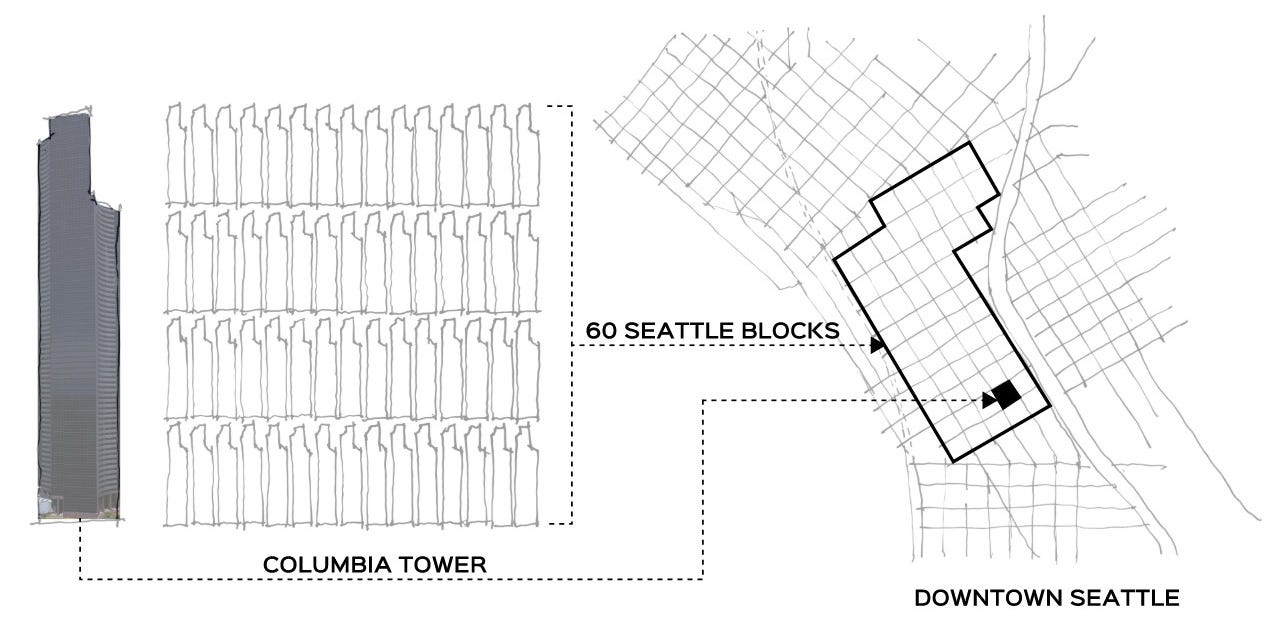
Can readers visualize what 112,000 units actually looks like? We couldn’t and we’re policy wonks and architects. As architects do, we took to diagramming. Imagine building 60 Columbia Towers (Seattle’s tallest skyscraper) and filling all 60 with one and two bedroom units. That’s 112,000 units. Or look at Bellevue, home to 60,000 housing units today. We’d need two of them! Without unlocking single-family zones, these numbers would be unattainable.
To policy makers credit, they saw this coming. And against all political odds, they began to open up single family zones to more development. But the actual real world solutions, what gets built, is up to the builders and developers. That’s where folks get nervous.
At Allied8, we believe these policy changes put our city at an inflection point – a point where builders, developers and architects must be laser focused on designing affordability into our city. These zones are a clean slate, ripe for innovation in housing typologies that prioritize affordability, ownership, community and anti-displacement.
Our flagship project, Corvidae Co-op, exemplifies this approach. Located near the Mount Baker Light Rail station, Corvidae offers 10 homes across two subdivided “single family” lots. It includes two-bedroom, one-bedroom, and studio units. Designed for first-time buyers and downsizing seniors, the average home price was $380k, less than half the city’s average.
At Corvidae we deployed a new housing typology we call a “suite” which contains the essentials for daily living: bedroom; bathroom; living/dining and kitchenette while shared amenities like full kitchens, laundry rooms, and guest suites are located in common areas. This model dramatically reduces costs by sharing space and resources, without compromising comfort, privacy and dignity. The project is centered around a communal courtyard, fostering social connection and shared stewardship. Corvidae was featured in the New York Times this year for its innovative approach to affordable homeownership.
This is just one idea, and it only helped 10 local households get stabilized. We, and by we, I mean all people and organizations that build housing, need countless new ideas centered around affordability and community, not maximizing profit. We need all-hands-on-deck dedicated to affordable homeownership rooted in anti-displacement. We need impact investors at the ready, willing to pay for early development costs.
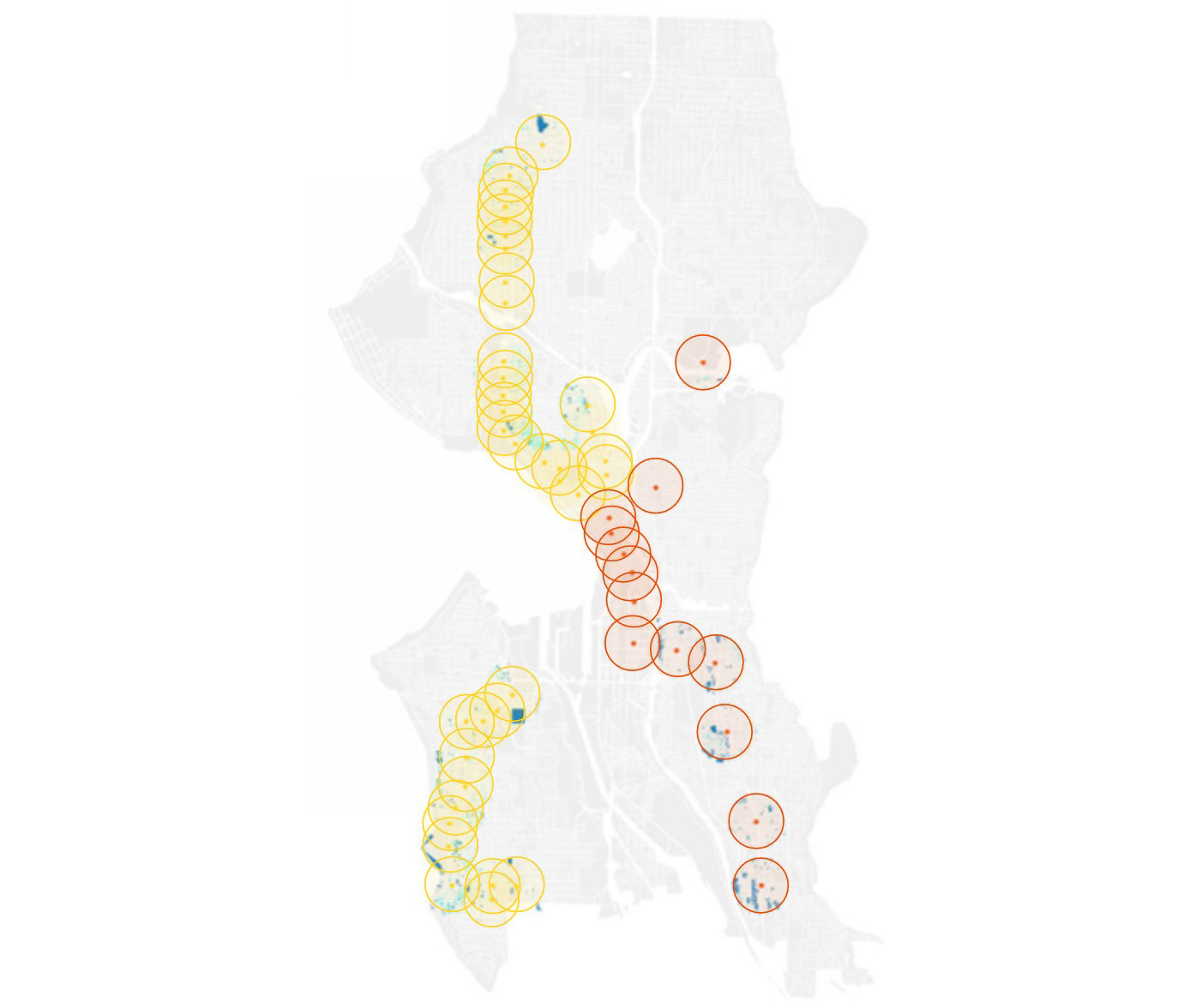
Allied8 believes there’s an ideal place to start. We conducted a GIS analysis of Seattle in 2018, with our good friends Mike Powe and Carson Hartmann. This was the basis of design for Corvidae Co-op. We mapped every bus rapid transit and light rail station with a half-mile radius around each. Within these transit-accessible zones, we found 17,600 single-family lots. We recognized that these areas already featured commercial activity, moderately high levels of density and infrastructure. With recent zoning changes allowing up to four units per lot (6 if affordable and near mass transit), these parcels could theoretically yield 70,400 - 105,600 new housing units, covering more than half of Seattle’s projected housing need. This analysis underscores the transformative potential of thoughtfully unlocking single-family zones (now referred to as neighborhood residential zones) near transit hubs.
Allied8 is developing affordable homeownership options such as cottages, duplexes, triplexes, stacked flats, and DADUs, using co-ops, condos, community land trusts, and mixed-income ownership models. We’re partnering with a wide network of organizations united by the mission of affordable homeownership rooted in anti-displacement. But to meet the need, our collective capacity must grow exponentially.
Building on neighborhood residential zoned land offers major advantages over multi-family zones. Construction costs per square foot are significantly lower thanks to simpler building methods and codes, making projects accessible to more builders and developers. This approach requires far less capital, reducing financial risk for lenders and investors. It also accelerates delivery due to shorter permitting and construction timelines.
By embracing small-scale, innovative, affordable homeownership, we can restore the housing ladder and create a city where everyone ready to buy a home has the opportunity. No single silver bullet will save us, not co-ops alone, not modular construction, not community land trusts. But now that the zoning framework is in place, the combined force of these ideas, focused on building innovative affordable homeownership solutions, just might. Are you with us? Come on, people - let’s go!
PS: For more on the root cause of homelessness, a corollary topic, please watch Greg Colburn’s video.
No posts
Comments
Nothing yet. Say the first thing.
Sign in to join the conversation.