
In matters of fight and might—the war in Iran, for example—news accounts in The Wall Street Journal sometimes read like those in The New York Times. Inside the Journal, however, editorials and columns often challenge progressive orthodoxies.
A recent essay by William McGurn is a good example. He took Pope Leo XIV to task for making comments about war, with specific reference to Iran. Speaking on March 4 from the Vatican, the Pope declared that “in the Middle East and in Iran,” and elsewhere, stability and peace could only be achieved “through reasonable, sincere, and responsible dialogue.”
On April 7 Leo XIV made his break with the President clearer, saying that Trump’s statements were “simply unacceptable” and urging Americans to contact their elected representatives.
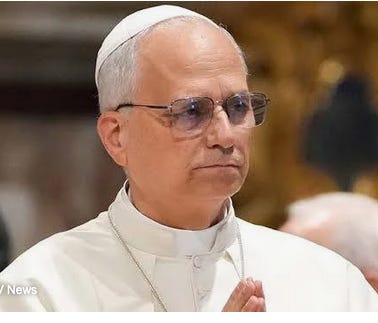
The Holy Father takes the progressive position, which holds that demonstrations of force by legitimate governments are always wrong. Western governments should defend human rights at the conference table. Those governments whose records on human rights are deplorable should be invited to meetings, not to battles. While progressives ignored Palestinian attacks on Israel, they denounced Israel for defending itself. In 2020 they defended the destructive riots led by Black Lives Matter across the U.S. The progressive approach to Iran fits that pattern: My enemy’s enemy is my friend. U.S. bad, anti-U.S. good. End of story.
Responding to the Holy Father’s claim that “reasonable, sincere, and responsible dialogue” is the only path to peace, McGurn asked, “Is that what history tells us?” As he pointed out, history tells us no such thing. If peace cannot be built by armies alone, it “can almost never be built without armies and without the threat of force.” It is force, McGurn wrote, “that makes dialogue possible.”
What many progressives want is not dialogue but defeat. These people are curiously called progressive, but as Andy Kessler points out in his WSJ column, they are fighting progress. They don’t want the rest of the world to share in the U.S.A.’s greatest assets, its freedom and its standard of living, which have been drawing people to this country for decades. They ignore great American victories—Team U.S.A. winning the gold hockey medal at the Olympics, the brilliant success of Artemis II, others.
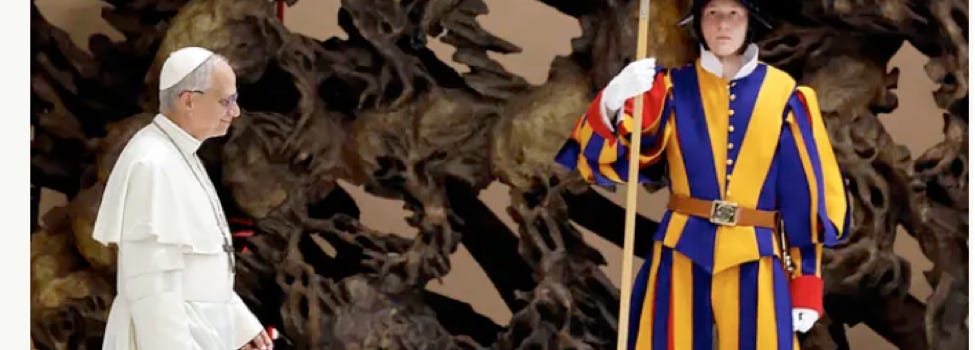
McGurn quotes the Rev. Gerald Murray, a New York pastor and a canon lawyer, who argues that the “legitimate use of force is virtuous”—as, for example, when it protects the innocent. Murray also points out that the Leo XIV himself is protected by the Swiss Guard and that everyone has to pass through metal detectors to get into St Peter’s Basilica.
Pope Leo prayed that the parties involved in the Iran war would use dialogue to halt “the spiral of violence.” Hearing that phrase, I was reminded of the work of French theologian René Girard and his theory about why violence always expands. In his view, nations fight because they want the same thing, which is dominance. Their desire is mimetic. They never resemble each other more closely than they do when their goals compete. This competition leads to war. Their violence spirals. No conflict shrinks as it is pursued. Girard illustrates his theory by saying that what makes one child want a particular toy is that another child wants it too. (Girard’s views on violence, mimetic rivalry, and the scapegoat mechanism, which is his most familiar concept, are helpfully critiqued by Bernard Keenan.)
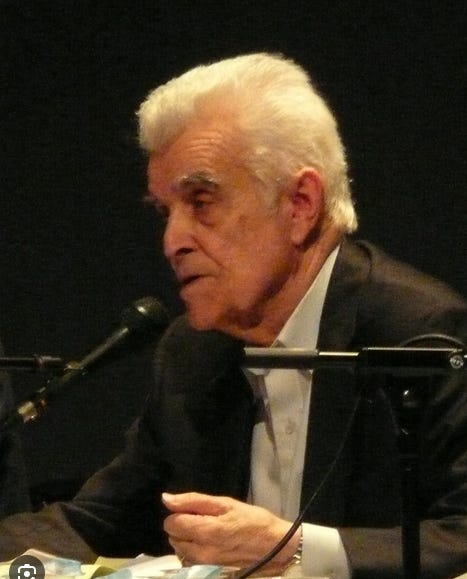
McGurn writes that force makes dialogue possible. But as Girard sees it, force does more. In his view, violence can be productive. He writes, “We are indebted to violence for the degree of peace that we enjoy.” This claim is at the center of his 1987 book, Things Hidden Since the Foundation of the World (p. 211; see Frantzen, pp. 40-45).
Christian and other faiths have long histories of pursuing violence, often under the doctrine of the just war, a theory we owe to St. Augustine (d. 430). As McGurn notes, Augustine is patron of the Augustinian Order to which Pope Leo XIV belongs. A just war is waged for a just cause (e.g., self-defense, protection of the innocent). A just war is waged by a legitimate state (i.e., not by a terrorist organization) and is proportional. Unlike the Holy Father, St. Augustine encouraged Church participation in political matters that sometime end in violence. He maintained a distinction between God’s power and Caesar’s, however, and he always asserted the Church’s independence.
Does the Holy Father believe in just war? Or does he, like Pope Francis (d. 2025), believe that there is no such thing? Leo XIV surely knows that the Church’s apostolic mission has often worked through and with the power of the state. This has been true since the time of Constantine (d. 337), who was the first Roman emperor to become Christian.
A century before Augustine, Constantine changed the nature of Christianity. The new religion is said to have been revealed to him in a vision in 312, with an inscribed cross: “In this sign, conquer.” Constantine then fought Maxentius in the Battle of Milvian Bridge (on the Tiber, north of Rome). He won. A year later he issued the Edict of Milan, ending state persecution of Christians and in effect making Christianity the state religion. This moment has long been seen as a revolution. What had been forbidden and persecuted became official doctrine.
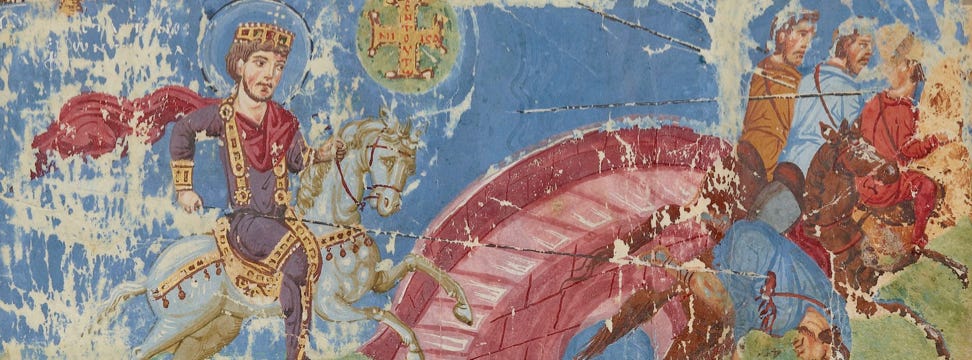
Constantine’s Vision (gold cross, in center), Battle of Milvian Bridge; Greek manuscript date 879–83 AD
(Let me note an unorthodox and rather cynical account of Constantine’s conversion, to be found in the “Author’s Note” that David Gibbins appends to The Sword of Attila, his 2015 novel. Gibbins underscores the political and military motives that inform the story of Constantine. He believes that the early Church set out to mimic the structure of Roman government and administration and used this and other mimetic strategies to present itself as a familiar institution rather than a radical one. After 312 the Church set out to conquer for Christ.
Many people deplore the violence of the Crusades (a series of wars fought 1095-1291). But they ignore the Islamic conquest of Persia and the Roman Levant, and, with it, Islam’s oppression of Christians. Many Catholics do not know that the modern Islamic concept of jihad (struggle) continues an ancient, holy, and distinctly unfriendly enterprise. They are unfamiliar with the meaning of the phrase Dar al-Islam, “the territory of Islam,” which, in some circles, refers not only to Muslim lands that are to be defended but also to other lands that are to be converted through conquest.
The Holy Father calls for peace. McGurn points out that peace can “almost never be built without armies and without the threat of force.” I thought about the difference between Holy Father’s views and McGurn’s when I read another book by Gibbins. In “Christianity and early Byzantium,” the fifth chapter of A History of the World in Twelve Shipwrecks (2024), Gibbins describes a sixth-century wreck that illustrate the imperial character of early Christianity. The wreck shows how Byzantium sought to extended its reach westward.
Gibbins highlights the connection between religious faith and the sea. His many examples range from ancient Egypt to classical Greece, Roman and Byzantine empires, Abbasid Islam, the Vikings, Henry VIII, the African slave trade in the Americas, and beyond, to World War II.
We know of a famous earlier religious wreck that is worth mentioning, even though no certain evidence survives. It involved St. Paul, whose career reveals the close connection of political and religious power that Gibbins points out.
Paul grew up in Tarsus (Asia Minor) and was educated in Jerusalem. He persecuted Christians until he was struck blind on the road to Damascus and was converted to Christianity (Acts 9, 22, 26). He then made enemies of both Jews and Romans. He spoke against Mosaic Law, offending Jewish authorities, and provoked the Romans by encouraging his followers to see Jesus rather than Caesar as their lord. He was taken to Rome as a prisoner, an experience his friend Luke, who apparently traveled with Paul, wrote about in Acts of the Apostles (28:1.)
In 60 A.D. Paul was put on a large commercial ship, a freighter that was used to move grain from Egypt to Rome. When they neared Malta, the sailors feared that high winds would drive the ship onto the rocks. Hoping that it would reach a sandy beach instead, they cut loose four anchors, as Luke noted (Acts 27:39-41). All 276 people onboard survived.
Interest in Paul’s journey was revived in the 1960s, when four Roman anchors were found in a coastal area that might have been the one Paul’s ship approached. Today, labeled as “Roman anchors,” they are housed in Valletta’s Maritime Museum. It is not, of course, certain that they are the anchors Paul mentions.
No other evidence of his ship survives, but we can get some idea of ancient means of transport and navigation from another wreck. This is the so-called “Church Wreck” of the sixth century, seen in the photographs below. The cargo is preserved in southeast Sicily, near Marzamemi, which is a fishing village now, as it was then. We see a diver approaching a marble column that the ship carried.
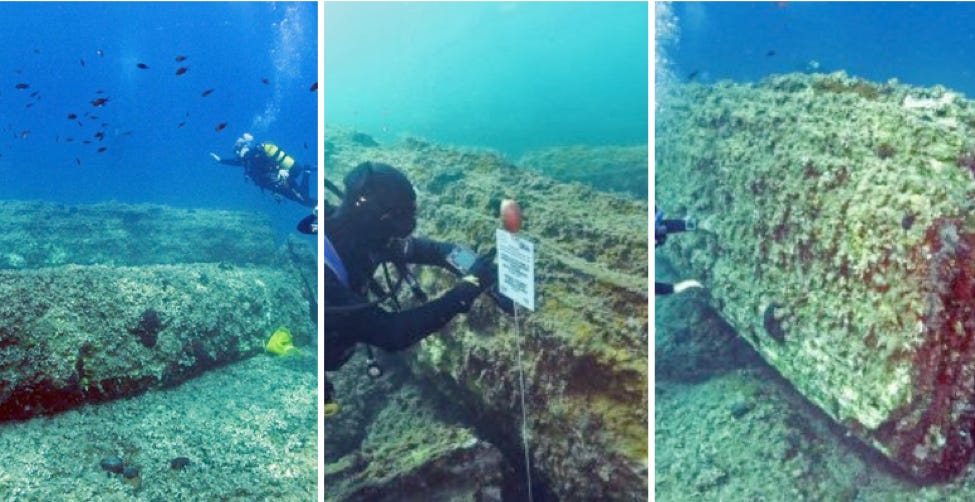
https://www.visitsicily.info/en/itinerario/marzamemi-wreck-of-the-columns/
Center and right photographs show column flutes
The ship carrying the column was large. The wreckage contains 28 marble columns, each weighing 1.8 tons, and the construction materials associated with them. These furnishing were intended for a large church in Malta and were sent from Constantinople (renamed Istanbul in 1930). The “Church Wreck” formed part of the Emperor Justinian’s “programme of church-building,” which was both religious and political in nature (Gibbins, A History, pp. 84-85).
Gibbins himself dived at the site of the wreck (center photograph, above). He cites other shipwrecks that include the “furnishings” of Christian churches, such as the marble components of a large ambo (pulpit, with balustrade) that, when constructed, would have been some 16 feet across and about 10 feet high. The source of these materials, he believes, was Constantinople, which was literally and figuratively then the center of Christianity.
Everything found in this wreck, Gibbins writes, “suggests that it was pre-ordered for a large church” (p. 86). Constantinople was the home of the Hagia Sophia. This enormous church, built by Justinian, represents “an association between Christianity and political power” that would last “through the medieval period and beyond,” as I trust Pope Leo knows. The church was built between 532 and 537. The Hagia Sophia contains some materials that had been brought from Rome, evidence of religious ambition and political power working together (Gibbins, p. 84). Church authorities wanted more such structures in the west.
As Gibbins points out, shipwrecks preserve stages of cultural processes. One project was to establish uniform furnishings for Christian church interiors, and offering “access to individuals,” and not only to the powerful people at the center of significant events (p. xii). The “Church Wreck” preserves a stage in a large project and tells us things that the finished structures cannot. The magnificent churches themselves have been standing for centuries. Shipwrecks containing unused building materials point to what we can call the prehistory of such buildings, fragments that have been preserved at the bottom of the seas.
The Church has long been associated with the sea. Gibbins discusses the pillars in the Church of St Apollinare in Classe (Italy), a striking example (below). The marble columns on either side, he writes, were quarried so that they would suggest waves. The ambo in center functions as a beacon, a guide for worshipers who are imagined as sailors on a dangerous sea. This connection echoes biblical references to the sea as the world and the Church as a ship that offers refuge from dangerous waves. In Mark 4:35-51, Jesus saves the Apostles on the Sea of Galilee. For churches built near the water, like this one, nautical references were, we can say, natural.
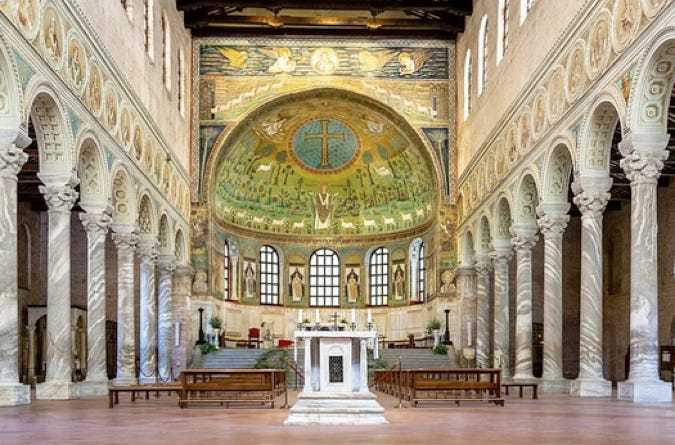
Shipwrecks preserve evidence of the union of religious ambition and the political power needed to transport the materials that were needed to build grand churches. It was a kind of cooperation that seems to work silently but effectively. We can think of “onward, Christian soldiers” and “onward, soldiers” as a single tune.
The Holy Father and progressive Catholics seem to disapprove of the use of power and force—just Christians, not soldiers, that is. His decision to criticize Trump looks like an attempt to steer U.S. foreign policy from the Vatican. He knew that his protest would be seen as setting the two most famous Americans in the world at odds. That makes a good story, and many are eager to take Leo XIV’s side. The pastor of the parish to which I belong wasted no time in doing so.
Rev. Murray (quoted by McGurn, above) has observed that everybody stands with the troops until the soldiers have to fight. Then nobody wants war. Pacifism, some think, “is the only true Christian response to military conflict.” That is why Pope Francis declared that “there is no such thing as a just war.” McGurn writes that such views are “a terrible abdication of responsibility and a false application of principle that serves only the interests of the wicked.”
I heartily agree. The Holy Father and those who endorse his views are not neutral. They are taking the side of the mullahs, sworn enemies of Christianity, whether they intend to or not. Muhammad took a positive view of Christianity. His modern followers regard Christian doctrine as corrupt and dangerous and see Islam as a corrected version of corrupting and corrupted Christianity. Doctrinal differences between, and among, religions are easily politicized. It is discouraging to find the leader of the Catholic Church, a pontiff laughably called “the quiet American” by The Wall Street Journal (Walker and Bernstein), boldly taking sides in a political fight about a war that could put followers of his faith danger. Like other believers, Catholics are free to disagree with Catholicism. But is he?
April 2026
Sources
Elkins, Benjamin. “Practical Just War: St. Augustine & His Framing of Just War Theory.” Discentes: Penn’s Classical Studies Publication. Oct.13, 2024. https://web.sas.upenn.edu /discentes/2024/10/13/practical-just-war-st-augustine-his-framing-of-just-war-theory/. Seen April 8, 2026.
Frantzen, Allen J. Bloody Good: Chivalry, Sacrifice, and the Great War. Chicago: University of Chicago Press, 2004.
Gibbins, David. A History of the World in Twelve Shipwrecks. New York: St. Martin’s Press, 2024.
——-. The Sword of Attila. New York: St. Martin’s Press, 2015. “Author’s Note,” pp. 245-63.
——-. “The Marzamemi Church Wreck (6th Century AD).” http://davidgibbins.com/the-marzamemi-church-wreck. Seen March 26, 2026.
Girard, Rene. Things Hidden since the Foundation of the World. With Jean-Michel Oughourlian and Guy Lefort. Stanford, CA: Stanford University Press, 1987.
Jensen, John Odin. Stories from the Wreckage: A Great Lakes Maritime History Inspired by Shipwrecks. Madison: Wisconsin Historical Society Press, 2019.
Keenan, Bernard. “Mimetic Desire & the Scapegoat: Notes on the Thought of René Girard.” Critical Legal Thinking. Sept. 4, 2023. https://criticallegalthinking.com/2023/09/04/mimetic-desire-the- scapegoat-notes-on-the-thought-of-rene-girard/. Seen March 31, 2026.
Kessler, Andy. “I Give Up on These Defeatists.” The Wall Street Journal, April 6, 2026. A15.
Leidwanger, Justin, Elizabeth S. Greene, and Andrew Donnelly. “The Sixth-Century CE Shipwreck at Marzamemi,” The American Journal of Archaeology, 125:2 (2021), 283-317. https://ajaonline.org/wp-content/uploads/2021/03/aja.125.2.leidwanger.pdf. Seen March 23, 2026.
McGurn, William. “Homilies Won’t Liberate Iran.” The Wall Street Journal, March 10, 2026. A15.
Rice, Matthew. “Pope Leo Calls Trump’s Iran Threat ‘Truly Unacceptable.’” New York Sun, April 7, 2026. https://www.nysun.com/article/pope-leo-calls-trumps-iran-threat-truly-unacceptable-urges-americans-to-call-members-of-congress?lctg=1745651855&recognized_ email=allenfrantzen%40gmail.com&utm_source=MG
Snow, Richard. “‘A History of the World in Twelve Shipwrecks’ Review: Watery Graves.” The Wall Street Journal, April 5, 2024. https://www.wsj.com/arts-culture/books/a-history-of-the-world-in-twelve-shipwrecks-review-watery-graves-f2978285? Seen March 17, 2025.
Walker, Marcus, and Elizabeth Bernstein. “The Quiet American: Pope Leo XIV Pushes Back Against President Trump.” The Wall Street Journal, March 21-22, 2026. C1-2.
Comments
Nothing yet. Say the first thing.
Sign in to join the conversation.