
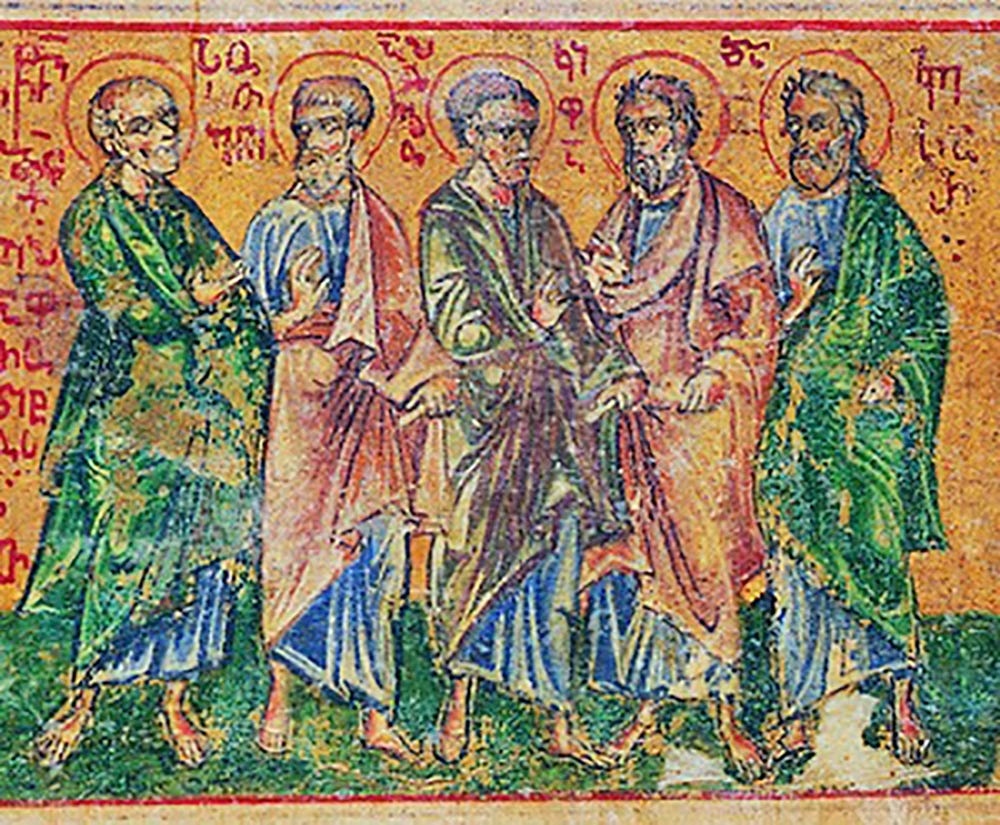
15th century Russian Icon, Apollos in middle,
Scripture
Semicontinuous - Psalm 105:1-6, 16-22, 45b; Genesis 36:1-8; Acts 18:24-28
Complementary - Psalm 85:8-13; 1 Kings 18:17-19, 30-40; Acts 18:24-28
(What are semicontinuous and complementary readings?)
___
Prayer
Almighty God, you have built your Church upon the foundation of the apostles and prophets, Jesus Christ himself being the chief cornerstone: Grant us so to be joined together in unity of spirit by their teaching, that we may be made a holy temple acceptable to you; through Jesus Christ our Lord, who lives and reigns with you and the Holy Spirit, one God, for ever and ever. Amen. (Book of Common Prayer)
___
Reflection
Perhaps one of the most fascinating but least conspicuous figures in the New Testament is Apollos. While he did not produce written material, and his only contribution appears to be briefly mentioned, Apollos was nonetheless a figure with a significant role in the early church.
Luke’s first mention of Apollos occurs in Acts 18:24-28. He is described as a Jewish man from Alexandria, the greatest city of Egypt, which was renowned for wisdom and philosophy and more. Alexandria also had a large population of Jews. Luke states that Apollos was “an eloquent man and well versed in the scriptures.” (Acts 18:24). He was indeed skilled and knowledgeable in the Old Testament and “fervent in spirit” and “boldly expounded the facts about Jesus.”
Initially, however, his knowledge of the gospel was inadequate in many areas. Acts 18:25 reads he ‘knew only the baptism of John’ so he was aware that Jesus was the Christ but ignorant in the area of Christian baptism and ministry of the Holy Spirit subsequent to Jesus’ death, resurrection, and ascension. Priscilla and Aquila “took him aside and taught him the way of God more accurately” (Acts 18:26). Their gentleness provided a good example of humility and grace. Apollos was intelligent yet willing to learn.
In Achaia, Apollo did an excellent job of promoting the Gospel. Luke tells us he “convincingly showed, through the scriptures, that Jesus was the Messiah.” His ministry was built on the foundation of other believers before him.
Apollos reappears in Paul‘s first letter to the Corinthians. The Corinthians have started to fracture into the respective camps; “I am of Paul,” and “I am of Apollos” (1 Corinthians 3:4). Paul would not support that sort of factionalism: “I planted, Apollos watered, but God gave the growth, says the apostle.” (1 Corinthians 3:6). They each had their role to play, but it was only God who could make the growth blossom.
In 1 Corinthians 16:12, Paul praises Apollos highly. In Titus 3:13, the apostle instructs the young pastor to provide for him, for his travels, and for the up-building of the church.
From Apollos we learn that to do ministry well we must be knowledgeable yet humble. He required instruction, and was humble enough to receive it. He was eloquent but knew that God who would make the gospel fruitful. The church can reflect Apollos’ attitude by being thankful for all that it has that enables it to function. Striving for unity, we remember that all faithful members have the same goal in presenting Jesus Christ to the world.
PRAYER: O Lord, make us have perpetual love and reverence for your holy Name, for you never fail to help and govern those whom you have set upon the sure foundation of your loving-kindness; through Jesus Christ our Lord, who lives and reigns with you and the Holy Spirit, one God, for ever and ever. Amen. (Book of Common Prayer)
___
Enjoying these posts? Become a paid subscriber to help sustain this publication and receive full access to everything published here.
Comments
Nothing yet. Say the first thing.
Sign in to join the conversation.