
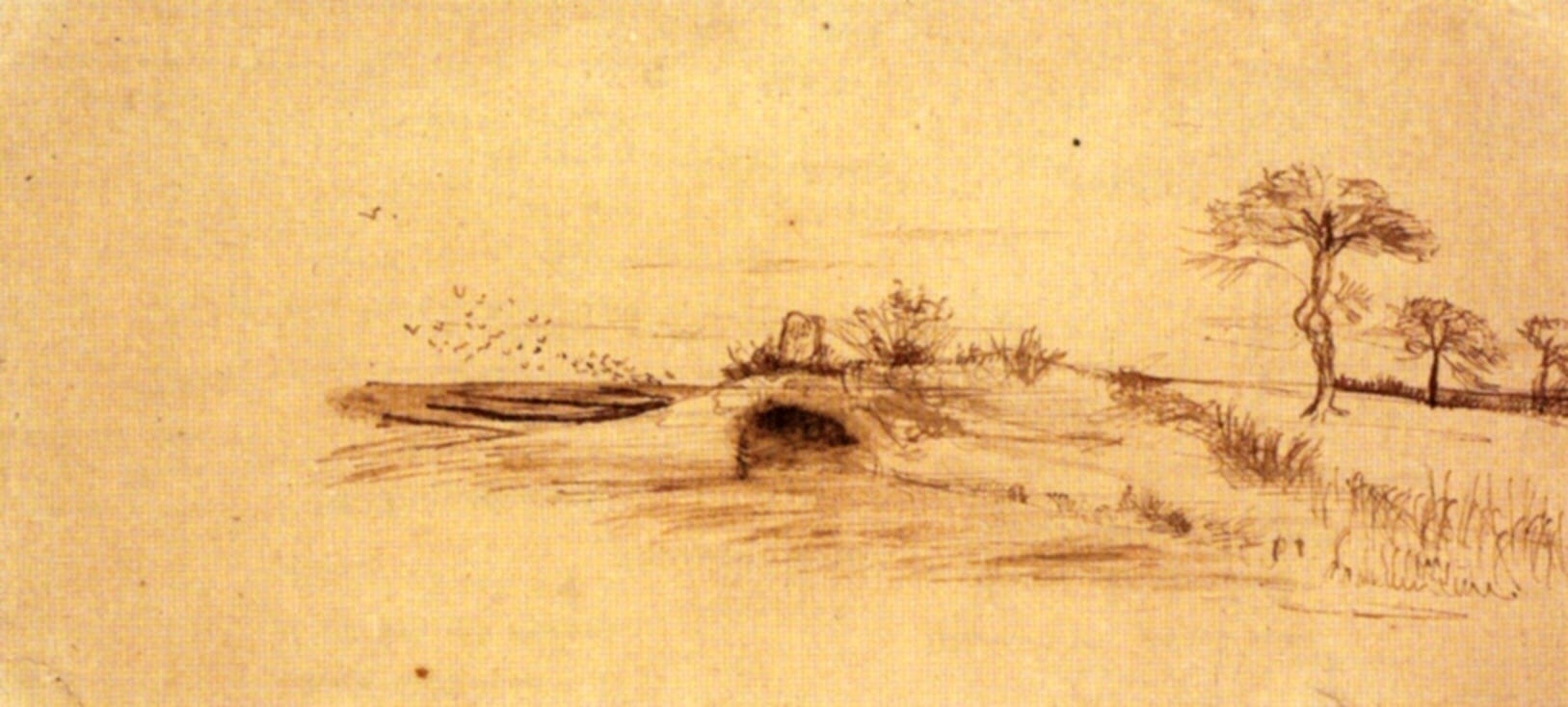
“The Cave of Machpelah,” Vincent van Gogh (1877)
Semicontinuous - Psalm 124; Genesis 49:29—50:14; 2 Corinthians 10:12-18
Complementary - Psalm 138; Ezekiel 31:15-18; 2 Corinthians 10:12-18
(What are semicontinuous and complementary readings?)
___
Loving God, open our ears to hear your word and draw us closer to you, that the whole world may be one with you as you are one with us in Jesus Christ our Lord. Amen. (Revised Common Lectionary)
49:29 / Then he charged them, saying to them, “I am about to be gathered to my people. Bury me with my ancestors in the cave in the field of Ephron the Hittite,
Jacob’s final testament to his sons begins with reminder that his death is imminent and his burial wishes must be honored.
49:30 / in the cave in the field at Machpelah, near Mamre, in the land of Canaan, in the field that Abraham bought from Ephron the Hittite as a burial site.
He is to be buried in the ancestral tomb of Machpelah. The geography of the matriarchs and patriarchs is important. It is a reminder of how the land is tied to the covenant.
49:31 / There Abraham and his wife Sarah were buried; there Isaac and his wife Rebekah were buried; and there I buried Leah.
That the covenant is tied to the land is reinforced as Jacob names those who are already buried there. God’s promises across generations continue even though the human actors in fulfilling the covenant pass from the scene.
49:32 / The field and the cave that is in it were purchased from the Hittites.”
Jacob reminds his sons that the field was purchased by Abraham, his grandfather. Thus, the claim to the land is permanent.
49:33 / When Jacob ended his charge to his sons, he drew up his feet into the bed, breathed his last, and was gathered to his people.
Jacob’s death is described as peaceful. It highlights that even though his life was marked by wrestling and struggle, it ends in confidence.
50:1 / Then Joseph threw himself on his father’s face and wept over him and kissed him.
Joseph’s grief is on full display. He weeps bitterly while kissing him. Perhaps part of the grief is occasioned in all the years Joseph and his father were separated.
50:2 / Joseph commanded the physicians in his service to embalm his father. So the physicians embalmed Israel;
Joseph has his father embalmed according to Egyptian practice.
50:3 / they spent forty days doing this, for that is the time required for embalming. And the Egyptians wept for him seventy days.
The family spends the customary forty days in morning, which is also the length of time required for embalming Jacob’s body. Egyptian embalming practices were thorough and detailed
50:4 / When the days of weeping for him were past, Joseph addressed the household of Pharaoh, “If now I have found favor with you, please speak to Pharaoh as follows:
Joseph approaches the household of pharaoh with an important request that would require a long absence.
50:5 / My father made me swear an oath; he said, ‘I am about to die. In the tomb that I hewed out for myself in the land of Canaan, there you shall bury me.’ Now therefore let me go up, so that I may bury my father; then I will return.”
Joseph frames his request as obedience to his father’s oath. Quotation is a common literary convention in retelling the story.
50:6 / Pharaoh answered, “Go up and bury your father, as he made you swear to do.”
Pharaoh responds favorably. It highlights how Joseph is favored in Pharaoh’s Court and the respect that was given to his father Jacob.
50:7 / So Joseph went up to bury his father. With him went up all the servants of Pharaoh, the elders of his household, and all the elders of the land of Egypt,
The procession of Egyptian officials bestows a state level honor for Jacob.
50:8 / as well as all the household of Joseph, his brothers, and his father’s household. Only their children, their flocks, and their herds were left in the land of Goshen.
Funeral processions are an ancient practice and customary in many societies.
50:9 / Both chariots and charioteers went up with him. It was a very great company.
The procession is given a military escort,,,,, not only signifying the importance of Jacob because of Joseph’s influence in Egypt, but security would have been necessary for the journey as much wealth and provisions would accompany the caravan.
50:10 / When they came to the threshing floor of Atad, which is beyond the Jordan, they held there a very great and sorrowful lamentation, and he observed a time of mourning for his father seven days.
In the ancient Near East mourning is very public filled with deep expression. Lament is a common feature in this world which would have created no embarrassment.
50:11 / When the Canaanite inhabitants of the land saw the mourning on the threshing floor of Atad, they said, “This is a grievous mourning on the part of the Egyptians.” Therefore the place was named Abel-mizraim;[a] it is beyond the Jordan.
The grieving of complete strangers was also a feature of ancient culture and customs, since death was the one thing that all people had in common.
50:12 / Thus his sons did for him as he had instructed them.
Jacob’s sons did for him what their father commanded. To do so reflected the deep respect and admiration for their father.
50:13 / They carried him to the land of Canaan and buried him in the cave of the field at Machpelah, the field near Mamre, which Abraham bought as a burial site from Ephron the Hittite.
Jacob had longed to return to the land promised to his forebears. His burial in the cave of Machpelah fulfills that longing.
50:14 / After he had buried his father, Joseph returned to Egypt with his brothers and all who had gone up with him to bury his father.
Joseph’s return to Egypt marks the transition from the patriarchal narratives in Genesis to the continuing story of Israel’s future that begins with the book of Exodus.
___
PRAYER: Move us to praise your gracious will, for in Christ Jesus you have saved us from the deeds of death and opened for us the hidden ways of your love. We ask this through Jesus Christ our Lord. Amen. (Revised Common Lectionary)
SOURCES
Victor P. Hamilton, The Book of Genesis (New International Commentary on the Old Testament Series).
Tremper Longman III, Genesis (The Story of God Bible Commentary).
John H. Walton, Genesis (The NIV Application Commentary).
Gordon Wenham, Genesis 16-50 (Word Biblical Commentary).
___
No posts
Comments
Nothing yet. Say the first thing.
Sign in to join the conversation.