
On the 10th of January 49 BC, Julius Caesar crossed the Rubicon, a shallow river that separated his province of Cisalpine Gaul from Italy. In leading his armies across it Caesar effectively declared war on the Roman state. The die, as he put it, had been cast; one of Rome’s bloodiest civil wars had begun.
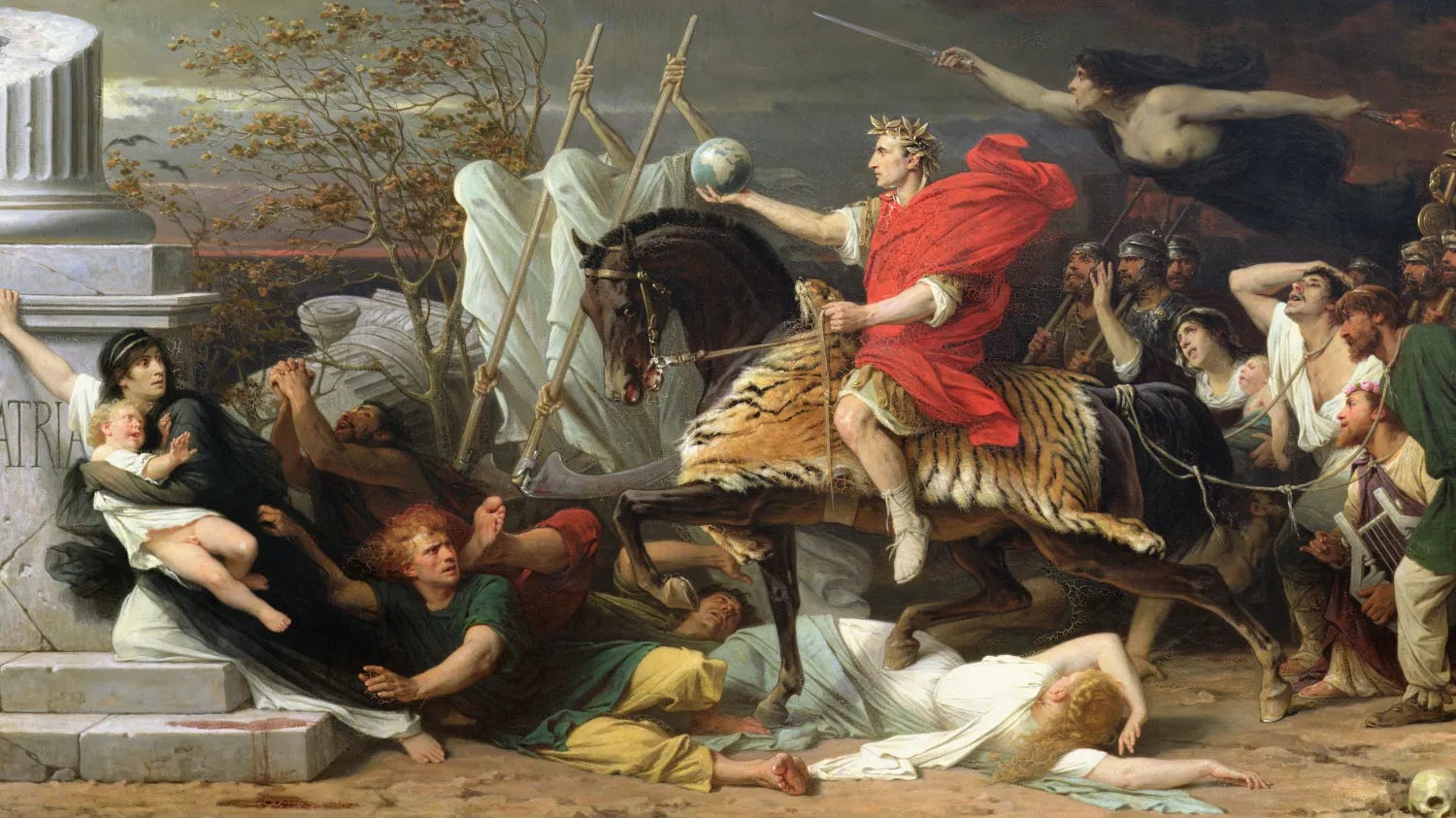
Within eighteen months, Caesar’s opponents had been crushed; the severed head of his greatest rival presented to him, quite literally, on a plate; he had won nothing less than sole and undisputed control of the Roman empire.
This chain of events is so familiar to us today that we risk assuming it was inevitable — it was not, and it did not look that way to contemporaries.
Julius Caesar was a great general, without doubt, but so was Pompey.
It was Pompey’s career, in fact, that had thus far looked the more extraordinary. By the time he was in his mid-twenties, his talent in the field had already gained him the official title Magnus (or ‘the Great’) and the unofficial nickname adulescentulus carnifex (‘The Teenage Butcher’). He had celebrated his first triumph before he even entered the Senate; he held the consulship as his first ever magistracy, with a special senatorial decree waiving the usual requirements of age and experience.
For the past three decades, Pompey had been the first man to whom the Senate and people of Rome turned when a crisis threatened and it looked like force might be required. They had voted him a string of unprecedented, extra-constitutional commands: over the entire Mediterranean for three years to root out piracy; over the three great Eastern provinces to face down Rome’s great enemy, Mithradates.
It was not only his record that was formidable. In January of 49 BC, Pompey looked to have the material advantage. He had most of the Senate on his side, and almost all of its most distinguished members; his naval supremacy was unassailable; he had multiple legions under arms, and the funds and reputation to raise more.
So, what happened?
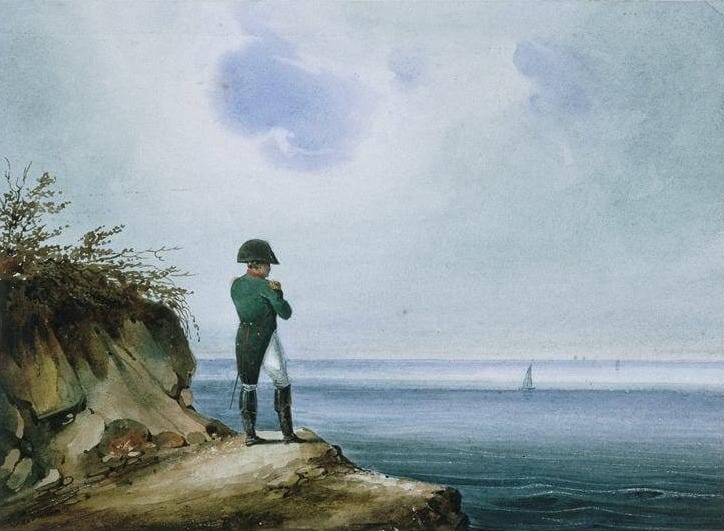
To Napoleon Bonaparte — writing a commentary on Caesar’s own account of the civil wars, during his exile on St. Helena nearly two-thousand years later — the answer seemed simple: Pompey had lost the war the moment he decided to abandon Italy.
By the middle of January 49 BC, the city of Rome was in ferment. The first panicked rumours were soon confirmed: Caesar had crossed the Rubicon and was marching his army on Rome; his legions might be at the gates of the city within days.
Amid all this, Pompey left; travelling south, taking the consuls and much of the Senate with him. For a while he seems to have tried to cut Caesar’s Italian supply lines, but on the 17th of March, Pompey cast his own die: he put out from Brundisium and sailed for the East.
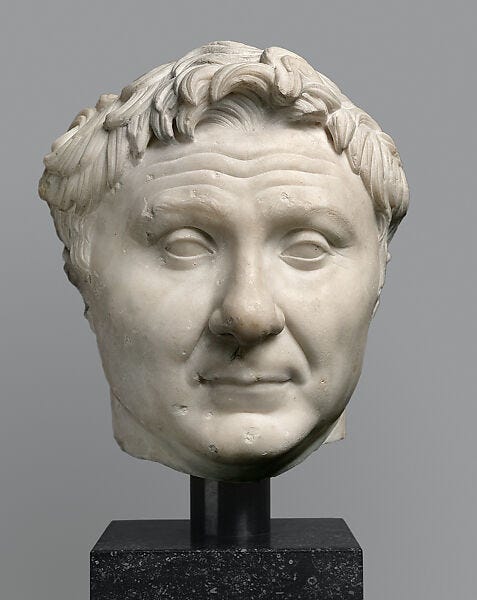
From a strategic point of view, there was much to commend this course of action. The East was by far the richer portion of the empire, and provided more fertile ground for the recruitment of new legions; besides, it allowed Pompey to make the most of his advantage at sea by forcing Caesar to ship troops out in order to meet him. Nor was it untested: it was via the re-invasion of Italy from the East that Sulla had established himself as sole master of Rome three and a half-decades before.
In leaving Italy, Pompey was not stupid or delusional, but he may have been the victim of his own military pragmatism. His assessment of the practical strategic advantages offered by an Eastern base was perfectly correct. What he had failed to take into account was its intangible, psychological cost.
Napoleon put it like this:
Pompey should have held on to Rome and concentrated all his forces there. At the start of a civil war, all the troops must be kept together, because they inspire one another and draw confidence from the strength of their side: they become attached to it and remain faithful.1
It was not only the morale of the troops that was affected by Pompey’s departure. To ordinary Romans, even those implacably opposed to Caesar, this looked like abandonment. And what of the future? Pompey would be forced into the unenviable role of invader — cutting Italian supply lines, landing on Italian beaches, starving out Italian towns — whilst Caesar played defender of the homeland.
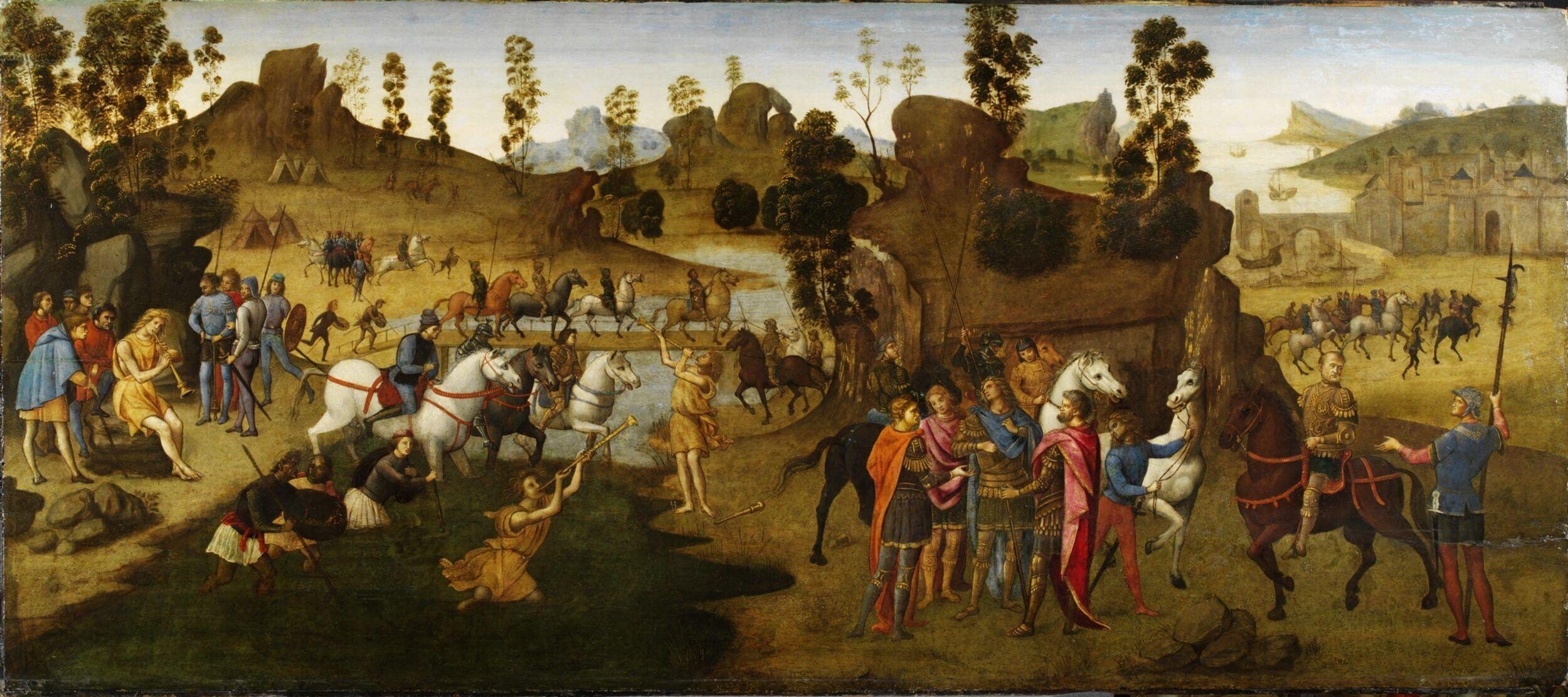
The statesman and orator Cicero was severely shaken. On the 17th of March 49 BC, with both Pompey and the consuls en route to the East, he wrote the following to his closest friend, Atticus.
You commend the consuls. I too commend their spirit — but I condemn their decision. In scattering, they have rendered any proposal for peace, such as the one I was planning, an entirely lost cause. . .
In truth, I am in no doubt that a ruinous war is coming, the beginning of which will be conducted by famine. . . I grieve not to be a part of the struggle. But this is a war in which such great violence and evil are soon to come that, though it is an unspeakable act even to fail to maintain one’s parents, our leaders can nonetheless consider murdering the fatherland, the most ancient and venerable parent of all, with famine.
And this is not the stuff of imagination; no, I am afraid I was present as it was discussed. All of the fleets — from Alexandria, Colchis, Tyre, Sidon, Aradus, Cyprus, Pamphylia, Lycia, Rhodes, Chios, Byzantium, Lesbos, Smyrna, Miletus, Cos — are being prepared with the intent of blocking Italian supply-lines and occupying the grain-provinces.
And how raging he [Pompey] will be when he comes. And most intensely with those who most sincerely wish him well; as though he has been abandoned by those whom he abandoned.
Cicero, Letters to Atticus 9.92
All this horror, technically, would be coming at the hands of Pompey.
With his characteristic speed and instinct for the feel of the crowd, Caesar was already taking advantage of the situation. He attempted to present himself, somewhat implausibly, as the upstanding protector of Rome and her constitution but he also (and probably more importantly) squeezed every drop of advantage from the monopoly of presence he now held. He met important men in person, coaxing them over to his side. And he worked on the wider public too. He was the man on the scene; that in itself might be reassuring for citizens fearing unrestrained chaos, but it also allowed him to allay popular fears about the consequences of his victory by showing them he meant no harm. His troops were kept under careful control as they moved through the Italian countryside and any opponents captured in the early skirmishes were treated with lavish and assiduously publicised displays of clemency.
It seemed to be working. In another letter to Atticus, Cicero expressed an existential foreboding.
Do you see what sort of man the res publica have fallen to? How sharp, how watchful, how resolved?
By Hercules! If he takes no lives and confiscates no one’s property, he is on course to be most prized by the very men who had most feared him.
Many townsmen speak with me, and many countrymen. They care for absolutely nothing except their fields, their minor estates, their little sums of money. And look how much the situation has reversed: they dread the man they used to trust, and love the man they used to fear.
I cannot reflect on how much has occurred by our errors and our faults without disgust. I have put down in writing for you my thoughts on what threatens us; and now I wait for your response.
Cicero, Letters to Atticus 8.13
But how much did all this really matter? Did one decision, made by Pompey before fighting had even begun, win Caesar the civil wars?
Napoleon believed it was decisive; arguing that if Pompey had remained in Italy —entrenching his legions there and shipping in reinforcements from Spain, Africa, Egypt, and Greece — Caesar would likely have been defeated.
It is not at all clear that he is correct; after all, military genius though he may have been, Napoleon’s judgement was certainly not infallible. Indeed, he only had the time to war-game the Roman civil wars because his comprehensive defeat by Wellington at Waterloo had left him a prisoner of the British state, held in well-guarded exile on the remote and sparsely inhabited Atlantic island of St. Helena.
We should take seriously Cicero’s note that Pompey was not happy with the competence and loyalty of troops available to him in Italy. There were two established and experienced legions, but these had been trained under Caesar’s banners; a particularly risky proposition given that Caesar was renowned for his ability to inspire lasting loyalty in his troops.
Beyond that, Pompey would be left to rely on untrained and untested new recruits. He did indeed spend two months, between Caesar’s crossing in January and his embarkation for the East in March, trying to muster fresh forces in the south of Italy, but he found himself unsatisfied with their quality and quantity. Removal to the East promised a cache of ready-made and battle-hardened legions — and the money and time required to effectively raise new ones.
Over the next eighteen months, Pompey would make a number of other — and probably more consequential — errors. There was his decision not to press his advantage after breaking Caesar’s lines in a battle at Dyrrachium, in modern day Albania. And then his capitulation to pressure from his allies to meet Caesar in an ill-advised and ultimately decisive pitched battle at Pharsalus in central Greece. It was mistakes like these, along with a string of Caesarean masterstrokes and the clean cruelty of luck, that left Pompey dead and Caesar master of the world.
Nevertheless, for all the strategic benefits a move East may have seemed to promise in the moment, the longer sweep of this period of Roman history shows that Cicero was justified in the foreboding he felt in the March of 49 BC. Over the next two decades, Rome would fight two more major civil wars. The first, between the assassins and heirs of Julius Caesar in 44-42 BC; the second, between Marcus Antonius and Octavian (the future Emperor Augustus) in 32-30 BC. Both campaigns would play out in an eerie echo of the conflict between Pompey and Caesar.
In every one of the three civil wars that ended the Roman Republic, the same pattern can be observed. The opposing sides mass on opposite sides of the empire: Caesar, then his heirs, then Octavian in the West; Pompey, then the assassins, then Marcus Antonius in the East. The decisive battles are fought in Greece — at Pharsalus, then Philippi, then Actium — and, every time, it is those men who hold Rome and Italy who win the empire.
Napoleon’s Commentaries on the Wars of Julius Caesar, observation 3 on the Italian campaign of the civil war. Translated by R. A. Maguire.
Comments
Nothing yet. Say the first thing.
Sign in to join the conversation.