
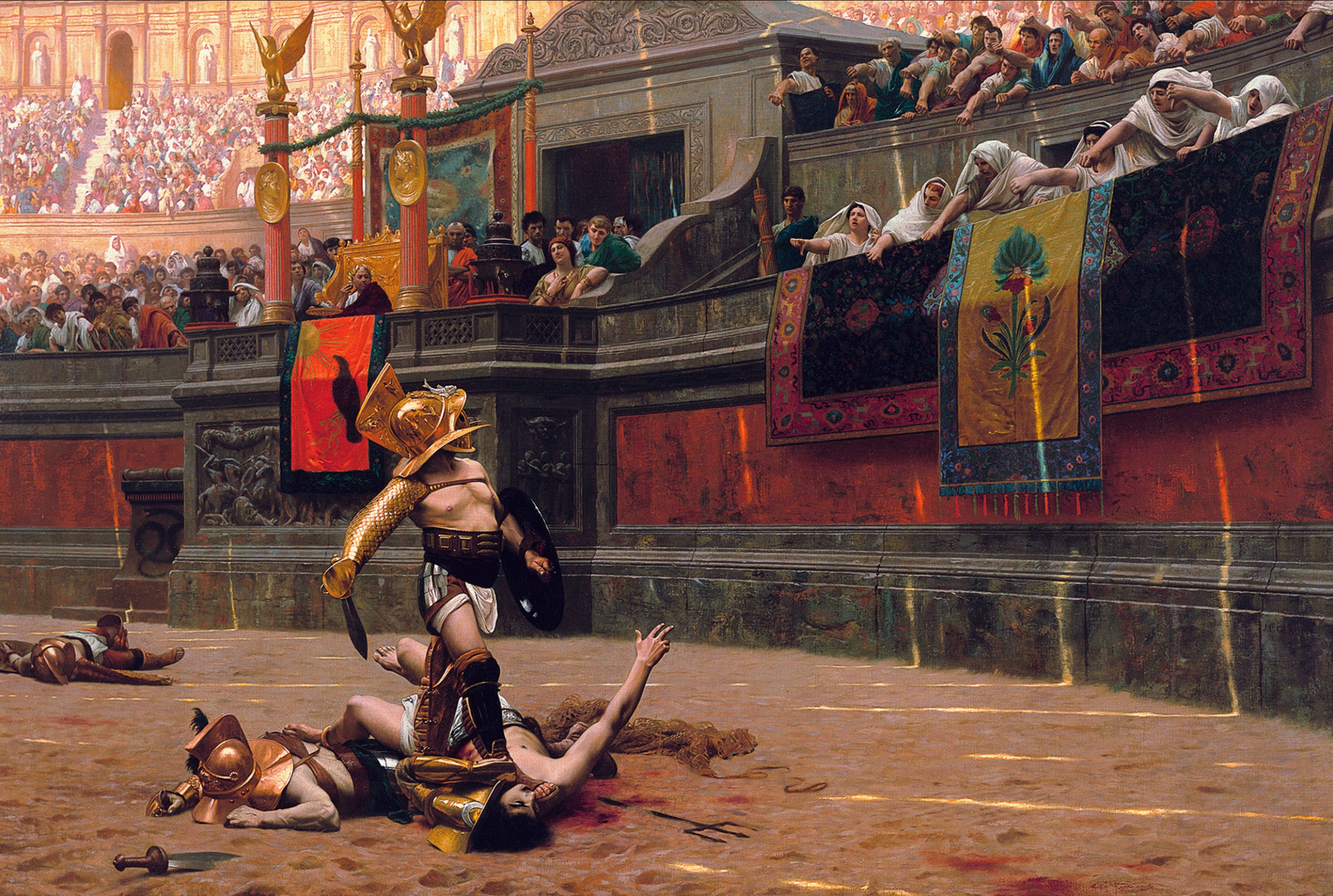
The leader sits at the side of the arena. Beside him, his consort and heirs. Behind him, the most powerful men in the state. Beyond the seats of honour, thousands of citizens have gathered to pay their respects to the Great Man, feel the thrill of patriotic ecstasy, and enjoy a little blood sport.
In the ring, two of the world’s toughest men circle each other. They have proven themselves extraordinarily capable of both inflicting and enduring pain and they will now demonstrate those capabilities by fighting it out, not to the death (this is a weak-livered age) but certainly to the bloody end.
Behind them rises a great columned edifice that stands as a symbol of the power of the state and its leader. The bouts of fighting are interspersed with panegyrics to the Nation’s strength and vigour. Victorious fighters – praised as paragons of physical domination – pay homage to the watching leader.
This could be a description of one of the great bloody games staged by the emperors of Ancient Rome, but it is no less accurate an account of the spectacular series of UFC fights conducted on the White House lawn last Sunday to mark the 80th birthday of President Donald Trump.
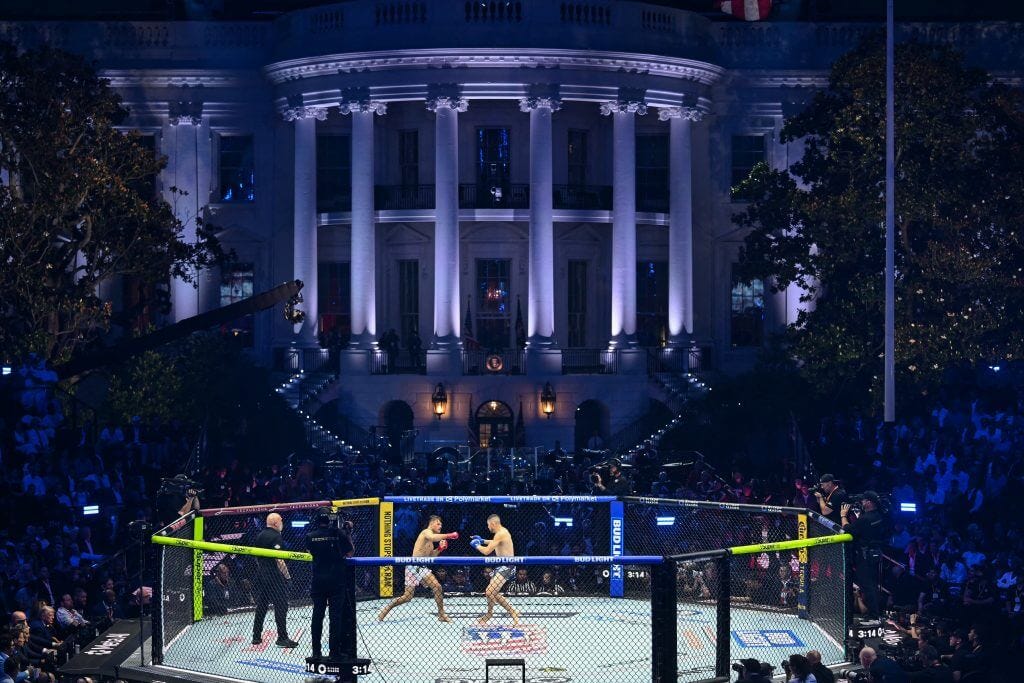
As occasions of civic pageantry, the scale and ambition of the Roman games make Trump’s efforts seem minor. Fourteen men fought in seven fights on Sunday night in comparison to the 10,000 gladiators who appeared in the games staged by the emperor Trajan, over 123 consecutive days, to mark his victory over the Dacians in AD 107. Nor was the Roman imagination constrained to ‘human cockfighting’, as the Senator John McCain described UFC. The emperor Claudius inaugurated an infrastructure project in AD 52 with a mock naval battle involving a hundred ships and nineteen-thousand armed men; his predecessor Caligula celebrated his 26th birthday in AD 38 with 600 horse-races and wild beast hunts which left 800 exotic animals dead in the arena.[1] In 2 BC, Augustus had staged the slaughter of 260 lions and flooded the racetrack to stage the hunting of 36 crocodiles that had been captured in the Nile.
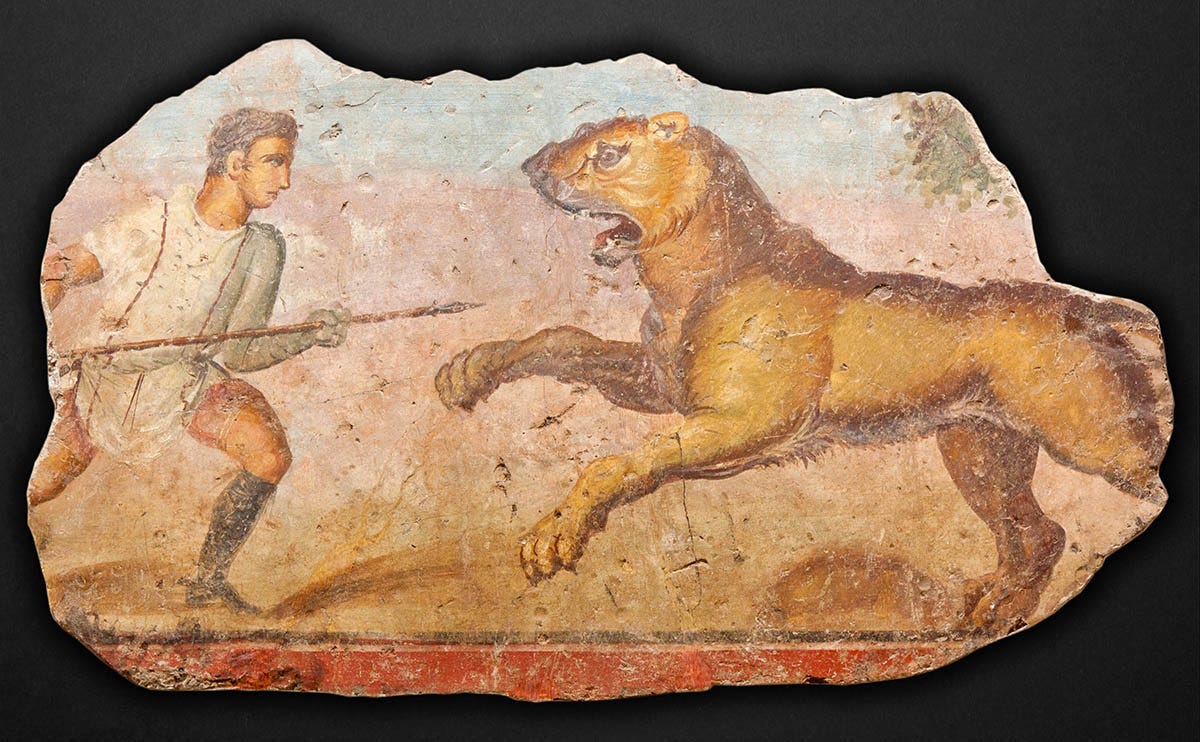
Although low on crocodiles, Trump’s celebrations had a theatricality that any Roman would have recognised. To the bloody drama of the fighting itself he added the showmanship of the fighters and commentators, the pomp of the military guard, the ritual of the president’s processional entrance, the music, the smoke, the lights, the fireworks, the flyover.
Despite the camera-rigging and the red, white, and blue fluorescence, a Roman might also have felt there was something familiar about the evening’s setting. Until the Coliseum was constructed in the 70s AD (from the profit derived from sacking the Temple of Jerusalem), the games took place in wooden arenas erected and dismantled for every show. Impermanence did not induce moderation in their size or decoration. One temporary amphitheatre constructed in the final years of the Republic had a capacity of 80,000 and was decorated with gilded panels, bronze statues, and columns of marble and glass. Like the Claw, these structures were erected amid the iconic spaces of Roman governance: in the Forum, for example, between the Senate House and the Rostra; or on the Campus Martius, where elections had traditionally been conducted.[2]
‘I saw an arena surge towards the sky on latticed beams,’ one Neronian poet wrote, ‘almost looking down upon the summit of the Capitoline’.[3] By transforming the familiar shape of the city, these ephemeral palaces of public entertainment promised the people a break from the mundane routines of daily life – and demonstrated that the men who built them possessed the power to alter the world on a passing whim. Here again, however, Trump did not quite match the surreal magnificence of Rome: his transformation of the White House lawn pales against the efforts of those emperors who bent nature by diverting waterways and digging vast lakes for the staging of naval battles.
The audience in the stands and the crowds on the Ellipse were perhaps a better match for the Romans in the fervour and tenor of their response. The stoic philosopher Seneca describes the chants of the arena crowd: “Kill him! Beat him! Burn him!” And their frustration at any let-up in the action: “Why is he so hesitant to rush towards the blade? Why does he die with so little bravery? Why does he kill with so little enthusiasm?”
Doubtless, the audience on Sunday would not have wanted to see men die for their entertainment (another sign of the degenerate effeminacy of our modern culture), but they do seem to have wanted to watch them bleed. “Don’t play with your food! EAT!” they chanted as O’Malley pummelled Zahabi. “Let them fight!” they demanded as a doctor examined Topuria’s bloodied face and swollen-shut eye.
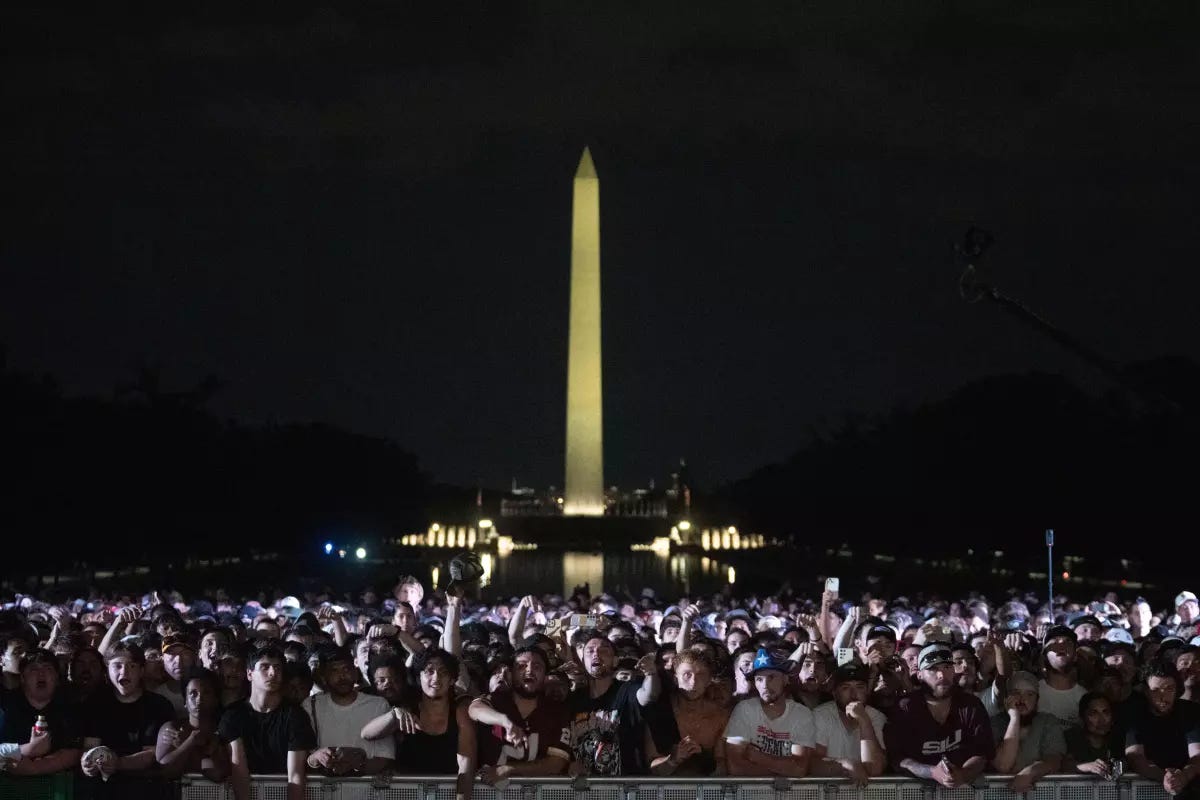
Did the audience realise that they, like their Roman predecessors, were part of the spectacle? “It was just the magnitude of the event,” Joe Rogan told his guest on Wednesday’s episode of his podcast, “So there’s the event that’s taking place on the lawn of the White House, and that has 4,000-plus people….But then behind that, not that far…There’s the Ellipse. The Ellipse has 85,000 people…And it was insane. You could hear them roar… You could hear it in the distance. It was insane. It was insane. Just the magnitude of it was insane.”
Know someone who’d enjoy this?
The 4,000 guests invited into the stands seem to have been handpicked to project a more specific message. The president sat, ringside and conspicuous, surrounded by his children and grandchildren. The top tiers of his administration were amassed behind him, alongside the most prominent Republicans in the House and Senate, and the pundits who panegyrised them on Fox News. They were joined by a panoply of billionaires – Mark Zuckerberg, Elon Musk, David Ellison, Ari Emanuel – many of them media or social-media men. Then there were the 1,200 military personnel in the standing-room sections. A leaked memo formally required that they wear their dress uniform and meet the DOW’s new waist-to-height ratio of less than 0.55; off the record, one official told CNN that ‘senior Pentagon leaders have signalled their preference that DoD attendees “look good” on camera during the event. “Basically, no fat soldiers.”
The combination seemed to represent an idealised vision of the foundations of Trump’s regime. The political invitees signalled internal stability and the exclusion of dissenting voices; the bloc of billionaires displayed the fact that those men who held the other great levers of American power were willing to fall in behind him; the well-built soldiers in their dress uniforms were pure, masculine Americana.
Roman emperors manipulated the stands at their spectacles in much the same way. Augustus, seeking to inure Rome to the unfamiliar idea of heritable power, gave the women of his household unprecedented seats of honour and the emperors’ appearances at the games with their families – the way they placed their relatives in relation to themselves or sat young princes on their knees – became an established medium of dynastic messaging. The raked seating that rose behind the imperial box offered a canvas for envisaging an ordered ideal of Roman society: the front rows were reserved for the senators; then came the equites;[4] then the common men; and finally, in the uppermost seats with the worst view, those women who were not members of the divine Imperial house.
The emperor, highly visible and presiding over it all, was the lynchpin of this reassuringly well-ordered microcosm and the family seated around him promised that stability would endure for generations to come. As the people looked down towards the fighters, they saw their leader through the foundations of his support – serried ranks of rich men and political aristocrats – and when the senators heard an acclamatory crowd at their backs, they were forced to acknowledge the weight of his popularity. The Roman arena, as one scholar put it, was a means for ‘mapping [the] technology of power’.
The emperor’s mastery of the world beyond Rome was on display too. It was visible in the foreign embassies, seated in blocks, distinct from a sea of togas in their national dress. And in the exotic animals being butchered below – crocodiles, bears, panthers, lions, elephants, rhinoceroses, giraffes, ostriches, hippopotami – all captured in their native lands, brought to this imperial capital, and spat out into the ring via complex systems of Roman engineering.
All these political messages were dependent on the efficacy of the show. The Romans did not come to the arena to be lectured about social order or the power of the imperial regime. They came to be entertained – to be amazed by the spectacle, to follow the twists of a fight, and to get caught up in the ecstatic frenzy of a sporting crowd.
Nonetheless, captivated, dazzled, and distracted audiences were temporary captives to the show-master. The Romans saw a serious political risk in this dynamic. The construction of permanent entertainment spaces had been banned under the Republic because it was feared that the man who built them would gain the kind of popularity that might enable him to override the delicate system of checks and balances designed to prevent the emergence of a new king. As emperor, Augustus decreed that games held by other men could include no more than 120 gladiators; the eight spectacles he produced himself included 10,000.
In Rome, the overwhelming clamour of the arena provided cover for a series of elisions: between strength and virtue, entertainment and politics, performers and audience, allegiance to the state and personal obeisance to the emperor and his family. Sunday’s less spectacular proceedings perhaps fulfilled a similar (though correspondingly more muted) function. We were presented with a series of uncomfortable incongruities – the White House and the Claw; a civic event and a corporate advert; quotes from the Constitution and a quasi-monarchical processional entrance; a celebration of the country’s founding and one man’s birthday – but the festive theatricality of it all encouraged you not to look at the stitches.
If you enjoyed this, there’s more to come.
[1] The celebrations also marked his dedication of a Temple to Augustus.
[2] These spaces were not considered to be desecrated by the presence of short-lived arenas, as some feel the White House was last weekend.
[3] The Capitoline was Rome’s most sacred hill; home to the Capitoline Triad of Jupiter, Optimus Maximus, Juno, and Minerva. Calpurnius Siculus, Eclogue 7.23-24.
[4] Wealthy and respectable citizens – traditionally, men who could afford to furnish a war horse rather than fighting on foot.
Comments
Nothing yet. Say the first thing.
Sign in to join the conversation.