
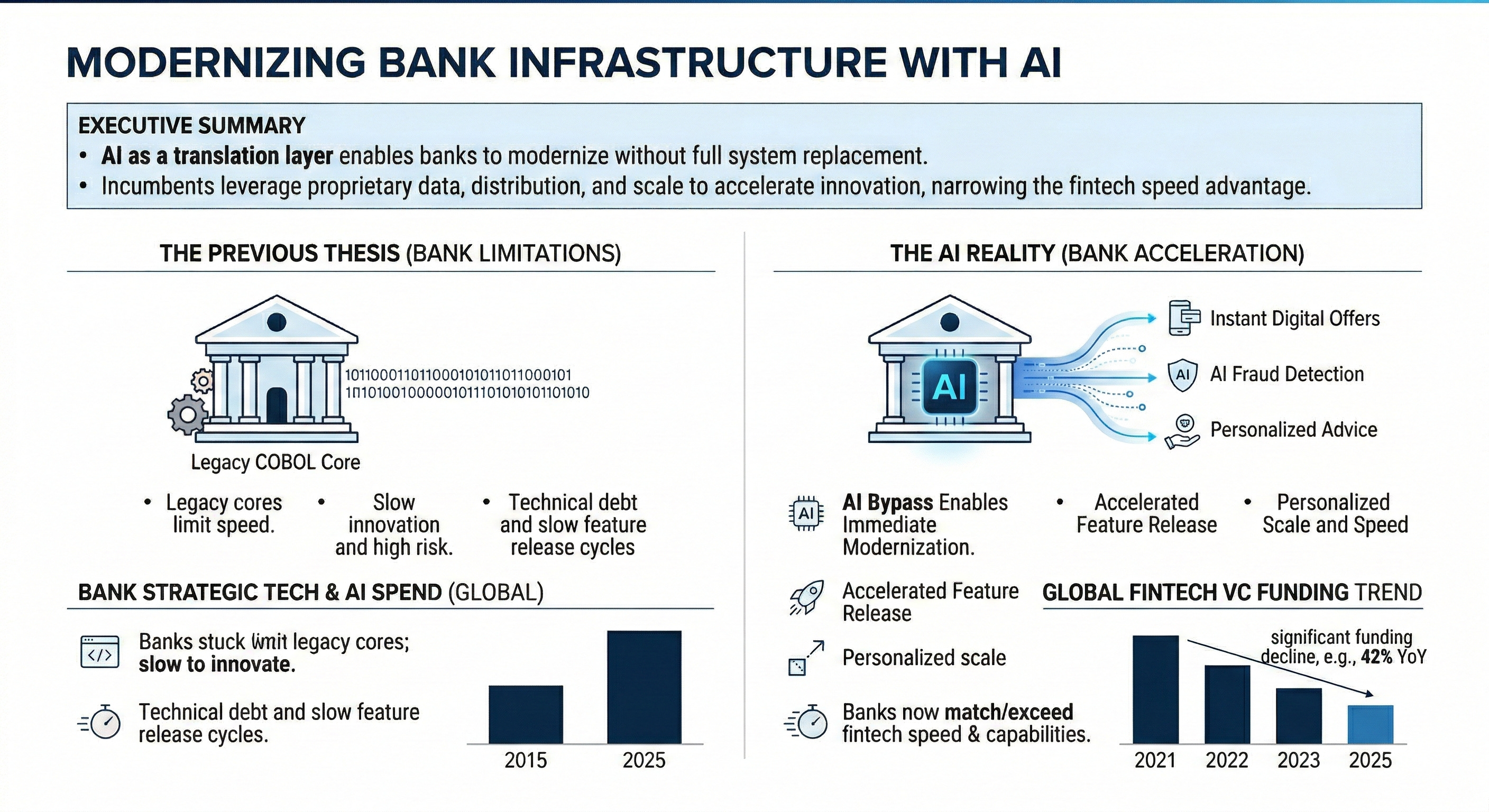
The entire fintech thesis was built on one structural premise: banks are trapped by their technology. Legacy core systems, decades of accumulated technical debt, and the regulatory inertia that makes replacing infrastructure a multi-year nightmare. Fintechs were supposed to win because they started from scratch. Clean architecture. Modern stacks. No baggage.
That premise is collapsing.
JPMorgan Chase is spending $18 billion on technology in 2025. Bank of America deployed $4 billion specifically on new strategic technology and AI initiatives — a 44% increase over the last decade. Goldman Sachs launched a centralized AI-driven operating model it calls “One Goldman Sachs 3.0.” These aren’t pilot programs or innovation theater. These are industrial-scale deployments, and the critical point is not how much they’re spending — it’s what AI lets them do with that spend. AI doesn’t require banks to replace their legacy systems. It wraps around them, translates them, and makes them functional in ways that would have required a full re-platform just three years ago.
Here’s the thesis: AI augmentation neutralizes the legacy infrastructure disadvantage that justified fintech valuations for the last decade. By 2028, the fintech-vs-bank framing inverts. Incumbents with distribution, deposits, regulatory moats, and AI-augmented operations will recapture the structural advantage. The market hasn’t priced this in.
Go back to 2015-2021. The core investment logic behind fintech was elegant and straightforward. Banks operated on COBOL mainframes. They couldn’t ship features fast enough. Customer experience was terrible. Compliance was manual and expensive. A company that built from zero, with modern APIs and cloud-native infrastructure, could deliver the same financial product at a fraction of the cost and ten times the speed.
And it worked — for a while. Neobanks like Nubank, Revolut, and SoFi grew to nearly $30 billion each in deposits, putting them in the top 1.5% of American banks by size if they were US-chartered. Stripe and Adyen reached $1.4 trillion in total payment volume. Roughly $1.8 trillion in venture capital poured into fintech over the last decade. The numbers were extraordinary.
But the underlying assumption — that banks would remain trapped — was always time-limited. The question was never if banks would modernize, but how fast and at what cost. AI just collapsed that timeline.
Here’s what the market is missing. Previous modernization strategies required banks to rip and replace core systems — a process that routinely took 5-7 years and cost billions, with catastrophic failure rates. TSB’s 2018 IT migration disaster in the UK, which locked millions of customers out of their accounts, became the cautionary tale that kept every bank CTO awake at night.
AI doesn’t require rip-and-replace. It operates as a translation layer. JPMorgan’s LLM Suite now has 200,000 employees using generative AI tools that sit on top of existing infrastructure, extracting data from legacy systems and making it actionable. The bank has moved 65% of its applications to cloud — up from 50% just a year ago — and its CFO has stated that peak modernization spend is now behind them. Goldman Sachs used AI assistants to modernize legacy codebases, reducing post-release bugs by 15% and accelerating developer onboarding by 25%.
This is the structural shift. AI gives banks the functional equivalent of modern infrastructure without the migration risk. They can now offer the speed, personalization, and user experience that fintechs pioneered — while retaining the assets fintechs can never replicate: regulatory licenses, deposit bases, decades of proprietary transaction data, and institutional trust.
McKinsey estimates that AI could generate as much as $340 billion annually in value creation for the global banking sector. That’s not a technology story. It’s a structural repricing of who wins in financial services.
The numbers tell the story on the other side of the trade. Global fintech funding declined 42% year-over-year in 2025. Revenue growth for the median mid-stage fintech slowed from 35% in 2023 to 17% in 2025. Customer acquisition costs rose approximately 18% while lifetime value improvements stalled, compressing the LTV/CAC ratio below the 3x threshold that venture investors require for conviction.
Meanwhile, lending spreads for fintech platforms compressed by 150 basis points in a single year — from 5.7 percentage points above benchmark in Q4 2024 to 4.2 percentage points in Q4 2025. And perhaps most telling: of the 16 fintech companies that went public in 2025, only two traded above their IPO price by year-end. The Q1 2026 sell-off eliminated over 80% of the Fintech Index market cap gain accumulated between 2024 and 2025.
The conventional narrative blames macro headwinds and the funding cycle. But the deeper signal is structural. The competitive moat that justified premium fintech valuations — superior technology relative to banks — is eroding. When JPMorgan can deploy AI-powered fraud detection, personalized financial advice, and instant underwriting on top of its existing infrastructure, what exactly is the neobank selling that justifies a 15x revenue multiple?
This is a classic case of asymmetric optionality, and the incentives are stacked overwhelmingly in favor of incumbents.
Banks have what’s hardest to build: regulatory moats, cheap deposit funding, and proprietary data at scale. JPMorgan processes over an exabyte of data daily across nearly 100 countries. AI doesn’t just use that data — it compounds its value. Every new model trained on JPMorgan’s transaction history widens the gap between what an incumbent can offer and what a startup can replicate. Goldman is already signaling that it views its proprietary data as a monetizable asset, potentially licensing access to AI companies — turning a cost center into a revenue line.
Fintechs have what’s easiest to replicate: user interfaces, cloud-native stacks, and product speed. When AI allows any institution to ship software faster, the speed advantage compresses. And there’s a deeper Austrian economics point here about the time structure of capital. Fintechs raised at peak valuations during a zero-interest-rate environment. They built organizations optimized for growth, not profitability. Now they face compressed margins, rising CAC, and a funding environment that rewards unit economics over user growth — exactly the conditions where incumbent advantages in cost of capital and operational scale become decisive.
The irony is almost poetic. The same legacy infrastructure that created the fintech opportunity may now be what closes it. Not because banks fixed their infrastructure — but because AI made fixing it unnecessary.
For founders building in financial services: The window for “we’re better than banks at technology” as a standalone thesis has narrowed dramatically. The surviving fintech winners will be those embedded deeply enough in specific verticals or workflows that AI augmentation at banks can’t easily replicate them — think Ramp in spend management, Toast in restaurant payments, or compliance-specific infrastructure plays. If your moat is “better UX than Chase,” you have 18-24 months before that stops being true.
For investors evaluating fintech positions: Rerun your models with a different assumption. Instead of banks remaining structurally slow, model a scenario where large banks achieve 60-70% of fintech-equivalent capabilities through AI augmentation within 36 months. What happens to your portfolio company’s competitive position? To its unit economics? The fintechs worth holding are those with genuine network effects, proprietary data moats, or regulatory positions that bank AI adoption cannot erode. The rest face a repricing.
For capital allocators watching the sector: The smarter trade may be going long on banks that are deploying AI effectively and short on the fintech category as a whole. JPMorgan’s $2 billion in projected AI-related upside is a leading indicator. Watch for Bank of America’s Erica adoption metrics, Goldman’s One GS 3.0 efficiency milestones, and Citi’s post-modernization AI deployment speed. These are the signals that tell you the inversion is accelerating.
The fintech-vs-bank narrative dominated the last decade of financial services. It’s inverting. AI doesn’t disrupt banks — it removes the structural disadvantage that made disruption possible. Within 36 months, the largest US banks will match or exceed the functional technology capabilities of 80% of funded fintechs, while retaining advantages in funding cost, regulatory positioning, and data scale that no startup can replicate.
The market is still pricing fintech as if the technology gap is permanent. It isn’t.
No posts
Comments
Nothing yet. Say the first thing.
Sign in to join the conversation.