
Goldman Sachs published a note last week arguing that blockchain is the natural trust and coordination layer for AI agents. The thesis is gaining traction. Google released its Agent Payments Protocol. Coinbase partnered with Cloudflare on x402, a protocol for machine-to-machine payments. Ethereum proposed ERC-8004 for decentralized AI agent identity. Major firms are racing to build the infrastructure for autonomous AI to transact.
Here is what almost everyone analyzing this convergence is getting wrong: they are framing it as a technology story. It is not. It is a regulatory arbitrage story. And the arbitrage window is 18-24 months.
The real bottleneck for the agentic economy is not AI capability or blockchain scalability. It is a single, unresolved legal question: who is liable when an AI agent makes an unauthorized payment?
No regulator on earth has answered this question. Not the SEC. Not the EU under the AI Act. Not a single U.S. state among the dozens rushing to pass AI legislation. Courts have not issued a single definitive ruling on liability for fully autonomous agent behavior. The liability framework that governs every digital transaction today was designed for a world where a human clicks “buy.” That world is ending.
Consider the four-actor problem. Traditional payment liability falls across three parties: the consumer, the payment service provider, and the merchant. When an AI agent enters the picture, you suddenly have four actors with overlapping and undefined responsibilities: the merchant, the PSP, the model developer, and the deploying business. As a legal expert at Pinsent Masons noted just days ago, there is currently no guidance on how to allocate liability when an AI agent over-orders, pays the wrong merchant, or misinterprets a consumer instruction.
This is not an abstract problem. Consulting companies estimate the global B2C retail market could see $3-5 trillion in orchestrated revenue from agentic commerce by 2030. They also project AI agent applications growing at a 45% CAGR through 2030. Bank of America analysts expect global agentic AI spending to reach $155 billion by 2030. Trillions of dollars are flowing toward an economy that has no legal framework for its most basic function: paying for things.
Now here is where the asymmetry emerges.
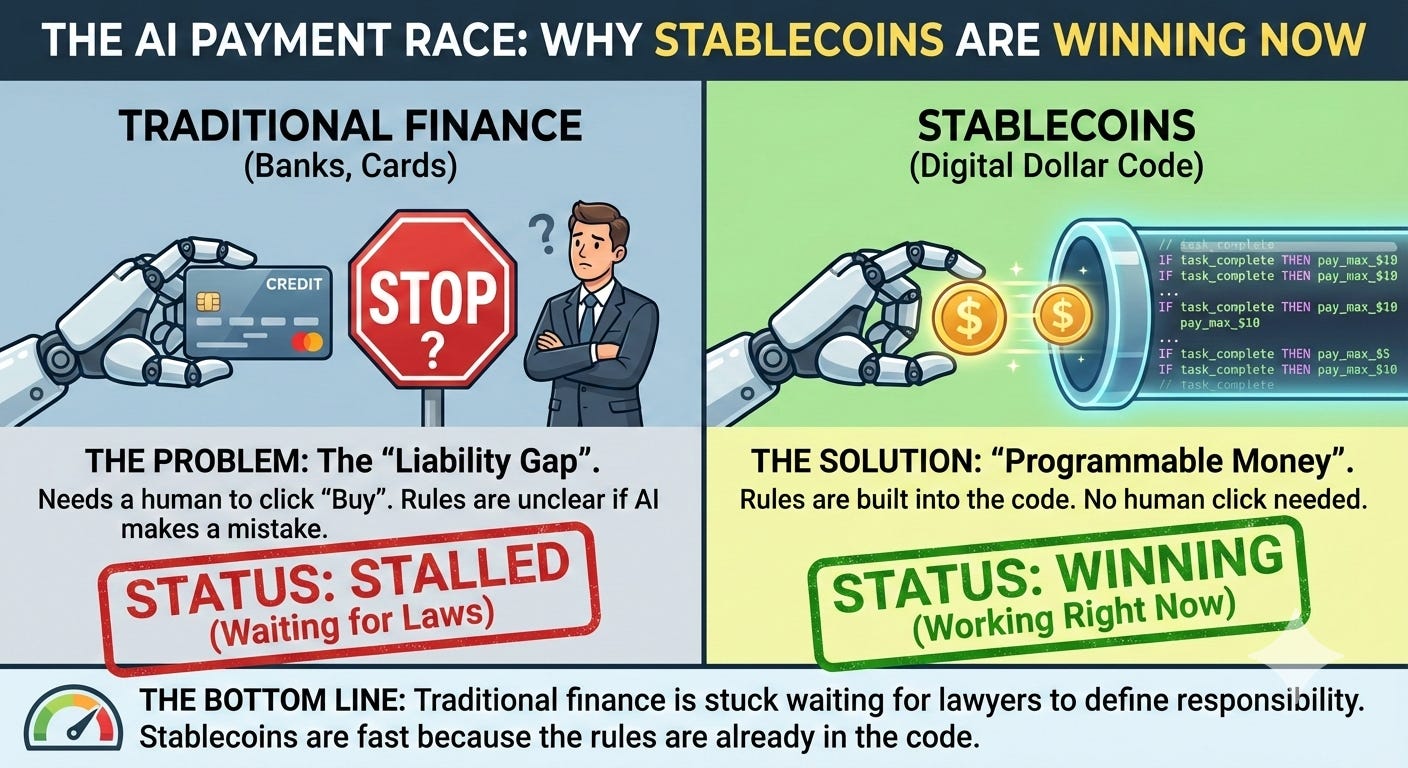
Traditional payment rails - Visa, Mastercard, bank transfers - cannot operate in a liability vacuum. Their entire business model is built on clearly defined liability chains, chargeback rights, and regulatory compliance frameworks like PCI DSS, AML, and KYC. Every transaction requires defined accountability. When no one can say who is responsible if an AI agent goes rogue, traditional rails freeze. They wait for regulators.
Crypto rails do not have this constraint.
Stablecoins already process $33 trillion in annual transaction volume. The market cap has crossed $312 billion, up 6x from under $50 billion in early 2020. Visa’s stablecoin settlement volumes hit a $4.5 billion annualized run rate as of January 2026. B2B stablecoin payments surged from under $100 million monthly in early 2023 to over $6 billion monthly by mid-2025. This is not speculative activity. These are real economic flows running through programmable, borderless infrastructure - infrastructure that does not require a human to click “authorize.”
The structural advantage is straightforward. Stablecoins are programmable money operating on programmable rails. Smart contracts can embed authorization logic, spending limits, and compliance rules directly into the payment itself. An AI agent operating on blockchain rails does not need a human to approve each transaction because the rules are encoded in the infrastructure. Zero-knowledge proofs can verify that an agent acted within its mandate without exposing the user’s financial data. The audit trail is immutable.
None of this requires regulators to first define who is liable. The guardrails are in the code.
This is the mechanism the market is underpricing. Goldman, a16z, and Tether’s CEO are all correct that blockchain infrastructure will matter for the agentic web. But the reason it will matter is not primarily technological superiority. It is regulatory timing.
Traditional finance players - banks, card networks, payment processors - will not deploy AI agent payment capabilities at scale until the liability question is resolved. That resolution requires legislative action or definitive court rulings, neither of which moves quickly. The EU AI Act’s next enforcement deadline is August 2026, and it still does not address autonomous agent liability for financial transactions. In the U.S., the federal government is actively fighting with states over who even has jurisdiction to regulate AI, with the Trump administration’s December 2025 executive order creating a Task Force to challenge state-level AI laws. This is jurisdictional chaos, not the environment in which clear liability frameworks emerge.
Meanwhile, stablecoin infrastructure is shipping production-ready agent payment protocols right now. Coinbase’s x402 enables AI agents to make payments with zero human intervention. Google’s Agent Payments Protocol establishes authorization standards specifically designed for agent-initiated transactions. These are not whitepapers. They are live systems processing real money.
The window is 18-24 months. That is roughly how long it will take for the first meaningful regulatory clarity on AI agent liability in financial transactions -- whether through the EU’s ongoing AI Act implementation, a landmark U.S. court ruling, or federal legislation. During that window, stablecoin-native infrastructure will accumulate users, transaction volume, developer ecosystems, and network effects that traditional rails will struggle to displace even after regulation catches up.
If you are building in agentic commerce, the implication is clear. Design your agent payment stack around programmable money rails from day one. Do not wait for Visa and Mastercard to figure out the liability question. By the time they do, the protocols, standards, and network effects will already be established on crypto rails. The companies that integrate stablecoin payment capabilities for their AI agents now will have a 2-year compounding advantage in a market projected to reach trillions.
If you are allocating capital, watch two leading indicators. First, stablecoin transaction volume attributable to non-human-initiated payments. This metric barely exists today but will become the single most important signal of agentic economy adoption. Second, the first major court ruling or legislative framework that defines AI agent liability for financial transactions. That is the catalyst that unlocks traditional finance participation - and the moment the early-mover advantage begins to narrow.
The broader pattern is one I have seen repeatedly from inside the policy machine: regulation does not prevent market formation. It redirects it. Capital and innovation do not wait for permission. They flow to wherever the friction is lowest. Right now, for AI agents that need to transact autonomously, that is stablecoin infrastructure.
Goldman is right that the agentic web needs a trust and settlement layer. But the market is treating this as a question of which technology wins. It is actually a question of which infrastructure can operate before regulators catch up. Stablecoins have an 18-24 month structural head start - not because blockchain is inherently better, but because programmable money does not need a liability framework that does not yet exist. By the time that framework arrives, the rails will already be built.
No posts
Comments
Nothing yet. Say the first thing.
Sign in to join the conversation.