
It was a Roman inscription in Tarragona that inspired me to start this substack newsletter a year and a half ago. It also inspired me to learn Latin; since I first laid eyes that first inscription, I’ve had time to reach an intermediate level.
Now I am back in Tarragona on holiday, and I’ve found another mysterious inscription:
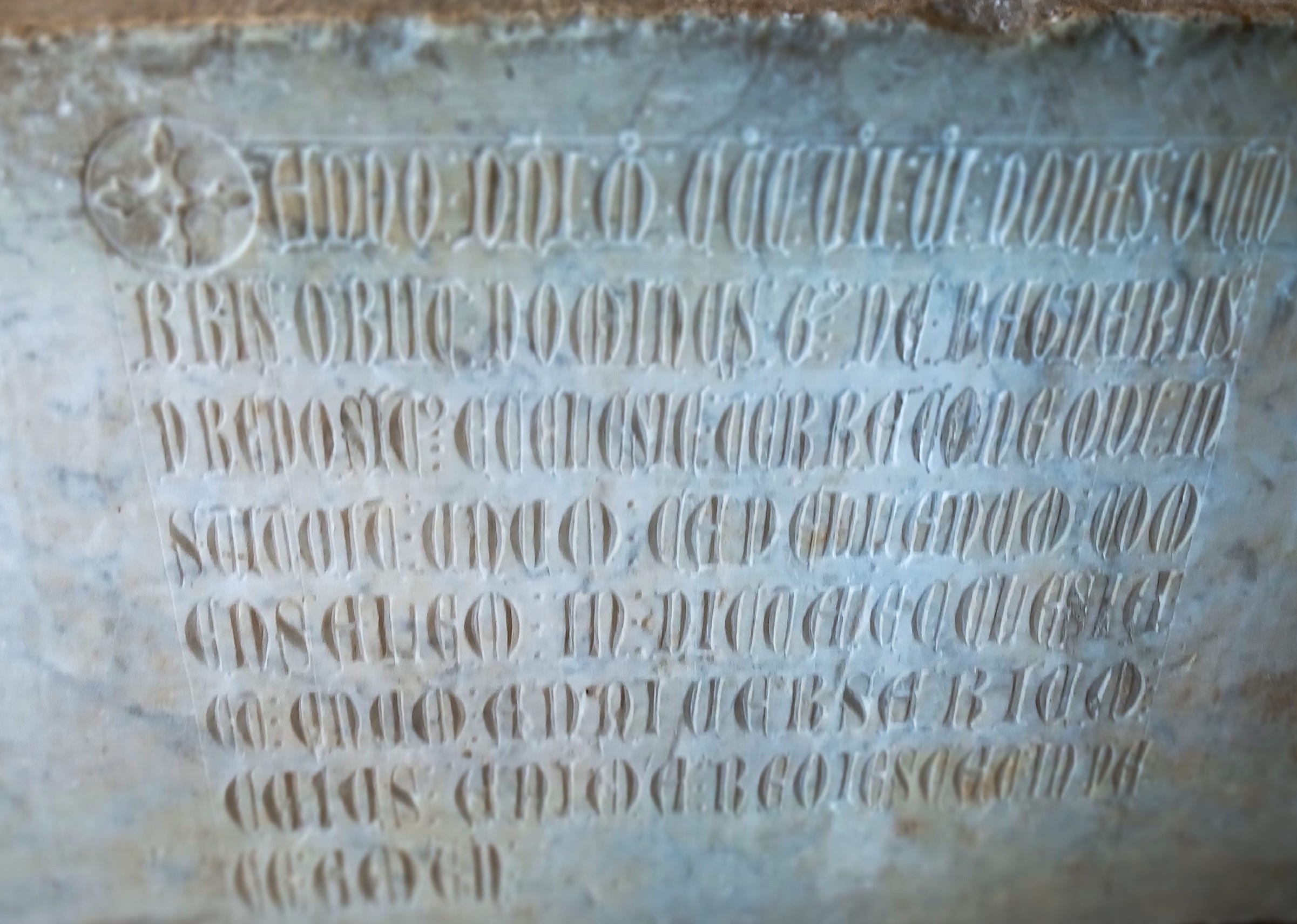
It’s on a sarcophagus in the museum of the Roman Circus, the stadium dedicated to chariot races that dates from the first century A.D. The Roman Circus in Tarragona is unusual in that it was built inside the city walls. Because of that, it was built over during the Middle Ages. When I was a middle-school student in Tarragona some time back, I didn’t even know that the Circus was there, as little was still visible. However, in the last two decades more and more has been uncovered and now the exposed parts include the tunnels that ran beneath the public seating, parts of the public seating, a part of a curved section, and a building associated with it which now houses a museum where a series of stone inscriptions can be found.
Because the circus was so extensive (it measured 325 meters by 115 meters), other parts of it can be glimpsed as you make your way through the Old Town. You walk past parts of track and public seating. And on the Plaça de la Font you can go into restaurants that were built into what were once the vaults of the stadium. You can see fantastic images of it here.
But what does the inscription say? And why does the Latin text look so different from that of the first inscription I wrote about here?
The museum transcribed it as follows:
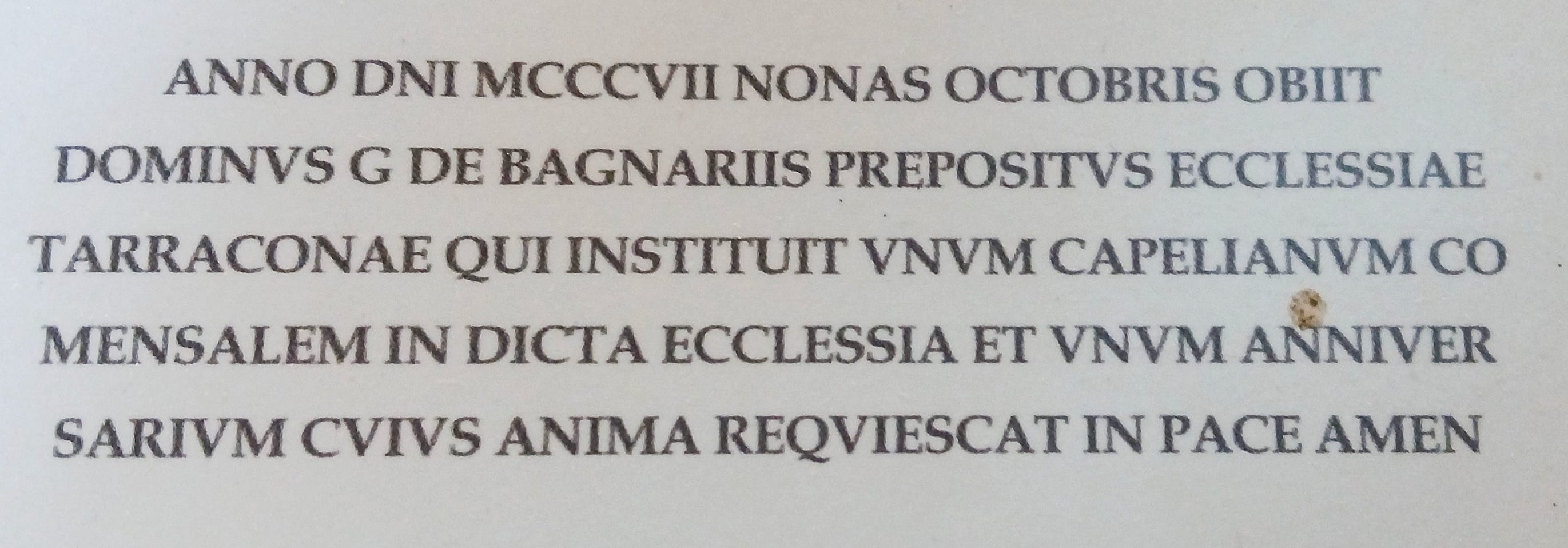
The inscription starts off with a date: ANNO DNI MCCCVII NONAS OCTOBRIS. “Anno” means year, and “DNI” is an abbreviation for “Domini,” which translates “of the Lord.” MCCCVII is a Roman numeral: the M stands for one thousand, each C is one hundred, the V is a five and then two singles are added, which gives us the date 1307. “Nona” means nine and “Octobris” is October. So the date is October 9th, 1307 of the Christian Era.
Now we find out who this inscription is about: Dominus G de Bagnariis. “Dominus” means “Lord” (here in the nominative case while in the DNI it was in the genitive case, indicating posession, i.e., “the year belongs to the Lord”). But “Dominus” is a human lord, not the heavenly Lord of Anno Domini. What was this lord’s name? According to the museum card, here the G stands for Guillem, or William. “De Bagnaris” is a surname that comes from the place where he is from.
What happened to Guillem de Bagnariis? The verb is OBIIT. We have a word in English that descends from this Latin word: obituary. OBIIT means he died, but we would not be far off if we looked at this inscription as an obituary, as the rest of it tells us about his accomplishments. First we get his title: PREPOSITUS ECCLESIAE TARRACONAE - "Provost of the Church of Tarragona." "PREPOSITUS" means "provost" or "prior." "ECCLESIAE" is the genitive singular of "ecclesia," meaning "of the church." "TARRACONAE" is the genitive singular form of "Tarraco," indicating the church in Tarragona. The Latin translator I use when I’m stumped said "PREPOSITUS" means "provost" or "prior." The word in the museum translations in Spanish is “paborde” and in Catalan “pavorde.” I’ll write more about this in my next newsletter.
So while Guillem de Bagneres was a Provost, what did he do?
QUI INSTITUIT UNUM CAPELIANUM COMENSALEM IN DICTA ECCLESIA - "Who established one chaplain in the said church."
"COMENSALEM" is an adjective meaning "attached to the table," often referring to a chaplain who ate at the same table. More about this in the next newsletter.
ET UNUM ANNIVERSARIUM - "And one anniversary." "ET" means "and." "UNUM ANNIVERSARIUM" refers to the commemoration or anniversary of the death. Since he died in 1307, this might mean the memorial stone was created in 1308.
CUIUS ANIMA REQUIESCAT IN PACE AMEN - I think many of my readers will be familiar with “Requiescat in Pace.” We see this often on tombstones in American cemeteries, abbreviated as RIP, “Rest in Peace.” “Anima” is the word for soul and “Cuius” means “whose.” So the full translation is: "May his soul rest in peace, amen."
The museum card adds that Guillem de Bagneres was made provost in 1303, appointed by the Archbishop of Tarragona, Rodrigo Tello.
Overall, the inscription seems to refer to the last years of a cleric’s life. At the end he managed to add a chaplain to the church, apparently by financing the chaplain’s upkeep. A bit of a dull story, right? I almost stopped once I’d worked out a translation of the inscription. Then I decided to dig a little more and found out that I couldn’t have been more wrong about Guillem de Bagneres.
No posts
Comments
Nothing yet. Say the first thing.
Sign in to join the conversation.