
If you’ve read my first post for this thread, you know that I visited Tarragona this summer and was fascinated by the Latin inscription on a sarcophagus.
The sarcophagus once held the body of Guillem (William) De Bagneres, who was a provost of the Cathedral of Tarragona, and died in 1307.
In my second post for this thread I explored the life of Archibishop Rodrigo Tello, who made De Bagneres into a provost in his cathedral. The name “Bagneres” comes from the Latin word for “bathing place.” The name has changed through the years and now the area in Tarragona that was the family seat is known as Banyeres, and the village is now Banyeres del Penedés.
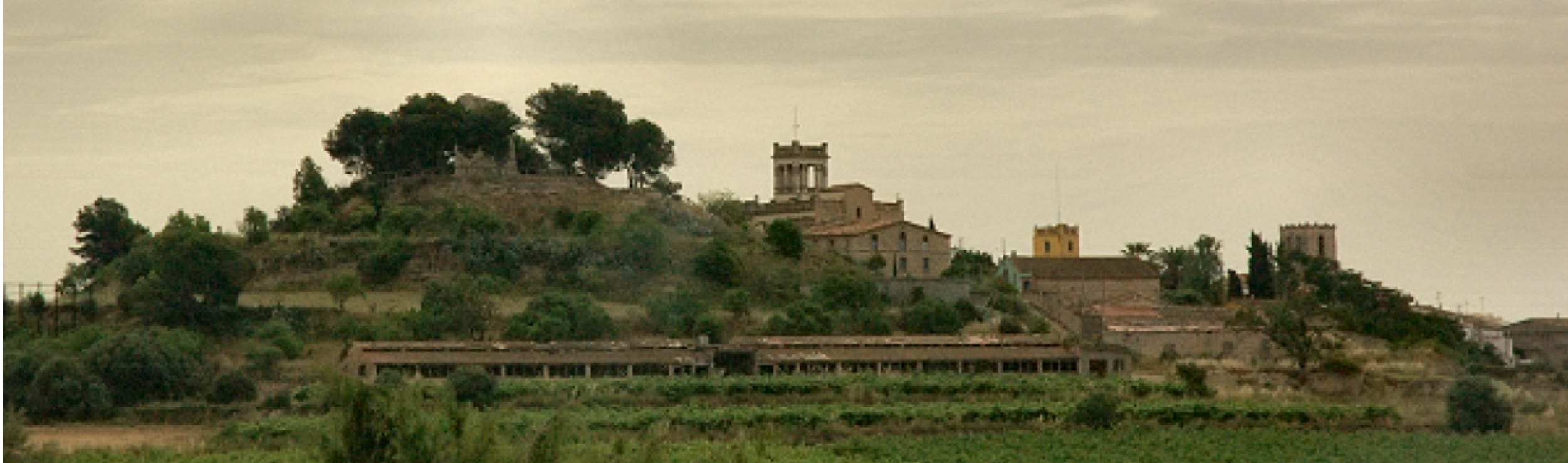
The town where Guillem is (likely) from started as a military base once held by Moors. Wikipedia says: “In documents from 938, the tower located on a small hill in the town is referred to as the Torre de la Guardia. It was owned by the Bishop of Barcelona from the 10th century onwards. It is believed that the site was previously occupied by the Saracens, as remains of Arab pottery were found inside.” The area had been inhabited for over a thousand years before that, as remains have been found from various eras: the Bronze and Iron Ages, an Iberian settlement, a cistern and an impressive military Roman fortification, a medieval city with pre-Romanesque and Romanesque churches, an a castle. What Guillem might have been familiar with would be the tower and the Priory of Santa Maria, of which only a chapel is left.
The Banyeres family was well established in Barcelona by 1201, a family who did business in textiles and banking. The first Banyeres to arrive were the brothers Guillem, Ramon, and Albert. Albert fathered a Guillem de Banyeres who became a canon of the Sant Joan altar in Barcelona. The wealth of the family enabled other family members to become high-ranking clergy, including Bernat, a brother of the canon who died in 1282, who was rector of the Sant Vicenç de Sarrià altar, the family altar. Canon Guillem died in 1256. Both nephews of Canon Guillem became priests. It’s possible that one of the nephews is the Guillem de Banyeres we are talking about here.
Though I scoured historical documents and databases in English, Spanish, and Catalan, I could not find anymore about this Guillem than what is available on the Catalan Wikipedia page. But what’s there is fascinating!
We first hear of Guillem de Banyeres in 1264, when Pere Bernat left his ecclesiastical position of “waiter” for the town of Reus (a position that gave him control over one third of the town and entitled him to live in the castle and collect tithes) to become provost of Tarragona. Guillem de Banyeres, son of Ermengol de Banyeres was named his successor and, therefore, ecclesiastical lord of the town.
Guillem also inherited a feud with Archbishop Benet de Rocabertí , who wanted to impose several reforms on the chapter of the canons of the See of Tarragona to which a majority sector was opposed. The feud became violent, and Guillem had to defend himself violently. He badly wounded an officer of the mitre, a former knight named Ramon de Vilafranca, nearly killing him. This led to him losing his position as waiter. Ramon de Villafranca sued and was given Guillem’s property in 1269, but Guillem de Banyeres appealed his case to the Roman Curia and managed to keep his position until the matter was decided in 1275. The decision gave Villafranca the chamberlainery of Reus. But the incomes from Vila-seca and Tarragona were used to support a Deanery and two Archdeacons (those of Vilaseca and Sant Fructuós) associated with the Cathedral of Tarragona. In 1277 Guillem de Banyeres was appointed provost, a position he held until he died in 1307.
During his term, Archbishop Bernat d'Olivella died , and reaffirming the old custom, Guillem de Banyeres, as provost went on to govern the Mitra in Vacant See. But he found himself from the first day with serious difficulties presented to him by some canons, who refused to give him control of the assets of the Mitra, which made it difficult for Banyeres to do his job as provost. The Wikipedia page says: “In 1288, Guillem de Banyeres appealed to the Holy See for the insults and disobedience he had received from some of the Tarragona capitulars. Finally, on 11 October of that year, Guillem de Banyeres excommunicated all the canons who retained property from the Mitra and also against those who committed other offenses against the capitular institutions.”
So it seems that neither Rodrigo Tello nor Guillem de Banyeres were simply clerics. They were litiguious fighting men who mostly seemed concerned with governing and their sources of income, and in Tello’s case, beautifying the Tarragona Cathedral. We benefit from his efforts as we walk around Tarragona today.
No posts
Comments
Nothing yet. Say the first thing.
Sign in to join the conversation.