
The first time I let OpenClaw run a job in production without watching it, I checked on it more times than I’d like to admit. Nothing was wrong. I just didn’t trust that it would tell me if something had gone wrong.
That’s the whole game with agents, and it took me longer than it should have to see it. The hard part was never whether the model could do the work. It was whether I could believe it when it said the work was done. A migration declared clean. A bug declared fixed.
Every model I’ve shipped on has carried the same quiet failure mode underneath the competence: the confident shrug. It tells you it’s finished, the evidence is thinner than the confidence, and you find out three days later when the thing it touched falls over in front of a customer.
I’ve shipped that bug more than once. The outage is never the worst part. The worst part is realizing someone downstream trusted a green checkmark because I did.
So I built my production setup around not trusting the shrug. Verification passes. A second agent whose only job is to try to break what the first one produced. A reflex to re-read work I supposedly delegated, which quietly defeats the point of having delegated it. None of it is elegant. It’s the tax you pay for automating something that will occasionally lie to you with a straight face.
Opus 4.8 shipped this week. I wrote the feature walkthrough on Medium, the full tour: effort control, dynamic workflows, the Messages API change, fast mode. This is the part I left out of that piece, because it’s an opinion, and Medium isn’t where I keep those.
Here it is. Of the four things Anthropic shipped, only one of them touches the problem I just described. And it is not the one the internet is about to lose its mind over.
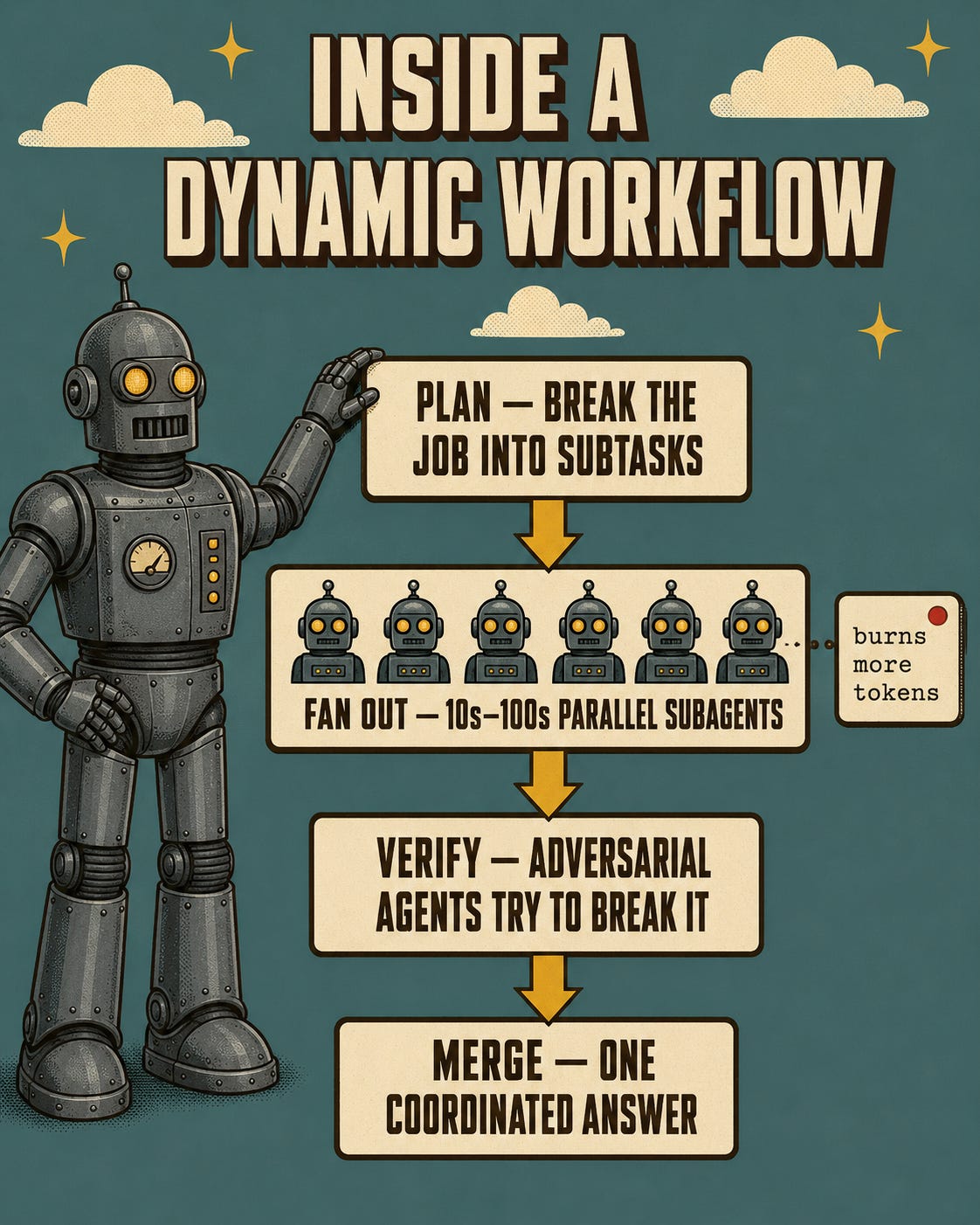
The thing everyone will write about is dynamic workflows, and specifically the Bun rewrite. Jarred Sumner used them to port Bun from Zig to Rust: roughly 750,000 lines, 99.8% of the existing test suite passing, eleven days from first commit to merge. It’s the most impressive thing in the launch. It will be in every thread by Monday morning.
It’s also, for most of us, the least useful thing that shipped. A research-preview feature that fans a job across hundreds of parallel agents and burns tokens at a rate that should make you a little nervous is a brilliant demonstration of the ceiling. It is not what changes your Tuesday.
Anthropic says as much themselves, in plain text: the Bun rewrite is not in production. Read that line twice before you aim a hundred agents at your own codebase and walk away.
What changes my Tuesday is dull by comparison. Anthropic trained this model to be less willing to assert things it can’t support. By their own evaluations, Opus 4.8 is roughly four times less likely than the previous version to let a flaw in its own code slip past without flagging it.
I can’t verify that independently. It’s their number, from their testing, and I haven’t had the model under real load long enough to have my own. But I know exactly what that number is worth if it holds, because I’ve spent years paying for its absence.
Here’s the math that matters, and it’s not on any benchmark slide. A slow agent costs you a few minutes. A confidently wrong agent costs you the habit of checking, and that’s the expensive one, because you don’t notice the habit is gone until after you’ve already stopped looking.
The first time an agent swears a migration is clean and it isn’t, you go back to re-reading everything for a month. A model that says “I’m not sure about these three files” instead of “done” doesn’t only save you that one bug.
It hands back the thing that makes delegation possible at all: the ability to not check.
That’s the product. The autonomy features are the demo reel.
There’s a quieter change I like even more, and I’d bet money it gets the least coverage of anything in the launch. You can now slip a system instruction into the middle of a running task through the Messages API, without invalidating your prompt cache and without smuggling it in disguised as a user message.
If you’ve never built an agent harness, that reads as plumbing. If you have, you know the two ugly options it kills.
Change the instructions mid-run and you either blow away a warm cache, which is the expensive path, or you inject the update as a fake user turn, which pollutes the transcript and confuses the model about who’s talking.
Both cost you something on every long run. Now neither does. It’s deeply unglamorous and it removes friction I hit most weeks. I’ll take that over a 750,000-line magic trick any day.
One more, briefly, because it’s the sleeper that’s free to everyone: effort control. You can now set how hard the model works per response. I read that as a quiet admission baked into the product itself. The model’s confidence isn’t uniform, and you should spend more compute on the things you can’t afford to get wrong. Which is the honesty change wearing different clothes.
Now the part where I tell you what I can’t tell you, because the entire point of this post is honesty in a system you’re trusting with real work.
I have not run Opus 4.8 in production. Nobody has for long; it shipped days ago. What I’m doing is reading the launch and holding it against years of running agents for real, OpenClaw in production, and the claude-skills library I maintain in the open (330-plus agent skills, 70 plugins, link at the bottom). That’s the lens. It is not a benchmark report, and anyone publishing one this week is inventing it.
And here’s the part that makes this personal rather than academic. I build openLEO, an agent platform for people who can’t read the code the agent writes. My users don’t have the habit of checking, because they never had it to begin with. They can’t open three files and tell you which one the agent got wrong. For them, a confidently wrong agent isn’t an annoyance.
It’s the line between a product that works and a liability I shouldn’t have shipped. So model honesty isn’t a feature I’d like to have. It’s the entire question of whether the thing I’m building is responsible to put in front of someone. Anthropic moving the model toward admitting doubt matters more to me than any amount of parallel-agent horsepower, because horsepower I can manage and confident lying I cannot.
Even if the honesty number is exactly right, it doesn’t solve the trust problem. It moves the threshold.
Every feature in this launch trades tokens for autonomy, dynamic workflows most of all, and nobody can price that trade for your specific work except you. Prompt-writing stopped being the scarce skill a while ago. The scarce skill now is judging when the autonomy is worth the spend, and when it quietly isn’t. I’m still calibrating that for my own work. I’d be lying if I told you I had it solved.
So, for whatever a stranger’s advice is worth: skip the Bun thread. Point a workflow at something small and scoped first, purely to feel the token burn before it surprises you on a job that matters. And once you’ve got real hours on the model, watch your own honesty number, not Anthropic’s. That’s the one that tells you whether you can finally stop checking on the job four times in twenty minutes.
Two questions I keep turning over, and I want your answers, not your applause. What’s the first job you’d hand to an agent you wouldn’t watch? And what would it take, exactly and specifically, for you to trust the merged result without re-reading every line it touched? Reply and tell me. I’m collecting failure modes, and yours are worth more to me than any benchmark.
(I wrote a straighter, feature-by-feature version of this on Medium last week. This is the unguarded one.)
If this resonated: I write about agentic engineering, Claude Code, and what production AI actually costs to learn, most weeks. It’s free. If you’ve been burned by an agent’s confident “done,” you’re my exact reader. Subscribe and I’ll see you in the next one. The deep-dives go further than I can in a free post ($7/mo, $60/yr), or just hit reply, I read every email.
— Reza
Comments
Nothing yet. Say the first thing.
Sign in to join the conversation.