
With the recent success of Assassin’s Creed Black Flag Resynced and the launch of the Halo: Campaign Evolved, we thought we’d dig into our copies-sold-through estimates for remakes and remasters, specifically the ones launched since the start of the current PlayStation and Xbox generation.
Chuck on the rose-tinted glasses and let’s jump in.
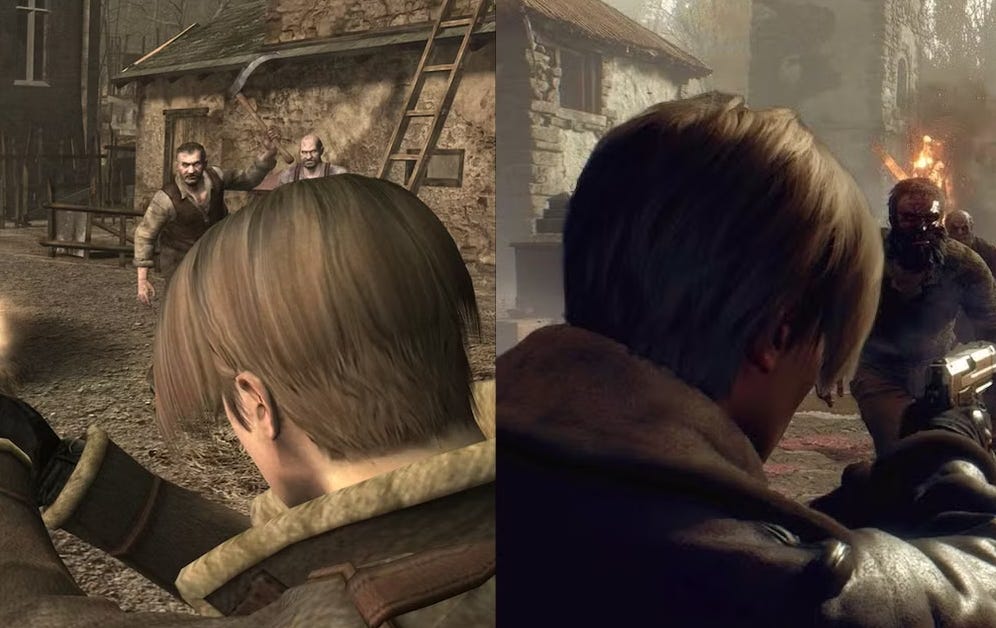
The top-selling remake since 10 November 2020 is 2023’s Resident Evil 4 remake, which has sold a monstrous 16.8M copies across PlayStation (7.4M, 46.9%), Steam (6.8M, 42.9%), and Xbox (1.6M, 10.1%). Almost 4M of those were sold this year.
Resi 4 is a ground-up remake of the 2005 classic, and comfortably one of the best horror games ever made, in my humble (grumble?) opinion. It’s also among the most successful single-player horror games in history, generating $560M in gross revenue for Capcom so far across the three platforms, split 53.1% PlayStation, 34.1% Steam, and 12.8% Xbox.
As ever, Steam brings in less revenue per copy, thanks to a higher volume of sales in lower-priced regions and heavy discounting. China, Brazil, and Russia sit in the top five territories for Resi 4 on Steam, where players are especially responsive to price cuts.
Steam’s share of total Resident Evil 4 revenue has grown from 28.0% in launch week to 34.1% today. There’s that Capcom catalogue flywheel again – a game earning a bigger slice of its lifetime revenue years after release, at the low end of the price curve (in markets consoles barely reach).
Resident Evil 4 is arguably the ideal remake candidate, with the 2005 original is a classic that pretty much every critic list ranks among the greatest games ever. This game’s influence cannot be overstated, impacting third-person game design forever.
Resi 4 was also three console generations old and visually dated, making it a sweet spot for remakes. It’s revered enough to guarantee demand and old enough that the remake feels new. And Resi 2’s fantastic 2019 remake also showed that Capcom was up to the task.
Ark: Survival Ascended, the late-2023 remake of 2015’s Ark: Survival Evolved, has sold 7M copies overall, the bulk on Steam (3.9M), then PlayStation (2.1M) and Xbox (1.0M).
It also hit PlayStation Plus (adding 2.4M players) and Xbox Game Pass (adding 3.8M players) in 2024, less than a year after release. Those subscription inclusions, paired with free-weekend promotions, pushed total player counts past 13M across the three platforms.
Survival Ascended has generated nearly $230M in gross revenue to date and still pulls roughly 1.4M monthly active users (mostly on Steam, despite the ongoing console-subscription availability).
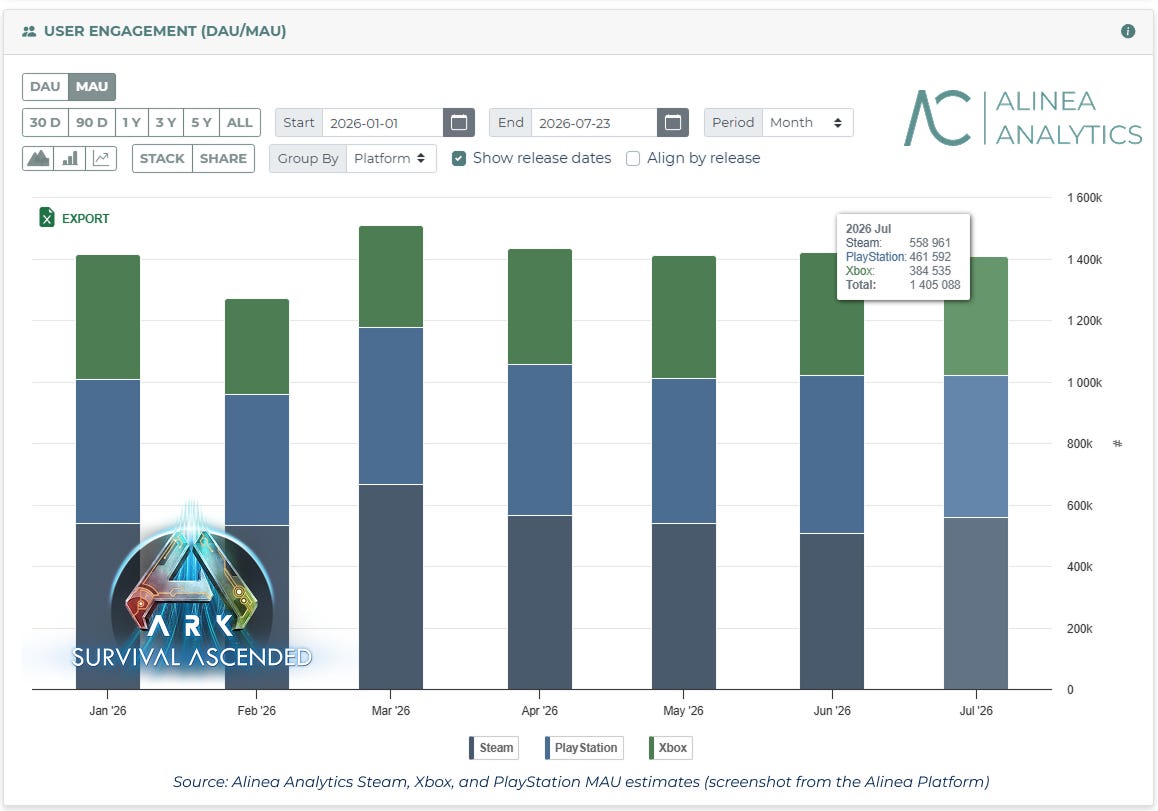
On Steam, nearly 75% of Survival Ascended players have previously played the original Survival Evolved. Nostalgia clearly dragged veterans back, but the remake also captured a nice chunk of newbies.
There’s a slightly different lesson here than Resi 4’s. Survival Ascended’s survival-sandbox remake sells on being the definitive version of a game people sunk hours into less than a decade before.
Here’s how the rest of the top current-gen remakes and remasters stack up:
The Last of Us Part 1: Naughty Dog’s remake of its 2013 original (which already saw a PS4 remaster in 2014) has sold 6.3M copies, split across PS5 (55.4%) and Steam (44.6%). This is topical, given reports that Sony is dialling back single-player day-and-date PC releases, as it sharpens its focus on margins. That said, TLOU Part 1 was the title’s first-ever PC release, whereas the PS4 remaster had been cheap and available on PlayStation for years (including via PS Plus), softening its console pickup. Still, if I were Sony, I’d add remakes to the roster of PC releases, as it’s trying to up margins.
Oblivion Remastered, Bethesda’s shadow-dropped remaster from last year, has moved 4.5M paid copies (2.8M on Steam, 1.2M on PlayStation, and about 500K on Xbox). Oblivion launched day-and-date on Game Pass, where another 4.1M players accessed it across Xbox consoles and PC. These numbers position the just-announced Fallout 3 and New Vegas remasters for big runs, especially if Bethesda can time them to future seasons of the Amazon show (no easy feat given always-shifting dev timelines…)
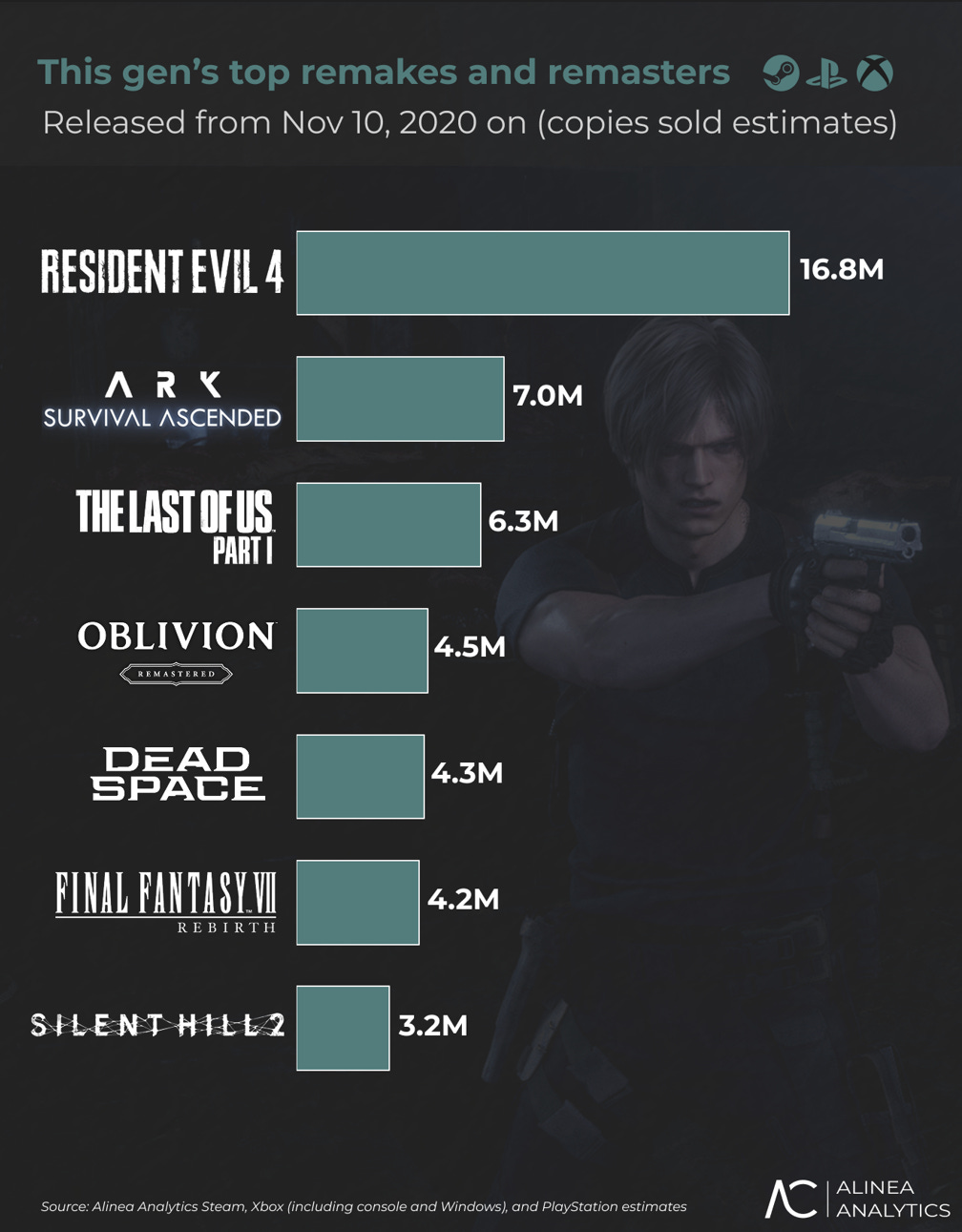
2023’s Dead Space, a remake of EA’s 2008 sci-fi horror classic, has sold 4.3M copies. Steam leads at 2.8M, then PS5 at 1.4M and Xbox at ~150K. Xbox’s low share is due to its EA Play inclusion (bundled into Game Pass Ultimate and PC Game Pass), plus the fact the 2008 Xbox 360 original has been on Game Pass for nearly a decade with back-compat enhancements (Auto HDR, faster loads).
Final Fantasy VII: Rebirth, the second entry in Square Enix’s remake trilogy has sold 4.2M copies: PS5 leads with 2.9M (launched Feb 2024), Steam 1.1M (Jan 2025), Xbox under 75K (launched last month). The final instalment, Final Fantasy VII: Revelation, will launch simultaneously across PS5, Xbox, PC, and Switch 2. Square Enix is finally adopting Capcom’s multiplatform, wide-as-possible strategy. It’s a smart move. Their days of long PS5 exclusivity windows (leaving money on the table) are clearly over.
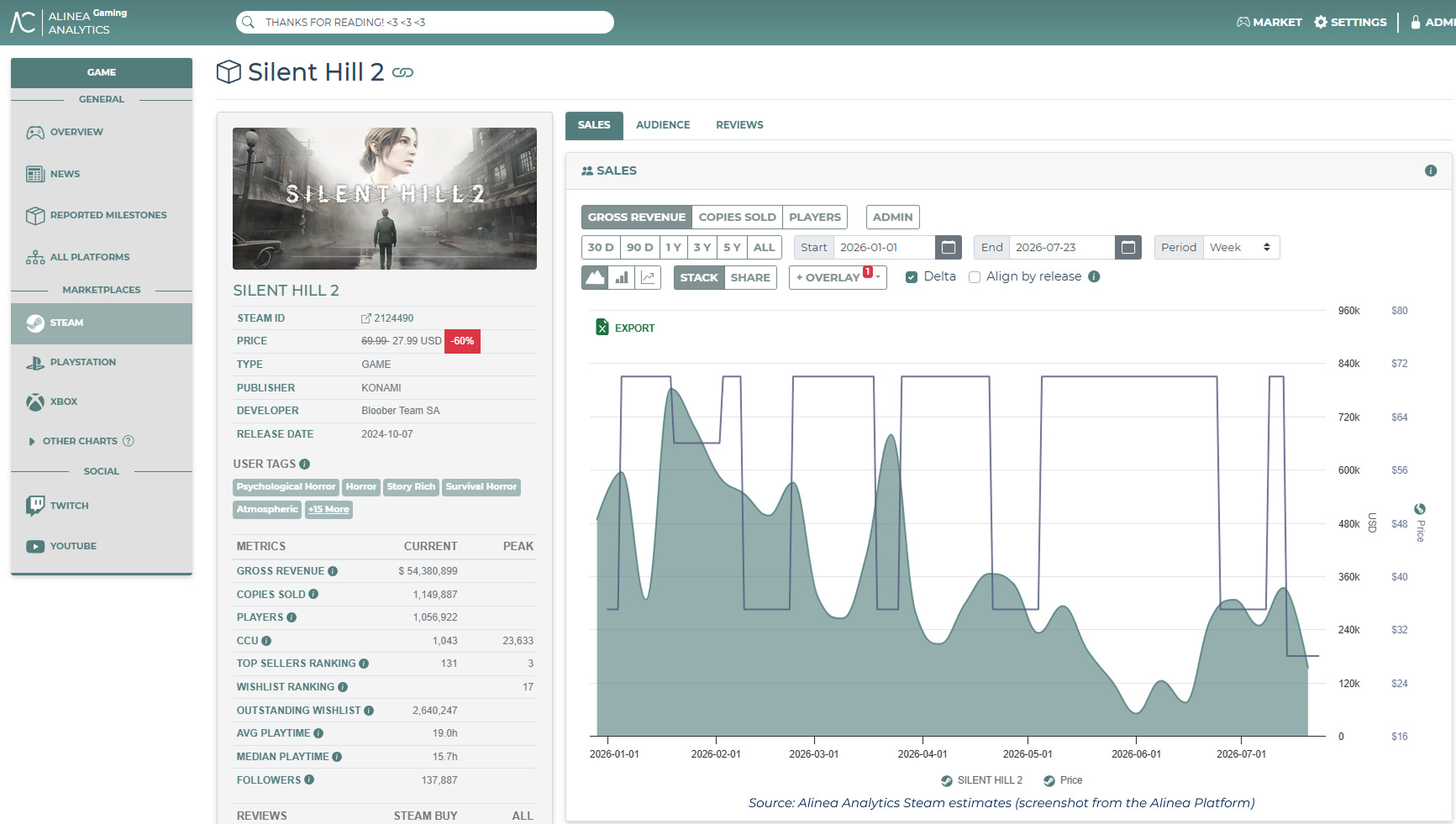
Silent Hill 2, Konami’s return to form and remake of the PS2 classic, has sold through (through, folks) 3.2M copies, grossing $170M. About 57.2% of those revenues are on PlayStation, 37% on Steam, and 5.8% on Xbox (which launched a year after the initial window). Silent Hill 2 is one of the most critically revered horror games ever, and there was a lot of doubt surrounding the remake. Not anymore.Candidly, the remake has done more for the Silent Hill brand than a decade of false starts. On Steam, Konami too is mimicking Capcom’s long-tail discounting, pulling steady catalogue revenue after dropping to a record-low $28 last week.
Check the Alinea Platform screenshot below to see just how much impact the discounts have made so far (the line is price, and the area chart is a delta of weekly copies sold):
As for the pattern for these successes: they’re adored, aged, and available everywhere (took me longer than I’d like to admit to come up with that…)
Remakes have always existed (I’m old enough to revere Super Mario Bros. Deluxe and Link’s Awakening DX on Game Boy Color), but remakes have gone from the occasional nostalgia play to a pillar of nearly every AAA publisher’s strategy in the space of a few years. The way I see it, it's a direct response to the AAA market's woes.
A few separate pressures all landed at once. We had a pandemic boom where everyone was stuck indoors buying games and hardware, and the industry foolishly mistook a bubble for a new baseline (and candidly, many of those forecasters have since historically revised those numbers, obscuring that fact).
Anyway, studios staffed up, budgets ballooned, acquisition sprees happened, and a lot of folks assumed the number would just keep going up. Then interest rates rose, money stopped being free, the cost-of-living crisis hit, and that growth went to shite.
Now we’ve got an industry carrying a bloated cost base under pressure to make its money back. Sadly, the two go-to levers for the powers that be are “efficiency” (read: cutting staff) and charging more. We’ve seen a brutal amount of both. Remakes do come into this, I promise…
Wanna know how well Halo: Campaign Evolved sells on PS5? Hit subscribe below for that in your inbox next week!
On the software side, the AAA arms race did its own splash damage. AAA games now cost hundreds of millions and the better part of a decade to make. If something costs $150M-plus to make, you can bet your arse that the budget gatekeepers at publishers get risk-averse by necessity.
They chase every way to raise revenue per player (ARPU and lifetime value), which is how you end up with $80 base prices, day-one DLC, and battle passes stacked onto premium games. Very high-profile failures only compound this.
This is where the remake earns its place. I promised we’d get there. A brand-new IP is a six-to-eight-year gamble with no guaranteed audience, the riskiest bet on the board at the worst possible time to be making those bets. A high-fidelity remake is different, with a proven design blueprint, a built-in fanbase, and a much shorter, cheaper production cycle. So the budget gatekeepers aren’t gambling on whether people want the thing – the demand’s proven. AKA, less risk.
Of course, remaking the same games over and over would be nuts. The smarter publishers out there will use that reliable remake pipeline to de-risk the rest of the slate, like what Capcom is doing. It made weirdo banger Pragmata possible.
A near-guaranteed hit like a beloved horror remake throws off dependable revenue and keeps an IP warm and culturally present between mainline entries, buying a publisher the breathing room to make the innovative, swing-for-the-fences bets on the side. All the while, the catalogue keeps printing money.
This only works if the company is lean and smart, though. The remake model won’t rescue a bloated cost base. A remake’s whole advantage is efficiency (lower cost, lower risk, faster turnaround), and that advantage evaporates if it’s run through the same over-staffed, over-budgeted machine that got publishers into trouble in the first place.
Capcom wrote the playbook, really, but look about and it’s now the industry default. PlayStation is leaning harder on remakes and back-catalogue revenue, Xbox is reframing itself around proven IP and catalogue value, Square Enix is remaking FF7 three times over and taking it multiplatform, Ubisoft waved the Black Flag when it needed a sure thing, and Konami is back in the game thanks to its awesome remakes and remasters.
The specifics differ, but a proven asset rebuilt for a modern audience is the closest thing to a guaranteed win the industry has right now. So expect a lot more of them, because the pressures that got us here aren’t easing any time soon, innit.
Dino Crisis remake when?
We’re offering a free trial of our platform for games companies.
Send us a message here, or reply to this email, and we’ll set you up.
Reply to this email – or reach out here – if you have any feedback for the newsletter – or want to request a game for us to cover.
[Alinea Analytics boasts the most accurate PC and console estimates in the business. Game makers use our platform to understand their audience, keep an eye on the competition, monitor sales trends, and spot new opportunities. We equip game studios and financial institutions with accurate data and the confidence to make smarter, data-driven decisions. Want to talk about all things games market data? We’d love to chat!]
Comments
Nothing yet. Say the first thing.
Sign in to join the conversation.