
Two weeks ago, Pocketpair’s Palworld officially entered 1.0, crossing 40M total players across Steam, PlayStation, and Xbox. In terms of premium unit sales, our platform estimates put Palworld at roughly 30.5M copies sold, with nearly 86% of that total originating on Steam.
Obviously that makes Palworld one of the biggest new gaming IPs ever. It launched in early access on January 19 2024 on PC and Xbox (Game Pass day and date). It came to PS5 in September of that year.
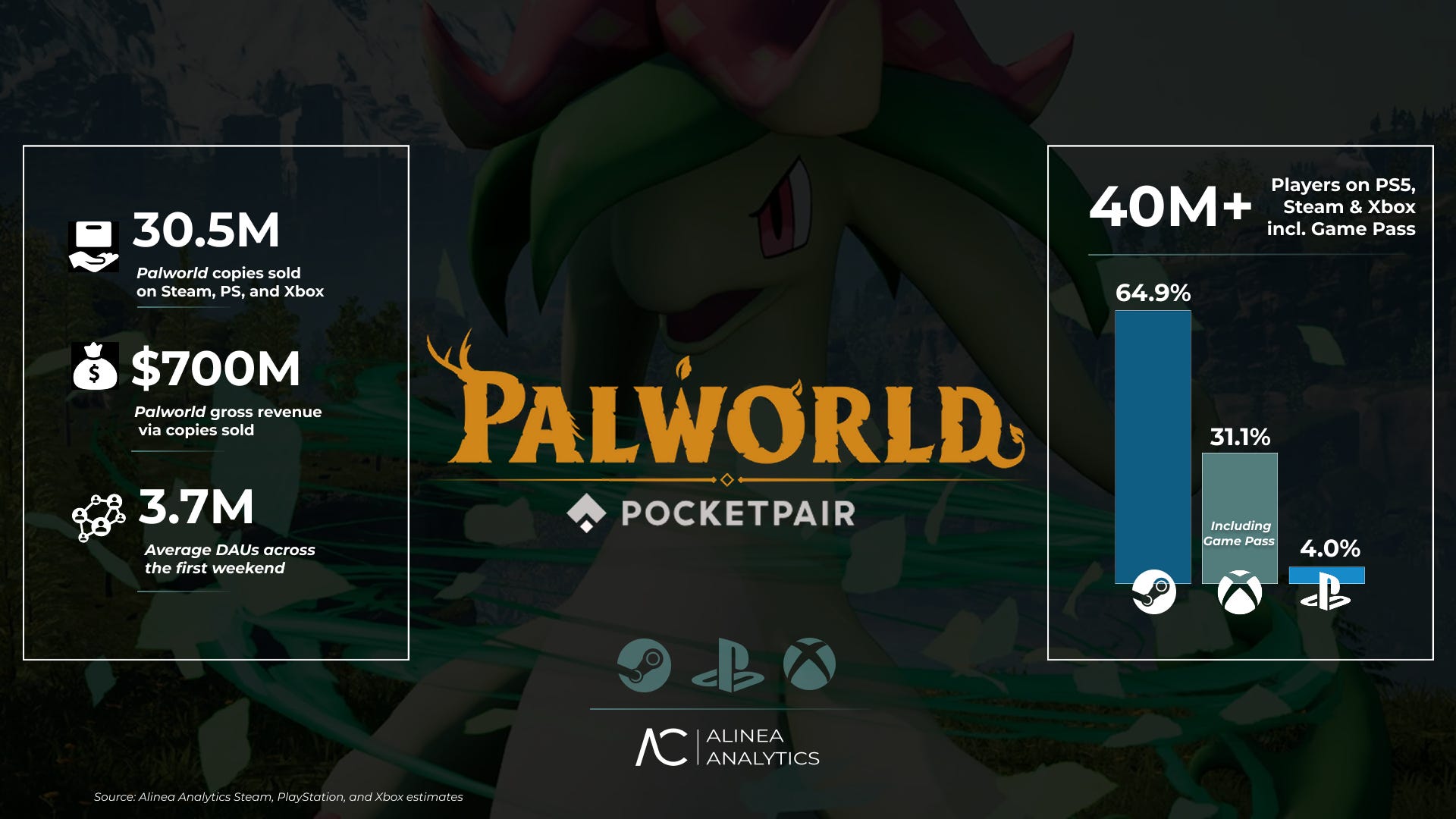
A calculated 30% launch discount for the 1.0 release (its lowest price point to date) gave Palworld a strong secondary sales surge across Steam (starting June 25th) and PlayStation (starting July 16th). This push also helped Palworld reach a monumental $700M in gross revenue from direct software sales alone.
Steam is Palworld‘s top platform by far
Breaking down post-1.0 performance across platforms:
On Steam, Palworld sold nearly 1.5M additional copies since its 1.0 launch ($25M in gross revenue).
On PlayStation, the game moved roughly 300K additional copies post-1.0 (about $7M in revenue).
On Xbox, copies since 1.0 reached a little under 70K copies (about $1M in revenue).
PlayStation and Xbox yield higher gross revenue per copy sold due to geographic distribution. Steam commands a much higher market share in territories like China, where regional pricing scales the base price down ($11 in China versus $21 in the US).
Want more insights in your inbox twice a week? Subscribe below!
Speaking of which, the US and China represent the two largest markets for Palworld on Steam (which accounts for 27.1M of its total unit sales), holding an equal share of roughly 27% each as per our estimates. Our review sentiment analysis surrounding 1.0 release showed some regional contrasts between Chinese and English user bases:
English-language reviewers framed buying the game as an explicit statement against – in their words – Nintendo’s anti-competitive business practices, actively celebrating the resolution of Nintendo’s legal challenges against Pocketpair.
On the negative side, English reviews highlighted AMD GPU performance issues and missing FSR support as 1.0 oversights.
Chinese-language reviewers focused heavily on core mechanics, praising the integration of creature collection with survival crafting in the new 1.0 biomes.
Chinese users celebrated the sheer volume of collectables and playable hours, seeing it as evidence of long-term developer commitment.
Chinese players voiced stronger complaints about 1.0’s balance adjustments (pal-breeding nerfs, workflow changes) affecting their established playstyles compared to the global average.
But this was not enough to dampen the positive reviews, as Simplified Chinese reviews are at 92% positive, just a bit lower than the global average.
The 1.0 launch also brought loads of players back into the fold, pushing daily active users (DAUs) to an average of 3.7M over last weekend.
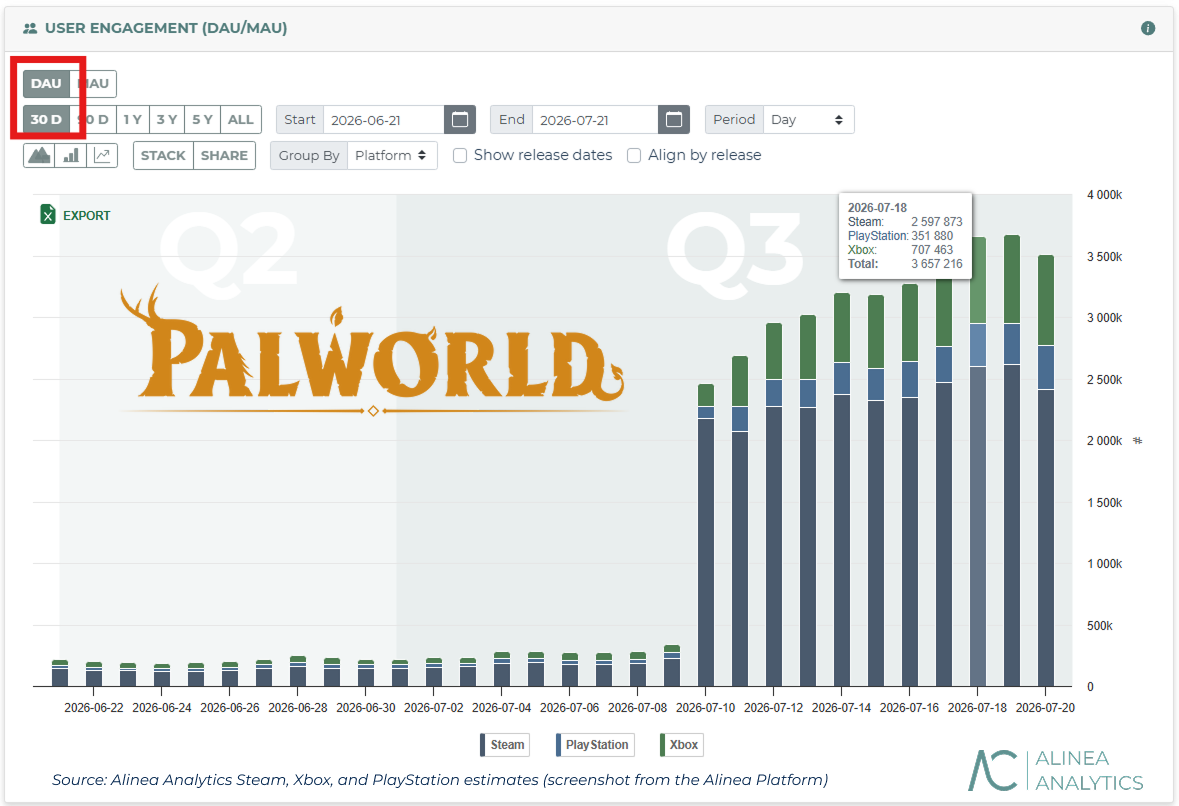
Monthly active users (MAUs) are currently pacing to cross 10M this month across PC and console, as well.
User reviewers love Palworld
When Palworld launched into early access in early 2024, hot takes wrote it off as a gimmick (”Pokémon with guns”). In reality, the game has carved out an enduring identity of its own.
While there’s no denying that certain character models borrow heavily from Pokémon classic creature-design tropes (much like Pokémon borrowed from 80s Dragon Quest designs, just sayin’), Pocketpair has largely silenced critics by continuously delivering something bloody awesome.
Subscribe for free to get the most accurate games estimates in your inbox twice a week 🫶
To many players, Palworld satisfies the open-world monster-catching fantasy that 90s kids grew up wanting, while its survival systems add systemic depth. Our 1.0 sentiment analysis indicates that despite minor optimisation bugs, player response remains overwhelmingly positive.
Steam reviewers frequently highlight how the loop of monster catching, base building, and resource automation creates a sticky progression structure that sustains engagement well past the 100-hour mark.
This is reflected in our playtime distribution estimates:
20% of Steam owners (roughly 5.2M players) have logged over 100 hours in Palworld, while 0.7% (nearly 200K users) have logged over 500 hours.
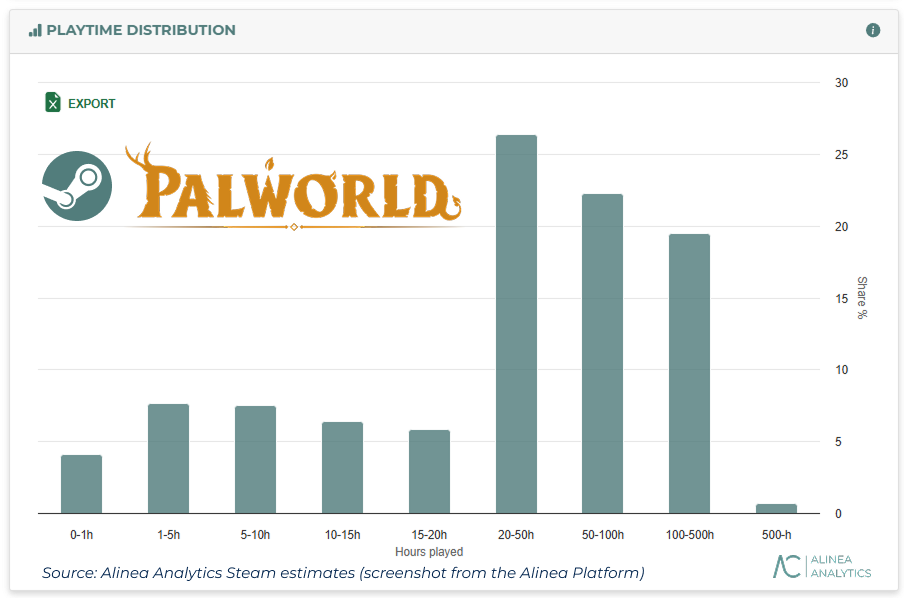
The playtime curve on PS5 closely mirrors Steam’s profile. Xbox, however, displays a fundamentally different engagement profile due to the “try-and-ditch” dynamics of Game Pass.
Nearly 50% of Xbox players dropped the game under the 5-hour mark (compared to 12% on Steam and 23% on PlayStation), and only 8% crossed 100 hours of playtime.
Why do players love Palworld so much? And what’s next for the IP?
Key highlights from Steam 1.0 user reviews include:
Substantial content expansion: The addition of 72 new Pals, an expanded tech tree, new biomes, dungeons, and raid bosses provided deep replayability for an already chunky game.
Open-world agency: Players praised the non-linear progression, customisable world settings, and the absence of forced linear gating.
Cross-platform co-op: Another positive was the multiplayer functionality across PC, PlayStation, and Xbox. I can vouch for this one, as I’ve been playing with some mates on other platforms.
Fair pricing strategy: Pocketpair maintained its sub-$30 price point from early access through 1.0 – and even discounted. This is a clear high value-to-cost ratio during an era of $70 to $80 AAA games.
Looking ahead, Pocketpair is expanding the IP with Palworld: Palfarm, a cozy farming and multiplayer simulation in the vein of Stardew Valley.
Our platform overlap metrics show that Stardew Valley ranks as Palworld’s #3 game in terms of shared unique players. Targeting this exact audience with a lower-priced spin-off is a smart ecosystem play.
So yes, Palworld is bloody massive – and the IP is on track to grow even further, especially on Steam. That brings us to the next question, a question I’ve had about five times this week…
BIG READ: Is console gaming doomed?
While “doomed” is hyperbole (sorry!), the console sector is undeniably facing an existential crisis. Unlike the software-glut crash of the 80s, today’s crisis is an economic and margin crisis rather than an audience one.
The traditional console playbook went a little something like this:
Building bespoke hardware
Subsidising it heavily at launch
Then making margins back on software royalties
Today, that model is structurally broken and also impossible. After all, component cost inflation shows no signs of abating, driven largely by a fickle, misguided, greed-driven generative AI bubble crowding out global DRAM and storage fabrication capacity.

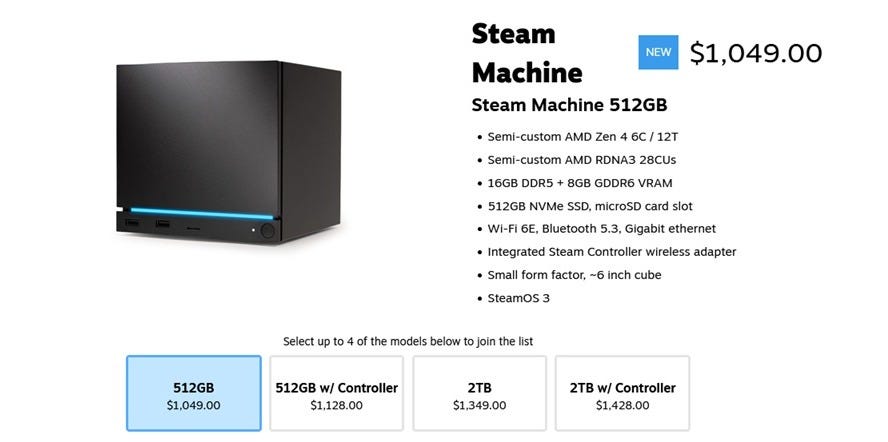
The market’s choked because hardware is either too old or too expensive for average consumers looking to upgrade. Recent hardware price hikes across console platform holders, alongside the sticker shock of Valve’s new Steam Machine, say it all.
The traditional box business model is smacking its head against the ceiling, so console makers are now all about increasing ARPU (average revenue per user, for the non-consulting-brain-addled folks in the audience). Oh, and LiFeTiMe vAlUe. That’s exactly what PlayStation is doing by phasing out physical discs, and what Asha Sharma is hinting at by going on about profitability margins.
Microsoft explicitly noted that memory and storage component costs scaled by more than 2.5x, forcing them to increase hardware retail prices and eliminate their 2TB SKU entirely.
Subscribe for free to get the most accurate games estimates in your inbox twice a week 🫶
If the baseline buy-in for next-generation hardware approaches a $1,000 digital-only box, mass-market growth is effectively dead on arrival. High-priced, drive-less hardware introduces a nuts barrier to entry.
Casual consumers will simply opt out of newer hardware, redirecting their time and wallet share toward mobile, PC, or existing hardware. Cross-generation games on the previous platforms will keep monetising those more casual players anyway – the folks buying the sports games, CoD, and all that.
There will be a lot more of them entering the PS5 generation soon, thanks to GTA 6. PlayStation in particular is probably happy about that. But the PS6 is another question – and one for another newsletter. I reckon that native PlayStation Portal can help bridge the gap, though. But that’s a question for another newsletter, too.
What impact will Steam Machines (and Steam OS boxes) and Nex Playground have?
Console won’t be affected much by these kinds of devices. Valve’s Steam Machine is primarily an ecosystem retention tool designed to lock existing Steam users deeper into the platform by transitioning their libraries to the couch; it operates under the exact same hardware cost constraints mentioned earlier.
The Steam Machine’s real strategic value is acting as a Trojan horse to seed SteamOS to third-party PC OEMs (I just watched The Odyssey, alright?).
Similarly, devices like the Nex Playground sit firmly in the casual toy and novelty vertical. While the Nex Playground may peel away a sliver of Nintendo’s family demographic, its threat to core, high-ARPU PlayStation or Xbox install bases is damn low (as things stand anyway).
An 8-to-10-year console lifecycle is the new operational reality. The standard 6-to-7-year console generation is a relic of an era when silicon fabrication costs dropped predictably every two years and graphical jumps were transformative. The jump from NES to SNES, or PS1 to PS2, was mind-boggling; modern visual jumps yield diminishing returns to the casual eye.
Sony establishing a physical disc cutoff for January 2028 serves as a public admission that PlayStation 6 hardware isn’t landing anytime soon, as well. With supply and component constraints projected to hold firm until at least 2029, rushing out next-gen machines right now would be financial suicide for platform holders.
Subscribe for free to get the most accurate games estimates in your inbox twice a week 🫶
They can’t afford to fabricate a massive leap in technological specs while hardware costs are peaking. Instead, the industry will rely on cross-generation software and extended mid-generation refreshes like the PS5 Pro until component manufacturing comes back down to earth (if indeed it ever does).
Console is transitioning away from being a ubiquitous, mass-market household appliance and becoming a premium lifestyle tier for dedicated, core enthusiasts.
Moving forward, the target audience for consoles will be of higher-income core gamers who value a frictionless, optimised, plug-and-play living room experience and are entirely unfazed by paying four figures for a machine.
Meanwhile, younger, casual mass audiences have shifted toward PC, mobile, and massive UGC ecosystems like Roblox and Fortnite. They have zero interest in paying a steep upfront hardware tax just to access digital spaces where their friends hang out for free, or for a very low price.
A positive to all this is that Gen Z developers hitting the workforce are building natively for their own demographic’s habits; even if that might be bad news for more traditional folks like you and me.
Yes, I see the demographic data of the readers, and we old.
Will the next console generation be the last?
The core challenge facing platform holders is navigating the intense friction between creative ambition, hardware premiums, and spreadsheet realities. Platform holders are trapped trying to serve two completely conflicting masters, maintaining their identity as premium first-party hardware providers while funding $250M+ exclusive titles that require massive multiplatform reach to break even.
For better or worse, the spreadsheet always wins in the end. That’s why Xbox is shifting its centre of gravity toward PC and mobile, and why first-party exclusivity is being dismantled on a “case-by-case” basis (walking away from huge external player bases makes zero economic sense for a struggling platform).
While the next console generation won’t be the last generation of hardware devices plugged into our televisions, it’ll likely be the last generation of proprietary, closed-box silicon fabricated at a loss by traditional platform holders.
So no, console isn’t doomed, but bloody hell is it in for a tough period. And platform holders (by financial necessity) are going to bleed us superfans dry to sustain the model. Console whales.

At the end of the day, modern games already look bloody fantastic, and current-gen platforms still have plenty of headroom. Developers will continue to ship brilliant, well-optimised games on existing hardware, keeping most players happy without forcing a mandatory $1,000 upgrade.
While baseline hardware prices are steep, accessible entry points still exist if you look for them. You can still grab a digital PS5 for around $400 during promotional sales windows.
To offset these hardware friction points, console manufacturers are actively exploring alternative pricing strategies (cellphone-like payment plans, for example) and in-game and on-platform advertising.
While I’m not personally a fan of ads and debt collectors creeping into the premium console experience, given the macroeconomic realities facing platform holders right now, that’s one of the directions the console tide is heading.
Want to get your hands on our data for yourself – for free?
We’re offering a free trial of our platform for games companies.
Send us a message here, or reply to this email, and we’ll set you up.
The last word
Reply to this email – or reach out here – if you have any feedback for the newsletter – or want to request a game for us to cover.
[Alinea Analytics boasts the most accurate PC and console estimates in the business. Game makers use our platform to understand their audience, keep an eye on the competition, monitor sales trends, and spot new opportunities. We equip game studios and financial institutions with accurate data and the confidence to make smarter, data-driven decisions. Want to talk about all things games market data? We’d love to chat!]
Comments
Nothing yet. Say the first thing.
Sign in to join the conversation.