
Before we get into the winners, some hard truths, because they’re always worth mentioning. Steam Next Fest is becoming less useful. There were over 4,300 demos this time by our count, so standing out is hard – and harder than it’s ever been.
And the metric developers are chasing hardest, wishlists, are sliding into vanity-metric territory. A wishlist is not an indicator of launch sales. It never really was, but it’s getting more obvious.
We looked at the top games from the June 2025 Next Fest and tracked how many of their wishlisters actually became buyers once the games launched (as per our estimates):
Dispatch, one of the better converters, turned about 25% of its June 2025 wishlisters into buyers within three months. It’s still sitting on the other 75%.
No, I’m Not a Human converted around 15% of its 189K wishlisters three months post-launch.
Jump Space managed about 10%.
Dead as Disco converted roughly 5% within 30 days (it came out last month)
Ball X Pit hit about 26% at 90 days, near the top of the range.
Pioner converted around 1%, sunk by heavy technical and optimisation problems at launch.
So even the strong performers leave the large majority of their wishlists unconverted, and most of those people won’t buy until a heavy discount lands much later, if at all.
Again, the lesson is the uncomfortable one, but one worth saying. Being a top Next Fest game undeniably helps visibility, but it’s the games that became the zeitgeist on the strength of their quality, and the marketing around them, that actually got bought.
None of this is to take the wind out of the event’s sails. It’s always a highlight of my quarter (or my third, I guess?) But its discoverability problem is really a microcosm of gaming’s, and Steam’s, discoverability problem at large.
Next Fest is becoming a tick-box exercise that only pays off for the absolute upper tier. For some devs, it might genuinely be smarter to drop a demo outside the event window and own your own spotlight rather than fight 4,300 others for the algorithm’s attention.
We analysts often get obsessed with these kinda of events, but the impact is modest even for the biggest games, and minimal for anything outside the top 25 (hell, top 10). Some games will benefit. Most won’t.
My advice would be to stop putting so much weight on wishlists and watch two things instead: demo playtime and demo-to-wishlist attachment rate.
Both measure whether people who tried the game actually liked it enough to come back, which is a far better predictor of launch conversion than a wishlist count that mostly captures idle curiosity.
We’ll be looking at a lot of those numbers, but – as everyone is so bloody obsessed with wishlists, let’s look at who actually won on wishlists, too.
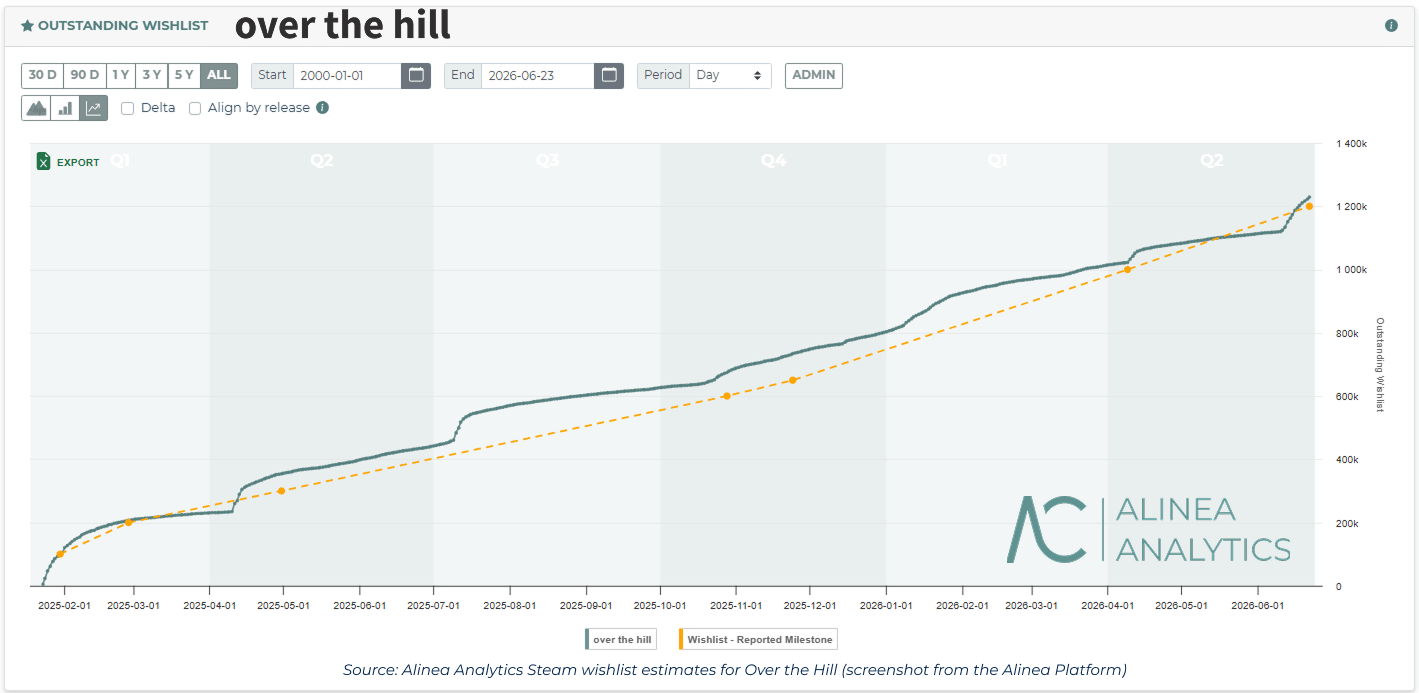
Before the wishlist ranking, a game that didn’t crack the top 10 by new wishlists but deserves a spotlight is Over the Hill, a stylised, laid-back off-road driving and exploration game. It’s sitting on around 1.2M wishlists.
The Over the Hill page has been live a while, so it didn’t post a huge new-wishlist spike during the event. But it was the #5 most-played demo, and it added roughly 100K wishlists off an already-large base.
The Over the Hill demo was played by over 400K Steam users, with a damn global top five (US, China, Russia, Brazil, UK). About half of the demo players played for more than an hour.
Something that stood out was that demo players were most likely to be playing Meccha Chameleon this month (18%), another recent co-op friendslop hit. Forza Horizon 6 (13%) was another top crossover game, so Over the Hill is pulling from both the co-op crowd and the racing crowd at once.
Given you can explore its open maps solo or with up to three friends, that overlap makes sense and bodes well. There are no racing lines or podiums here; the loop’s about picking your own route, reading the terrain, and working out how to get there. I really enjoyed what I played, and it brings something fresh to what I see as a fairly tired (tyred?) genre.
Ironically, Over the Hill‘s Next Fest success is more about the momentum it carried into the event, not the event itself. Players were primed for the demo and would have turned up with or without Next Fest.
As Strelka CEO Pietro De Grandi implied on LinkedIn, much of the success came from the surrounding campaign, press and influencer outreach via Game-Drive.nl, Evil Empire handling the Chinese community, and the rest of the marketing machine.
As always, the win here belongs to the team, not the festival.
Looking at the top games by wishlists, Bombanana added the most new wishlists of any game at Next Fest and – more importantly – was the single most-played demo of the event.
The premise is the pitch, really: three players are a bomb-disposal squad of monkeys – one blind, one mute, one deaf (see no evil, speak no evil … you get the picture) working out of a minivan-turned-bomb-workshop. You defuse against the clock with deliberately limited communication. It’s weird, instantly legible, and it’s clearly engineered to be talked about. And look at us, talking about it!
The friendslop crowd has noticed. Of demo players, almost half have played R.E.P.O., 46% PEAK, and 25% this month’s friendslop hit Meccha Chameleon. That audience cycles between the genre’s hottest releases, and if Bombanana sticks the landing, it’s next in the queue for the zeitgeist, almost certainly by design.
Every recent friendslop breakout, PEAK, RV There Yet, Meccha Chameleon, has won by bringing something genuinely strange and cool to the table that nobody else was doing.
What makes Bombanana worth more than a paragraph is what the founder said about how it got here, because it demolishes the idea that the event did the work.
The Steam page went live just 25 days before Next Fest, after about five months of development. The marketing was entirely the ‘’free’’ stuff any developer can do:
Press releases, trailers, and posting the concept across Instagram, TikTok, X, Reddit, YouTube and Discord.
Smaller creators picked it up organically, then bigger ones, and the inflection point was an Indie Game Joe tweet that pulled around 650K views and triggered the snowball.
Japanese coverage, led by denfaminicogamer, sent wishlists from Japan soaring too (5% of the overall number by our count).
The deciding factor, really, was a concept people understood instantly, wanted to talk about, and felt compelled to share. That’s a huge part of the game, and that’s the power of these kinds of games.
In an event with 4,300 demos and an algorithm rewarding engagement, the only durable edge is a hook so clear and so novel that players do your distribution for you.So, Next Fest didn’t make Bombanana at all. It was the shareable idea that did it, and the festival just amplified a fire that was already lit.
And yes, the genre is called friendslop, but we’re not in mobile shovelware territory here. That’s the real slop bucket. I was always told not to say that, but honesty’s the best policy…
Anyway, friendslop games are a long way from slop. Almost 80% of demo reviewers and 60% of demo players put in over an hour. And of Bombanana’s wishlisters, 24% played Meccha Chameleon this month, so while conversion is generally low, this particular audience is primed to actually buy budget friendslop, and it moves fast between the hottest releases.
It’s trending hardest in Brazil, the demo’s biggest market at over 30% and the lead market for base-game wishlists too at over 25%. Pricing will be key here. Go low, folks.
The rest of the top games by new wishlists span just about every genre, which is its own small rebuttal to the “everything on Steam looks the same” complaint:
Iron Nest: Heavy Turret Simulator came in at #2 with close to 200K new wishlists during the festival and 500K-plus to date. Of all its wishlisters, 36% had played the demo, rising to 48% among those who wishlisted this month, so the demo is doing its job. About 17% of this month’s wishlisters have also played War Thunder, despite the two being wildly different. Iron Nest is a slow, methodical first-person puzzler, but War Thunder is fast vehicular combat.
XenoFeels, a space customs simulator that wears its Papers, Please influence on its XenoSleeve, was #3 by new wishlists. You compare aliens’ documents and photos against the things and beings in front of you to sniff out terrorists. About 20% of wishlisters played the demo. It’s the work of KotaMota, an indie dev-and-comic-artist duo from Russia, and Russia is fittingly its top market at almost 25% of wishlists. Around 12% of wishlisters (and 10% of demo players) have played Papers, Please, which surprises no one. ENTRY GRANTED.
Mistfall Hunter, a third-person PvPvE extraction ARPG dripping in bleak dark fantasy, pulled around 150K new wishlists. I gave it a go, and it’s firmly one for the Elden Ring: Nightreign crowd, as combat is deliberate, positioning-led, and bloody punishing. The crossover data agrees: 16% of wishlisters have played Nightreign, 28% ARC Raiders, and 13% Remnant 2, so fans of the genres it’s blending are turning up.
Empulse, a fast 6v6 movement shooter (think Titanfall, wall-running and mechs) landed at #5 and now sits above 250K wishlists. It’s from 1047, the Splitgate 2 folks, and frankly seems like last-chance saloon after that game’s rough launch last year. Where Splitgate riffed on Portal and Halo, Empulse is more Titanfall crossed with Portal 2’s ability gun (bouncing, heals, and stuff). Around 30% of wishlisters played the demo, 31% have played Titanfall 2, 23% Splitgate 2, and 16% Highguard. Empulse plays damn good, but whether it can carve out space in a crowded, zero-sum live-service market is the open question. I’m a bit worried.
Echoes of Aincrad, a single-player action RPG from Bandai Namco and Game Studios Inc set in the Sword Art Online universe, gained ground during the event. The devs are pitching it as newcomer-friendly, and the wishlist data suggests that’s working, as the vast majority of wishlisters have never played a prior SAO game on Steam, so the goal of bringing fresh players to the IP seems met. The catch is the $70 price, which will throttle early wishlist-to-buyer conversion. Even so, it’s already sold more than 50K copies on Steam pre-launch ($3M), so the franchise faithful have quite literally bought in.
Dust Front RTS is, as the name promises, a real-time strategy game. It’s also got some grand-strategy and 4X influences, a non-linear campaign, army creation, base-building, resource-gathering, and procedurally generated maps. All that stuff. About 25% of wishlisters played the demo, which landed a stellar 94% positive review score. About 15% of demo players have already logged over 10 hours and 5% over 15, so the hardcore RTS faithful are putting it through its paces, a great sign for a demanding audience.
The Mound: Omen of Cthulhu is a four-player co-op reimagining of Lovecraft’s 1940 novella, with eldritch horror in abundance. Over 200K people played the demo, 20% of them went on to wishlist, and almost 7% of demo players put in more than five hours.
ReStory: Chill Electronics, the #9 game by new wishlists, is a deeply cosy tinyBuild-published game about restoring game consoles in a mid-2000s Tokyo repair shop. It’s added a nice chunk of wishlisters during Next Fest and sits around 500K overall, so most of its audience arrived earlier. Its demo attachment was notably lower than its peers, just 4% of all wishlisters played it, but 15% of this month’s wishlisters did, which suggests the Next Fest demo and its promotion are converting at least some interest.
Nightwater, an open-world sandbox-meets-incremental game from a solo dev, brought in about 75K new wishlists, but its real story is a clever bit of cross-promotion. A collab with Irox Games handed out two exclusive Bongo Cat items, one for wishlisting Nightwater, one for playing the demo for five-plus minutes, and it clearly worked: 73% of Nightwater’s wishlisters played Bongo Cat this month, so they’re active, engaged players rather than passive list-padders.
At this point, Next Fest is an amplifier, not an engine. It will make a loud game louder, but it won’t manufacture demand that the game itself didn’t earn through a sharp concept and the marketing graft around it.
For the handful of titles with a shareable hook, it’s rocket fuel. For the other 4,000-odd, it’s a crowded room where almost nobody hears you, and a pile of wishlists that, on our numbers, mostly never become sales.
My advice: Build that hook first. Steam Next Fest is not a silver bullet, and can only amplify what’s already there.
We’re offering a free trial of our platform for games companies.
Send us a message here, or reply to this email, and we’ll set you up.
Reply to this email – or reach out here – if you have any feedback for the newsletter – or want to request a game for us to cover.
[Alinea Analytics boasts the most accurate PC and console estimates in the business. Game makers use our platform to understand their audience, keep an eye on the competition, monitor sales trends, and spot new opportunities. We equip game studios and financial institutions with accurate data and the confidence to make smarter, data-driven decisions. Want to talk about all things games market data? We’d love to chat!]
Comments
Nothing yet. Say the first thing.
Sign in to join the conversation.