
Since the start of the year, PlayStation has sold around 10M copies of first- and second-party games across PS5 and PS4. While revenue and price matter, of course, just 16% of those copies came from games that launched in 2026. The rest is catalogue.
A few high-level findings from the 198 games we looked at:
14.8% of copies came from 2025 games, mostly Ghost of Yotei.
The pre-2020 catalogue still accounts for 23.3% of everything sold this year (copies-wise),
Marvel’s Spider-Man is the single biggest franchise at roughly 14% of all copies, just ahead of the Ghost games, which manage nearly the same share from only two titles (thanks to the October 2025 release of Yotei).
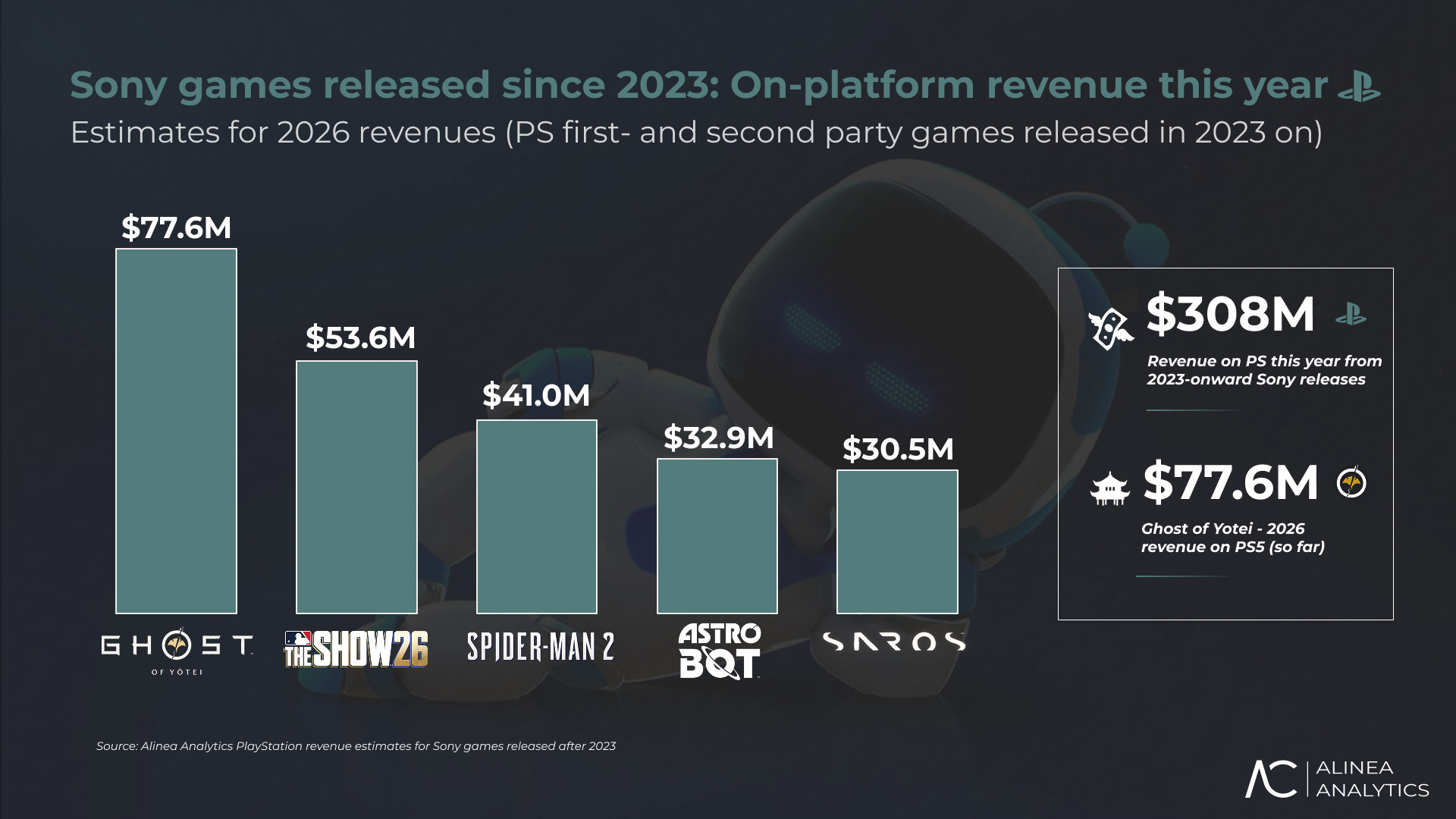
On revenue, PlayStation has generated almost $310M on its platform from first-party games released since 2023, with about a third of that coming from this year’s releases.
Let’s get into the individual games.
Ghost of Yotei is both the #1 Sony game on PlayStation by 2026 copies sold (1.1M) and 2026 revenue ($77.6M) in 2026. As we covered a week ago, Yotei’s well on its way to 5M lifetime since launching in October 2025.
I described Yotei a ‘‘resounding success’’ for PlayStation first-party last week, on the back of nearly $350M in revenue on a single platform. I got some pushback on that from a few bad-actor online grifters, on the grounds that you play as a woman voiced and performed by a queer Asian person.
So let’s look at the estimates. Yes, Yotei is selling fewer copies than Tsushima on a launch-aligned basis. But that headline misses the context. Our sold-through estimates (so no unsold retail copies) have Yotei tracking around 1M copies behind Tsushima at the equivalent point.
Tsushima launched at the absolute height of the pandemic, when players had far more time and looser wallets than today’s cohort. They were also buying consoles in droves, including Tsushima-included standard retail bundles.
The PS5 install base is roughly 93M right now, against the 116M PS4s in the wild at the same stage of Tsushima‘s run, so Yotei is selling into a meaningfully smaller pool.
Yotei launched at $70 and has had exactly one discount in seven months: a two-week drop to $50 from late May into early June.
Tsushima launched at $60 and was cut to $40 within months, a price it returned to regularly.
So yeah, while Yotei is selling fewer copies than Tsushima, it’s making more revenue, because it’s holding price where Tsushima discounted hard and early.
No agenda – just the data.
Gran Turismo isn’t the first name most people reach for when they list PlayStation’s marquee franchises, but it’s quietly always been one of Sony’s biggest sellers, and GT7 is no exception.
Since its 2022 PS5 launch, GT7 has sold almost 12M copies, and it’s added another 835K this year alone. Some of that is down to a few steep discounts ($60 to $20), but GT7 is simply one of those titles that never stops selling, even at full price.
The audience tells you why it’s so valuable to the first-party suite. In a given month, GT7 players’ top crossover titles are the likes of Fortnite, GTA 5, FC 26, and Roblox, a different cohort from the typical Sony prestige-AAA player.
The PS5 port of Xbox’s Forza Horizon 5 has sold 6M copies on PS5, but GT7 and Forza Horizon 5 share just 7.8% of their unique players. A sim racer and an arcadey open-world racer are different games for different audiences.
There’s clearly a large PlayStation audience hungry for an arcade-style racer that GT doesn’t serve – and always was. In another timeline, a Forza Horizon-style Gran Turismo spin-off could have sold gangbusters.
Forza Horizon 5 has come to PS5 and planted a massive checkered flag on that audience, as shown by the $338M in gross revenue it made on PS5. Although, nearly $100M of that was pocketed by PlayStation, so I don’t think they’re losing too much sleep.
In a similar ballpark (ayy) is MLB The Show 26, which has sold 756K copies (almost $54M) since launch. As we noted last week, this year’s edition is tracking well behind the 2025 one, though. Footie fever? Baseball boredom? Franchise fatigue? Or something else?
We’ll have to see. And yes, I’ll chill out on the alliteration. Maybe.
Marvel’s Spider-Man 2 has sold another 699K copies in 2026 for $41M, most of those before it joined PS Plus Extra on 18 February. Since its October 2023 launch, Spidey 2 has now generated $1.2 billion on PS5, and it reliably spikes every holiday season. So I’m expecting it off PS Plus by December.
Spidey’s top May crossovers were Fortnite (41% of that month’s Spider-Man 2 players) and Roblox (30%), so plenty of these are younger players, and plenty of those copies went under a Christmas tree (or equivalent for their holiday of choice).
Astro Bot has turned into a genuine evergreen title, shifting over 600K copies this year (almost $33M), including roughly 100K in each of the last two months.
Lifetime, it’s at 4.3M copies and around $250M. The crossover data here is telling: every single month this year, Astro Bot‘s top crossover game is Astro’s Playroom, a pre-installed game on every PS5. That suggests two things:
Astro Bot is being bought heavily by new PS5 owners.
The pack-in is doing a brilliant job converting them.
Every month, Astro Bot’s other top games by MAU crossover are – without fail – Fortnite, Roblox, and Minecraft.
So Astro Bot is quietly becoming one of PlayStation’s few genuinely family-friendly brands. I’d expect a film or TV announcement before long, and a big push – or perhaps a sequel – timed around the incoming PlayStation handheld. We’ll get to that later.
If Sony can keep growing Astro, it’s an ideal on-ramp into the rest of the PlayStation IP catalogue, which is exactly what LEGO Horizon Adventures was supposed to be and, by our estimates, sadly clearly wasn’t.
Maybe Astro Bot becomes what that game was meant to be. Sorry, Herman!
And tucked in among these is Saros, Housemarque’s bullet-hell title, which we also dug into last week. At 415K copies it’s outsold by a 2022 racing sim, which is the whole story of PlayStation’s 2026 in one data point: the new creative bets are landing below the catalogue.
Launch-window sales still matter, obviously, but the centre of gravity is shifting. AAA single-player games are accumulating faster than players can get through them, and graphical leaps deliver less of a wow with each generation (hell, with each new big AAA game).
What I’m saying here is that a brilliant five-year-old game now looks and plays close enough to a new one that the new release isn’t competing only with its peers, it’s competing with the entire, usually cheaper history of the medium.
Every new game now launches into a market where its toughest rival might be a banger from 2021 at a third of the price.
That’s why the catalogue numbers in this piece matter more than the launch charts. For the AAA publishers and platforms, catalogue becomes more important every month.
The incoming PlayStation handheld sharpens all of this. The Steam Deck proved that a portable actively drives new purchases of older games people finally have a reason to play on the go.
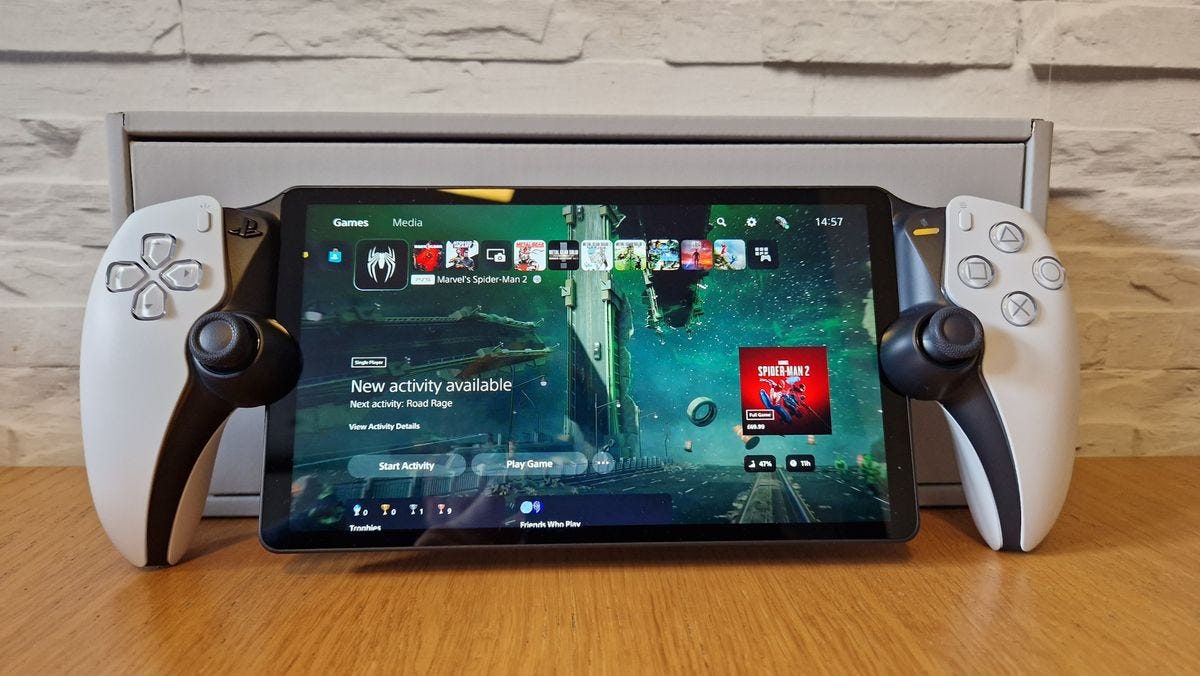
A PlayStation handheld pointed at that same back catalogue could turn Sony’s deep library from a preservation exercise into a genuine revenue engine, which is pretty much the Nintendo playbook.
Nintendo is the gold standard at keeping old games selling at full price for years, and PlayStation’s unusually thin discounting for recent first- and second-party titles suggests Sony has been looking at this stuff closely.
Evergreen is the future, and every new game competes with the best of the past. The great new releases will keep coming thick and fast.
But the older ones, most of them every bit as good, are only going to get more important to the bottom line. The publishers who win the next decade will be the ones who treat their back catalogue as an asset to be monetised, not a vault to be archived.
Capcom knew it, and others are catching wind.
We’re offering a free trial of our platform for games companies.
Send us a message here, or reply to this email, and we’ll set you up.
Reply to this email – or reach out here – if you have any feedback for the newsletter – or want to request a game for us to cover.
[Alinea Analytics boasts the most accurate PC and console estimates in the business. Game makers use our platform to understand their audience, keep an eye on the competition, monitor sales trends, and spot new opportunities. We equip game studios and financial institutions with accurate data and the confidence to make smarter, data-driven decisions. Want to talk about all things games market data? We’d love to chat!]
Comments
Nothing yet. Say the first thing.
Sign in to join the conversation.