
Disclaimer: nothing in this article and nothing shared by Aligned Motherhood Co. is ever to be taken or misconstrued as medical advice. The Vitamin K Injection and Vitamin K Deficiency Bleeding (VKDB) are serious medical considerations and conditions, and must be discussed with a medical professional. Always consult your doctor.
Why has the Vitamin K injection become a routine practice?
There are several reasons (and history) as to why this is the case, but two of the main reasons are due to Vitamin K levels being very low in infants at birth, and the risk of Vitamin K Deficiency Bleeding (VKDB).
Why are babies born with such low Vitamin K levels? Is this a mistake? A problem to be corrected? Or is this intelligent design?
This article will explore the reasons and history as to why Vitamin K injection is routine, oral vitamin K pros and cons, delayed cord clamping, and much more.
The goal of this article is to help educate parents on the risks associated with the Vitamin K injection, as well as explore alternatives, so an empowered and informed decision can be made when it comes time to decide on Vitamin K at birth.
Vitamin K Deficiency Bleeding (VKDB):
VKDB is the reason why the Vitamin K shot is routine in birth (specifically hospital birth) settings.
VKDB is defined as: “a rare but serious condition in newborns and infants caused by insufficient vitamin K, preventing proper blood clotting. It can lead to severe, spontaneous internal bleeding, particularly in the brain or intestines, and can be fatal.”
According to the CDC: “unfortunately, in the majority of cases of VKDB, there are NO WARNING SIGNS before a life-threatening event starts”, but some signs and symptoms of VKDB can include:
Bruises, especially around the baby’s head and face.
Bleeding from the nose, umbilical cord, or circumcision site
Skin color that is paler than before. For babies with a darker complexion, the gums may appear pale.
The white parts of your baby’s eyes look yellow after the first 3 weeks of life.
Stool that has blood in it, is black or dark and sticky (also called “tarry”), or vomiting blood.
Irritability, seizures, excessive sleepiness, or a lot of vomiting (possible signs of bleeding in the brain).
Vitamin K Deficiency Bleeding can occur from birth up to about 6 months of age, with the highest risk for severe late VKDB occurring between 2 weeks and 3 months of age. Cases of early/classic VKDB range from 250 to 1,700 per 100,000 births in babies who did not receive the Vitamin K shot (0.25% and 1.7%, respectively).
VKDB most commonly occurs in infants who have had a traumatic birth (c-section, forceps delivery, vacuum delivery, or babies who show bruising after delivery), but it still can occur in babies who had a trauma-free birth and no blatant indications of needing Vitamin K, though it appears that the rates are very low.
Therefore, the Vitamin K injection is a routine practice in medicalized and hospital birth settings, unless declined by parents. But is the Vitamin K shot harmless? After all, it’s just a vitamin injection right?
Unfortunately, it’s not just a simple vitamin injection with no possible repercussions, so we believe parents should be fully informed before deciding to accept or decline the vitamin K injection.
First and foremost: the Vitamin K injection is not just a vitamin. The injection has many other ingredients, comes with a black box warning, and includes a Section 13.1.
Let’s break these three things down:
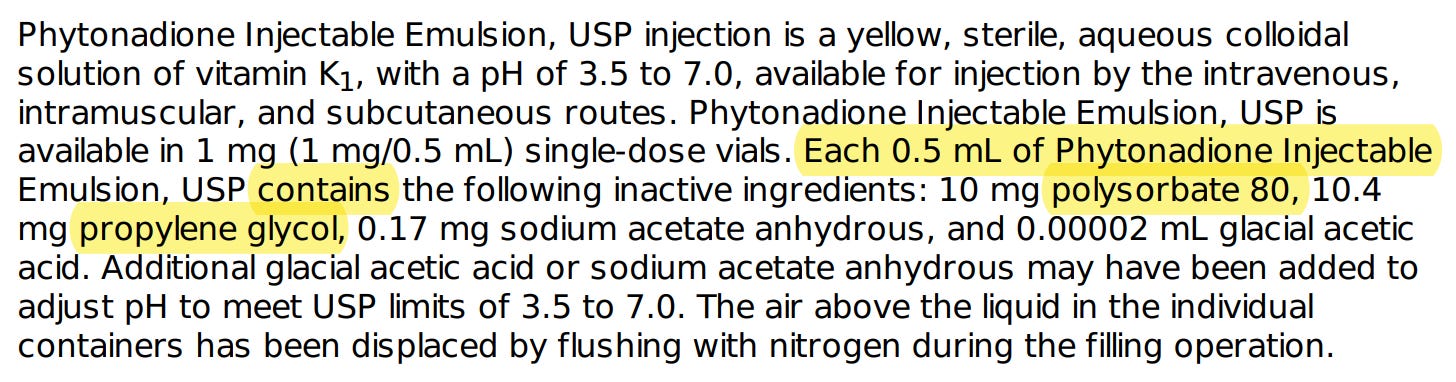
It’s not just “just a vitamin” → Each version of the Vitamin K injection (the version with preservatives & the version without), both contain many other ingredients:
“Preservative-Free” Version: “Each 0.5 mL of Phytonadione Injectable Emulsion, USP contains the following inactive ingredients: 10 mg polysorbate 80, 10.4 mg propylene glycol, 0.17 mg sodium acetate anhydrous, and 0.00002 mL glacial acetic acid. Additional glacial acetic acid or sodium acetate anhydrous may have been added to adjust pH to meet USP limits of 3.5 to 7.0.”
Preservative Version: “Each milliliter contains phytonadione 2 or 10 mg, polyoxyethylated fatty acid derivative 70 mg, dextrose, hydrous 37.5 mg in water for injection; benzyl alcohol 9 mg added as preservative. May contain hydrochloric acid for pH adjustment.”

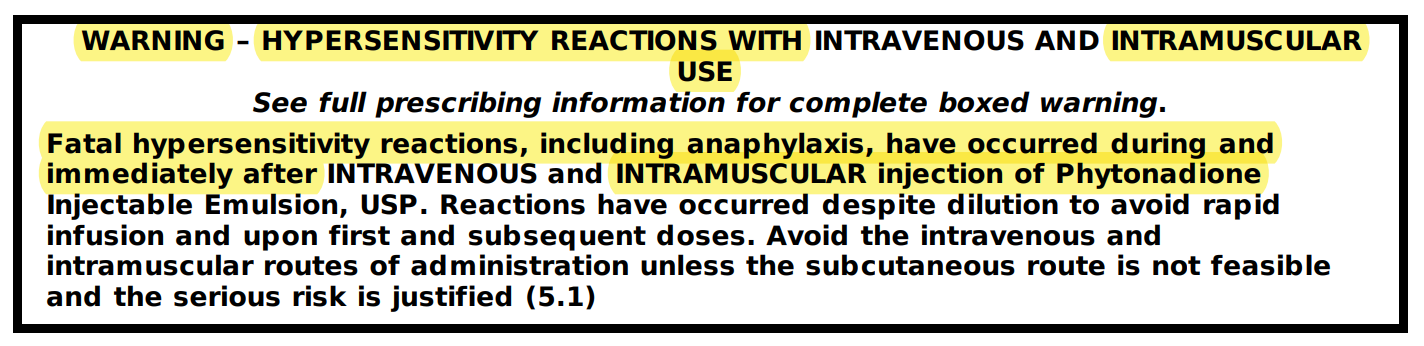
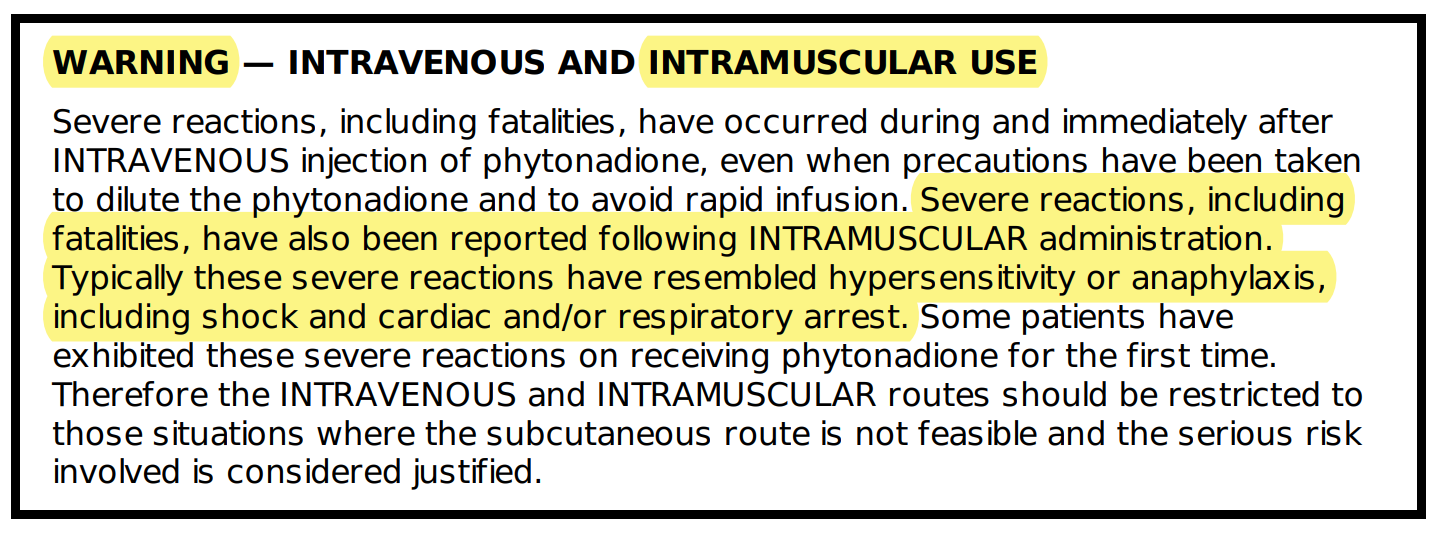
The Vitamin K shot has a Black Box Warning → Both versions of the Vitamin K shot have black box warnings. A black box warning is “the most stringent safety warning issued by the FDA for prescription drugs, highlighting severe, life-threatening, or fatal side effects.”
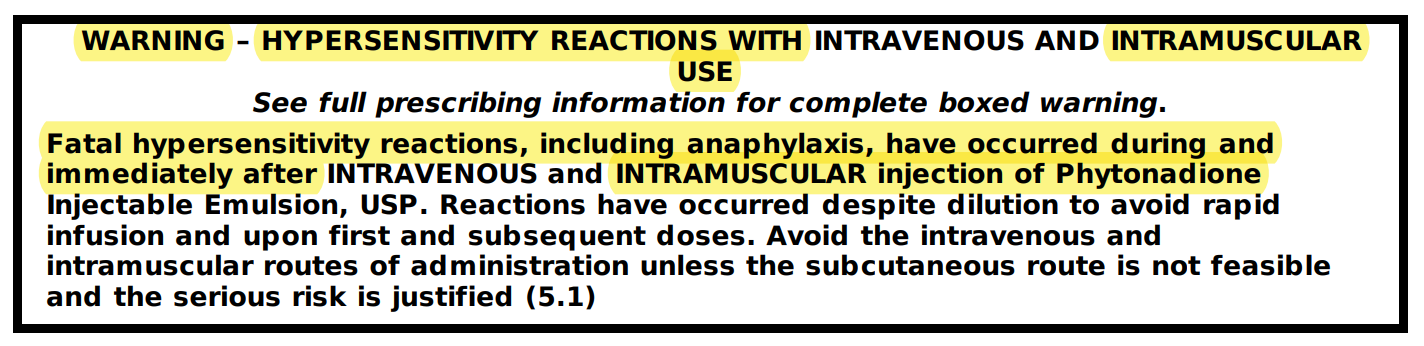
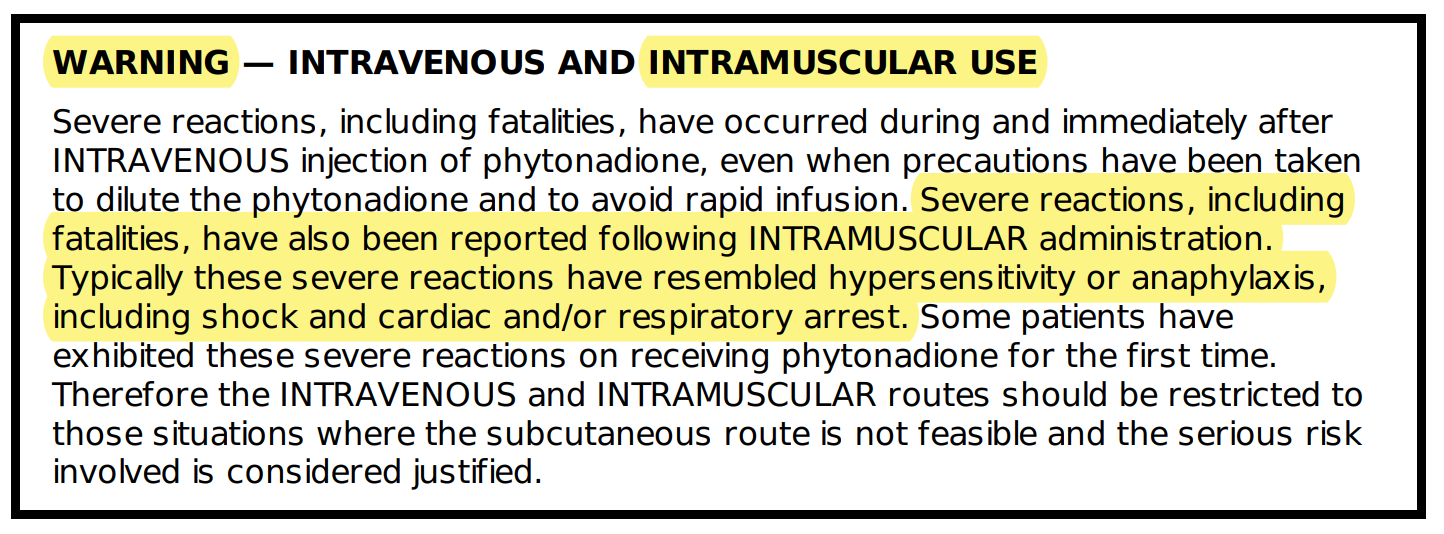
To take things one step further, we need to turn our attention to the last sentence in both black box warnings. They state explicitly that the intravenous and intramuscular route of delivery should be avoided:
“Therefore the INTRAVENOUS and INTRAMUSCULAR routes should be restricted to those situations where the subcutaneous route is not feasible and the serious risk involved is considered justified.”
But then, within the very same insert, the American Academy of Pediatrics blatantly contradicts this recommendation, and advises intramuscular injection. This alone should cause us to question the entire Vitamin K injection practice (or at the very least, the delivery method).
The inserts have a Section 13.1 → Both versions of the Vitamin K shot have the infamous Section 13.1, stating that the injection has not been evaluated for carcinogenesis, mutagenesis, or impairment of fertility.



Second, babies are born with very low Vitamin K levels on purpose.
A newborn’s umbilical cord is is filled with stem cells at birth. These stem cells are designed to rush to aid any damaged areas from labor. If newborns had high Vitamin K levels at birth, and therefore blood that coagulates much easier, this would slow down (or prevent) the stem cells from arriving to the repair sites they need to get to.
This brings up some major problems:
Premature Cord Clamping
When the cord is clamped prematurely, up to one third of the baby’s blood doesn’t make it into their body, and therefore, neither do their stem cells. Stem cells are necessary for: immune system development, tissue repair, and blood formation.
The solution to this problem is delayed cord clamping. And not the 1-3 minutes of “delayed” cord clamping that is standard in hospital settings (although this still is better than immediate cord clamping) … but delaying cord clamping at least until the cord stops pulsating and becomes white and limp. This can take up to 25 minutes, or even longer.
The Hepatitis B Injection
The Hepatitis B injection is given within the first 24 hours of life. A listed adverse reaction in Section 6.2 of the insert of the of Hepatitis B injection is Thrombocytopenia. Thrombocytopenia is a “medical condition characterized by an abnormally low number of platelets (thrombocytes) in the blood.” Platelets are essential for blood clotting, and a low number of platelets can directly lead to bleeding disorders. Could it be that routine Hep B injection itself is a major cause for the need of the Vitamin K injection?
So, what are your options?
Now that we’ve covered the risks of the Vitamin K injection, we will break down the options parents have when it comes to Vitamin K at birth. Those three options are:
Accept the Vitamin K injection
Decline the Vitamin K injection & opt for oral drops
Decline the Vitamin K injection & the oral drops
Let’s dive in.
Option 1: Accept The Vitamin K Injection
… and assume the associated risks.
Here are the risks according to the package inserts (links to all inserts are in the sources section at the bottom of this article):
First, the blackbox warning: “Fatal hypersensitivity reactions, including anaphylaxis, have occurred during and immediately after INTRAVENOUS and INTRAMUSCULAR injection of AquaMEPHYTON. Reactions have occurred despite dilution to avoid rapid infusion and upon first and subsequent doses. Avoid the intravenous and intramuscular routes of administration unless the subcutaneous route is not feasible and the serious risk is justified.”
“Most common adverse reactions are cyanosis, diaphoresis, dizziness, dysgeusia, dyspnea, flushing, hypotension and tachycardia”
“The possibility of allergic sensitivity including an anaphylactoid reaction, should be kept in mind.”
“Additional adverse reactions included: gradual neurological deterioration, seizures, intracranial hemorrhage, hematologic abnormalities, skin breakdown, hepatic and renal failure, hypotension, bradycardia, and cardiovascular collapse. Preterm, low birth weight infants may be more likely to develop these reactions because they may be less able to metabolize benzyl alcohol.”
Hemolysis (the destruction or breakdown of red blood cells, releasing their hemoglobin into surrounding fluids), jaundice/hyperbilirubinemia, and more.

The impact this amount of Vitamin K1 (the type of vitamin K in the vitamin K injection) has on the liver is very worth discussing. According to Dr. Ben Tapper, the Vitamin K levels in newborns after injection reach almost 9,000 times normal adult levels for intramuscular Vitamin K. When levels 9,000x the normal levels of adults are injected into an hours-old baby, the liver takes a hit. This is (of course) why some of the listed side-effects on the insert of this injection (jaundice and hyperbilirubinemia) are a result of the liver being overburdened.
Option 2: Accept Vitamin K Oral Drops
Oral Vitamin K has been shown to be as effective as the intramuscular injection, but that doesn’t mean it comes without potential drawbacks of its own, so it’s worth exploring the pros and cons.
First, when comparing the effectiveness of the Vitamin K oral drops to the Vitamin K injection, A PubMed study (PMID: 11775338) states: “Oral administration of vitamin K is as effective as the intramuscular route in the prevention of the hemorrhagic disease of the newborn.”
Yet another source states: “The Danish practice of parents providing weekly oral doses of vitamin K for the first 3 months for primarily breastfed infants revealed high parental participation and no reports of hemorrhagic disease in an 8-year period.” (Hansen et al., 2003).
But the problem here is… babies are born with immature digestive systems.
In order for Vitamin K to be absorbed properly (by anyone, infants included), there needs to be:
Adequate bile production
Proper pancreatic enzyme activity
Efficient fat digestion
A functioning intestinal microbiome
Newborns are physiologically immature in all of these areas, and therefore, their ability to absorb Vitamin K is limited until they start solids, at about six months to one year of age. This is because when babies start solids and are introduced to new foods, they become able to produce vitamin K with from their gut flora (where internal vitamin K is produced).
“The infant gut microbiome undergoes a crucial transformation when solid foods enter the diet during weaning. This introduction normally happens at about six months post-birth and leads to major shifts in the gut microbiome.” (Source: PMID 41208251)
So then… if a baby isn’t able to absorb a high quantity of Vitamin K due to an immature digestive system… doesn’t this make the perfect argument in favor of the injection? It may seem that way, but don’t forget to refer back to the risks of the injection, discussed above.
With this information, this means the biggest risks of supplementing oral Vitamin K are three things: First, that the Vitamin K isn’t fully absorbed, second, that supplementing vitamin K in a baby (who has low levels of vitamin K by design) can overburden the liver, and third, that we’re still administering Vitamin K, when it may not in fact be necessary as we will discuss next (again, situationally dependent, and taking birth outcomes into consideration, such as traumatic deliveries, bruising, etc.).
If you are interested in doing oral Vitamin K drops, I recommend Dr. Green Life Natal K. From what I’ve seen online, when you order the supplement, you will receive a protocol/schedule on how and how often to administer the supplement to your infant (Note: it is not a one-time administration. It is administered multiple times over a specified time span).
Option 3: Decline The Injection & Oral Drops
Noting that there are potential risks, parents can choose to decline intramuscular or oral Vitamin K, and opt for delayed cord clamping.
Again, true delayed cord clamping is not 1-3 minutes, although that is routine in most hospital birth settings. Even 3-5 minutes of delayed cord clamping can help tremendously, but true delayed cord clamping is not clamping the cord until it is white and finished pulsating, which can take up to 25 minutes. Even then, there is no rush to cut the cord at that point, and the cord can actually be left on and attached to the placenta until it falls off on its own (this is called a lotus birth).
Colostrum, Breast Milk & Vitamin K
One of the main arguments for the vitamin K injection or drops is that breast milk and colostrum are both low in Vitamin K, so therefore, the baby is not getting any from breastmilk. ) Again, it seems as though this is by design. If the baby is born low in Vitamin K AND colostrum/breastmilk isn’t high in vitamin K, perhaps there is a reason for this?)
However, what is important to take into consideration here is that although the levels of Vitamin K are low in colostrum and breast milk, the baby’s absorption of the available Vitamin K is extremely efficient and high.
Something else to consider is according to Dr. Green Mom, “giving breastfeeding mothers 5 mg of oral vitamin K1 can increase the vitamin K1 content of breastmilk enough to increase the vitamin K levels of her baby. There haven’t been any studies looking at the efficacy of supplementing breastfeeding mothers with vitamin K1 as a strategy for preventing VKDB, so I can’t comment on or recommend this strategy.” (Source: Dr. Green Mom quoting PMID: 29999981)
This also begs the question… if mother supplements Vitamin K2 during pregnancy (as recommended in our book Eat Your Prenatal), could her baby be born with increased clotting factors naturally? Unfortunately, we don’t know, because according to my research at the time of writing this article, no studies have been done on this topic directly.
Improved blood clotting factors is one of the reasons why we do recommend supplementing with Vitamin K2 in pregnancy (among the many other benefits of supplementing with Vitamin K2).
There are two types of Vitamin K. The Vitamin K injection is an injection of a synthetic form of Vitamin K1 called Phytonadione. Phylloquinone is the natural form of K1 found in food. Vitamin K1 plays a direct role in coagulation, as it is primarily transported to the liver to activate clotting factors. Vitamin K2 (menaquinone), on the other hand, plays an indirect role in regulating coagulation by activating proteins in peripheral tissues.
Therefore, if a mother takes Vitamin K2 throughout pregnancy, we wonder the impact this could have on the clotting potential for the baby. Hopefully studies will be conducted on this at some point.
So, what do you think? Does God make mistakes when it comes to our design? Or have we messed with God’s design in a way that has created the “need” for an intervention that is potentially very harmful?
We’ve tampered with birth in so many (mostly unnecessary ways). Could it be that the cascade of interventions in medicalized birth creates a greater need for Vitamin K, as there are an now increased amount of traumatic births from said interventions? Let’s look:
Birth moved almost exclusively into hospitals → Routine, non-medical inductions → baby doesn’t tolerate induction → foreceps, vacuum, or c-section delivery → traumatic birth → need for Vitamin K… just a thought.
Remember that Aligned Motherhood Collective is a community space. We’d love to hear from you in the comments. Please feel free to ask any questions and share your experience with us below.
In alignment,
Annika & Emmalee
Remember our Disclaimer: nothing in this article and nothing shared by Aligned Motherhood Co. is ever to be taken or misconstrued as medical advice. The Vitamin K Injection and Vitamin K Deficiency Bleeding (VKDB) are serious medical considerations and conditions, and must be discussed with a medical professional. Always consult your doctor.
Sources:
Vaccine.Guide - a website that allows easy access to vaccine inserts
Vitamin K Injection Insert - With Preservatives
Vitamin K Injection - Without Preservatives
Evidence Based Birth - Oral Vitamin K Regimen for Newborns
Hepatitis B Injection Insert - See section 6.2 to see Thrombocytopenia listed as an adverse reaction
Vitamin K Choices for Newborn Explained - By Sarah Wickham, Midwife
Just the Inserts - great deep dive into vitamin K injection
Dr. Green Life - vitamin K article & vitamin K drops
Vitamin K forum quoting Lauwers, Judith, and Anna Swisher. Counseling the Nursing Mother: A Lactation Consultant’s Guide. 5th ed. Sudbury, MA: Jones & Bartlett Learning, 2011. 194. Print.
No posts
Comments
Nothing yet. Say the first thing.
Sign in to join the conversation.