
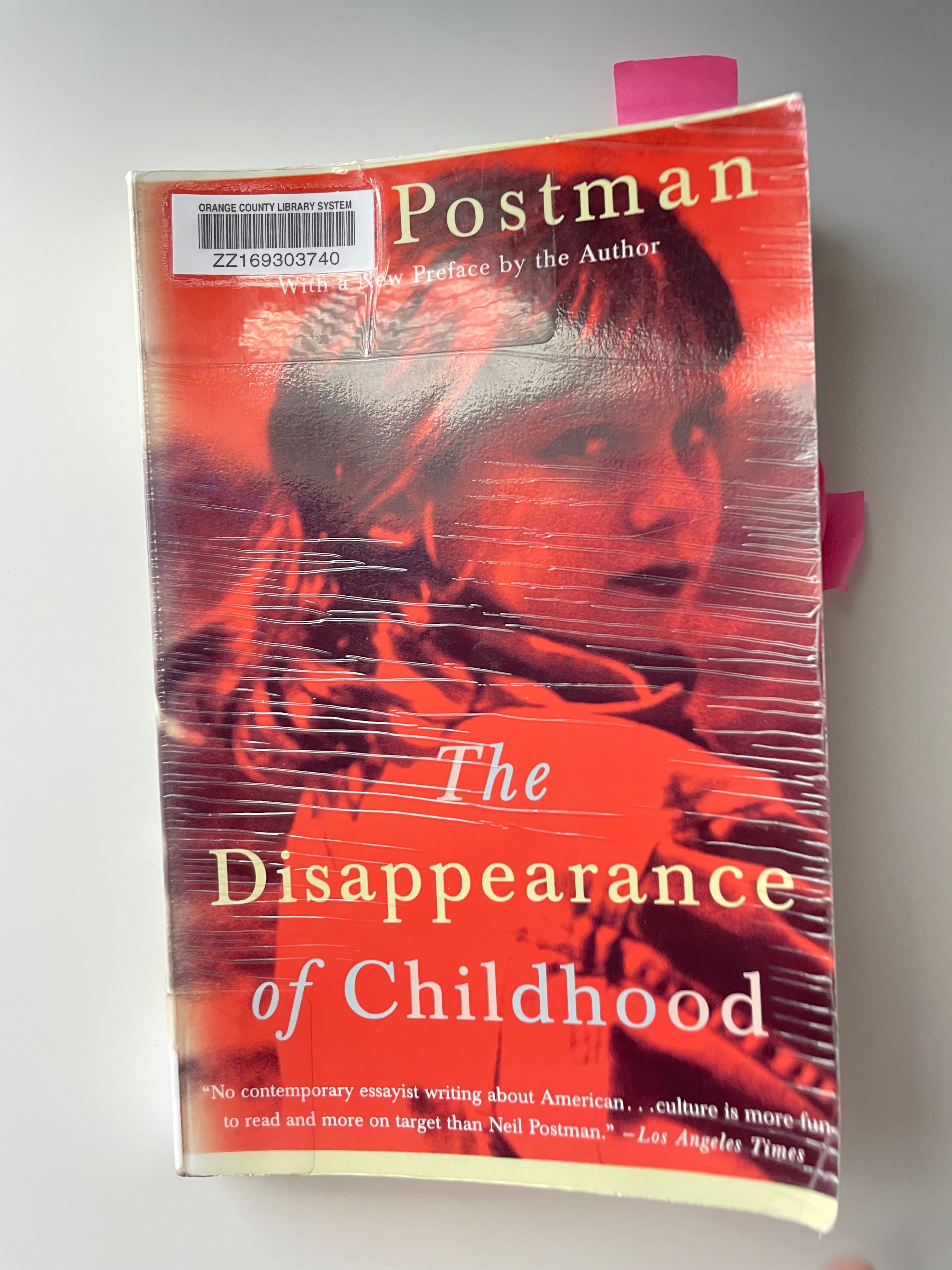
I didn’t read much this month. I finished The Disappearance of Childhood by Neil Postman and there is simply so much to say about his argument re: childhood coming to an end w/r/t the way things are now with big tech and YouTube celebrities and shorts and reels coming to erode all of our attention spans. Anyway, here are some of my favorite excerpts and some notes:
What is the effect of a medium [television] that must abjure conceptual complexity and highlight personality? What is the effect of a medium that always asks for an immediate, emotional response?
Postman couldn’t have anticipated big tech infiltrating our lives as much as it is now — with short form content taking the place that television once had — or that its effects could be even worse due to its unparalleled accessibility. “The six-year-old and the sixty-year-old are equally qualified to experience what television has to offer,” he writes. “Television, in this sense, is the consummate egalitarian medium of communication, surpassing oral language itself.” Replace “television” with “social media” and the argument holds true. What was once understood as a newfangled preoccupation belonging solely to the youth now belongs to everyone, with little differentiation in magnitude among age groups. This compels us to ask not who is addicted but who isn’t addicted. What would Postman and Holt say about three year olds carrying around their iPads at the grocery store? The question behooves me.
Print means a slowed-down mind. Electronics means the speeded-up mind. One of the consequences of this fact — apparently unnoticed by Mr. Blessington — is that television “Las Vegasizes” our culture. The gap he speaks of is the difference between the slowed-down processes of thought encourages by exposition and the fast-tempo responses required by a visually entertaining show.
This brings up a whole other topic that is worth investigating: in an era of media hype and an increasing amount of value placed on online presence, what does that mean for writers? I question writers specifically because our work is continually undermined and perceptually nonexistent in a world abundant with images. Our work is silent, but the world is resonant with noise, noise, and more noise — as Postman described the advent of the telegraph, “News from nowhere means news from everywhere, about everything, in no particular order.” Reading this, I think about the uncontrollable impetus of not only news and information, but content, and what it means to produce what might be argued as its opposite: that which is long form, quiet, slow, developmental, and created for an end-in-mind that is beyond the self. What does it mean to live in an age inundated with the endless noise of what’s happening next?
Moving on though. My favorite read this month has to be Rob Horning’s post on generative AI, “Commodified Incuriosity”:
As Chiang insists, the point of art (or education, or thinking, or living) is to be confronted with intentionality — with irrefutable proof of subjectivity, the fact that something “derives from … unique life experience and arrives at a particular moment in the life of whoever is seeing [a] work” — and to draw from it the energy to enhance your own, to sustain the will to will. You decide to be present for something, and try to make the effort to come to terms with the presence of another subjectivity that is more than just a projection of your own. That presence of mind is itself thinking, the basic unit of intentionality. Tech companies seem adamant in insisting they can make money by extinguishing it.
Generative AI, Recht argues, “always seems to provide the minimal effort path to a passing but shitty solution,” which actually seems like a fairly charitable assessment. But it is obviously something that worker-users would employ when they don’t care about what they are asking for or how it is presented, for optimized producers who see research as an obstacle to understanding rather than the essence of it, for people conditioned to be absent at any presumed moment of communion. Generative AI is the quintessence of incuriosity, perfect for those who hate the idea of having to be interested in anything.
I love this because it perfectly articulates something that is poorly understood about the usage of AI, which is the error of using it as a means to an end and defaulting to replacing the intentionality that exists behind anything worth reading. As Ted Chiang writes, "“Any writing that deserves your attention as a reader is the result of effort expended by the person who wrote it. Effort during the writing process doesn’t guarantee the end product is worth reading, but worthwhile work cannot be made without it.” I agree with Chiang and Horning in that it is very much a “path of least resistance” solution. I can’t tell you how many times I’ve seen social media pages that are full of posts utilizing the same emojis, em dashes, and turns of phrase (Why does ChatGPT love em dashes so much? It loves them more than I do.) I almost always end up scanning through it once I realize it’s ChatGPT (very quickly, in a split second), and it leaves me feeling hollow, empty — as if what we say hardly matters at all and is simply another task to be checked. Open ChatGPT, send prompt, copy and paste. “Generative AI is the quintessence of incuriosity, perfect for those who hate the idea of having to be interested in anything.” Perhaps that’s exactly the point: where there’s a lack of interest, displeasure even — ChatGPT provides some happy solutions, but only on the surface, as mere affectation.
That is all. July was a hard month so I’m ready for the clean slate that is August. I put in a request for Middlemarch at my library as well as a biography of Søren Kierkegaard so there’s already much to look forward to reading-wise. Happy August!
No posts
Comments
Nothing yet. Say the first thing.
Sign in to join the conversation.