

Quick note: I'm out of the country with my family for the next few weeks. To keep the inbox alive while I'm away, I'm resurfacing three of the most-read pieces I've ever published, one a week. This first one is the single most popular thing I've written. If you joined recently, it will be new to you, and it holds up.
Your manager has already put you in a box.
Whether you realize it or not, they've mentally categorized you into one of three buckets: the stars they can't afford to lose, the solid performers who get the job done, or the baseline employees who just meet expectations. Once you're labeled, it's surprisingly difficult to change categories—but the quality of your work life depends on which bucket you're in.
Well, that’s not entirely true. There’s a fourth bucket of low-performers that your manager does not favor. But those people get let go and so it transitions back to the three buckets.
The four three manager buckets:
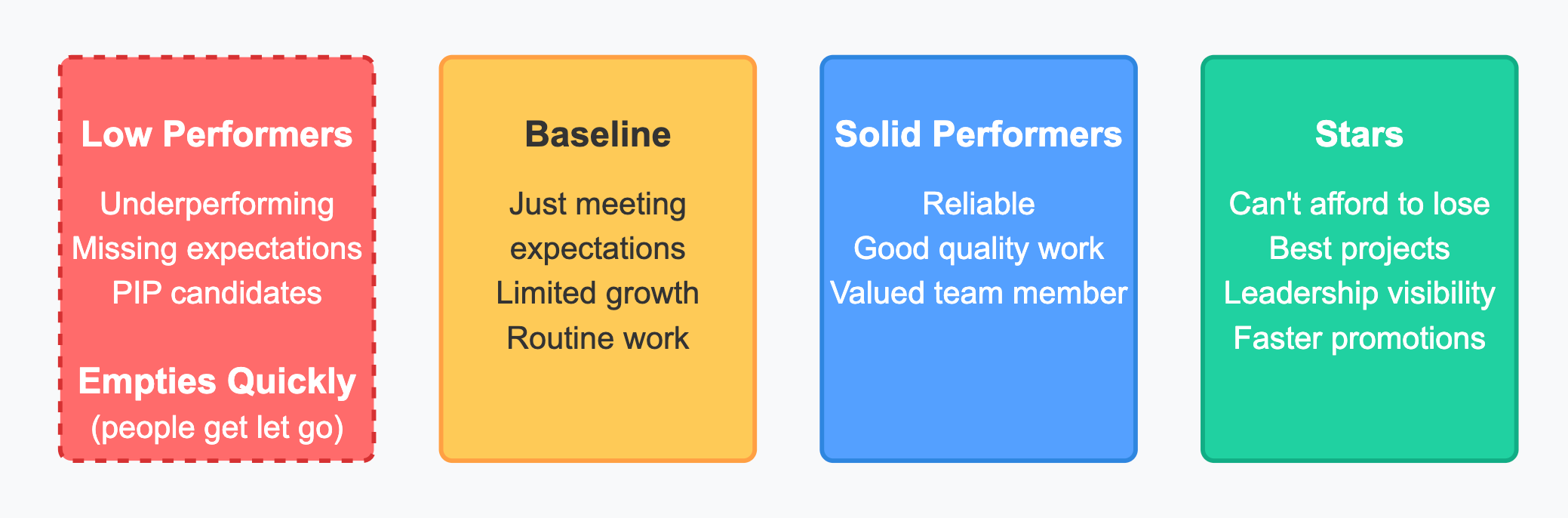
The stars get the best projects, visibility with leadership, higher ratings, faster promotions, and the benefit of the doubt when things go wrong.
The baseline employees? They get the routine work, meager cost-of-living increases (if anything at all) and live in the fear of moving to the low-performers bucket.
This newsletter isn't about manipulation or brown-nosing—it's about doing simple things that make your boss's job easier while positioning yourself as the high-value team member you are.
Here's something most career advice gets wrong: Movement between these buckets doesn't happen gradually. You don't slowly drift from "meets expectations" to "star performer" through incremental improvements in your work quality.
Instead, these transitions happen in quantum leaps — sudden shifts in how your manager perceives your value. Your manager mentally re-categorizes you after specific moments or actions that fundamentally change how they see you.
The truth is that doing good work consistently is necessary but not sufficient. Many solid employees produce quality work for years without ever making it to the star category. The difference isn't just about work output—it's about how you make your manager's life easier and how visible your contributions are.
These five strategies aren't about manipulation—they're about smart relationship management with the person who has the most influence over your career trajectory. Each one creates disproportionate value for the effort required, in other words, they are high-leverage.
From your boss's perspective, most feedback they give to their employees might as well go into a black hole. They'll spend time thoughtfully formulating constructive criticism in a one-on-one, only to see zero change in behavior. Week after week, they'll repeat the same suggestions, wondering if they're being heard at all.
This is precisely why when someone actually proactively asks for feedback and is seen acting on that feedback quickly, it's shocking—in the best possible way. It immediately differentiates you from 99% of employees.
Most people make the mistake of responding to feedback verbally rather than with action. They'll say things like "That's great feedback, I'll definitely work on that" or "I completely agree, I should do more of that." But words without follow-through reinforce the perception that you're all talk.
We want to show our managers that we're taking feedback, not tell them we've changed. There's a world of difference between saying "I'm working on being more proactive" and actually demonstrating proactivity through visible action.
When I asked my manager for proactive feedback, he mentioned that I should "take a more active role in upleveling my coworkers." The following week, I organized a brown-bag lunch session where I did a deep dive on our system architecture, highlighting some of the common traps and pitfalls of working on the system.
My team loved the session because it provided valuable context on the system. We ended up adding the recording to our onboarding process. In our next one-on-one, my manager specifically mentioned how he was impressed by my actions, even though he was the one that gave me the feedback.
Quick win: During your next one-on-one, ask for feedback and be seen taking some aspect of that feedback. The faster you do this, the better.
Most managers spend their days in an information desert. They're responsible for knowing what's happening across their team, but getting that information is like pulling teeth.
This is why delivering clear, proactive, and thorough status updates creates such a powerful impression. When everyone else is making your manager work for basic information, you're the oasis in the desert—the person who consistently provides exactly what they need before they even have to ask.
The typical employee approaches status updates as a checkbox exercise. They'll say things like "Project X is on track" or "Still working on that database issue" without any meaningful context or forward-looking information. They view status updates as reporting to authority rather than as a strategic communication opportunity.
What your manager actually needs is a complete picture of how things are going: what you've accomplished, what you're working on now, any challenges you're facing, and how you plan to address them. When you consistently provide this level of clarity without being prompted, you immediately stand out as someone who makes their job easier rather than harder.
I learned this lesson early in my career at Amazon. My team was working on a complex migration project with multiple dependencies. I started sending brief weekly summaries that outlined: completed items and milestones, current focus areas, existing and potential blockers on the horizon, and proposed mitigation strategies. When promotion discussions came around, my manager already had a six-month record of my impact.
It doesn’t have to be at the organizational or project level. Simply being proactive about status at the personal level with slack messages or during 1-1s already sets you apart.
Quick win: Play this game: Everytime your manager has to ask you about the status of something, you lose. When you are surfacing issues, make sure to come with solutions and a recommendation, not just with problems.
Managers hate surprises—especially negative ones. There's nothing more stressful for a manager than discovering at the last minute that a deadline will be missed, a feature is broken, or a client is unhappy. These moments trigger the feeling that they aren’t in control.
This explains why the employees who bring problems to their attention early—along with potential solutions—are so highly valued. When you preemptively flag issues before they become emergencies, you transform from a source of stress into a trusted partner that has their finger-on-the-pulse.
Bad news delivered early enough is just news. Bad news delivered late is truly terrible.
The average employee avoids delivering bad news until absolutely necessary. They hope problems will resolve themselves, try to fix issues without telling anyone, or wait until the last possible moment to admit something's wrong. They fear being associated with problems or having their competence questioned.
What they don't realize is that every manager knows problems are inevitable. What separates high performers isn't avoiding problems entirely—it's how proactively they identify, communicate, and address them before they spiral out of control.
I noticed concerning performance metrics in our staging environment just days before a major release. Instead of sitting on the information or waiting for someone else to notice, I did some quick research and reached out to my manager with a assessment:
"I've identified a potential scaling issue with the new service that could impact user experience during high traffic periods. Here's what we're seeing, here's what I think is causing it, and here are three options for addressing it before release. My recommendation is option two, which would require a two-day delay but ensure a smooth user experience."
My manager later told me this message gave him the feeling that he could absolutely trust me to do the right thing in his absence. This led to me being a stand-in for him to meetings meeting with external partners, growing my influence.
Quick win: The next time you encounter a potential issue or delay, immediately draft a message to your manager that follows this structure: (1) clear identification of the problem and how you came to know of its existence, (2) potential impact if not addressed, (3) options for resolution, and (4) your recommended approach. Send it as soon as you're confident in your assessment, not when the deadline is already in jeopardy.
Managers spend much of their time playing defense—reacting to issues, responding to requests, and putting out fires. This constant reactive mode means they rarely have bandwidth to focus on strategic initiatives or improvements. It's exhausting and often prevents them from making their own impact.
This explains why employees who can anticipate needs before they become problems become invaluable. When you identify and address potential issues before your manager even has to think about them, you demonstrate a level of ownership and foresight that immediately separates you from peers.
Most employees operate in a request-response pattern. They wait for explicit direction, complete the assigned work, and then wait for the next instruction. Even diligent, hardworking team members often limit their focus to their immediate responsibilities without considering the bigger picture.
High performers, by contrast, develop a sixth sense for pain points and proactively address them. They're constantly asking themselves: "What recurring issues are slowing us down?" "What information or resources are we frequently missing?" "What would make everyone's job easier?" Then they take initiative without waiting for permission.
I noticed our team was spending hours each sprint debugging configuration issues between environments. Nobody had explicitly flagged this as a problem—it was just accepted as part of the development process. Instead, I spent a few evenings documenting the inconsistencies and creating a configuration validation tool.
"I built a small utility that automatically checks for config mismatches between environments. I've been using it for the past week and it's saved me hours of debugging time. I've put it in a shared repo with documentation if anyone else wants to use it." Within a month, my tool extended and adopted as an automated part of our process.
While my manager didn’t really understand what I did, he was very pleased that it saved developer time and led to faster feature development. The fact that I did it without being asked was the thing that really boosted my contribution in his eyes.
Quick win: Identify one recurring friction point in your team's workflow—something that consistently causes delays, confusion, or extra work. Develop a simple solution (a template, script, documentation, or process improvement) and implement it without fanfare. Don't ask for permission; just solve the problem and casually share the solution as if it's the most natural thing in the world. Make sure your manager is CC’ed.
Your manager exists within a hierarchy, facing their own pressures, goals, and performance metrics. While they're evaluating your work, their boss is evaluating theirs. Just like you, your manager's success is directly tied to how their leadership perceives their effectiveness.
This explains why employees who actively contribute to making their manager look good to senior leadership live in the stars bucket. When you help your manager shine in front of their boss, you're not just doing your job—you're actively advancing their career, which creates a powerful incentive for them to advance yours.
The average employee considers only their direct responsibilities and perhaps their team's goals. They rarely think about how their work affects their manager's standing in the organization or what metrics their manager's performance is judged by. They assume that simply doing good work is enough.
High performers understand that the organizational context matters tremendously. They make it their business to know what their skip-level manager cares about, what initiatives are priorities at the leadership level, and how their manager's performance is evaluated. Then, they deliberately align their work to support those priorities.
I noticed my manager was under pressure to improve our team's feature velocity—a metric his boss had highlighted in a recent all-hands meeting. Instead of simply focusing on my assigned work, I took the initiative to analyze where our time was being spent.
After identifying several bottlenecks, I determined that we could substantially and reliably increase our delivery velocity if we didn’t spend so much time gathering, deep diving, and prioritizing requirements from product managers. I surfaced this to my manager, who was in a much better position to do something about it.
Once the product to tech handoff was identified as a problem, my manager rolled his sleeves up and initiated conversations with the product team. He shared with them the pattern of ambiguous or missing requirements, and the fact that insisting for “nice-to-have” items, instead of sticking to the necessary functionality, was slowing down the team (and were getting cut anyhow when dates slipped). Working with the product team to standardize this handoff and therefore increasing our velocity made my boss look good in front of his, and played some part in his (and eventually my) promotion.
Quick win: Schedule a brief conversation with your manager around this simple question: "What's one metric or deliverable that you are being measured on?" Once you understand this priority, look for ways to contribute to it.
These five strategies offer a clear roadmap for changing how your manager perceives your value. They don't require extraordinary talent or superhuman effort—just thoughtful attention to what actually matters in the manager-employee relationship.
What makes these approaches so powerful is their compound effect. Implementing just one creates a positive impression. Consistently applying several creates the quantum leap needed to move from one bucket to another in your manager's mind.
These transitions aren't gradual—they happen suddenly when your manager mentally recategorizes you based on a pattern of behaviors that set you apart from your peers.
Start with just one approach this week. Notice the response. Add another next week. Within a month, you'll have created a new dynamic with your manager—one that opens doors to opportunities reserved for those in the highest bucket.
Did I miss anything? Let me know below.
Enjoyed this week’s newsletter? Give it a ❤️ so I know to write similar ones in the future.
No posts
Comments
Nothing yet. Say the first thing.
Sign in to join the conversation.