
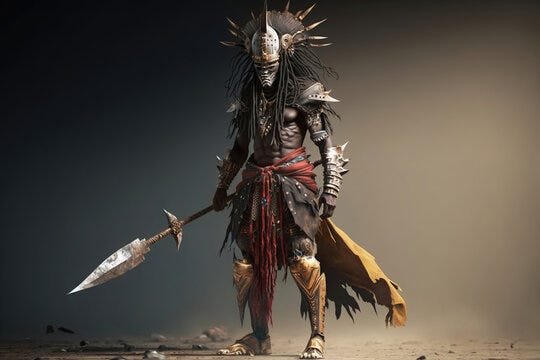
In European myth, the sword dominates the imagination. From Le Morte d’Arthur to the chansons of Charlemagne, sovereignty gleams along a blade’s edge. The sword is inheritance, legitimacy, and divine mandate made steel. It is the object drawn from stone, raised over battlefields, and laid across kneeling shoulders in rites of knighthood. Across much of Africa, however, the weapon that occupies a similar symbolic space is not the sword. It is the spear.
The spear is older than the sword, both technologically and symbolically. It is hunter’s tool, herder’s defense, warrior’s extension, and king’s scepter. It appears in ritual space as frequently as it does in war. If the sword in European traditions often represents chivalric individualism and aristocratic lineage, the spear in many African traditions represents continuity between survival, spirit, land, and sovereignty. It speaks less of solitary heroics and more of relational power between ruler and people, living and ancestor, human and divine.
In ancient Kemet, the spear or harpoon appears as a cosmic instrument. In the mythic struggles between Horus and Set, Horus wields a divine harpoon to pierce chaos and restore rightful kingship. The act reestablishes ma’at, the balance that sustains existence itself. The spear functions as law enforced through sacred violence.
The war god Anhur, also known as Onuris, carries a spear emblematic of disciplined conquest and sacred retrieval. His name means “He Who Brings Back the Distant One,” suggesting restoration as much as domination. The spear here is not simply destructive. It is corrective and restorative, a tool that retrieves what has been scattered and defends divine order.
In Yoruba cosmology, Ogun stands as the orisha of iron, forge fire, roads, and war. Ogun’s iron spear is ritually consecrated and invoked in oath making. It cuts through deception and obstruction as much as flesh. Where European swords often signify noble birth, Ogun’s spear is bound to labor and technology. It is forged through effort and sanctified through sacrifice. It represents the moral and spiritual weight of tools and the communities that depend on them.
Across these traditions, the spear does not glow with magic because of inherent enchantment. Its power emerges through ritual activation, invocation, and relationship to divine order.
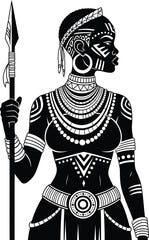
The spear also functions as a vessel of kingship and ancestral continuity. Among the Shilluk of South Sudan, the divine founder king Nyikang is associated with sacred regalia that includes spears embodying rain, fertility, and legitimacy. These objects are not inert heirlooms. They are treated as living conduits of Nyikang’s spirit, activated during coronations and moments of crisis. Authority is extended physically through the spear’s shaft.
In the Baganda kingdom of Uganda, certain royal spears were believed to contain the life force of the polity itself. Losing such a spear threatened dynastic stability. The weapon became a portable symbol of continuity and collective identity.
Among the Shona of Zimbabwe, Murenga is invoked as a spirit of resistance. During anti colonial uprisings, fighters carried spears believed to be guided by ancestral forces. The spear functioned as a spiritual antenna linking the living to the dead. Its power rested in invocation and communal belief rather than mechanical superiority.
Historical figures also become mythic through their association with spears. The short stabbing spear, or iklwa, popularized by Shaka Zulu transformed warfare in southern Africa. Oral praise poetry elevated this tactical innovation into legend. The spear became an extension of Shaka’s will and strategic genius. Similarly, Ethiopian imperial traditions preserved royal spears blessed through Christian liturgy and believed to carry divine favor into battle. These weapons symbolized covenant and continuity between heaven and throne.
Even in pastoral contexts such as Maasai lion hunting rites, the spear marks courage, adulthood, and relationship to land and animal. It proves discipline and communal recognition. In these cases, the spear binds social identity to physical action.
In many African traditions, magic is relational rather than intrinsic. A spear becomes powerful because it is consecrated through ritual, embedded within communal memory, and activated through invocation. This distinction has profound implications for tabletop roleplaying games that seek to reflect African or Black diasporic aesthetics.
Weapon hierarchies in many fantasy systems mirror European assumptions, often elevating swords to legendary status while relegating spears to basic categories. Re centering the spear requires more than adjusting statistics. It involves shifting narrative emphasis from solitary heroism to collective continuity.
In such a setting, a spear might serve as proof of political legitimacy. A leader could be required to plant it before speaking law, invoking ancestral witness. The weapon might gain narrative permissions rather than numerical bonuses, compelling truth during oath ceremonies or weakening when wielded in selfish intent. Seasonal rites, harvest festivals, or remembrance ceremonies could renew its potency. The spear becomes part of social infrastructure rather than a mere combat tool.
Equally important is honoring the symbolic weight of non magical spears. In a Black diasporic setting, a spear carried across generations might possess no overt enchantment and yet shape destiny through its history. It could represent survival through displacement and continuity through rupture. Its power would reside in memory and story.
Designers should also reflect diversity of form. Different cultures within a fictional world may employ different spear types, signaling distinct ecological and cultural identities. Activation through ceremony can replace static enchantment, encouraging players to engage with shrines, elders, and histories. The spear becomes a narrative hinge through which land, law, and lineage intersect.
Thoughtful engagement requires specificity and respect. African traditions are diverse and often living. Drawing inspiration demands care to avoid flattening sacred symbols into interchangeable fantasy tropes. Yet when approached with research and reverence, centering the spear expands the imaginative vocabulary of fantasy beyond familiar medieval European frameworks.
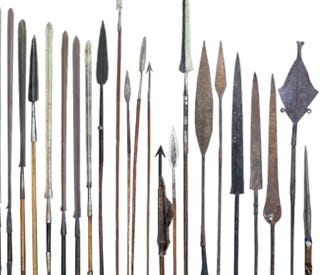
The spear in African myth is a line drawn between earth and sky. It plants kings, calls rain, seals vows, and pierces chaos to restore order. If the sword in European legend frequently symbolizes individual destiny and aristocratic inheritance, the spear in many African traditions embodies collective continuity and relational power.
When players in a tabletop game lift such a weapon, they should feel obligation as much as strength. To plant a spear in the soil is to stake a claim not only in territory but in history. It invites witness from the unseen and affirms connection to those who came before.
In centering the spear, worldbuilders center relationship. They affirm that power flows along lines of ancestry, community, land, and memory. And when the spear is raised before battle, it should promise not only victory, but responsibility.
No posts
Comments
Nothing yet. Say the first thing.
Sign in to join the conversation.