
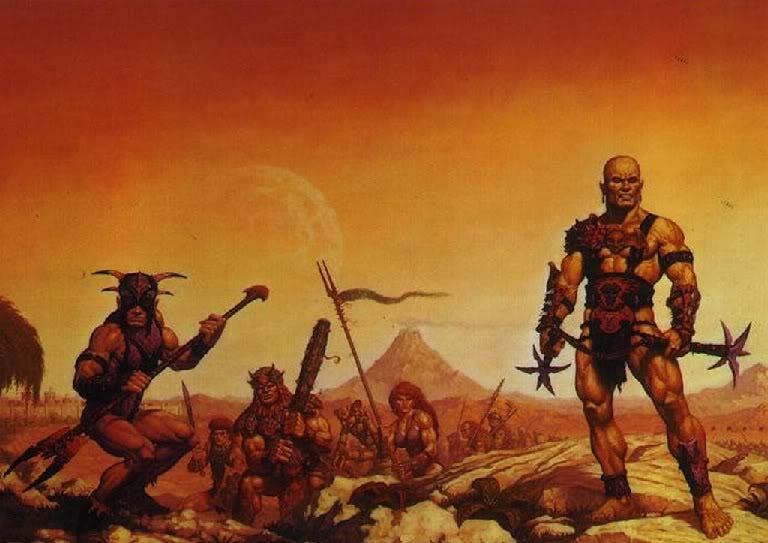
When TSR launched Dark Sun in 1991, Athas emerged as a stark contrast to the typical high fantasy worlds. It wasn’t the bright heroism found in Forgotten Realms or the gothic vibes of Ravenloft; it was a harsh desert landscape ruled by tyrants, ravaged by defiler magic, where living meant scrambling for every drop of water, metal, and shred of freedom. For many players in the 90s, this was true hardcore fantasy: it was brutal, unforgiving, and raw.
Yet, as a Black gamer who's been part of this community since the late 70s, I’ve observed how discussions around Dark Sun have evolved, and I’ve had to reflect on my own feelings about it. Back then, the focus was on gameplay mechanics and how fun it was to play. Now, the conversation has shifted to encompass representation, culture, and the politics woven into the worlds we inhabit. When I view Dark Sun through a Black lens, it becomes evident that its issues extend beyond gameplay mechanics. They touch on the harmful narratives surrounding race, slavery, colonialism, and survival. This is regardless of the designers' original intentions.
This piece aims to reconcile these two critiques: the traditional gamer frustrations and the modern focus on representation. When we place them side by side, a pattern emerges: Dark Sun has consistently grappled with the challenge of balancing brutality with depth, shock with substance, and survival with humanity.
The initial critiques of Dark Sun came directly from the gaming community, long before we had the vocabulary of cultural criticism. The standout complaint? The game was just too grimdark.
Unrelenting Oppression: Everywhere you turned, there was despair: gladiator pits, sorcerer-kings, cannibal halflings, ecological ruin. The bleakness sometimes felt less immersive and more like a drain on your energy.
Limited Playability: Athas thrived on scarcity. No metal for swords. Food and water were in short supply. Healing wasn’t easy. While that made sense thematically, at the game table, it could feel suffocating. Players often felt like they were merely surviving the rules instead of enjoying the story.
Slavery as Set Dressing: It was everywhere in the lore, but it lacked sensitivity. It was treated as a “cool” brutal detail without giving players room to engage with it meaningfully.
Unbalanced Psionics: Dark Sun prominently featured psionics, but the system was often clunky and unbalanced. Players either felt overpowered or completely lost in the rules.
One-Note Ecology: The world was ravaged by defiler magic, resulting in a desert wasteland. While that’s a catchy concept, it ultimately lacked depth. Once you grasped the idea that “wizards drained the life from the world” there wasn’t much else to unpack.
Despite these criticisms, many players were drawn to Dark Sun for its uniqueness. It offered an alternative to elves in shining armor; it focused on survival amidst the dust. But those traditional critiques reveal an essential truth: even at its foundation, Dark Sun had a tough time balancing harshness and depth, shock and substance.
Fast forward to today, and the conversations around Dark Sun hit home for me as a Black man. These discussions go beyond “rules complaints”; they delve into what it means to exist in a world where slavery, oppression, and colonialism are embedded in the core.
Slavery as a Universal Backdrop: It’s one thing for slavery to exist in a fantasy universe. It’s another when the game presents it as inescapable. Every city-state, every culture in Athas grapples with it. But the enslaved individuals are faceless; their narratives are absent. As a Black player, it’s hard for me to overlook how this trivializes my ancestors' histories. It transforms slavery into mere setting aesthetics rather than a profound human trauma.
Orientalism and Exoticism: Dark Sun borrows from images of North African, Middle Eastern, and Indigenous desert cultures. All of the architecture, the dress, the nomadic peoples. But it reduces them to pulp fantasy tropes: “savage tribes,” “desert tyrants,” and “exotic wastelands.” This isn’t truly representation; it’s oversimplification. It mirrors how colonial Europe depicted Africa and the Middle East: mysterious, savage, and primitive.
Bio-Essentialism: Muls are “bred for slavery.” Half-giants are “bred for war.” Thri-kreen are “alien predators.” Does that sound familiar? These biological determinist arguments have been used in the real world to rationalize racism and slavery. Seeing them woven into fantasy races hits hard, especially for those of us from communities that have lived under such ideas.
Cannibal Halflings and Savage Tropes: Athas halflings are notorious for being cannibals. It's edgy, sure, but it plays into stereotypes of Indigenous peoples as “savages” or “man-eaters.” For Black and Indigenous players, that’s not just edgy. It's a painful reminder of racist myths that have justified colonization.
Simplistic Climate Allegory: Athas is simply a world ruined by magic. That’s it. Real world ecological collapse involves empire, capitalism, resource extraction, and colonial violence. Dark Sun misses the opportunity to delve into these systemic issues, reducing environmental collapse to the actions of “a few greedy sorcerers.”
The modern critique digs deeper: Dark Sun doesn’t just complicate survival; it complicates representation. It borrows aesthetics from real cultures and peoples, then flattens them into fantasy, immersing players in a world saturated with themes of brutality, slavery, and despair.
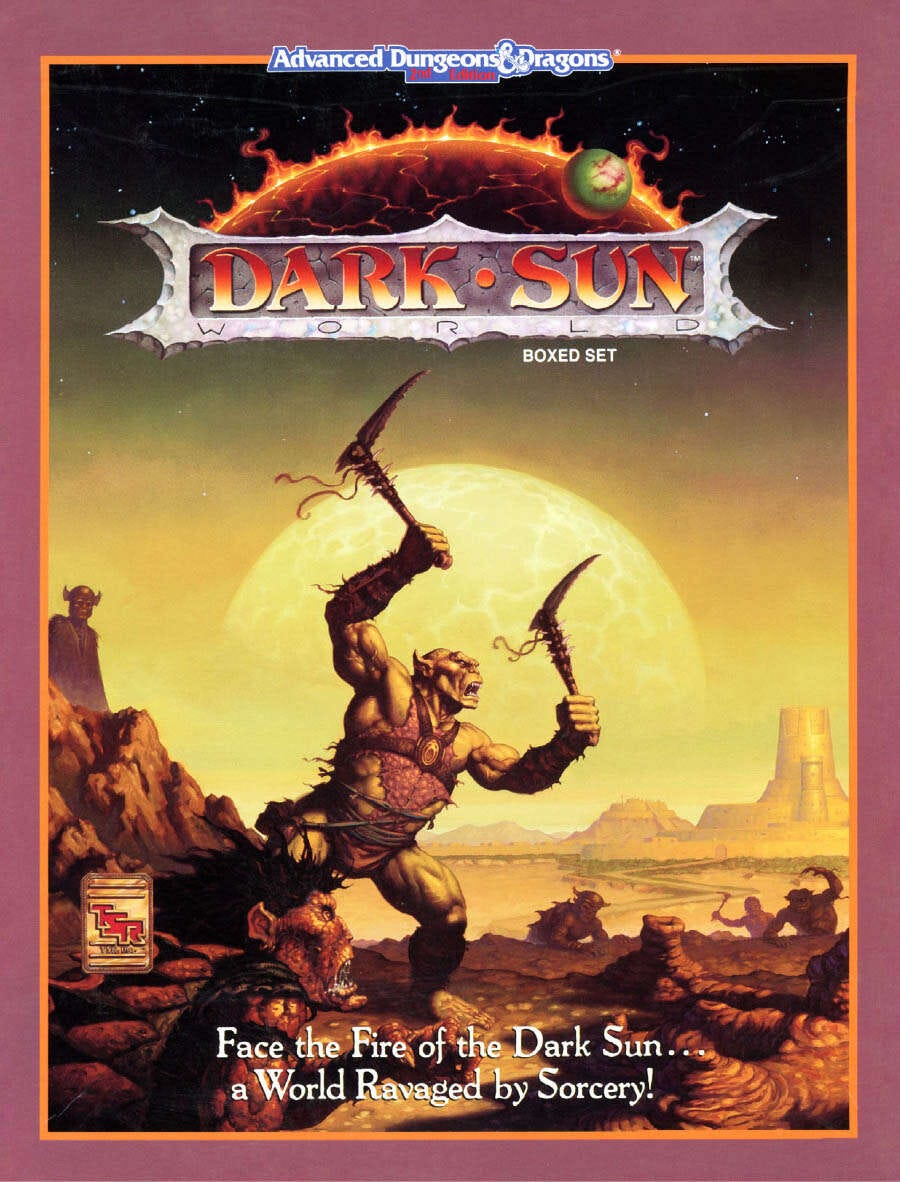
Here’s the reality: the traditional gamer critiques and the modern representation critiques aren’t isolated. They intersect. The design choices that make Dark Sun frustrating to play also contribute to its harmful representation.
That grimdark tone that made campaigns wearying also depicts cultures devoid of joy, resilience, and humanity.
The scarcity mechanics that stifled play meant Athasians were only displayed as struggling and never truly thriving.
The slavery-as-flavor issue that annoyed 90s players reads today as a trivialization of Black history.
The unbalanced psionics weren’t merely a mechanical flaw; they highlighted how the setting introduced large concepts without thought to accessibility, much like cultural aesthetics were tossed in thoughtlessly.
In essence, the issues in Dark Sun’s design have always existed. What’s evolved is our capacity to recognize them not just as “mechanical flaws,” but as political issues.
As a Black gamer, when I look at Dark Sun, I see reflections of real histories: plantations, auction blocks, colonial desert campaigns, and the way European empires viewed Africa and the Middle East as mere wastelands to exploit.
And I notice how the game turns these histories into fantasy aesthetics. Gladiator pits as cool flavor. Slavery as edgy backdrop. Cannibal tribes as shocking plot twists.
But here’s the reality: we’ve lived those stories. They aren’t cool or edgy to us. They are scars carried by our ancestors. When a game treats them as universal, casual, and faceless, it shifts from being survival horror to feeling like erasure.
At the same time, I get why many players have been drawn to Dark Sun. It was raw, different, and stripped down. It resonated with something other settings missed: the harsh reality of a world where resources vanish, rulers crush hope, and survival itself becomes an act of resistance. That vision holds power. But without care, representation, and humanity, it falls short.
Dark Sun serves as both a product of its era and a reflection of the hobby. In the 90s, players critiqued it for being too grim, too narrow in scope, and too unbalanced. Today, we call it out for being too colonial, too essentialist, and too careless with histories of oppression. Both sets of critiques convey the same message: Dark Sun aimed to shock, but it often fell short in terms of how to sustain, represent, and respect its themes.
For Black players like myself, the lesson stands out: fantasy realms are never merely “fantasy.” They are shaped by the cultures and histories we inhabit. When a setting takes inspiration from Africa, the Middle East, and Indigenous peoples, yet presents these peoples as savages, slaves, or nameless survivors, it isn’t neutral. It perpetuates the same colonial lens that has historically dehumanized our ancestors.
Perhaps that’s the real tragedy of Athas. Not just that the world was destroyed by sorcerers, but that even within fantasy, the marks of colonialism and slavery linger as we traverse the desert.
No posts
Comments
Nothing yet. Say the first thing.
Sign in to join the conversation.