
The more clearly we can focus our attention on the wonders and realities of the universe about us, the less taste we shall have for destruction.
From Rachel Carson’s Silent Spring (1962)
Rambling up the lower Maine coast last week, a fir-shaded lane leading to the Rachel Carson National Wildlife Refuge enticed my husband and me off the main road and onto its gravelly path. This entry, one of eleven spliced sections of the Refuge along a 50-mile stretch of Maine’s coastline, turned out to be a short looped trail along a salt marsh. With a bit more investigation, we found we could easily drive further up the coast and hike in a completely different environment.
Before we come to that, not everyone knows Rachel Carson (1907-1964). An American marine biologist, her early writings (known collectively as her “sea trilogy” (1)) focus on our deep connection to nature as a source of beauty and mystery. Many of us are more familiar with Carson’s later role as a conservationist and her book Silent Spring (1962). This book, along with her work to ban pesticides, led to the formation of the Environmental Protection Agency and a posthumous award of the Presidential Medal of Freedom.
Our next stop was a trail that took us through freshwater wetlands and saltwater marshes. There were views of the ocean and the mouth of the Little River. In hiking just over a mile, we were privy to so many ecosystems. And such beauty.
Rachel Carson would be smiling.
Ever since I wrote my Substack piece about wonder and awe - “The Writer’s Retreat, The Painter, and The Grand Canyon” (5/7/25), after returning from a trip to the American Southwest, I have been thinking about what more I can say about these than merely “capturing” such gigantic emotions. I crept a little closer in my post “Humility as the Gateway to Wisdom” (9/11/25) by connecting ourselves to some greater thing and voicing the need to value others’ dignity. It seems it took a trip to another magnificent place to jog my mind to the next right step: respect and responsibility. In May, I defined wonder as the emotion we feel when “something unexpected or extraordinary is encountered that inspires a desire to learn more.” Awe I defined as “a reverence or admiration brought on by experiences of vastness, beauty, or majesty.”
Expanding, wonder and awe are powerful human experiences that sit at the intersection of emotion, perception, and meaning making. Taking each in turn:
We have a subjective emotional experience. It is a conscious awareness; for example, we feel an inner peace. Our bodies react automatically to this peace by slowing down our heart rate and breathing. The subjective and the physiological become observable when we smile. Or cry.
Our senses are busy collecting stimuli from the environment, which are organized into patterns and interpreted by the brain. This is Perception 1.0. Perception 2.0 factors in our personal histories and experiences, our beliefs, attitudes, and biases, and filters out what distracts us. This becomes our worldview.
There are few constructs that demand “meaning-making” (serious illness and death are two that come to mind) more than wonder and awe. This is not a passive process (“to make” is one of those action verbs), but it is also not simplistic. People make meaning based on complex factors like personal value systems, cultural identities, religious beliefs, prior experience, and general knowledge base.
Meaning-making is the stepping stone to respect and responsibility (2). Starting with a childish example that takes us all back to high school, how many of us cared about the material we memorized by rote? How many of us still remember it? Now let us think about the subject matter we took the time to read carefully for comprehension. Chances are, it interested us. Fascinated us, even. Perhaps we even remember some of it.
In the second example, we were engaged with our learning, and motivated to learn more. We wondered, and in this wondering came an awakening. You and I remember the material because what we studied meant something to us. We folded it into our personal value systems. Tested it against our identities, beliefs and experiences. We filed it in our knowledge base. We made it our own.
We became stewards.
What if we are not studying for a test? What if we are matching wits with bonefish on a fly rod in the azure waters of the Bahamas? Skiing the powdery back bowls in Banff, Alberta, or the salty waves off the Florida coast? Would we start to care if we lingered by the edge of a tide pool, as Rachel Carson did, observing snails, starfish, and sea urchins? How could we not care while walking in the pine-perfumed woods? How can we not plop ourselves right in the middle of a vastness beyond our own boundaries? How can we not be immersed in beauty? In majesty. If you are still not convinced, step outside on a dark night and look up at the stars. We are tiny, yet a part of. This is awe.
Awe is humbling, isn’t it? All this vastness is a power beyond our control. As we notice the larger whole, our perspective shifts. Our self seems smaller. Awe makes us recognize our limits and how much we depend on the greater web of life.
We can fight this dependence with arrogance, or we can channel it into its rightful respect. We can recognize the intrinsic value of nature and its processes, bonefish and starfish and fir trees, not as raw materials for humanity, but as part of the greater web of life. As homes to creatures. As food sources for creatures. And as a balm for the soul of humanity. When we learn to value a thing by respecting it, we come to cherish what we once only admired.
With this knowledge comes the responsibility to act wisely. This is the nature of stewardship. Our arrogance and egos fall by the wayside, giving way to a transcendent respect for that which is larger. That which we all belong to. Ironically, it is in our self-interest to act wisely as stewards and show respect to the sleek silver bonefish, the nubbly starfish, and the sweet, woody fragrance of the balsam fir.
It is not enough to want to learn and see that we belong to something larger. It is not even enough to then respect this wonderment. This awe. In the end, there is a call to duty for each of us. This duty is a commitment to act in ways that protect, sustain, and honor the things we respect. We translate our love of fly-fishing for bonefish into ways to protect their habitat. We waterski away from seagrass beds where manatees feed. We plant trees.
We are sitting near the place where some of Rachel Carson’s ashes were scattered (3) at the tip of one of the many jagged peninsulas defining Maine’s coast. There is a plaque at the end of a garden pathway dotted with Monarch butterflies fattening up for their return journey to Mexico. It is cemented into a mammoth boulder, one of thousands tossed up long ago from the churning sea below. High above the tide line, where strands of seaweed lounge like limp spaghetti, the marker is unobtrusive. We might expect this.
I almost missed it.
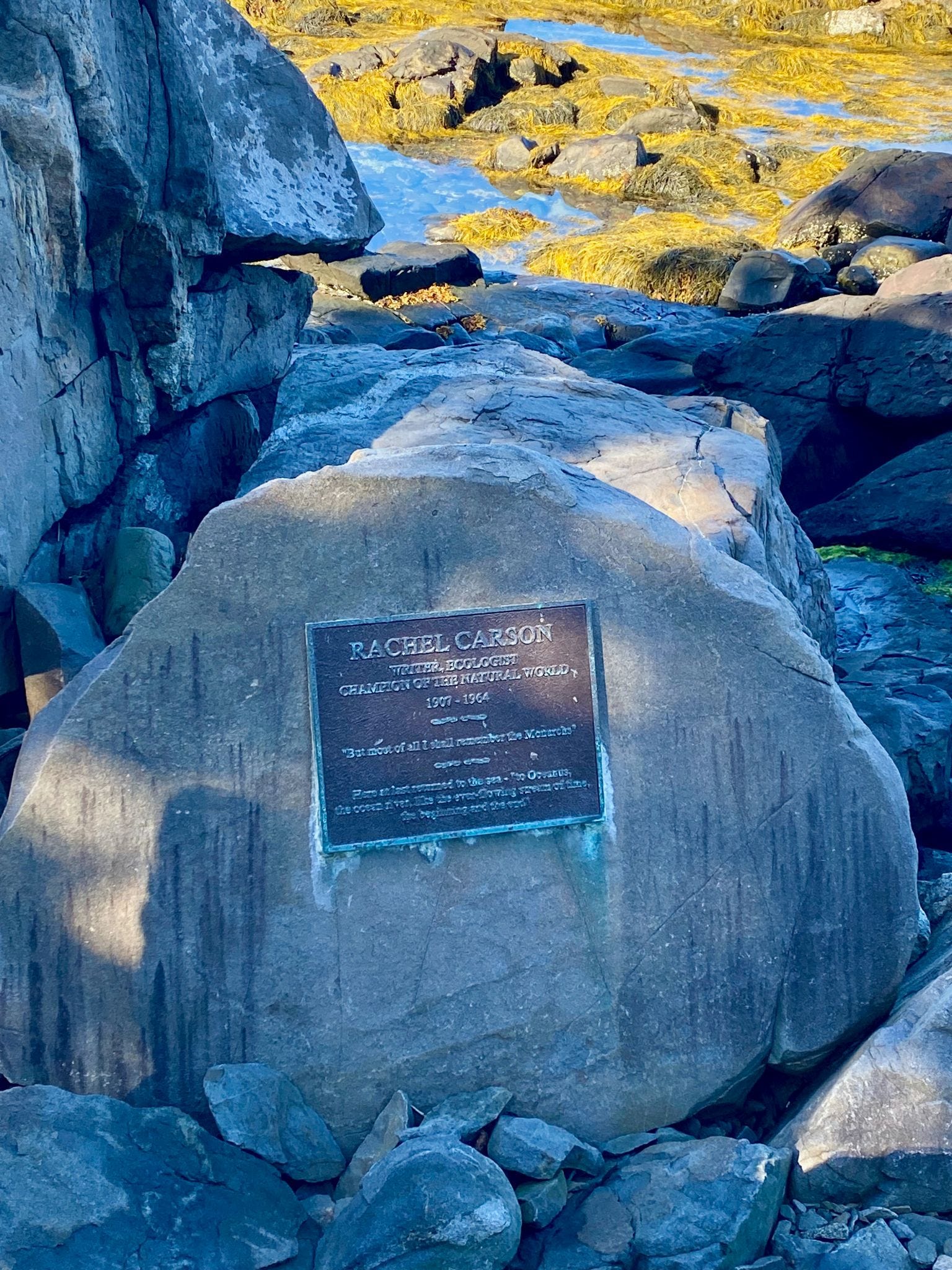
Photo Credit: Author
____
(1) The Sea Around Us (1951)-U.S. National Book Award Winner; Under the Sea Wind, (1941/republished 1952); and The Edge of the Sea (1955).
(2) Rachel Carson tackled the twin pillars of reverence and responsibility. Her treatment of the two was not only sweeping, but included practical application. Carson’s philosophy might be summarized as being called to act responsibly because we revere life, with the reverse also true. We revere life more deeply as we act more responsibly. Here I can only brush up against these groundbreaking ideas.
(3) In a complicated misappropriation of Carson’s wish to be buried in Maine, her brother insisted a portion of her ashes be buried beside their mother in Rockville, Maryland.
Love, Alice
No posts
Comments
Nothing yet. Say the first thing.
Sign in to join the conversation.