
I share three articles about revision with students. Here are links:
How I Be Revising by Brandon Taylor
First Thots on Revision by George Saunders
How To Revise A Personal Essay by Megan O'Rourke
There is a lot more advice out there, but ultimately revision is yet another aspect of the creative process that you have to figure out for yourself. You will get a long way toward bettering your work by following the guidelines above, yet no one else’s method will completely apply to you. You also have to dig into your own self and the particular piece you are working on to figure out how to fix it.
The first big hurdle is to accept revision at all. You will read interviews and articles where experienced writers say they love revision, it is their favorite part of the process, they revised a story 50 times and so on, but in early writing days none of that makes sense. If you knew what was wrong with the story, you wouldn’t have written the wrong things down in the first place! I remember taking a writing class early in my short story days and having the teacher tell me I had ended a scene too soon. My whole soul rose up in protest. I did it that way on purpose! I wanted to leave the important part of the conversation left unsaid to show that the people involved found it difficult to express themselves. But that was not the point. The point was, he saw something I couldn’t. I was writing in marble and I needed to discover clay.
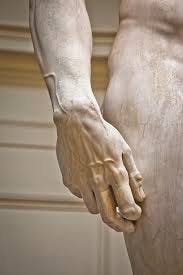
David’s hand
The next hurdle is to learn to hear feedback. In the beginning it is agony. Your stupidity has been found out! Writers especially feel this way because we learned to write at age five and should be able to do it by whenever we turn our intentions over to creative writing. People learning an instrument or how to paint or throw a pot don’t feel this way; they are learning something new. Beginning creative writers are too. Remind yourself of this. Yes, you are practiced with some of the tools, but the craft is all new. I have always advised that after receiving a workshop critique and a batch of marked-up pages to transfer all comments onto one copy of the manuscript and then put it away for a while. After that while, reread all the comments and cross out those that aren’t useful. Then, before dealing with the comments on a micro level, step back and take a look at the whole. Does it need a complete overhaul? Should you rewrite it completely without looking at this draft? Does the real story begin at the end of the one you have written?
Once you understand the job of revision, it’s a good time to stand back and write down why you are doing it. What’s it for? You already wrote the thing; why fix it? Is it in hopes of getting it published? In hopes of eliding the imperfect thing you wrote with the shining conception you had in your mind of what it would be? Is revision for an aesthetic principle, for other people, for its own sake, for fun? Write down all your thoughts and feelings about this, understanding that these are your current thoughts and feelings. These ideas might change. I suggest keeping a notebook called My Methods and revisiting it for each new project or every year. Topics may include How I Revise, How I Draft, What To Do When I Give Up 3/4 Through Because I Have A Much Better Idea, How I Stave Off Writer’s Block, Reliable Prompts, What Happened Last Time, and so on. It helps a great deal when you get stuck to be able to read what you did the last time at the same juncture—not someone else’s advice, but the thoughts and actions you took. Be your own coach. No one can help you more.
I have written this before in this place but I will write it again. Learning yourself is ten times as important as an artist as learning craft. Observe yourself honestly and pay attention to your reading. That’s my one sentence MFA.
Which brings me to the novel revision I am working on now. (I will wait until the book is announced to discuss it.) As I mark up the pages beyond and around and in light of my editor’s comments, I have created a new key as to what needs reconsideration. This key reminds of which mental habit mucked up the story. For example: L means lazy, GAWIT means I was hoping to get away with it, SS means I gave a passage short shrift, and so on. This has been really helpful, and reminds me of my intention with revision, which is to separate myself from the text at this point and send it off into a life of its own. In other words:
“Hey, Michelangelo, how did you carve David?”
“I started with a big block of marble and carved away everything that wasn’t David.”
Early writing is so much about capturing oneself; later writing is about stepping aside.
On Repeat This Week in The Studio:
Comments
Nothing yet. Say the first thing.
Sign in to join the conversation.