
When did I first hear about the Shakers? Very young, I think—I had the impression of women moving across pastures in long dresses, and polished wood floors. Celibacy and thrift. Self sufficiency and pacifism. A few years ago I visited the Shaker Village at Mount Lebanon and had a tour with a knowledgable docent and was enchanted—I had a strong past life feeling about the place. I bought a thick book about the Shakers that I dipped in and out over the years since, especially when I was researching Fellowship Point and the history of the early Quakers in England and America. (Who doesn’t love a utopian community?) Then I visited the Shaker village in Lenox, a much more touristic proposition that had a barnful of baby animals inside a windowless barn that functioned as a petting zoo, always worrisome. The quiet village was deeply moving. By the time of that visit I knew that celibacy was the least of it, and that I was drawn to their other practices and tenets: egalitarian principles that included all people, simplicity of dress and decoration, innovation and invention of ways of work, communal living, all ways of being that gladden my heart. They were an offshoot of the Quakers in England, coalescing around Ann Lee, who had a vision that guided her to understand that what stood between the human mind and God was fornication. Ecstasy belonged properly to worship. It’s a reasonable idea, and a lot of religious orders have had celibacy as a tenet, but it is a hard sell to most. Shakaeer converts really believed in their faith and in the practices it required. The religion had about 6000 members at its peak, living in 19 communities. The end of Shakerism (there are three Shakers left now, at the Sabbathday Lake settlement in Maine) is attributed more to the advent of factories and industrialization, which rendered their beautiful crafts, furniture, and cloth uncompetitive in the marketplace. Celibacy was a factor too, though not as much as it seems on the surface. They had excellent schools for neighboring children, and some who attended wanted to stay in the faith. It was a proselytizing religion; Anne Lee continued to travel and spread the word even after settling in a new world community.
Such powerful and to my mind logical commitments, pacifism and egalitarianism, and so interesting that they attracted many followers between the Quakers and the Shakers. I daresay there has been a falloff of those practices with population growth.
I am fortunate to live in a town that has an excellent film festival. This year I saw six movies. (I prefer the lively word movie to the dour film, except as the Irish pronounce it in two syllables, fil-em.) Jay Kelly, Hamnet, Secret Agent, Sentimental Values, Nuremberg, and The Testament of Ann Lee. Jay Kelly and Sentimental Values made me squirm with their central story lines of a famous movie star/a famous film director who’d often left home for work while his daughters (both movies featured men who have two daughters, no sons, and wives off stage, dead or divorced) missed them. Now the daughters are adults and still angry at Dad. I know pain is relative, and we all have a right to our own (though it is not always earned), but watching their whining so close to seeing footage everyday of ICE snatching parents from children and vice versa felt…bourgeois? To the enth? And in the worst way? I felt a bit sullied and embarrassed by them, though George Clooney is sooooo touching and able an actor. No doubt they will receive heaps of noms. Hamnet…I never read the book and was elated by the end of the movie, magical and brilliant and tear jerking. Paul Mescal…I’m here for him if he needs me is all I can say. Secret Agent was wacky and vibrant in Brazilian plot and hue, I had trouble following it but enjoyed the spectacle. Nuremberg is a hard pass, no matter how much one likes to see the era on film. Which brings me to The Testament of Ann Lee.
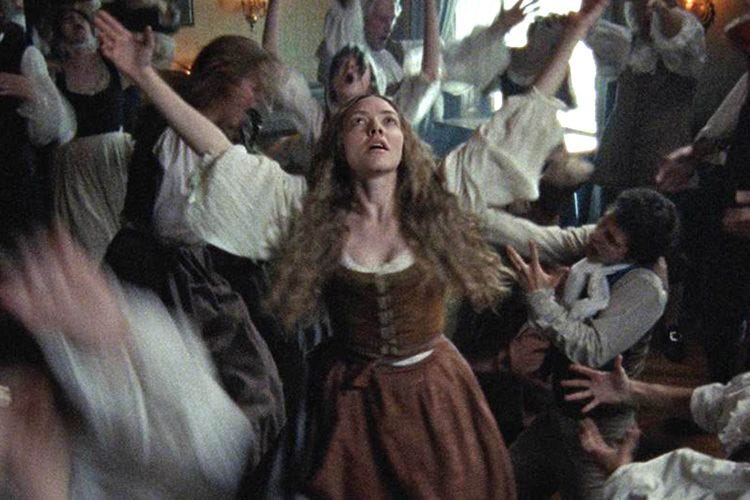
I knew nothing about it beyond Amanda Seyfried and Shakers, but those two mentions had me at attend a “late addition to the festival line up.” I bought two tickets but couldn’t get anyone to go with me, so I went alone under a moody sky at 11:30 a.m. and felt young again. It was in a school auditorium on a huge screen with a terrible sound system. Fortunately it turned out to be…a musical? Not the kind that bursts into song but more like a choral service with music throughout, the score and original songs composed by Daniel Blumberg and choreography by Celia Lawson-Hall. The writer-director is Mona Fastvold (script written with Bradley Corbett). Fastvold also wrote The Brutalist, which I found tasteless and brutal…maybe it got away from her? Ann Lee was the opposite, beautiful and tasteful from beginning to end in spite of some of the rawest scenes ever of childbirth, and violence. It tells the story of Ann Lee from vision to death, and if it doesn’t make you feel like you live a highly privileged cushy life nothing will. Four babies dead before age 1. An S&M loving husband who whipped her naked body before sex. A terrifying Atlantic crossing on a tiny ship. More instances of prejudice and outright physical attacks than she expected in the new world. And a daily life of round the clock work, with a leavening practice of wild dancing and baying at the moonlight that could be heard for miles. All flash by to tell the story, all are intimate and present rather than historical, all are seat-edge thrilling.
But that wasn't the thing that got me. What it was was I had never before seen a powerful woman’s life depicted on film like a woman’s life. There is no male gaze. There is no male mind. Seyfried, one of my top five actresses, or maybe top two, is inside of Ann Lee and inside of what her followers make of her…to them, she is the female Jesus. The second coming. She’s inside of it the way Jesus was inside of his thing, living it as an embodied mind and soul, not wasting time on labels or epithets. In a world of imagery of powerful women either putting on the pantsuit or the bandage dress and red-soled Manolos, she is the relief my heart needed. She is sure in her conviction, yet without an edge, without force, without taking on maleness. Her brother is her greatest advocate, and he lets her lead. She has something of a Malala vibe, if that gives a reference. Why don’t we have more images of women who aren’t palpably distorted by sexism? Women of whom we don’t explain “she has to do that/say that/take that position because…” in our disappointment still wanting to believe there is the other real woman in there somewhere, an uncompromised woman who can be a leader without monitoring the response from the hostile bleachers, or carrying our anxieties in her shoulder bag. Seeing Amanda’s performance and how the movie told Ann’s story made me feel so much better until I remembered reality again. Why is our country so relentlessly sexist? Because our Dads work too hard and leave us? Or because we live with a dominant religion where the first story is about a woman whose independent inquiry brought down the whole gambit God had set up? I don’t get it, I never will. But thank God for art where we get a chance to see the what if. Not in my lifetime will a woman be president. Ann Lee was an anomaly, sadly. Isn’t that completely insane and ridiculous?
Comments
Nothing yet. Say the first thing.
Sign in to join the conversation.