
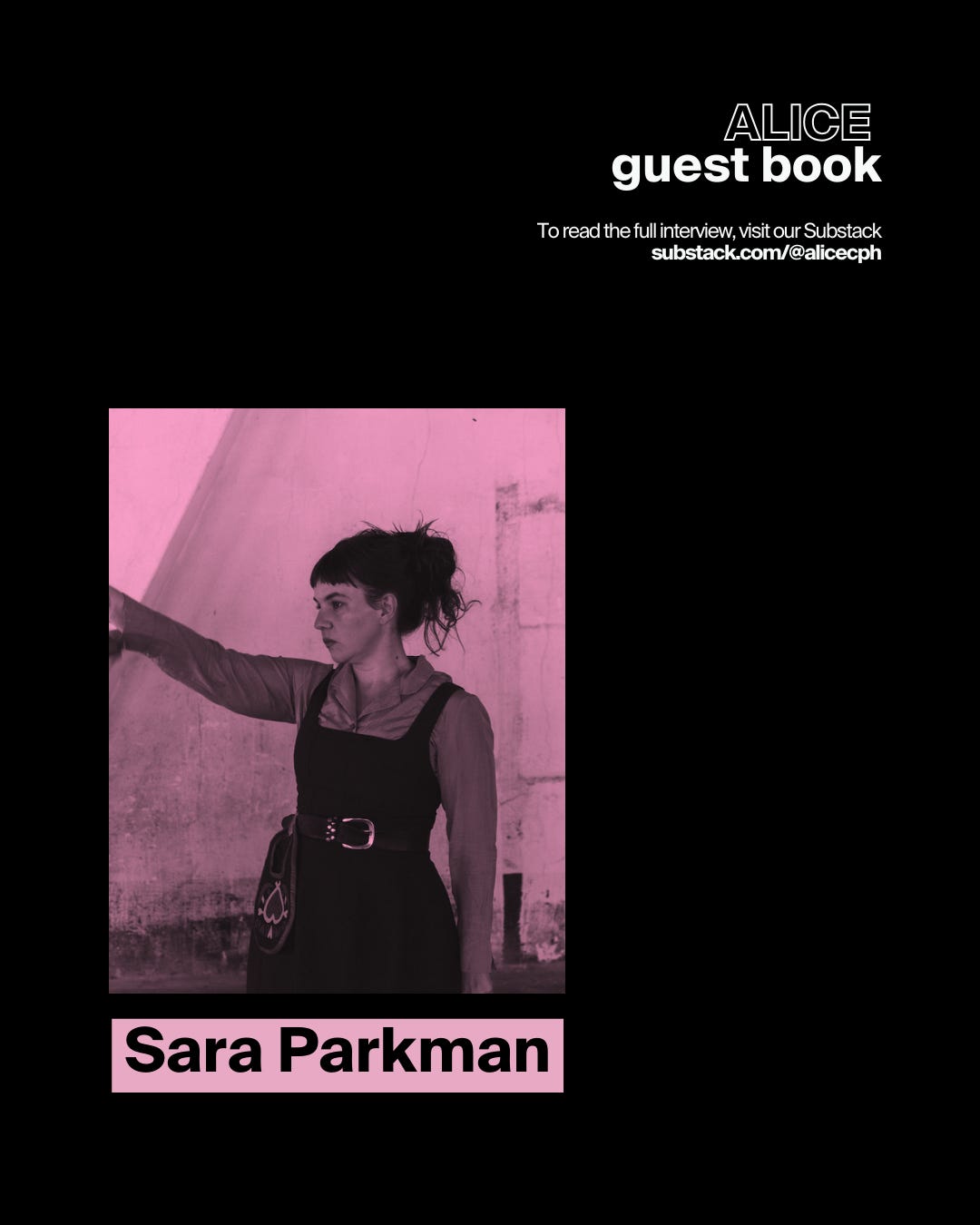
Twice sold out at Brorsons Church. During Vinterjazz 2026, ALICE once again had the pleasure of presenting the Swedish folk music phenomenon Sara Parkman, joined by musicians Anna Möller and Hampus Norén.
In addition to being a folk musician – as well as a composer, singer, and violinist – Sara Parkman is also the daughter of a pastor. Her music draws, in the most beautiful ways, inspiration from hymn traditions, prayer, and church choirs.
Thanks for reading ALICEcph’s Substack! Subscribe for free to receive new posts and support my work.
We met her the day after one of her church concerts and talked about the similarities between concerts and rituals, what she does with the awards she has received, and how you can make a difference in your local music community.
What does it feel like to perform in a church?
I grew up in church spaces, so for me it feels very homely: if we need a mirror, I know it’s in the sacristy. For others, it might feel overwhelming. Like a space that commands respect or evokes strong emotions. It’s wonderful to be able to invite the audience into a space they may not visit very often.
What is special about church spaces?
Churches are beautiful, and you’re given so much in terms of acoustics and atmosphere. I mean, the windows! And another really smart thing about churches is that they exist in almost every town in Sweden. So if you’re a touring musician and want to play in smaller cities, there may not be a venue – but there’s always a church!
Maybe it was the church space, but to me your concert almost felt like a ceremony. Can a concert be that?
Dramaturgically speaking, a concert very much resembles a church service. Everyone who comes to a concert knows what’s about to happen. When the lights go down, the concert will begin. When it’s over, you applaud for an encore. So yes, a concert is a kind of ceremony.
Yesterday at your concert, you said that all your songs contain a prayer. What did you mean by that?
It was something that came to me in the moment. Every song I write carries a will, an intention.
You can’t see songs. They only exist when we sing them. And perhaps it’s the same with prayers, whether they’re directed toward a god or something else. You can’t see them, but when you perform them, they start to become real.
Can music make someone more receptive to the divine?
I hope so, and that’s how it is for me. I can get stuck in questions about what kind of world this is and what place we have in it. Whether there is a god, and what the religious and spiritual are. But in music, I can move freely within those questions. It’s like a window toward the sacred.
Is that a feeling you get when you write music?
For me, composing is more like sitting and carving and shaping... It’s work! But when I play with others, it sparkles! During the birth of my child, I remember thinking that babies and music come from the same place. Some very inner room.
Your lyrics are very powerful. What’s the difference between writing existential and political lyrics?
When I was younger, it was easier for me to write lyrics that were politically hard-hitting. I find that harder now, because I experience things as more complex. I still hold the same views I did when I was 25 and angry. But I’m in a different place now, with a greater need to write from an existential perspective.
What has been the hardest thing for you to write songs about?
My most recent album was about love, and that was difficult to write.
What about the album you have coming up? Does it also have an overarching theme?
The garden! Both as an actual place and as a metaphor, because the album is about work and about beauty. And the garden is a place where I can see myself growing old. A place I’ve tended, where I’ve seen things grow. And die.
Do you have your own garden?
Yes, I’ve had one for the past five years. I love being there!
And what grows in it?
I’ve grown some potatoes, but mostly it’s flowers and beauty that I cultivate there!
You’ve won several awards, including a Grammis. Where do you keep your statuettes?
In a corner of my study. I don’t always know where to put them, because they’re not always that beautiful… But the Grammis award I received together with Hampus Norén, I move that one around a bit, because it feels so special. At the moment, it’s standing among some potted plants.
Does self-criticism disappear with award-wins?
No, unfortunately not. You’re affirmed in the moment, but the feeling doesn’t last. What’s good about receiving awards is that it legitimizes you keeping on making music. But I’ve actually found that my self-criticism has worsened over the years.
How so?
When you’re new, you can do anything. But when you’re more established, there are other expectations. You’re also an employer for people you’re responsible for.
If you were to give your younger self some advice as a musician, what would it be?
That would be to be collegial and nurture communities. I think it’s good to be goal-oriented, ambitious, and competitive, all that can be a driving force. But the most important thing is to cultivate good relationships and to be generous.
You’re part of the record label Supertraditional with, among others, Hampus Norén and Anna Möller, who were on stage with you yesterday. Why is Supertraditional important to you?
Actually, Supertraditional grew out of the fact that I was going to release my previous album, Vesper, and I didn’t really have any grand plans with it. But since then it has grown into a community. We actually looked toward ALICE’s broad definitions to find inspiration for what folk music and global roots music can be.
Supertraditional was created out of a longing for something we felt was missing in Stockholm – as well as a sense that we had to organize it ourselves. Over time, we’ve become a bit like ‘seniors’ who work with and advise younger musicians. It’s really fun. But also difficult, because we also have to say no to some people.
What is your advice to those who hear this and feel they want to make a difference in their local music community?
Do what you long for. If you’re missing a cozy Tuesday evening where you can eat soup and experience some music, then initiate it. I truly believe in communities because they build resilience against passivity and meaninglessness. It may sound banal to say, but that’s how it is, and that’s why we must do it. Because it’s meaningful to come together.
The ALICE Guest Book is an interview format where, through conversations with artists who have recently performed on our stage, we gather inspiration, advice, anecdotes, and even recommendations for other artists on the ALICE program that are worth experiencing. With the guest book, you can get closer to the personalities you may have just seen live and hear what drives them as musicians, people, and music fans. The guest book is a place where very different artists leave their mark side by side—together forming a picture of what it means to be a creative artist today.
You can read all the interviews in the guest book here on our Substack: substack.com/@alicecph.
Thanks for reading ALICEcph’s Substack! Subscribe for free to receive new posts and support my work.
Comments
Nothing yet. Say the first thing.
Sign in to join the conversation.