
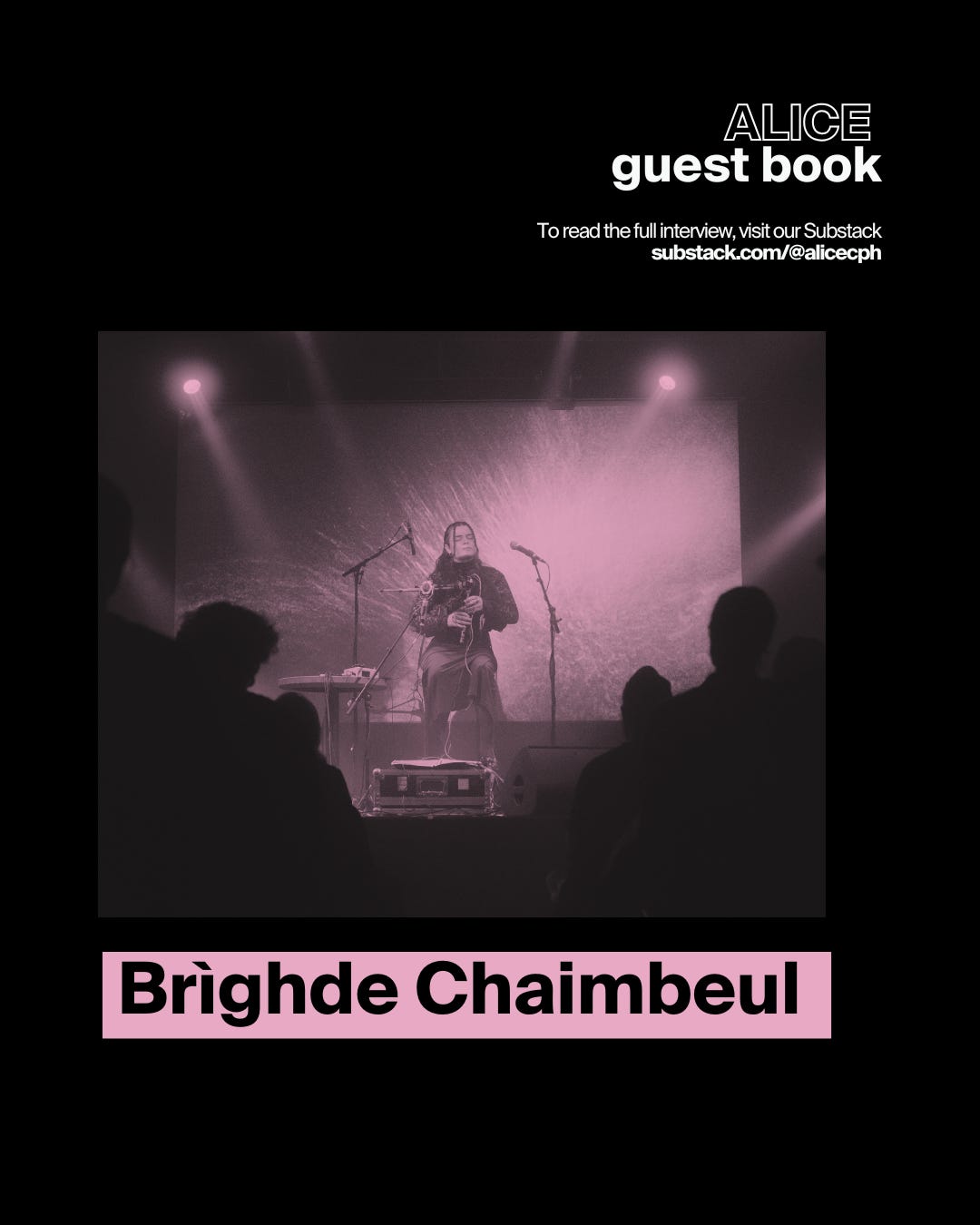
Scottish musician Brìghde Chaimbeul has captivated folk music fans and the experimental music community worldwide. Her exceptional bagpipe playing delves into deep Celtic traditions while simultaneously appealing to explorers of drone, ambient, and experimental music.
We had the pleasure of interviewing her before one of her two sold out shows in our concert hall in October.
Thanks for reading ALICEcph’s Substack! Subscribe for free to receive new posts and support my work.
What brought you to the pipes initially?
»I grew up in Slate, and first started learning the pipes with a neighbour of mine who was Greek. He played the pipes, and he taught me the foundations for a little while when I was quite young, maybe around 7 years old.«
Do you remember what it felt like, holding this instrument for the very first time?
»I do, actually! I was really drawn to it, and I loved playing it.«
What drew you to it?
»I don’t know, maybe it was the challenge. You have to figure out where to put your fingers and things like that.«
It does look a bit complicated to play pipes!
»Yeah, there’s a lot to it – coordination and so on. But I think that was part of what I enjoyed about it; it was never a chore. There’s also something I can’t really describe. I just liked it, and it suited me. It felt quite natural, for some reason.«
You transitioned from the Highland Pipes to the Scottish Small Pipes when you were around 15 years old. How do you play them?
»Essentially, there’s a pump attached to my elbow, and the air goes through the pipes by pumping the bellows. Because you’re blowing cold air instead of moist air, the reeds can be softer, so the tone is a lot more mellow.«
It’s my impression that there’s a lot of lore surrounding the pipes. What’s your favourite part of its history?
»I like that it’s part of a wider culture, not just an instrument on its own. Sometimes the pipes have a reputation for being a separate thing, but the music is really connected to song and dance.«
A lot of your material comes from old traditional tunes. Could you tell us more about how you find these?
»I like going to archives. We’re lucky in Scotland to have a great online resource from the School of Scottish Studies, which is full of digitised field recordings. You can also go to the library in Edinburgh itself – I’ve gone there too. There are melodies on my last record Sunwise that I came across this way, and on the one before that, Carry Them With Us, a few were found the same way.«
What does it feel like when you discover something great in the archives?
»If you find something you haven’t heard before and you love it, you can sort of become addicted to that melody.«
What do you typically search for?
»Stories or songs from a particular area, like Skye or Uist in the Outer Hebrides. Sometimes there’s a hidden song inside a story: someone will be telling a story, and in it a character sings a song.«
What is the best creative advice you’ve ever been given?
»Hmm. Good question. I think the best advice is just to find your authenticity. Figure out your own style, and the honesty in that. Play what you love, and what resonates with you. That will always come across.«
Who inspires you at the moment?
»Colin Stetson. I made my second record Carry Them With Us with him, and he continues to inspire me. There’s also a traditional piper and singer called Callum Johnston, and I listen to his recordings a lot. There’s so much soul in his music. They’re old recordings, but it feels like you’re right there with him.«
I’d be curious to hear you talk more about collaborating with musicians across traditions and genres. You’ve done that with saxophonist Colin Stetson and singer Caroline Polachek. What do you appreciate about it?
»I like feeling outside my comfort zone, learning something new, and creating sounds I haven’t tried before. When you play with people from different backgrounds, we approach the music with different ears and different contexts. That forces you to listen in a new way, or think about music differently.«
Do you have an example?
»When I play with people who have no background in traditional Scottish or Irish music, they hear the timing differently, which is really interesting – I’m so rooted in the traditional time signatures and dances. So when you shift the emphasis, the whole rhythm changes. Maybe in a tune I hear the stress in a certain place, but someone else hears it on a completely different beat. Changing the emphasis changes the whole feel of the tune.«
You grew up on the Isle of Skye, and your music is so connected to that place. Is there something in particular you’d like people to know about it, music-wise?
»There’s a famous piper family called the MacCrimmons, who were pipers to the landlords in a place in Skye called Dunvegan. That’s historical, but in the folklore people say the fairies gave them the gift of piping. I quite like that. It’s always the fairies. They’re always doing something with the pipes.«
What are these fairies like?
»Gaelic fairies are mischievous. You have to keep them happy. If you annoy a fairy, they’ll mess things up.«
Do they appear at certain times?
»I think they mostly appear when it’s dark and stormy. You might hear music playing somewhere, and you’ll come across them in their fairy mound — but if you go in, you’ll be stuck there forever.«
So be aware!
»Be aware of the fairies. Don’t piss them off.«
The ALICE Guest Book is an interview format where, through conversations with artists who have recently performed on our stage, we gather inspiration, advice, anecdotes, and even recommendations for other artists on the ALICE program that are worth experiencing. With the guest book, you can get closer to the personalities you may have just seen live and hear what drives them as musicians, people, and music fans. The guest book is a place where very different artists leave their mark side by side—together forming a picture of what it means to be a creative artist today.
You can read all the interviews in the guest book here on our Substack: substack.com/@alicecph.
Thanks for reading ALICEcph’s Substack! Subscribe for free to receive new posts and support my work.
Comments
Nothing yet. Say the first thing.
Sign in to join the conversation.