
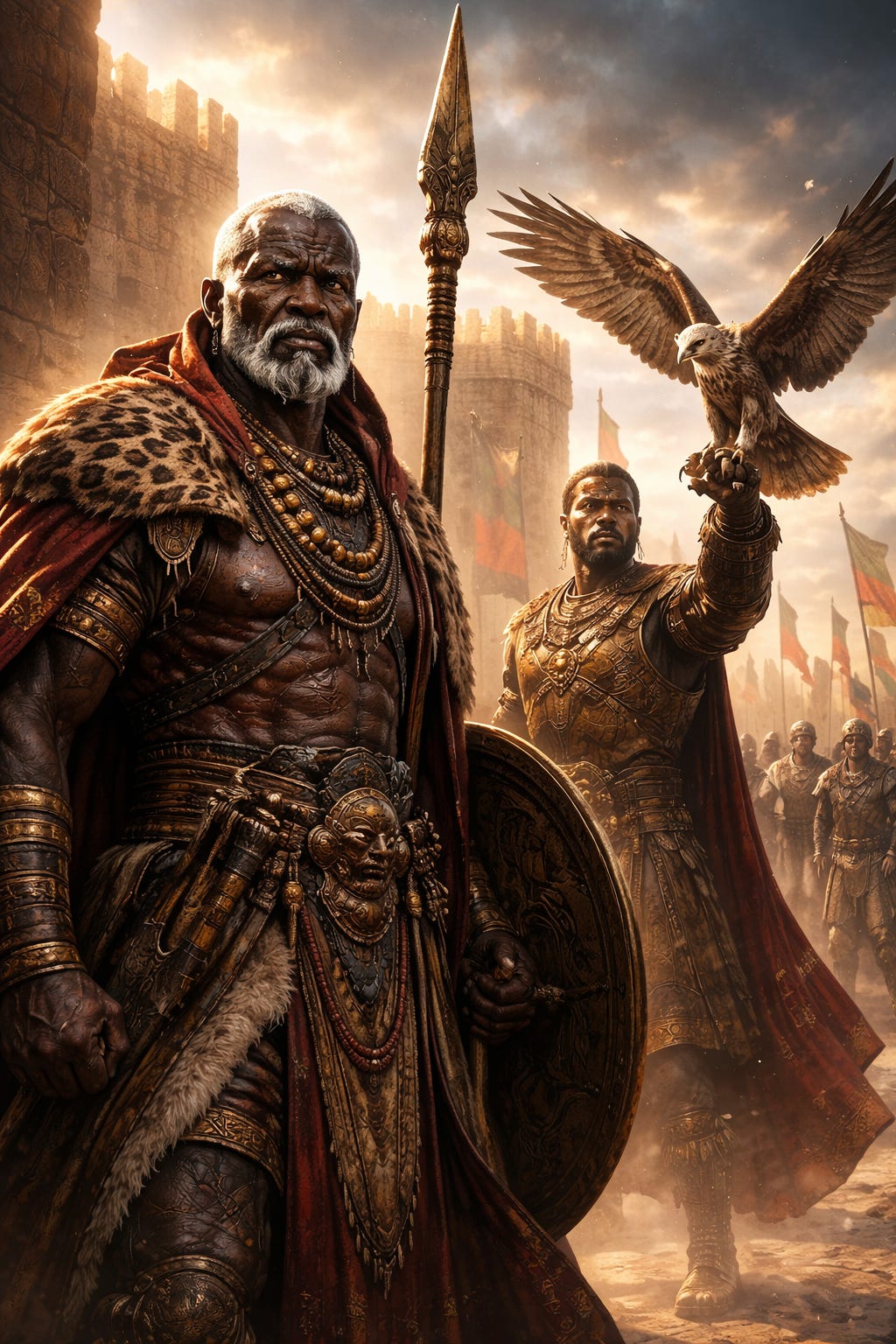
A sacred trust is assigned, a hawk is withheld, and an elder warrior discovers what those above him truly think of his life
Part I: The Certainty That Became Its Own Undoing
The kingdom moved with the disciplined calm that comes after weeks of successful campaigns. Scouts returned to the command camp as the sun dropped below the western hills, their horses barely lathered, their reports consistent: quiet roads, abandoned enemy positions, villages empty of threat. Fires burned low throughout the encampment, their smoke rising straight into still air that carried no tension, no whisper of danger approaching.
Confidence settled into the generals like warm armor worn so long it felt like skin. They had pushed the enemy back across three provinces. Supply lines held. Morale remained high. The war, while not won, had found its rhythm—and rhythm breeds certainty even where certainty has no right to live.
The village in question earned the label cleared after a single sweep by a forward unit. The word was spoken once by a junior officer, repeated by his captain, and entered into the command log by a scribe who had never seen the place. No second sweep occurred. No dissent gained air. The map showed empty space where danger once lived, and empty space asked nothing of those who studied it. It simply waited, patient as stone, for someone to test whether the label matched the truth.
The elder received the assignment without ceremony. A messenger arrived at his tent just after the evening meal, carrying orders written in the general’s own hand. A village needed securing—not conquest, not rescue, simply presence. He would take a small contingent: two seasoned warriors who had served under him for years, three young soldiers still learning the weight of their blades and the longer weight of responsibility. Simple work for a man who had spent thirty years navigating complex battles, who had held positions when holding meant choosing between death and dishonor, who carried in his body the proof that he had chosen neither.
He studied the terrain map longer than expected. The parchment lay flat on the wooden camp table, held down at the corners by smooth river stones. His finger traced the approaches, the ridgelines, the narrow places where sight failed and assumption became dangerous. The village sat in a small valley, three roads leading in, high ground on two sides. Good for defense if you held it. Good for ambush if you did not.
His instincts whispered caution the way old wounds whisper before rain—not with words, but with a tightening in the chest, a weight in the limbs that no amount of rest could lift. He had learned over decades to trust this whisper more than he trusted maps drawn by men who had not walked the ground they rendered in ink.
But the generals spoke with the certainty of men who had already moved past doubt. The village was cleared. The war was turning. Resources could not be wasted on excessive caution. The elder was being honored with a quiet posting, a chance to rest while still serving, to let younger men take the harder assignments.
Then the hawk was taken…
The order came just as he was preparing to depart, delivered by the same messenger who had brought the assignment. The general required the hawk for another purpose—communications to the eastern front, a matter of some urgency. The elder would not need it. The village was safe. The distance was short. If anything unexpected occurred, a runner could return in less than a day.
The order sounded procedural, almost forgettable, the kind of minor administrative detail that fills the gaps between larger decisions. Yet every seasoned warrior knew what the hawk meant. It was voice when distance silenced the mouth. It was the thread connecting the forward position to the command tent, the lone soldier to the assembled army, the vulnerable to those sworn to protect them. The hawk did not guarantee safety, but it guaranteed witness—and witness, in its way, was a form of protection. To remove it was to sever that thread deliberately, to say with action what no leader would say with words: *You are alone. What happens to you will reach us only as slowly as your feet can carry the news.*
This moment planted the seed of what would follow. Harm rarely announces itself with trumpets. Harm begins when vigilance relaxes into routine, when precaution becomes inconvenience, when those who should know better choose the comfort of certainty over the discomfort of care.
“Why does this mission go without a hawk?” the elder asked.
He stood in the command tent, the map of the region spread before them, the general and his lieutenant reviewing troop movements with the efficiency of men who had worked together so long they finished each other’s tactical thoughts. They looked up at the question, not with irritation exactly, but with the mild surprise of people interrupted by something they had already resolved.
The general’s response came easily, practiced, delivered in the tone of someone explaining what should be obvious. “Because nothing there calls for one. The village is quiet. The enemy has withdrawn. You will secure it, rest your men, and return with stories, not warnings.”
The elder held his gaze a moment longer than respect required. Long enough for the general to register the weight of the silence. Long enough for the lieutenant to glance between them, sensing something unspoken moving in the space where words should be.
Then the elder nodded. Authority recognizes authority, even in disagreement—especially in disagreement. A subordinate who cannot yield wastes everyone’s time. A leader who cannot question wastes everyone’s life. The elder had learned to do both, to know when each was required.
He would go. The orders were clear. The reasoning, if flawed, was at least comprehensible. But the absence of the hawk sat in his chest like a stone dropped into deep water, sinking slowly toward a bottom he could not see but knew was there.
Part II: Praise on Their Lips, Contempt in Their Hearts
I had seen the elder many times before that day, though I cannot say I knew him. Men like him exist in the army the way mountains exist in a landscape—always present, shaping everything around them without needing to announce themselves.
He carried history in his posture. When he walked through the camp, younger soldiers straightened without thinking about it, the way a man straightens when he passes a shrine. Not from fear. From recognition. He had fought in the long campaigns to the east, the ones most of us only heard about when older warriors gathered around fires and their voices dropped into that particular cadence memory requires.
His scars told stories his mouth did not. I saw them once when he bathed at the river after a brutal march through country that gave no shade. Three fingers on his left hand no longer closed properly—a spear shaft had crushed them against his shield years before. But the injury that defined him lived in his back and neck, where most men could not see it but everyone could sense it in the way he moved.
An arrow had found his spine in one of those eastern battles, entering just below his shoulder blade at an angle that should have left him dead or unable to walk. Somehow he had survived. Then, seasons later, another spear had caught him low in the back during an ambush, the blade sliding between vertebrae, seeking to sever what the arrow had only wounded. That he could still stand, still fight, still command—this was spoken of quietly, the way men speak of things that approach the miraculous without quite reaching it.
He walked with care, each step deliberate, his spine held in a way that suggested movement cost him more than he would ever say. When he bent to lift something, he did so from the knees, keeping his back rigid. When he sat, it took him longer than it should to rise. The pain lived with him the way a shadow lives with a man—constant, patient, impossible to outrun.
Respect surrounded him in speech. The generals invoked his name when they needed to inspire the younger soldiers. *The elder held the riverbank at Kuron with forty men against two hundred.* *The elder led the raid that freed the captives at Madara.* They spoke of him the way griots speak of ancestors—distant, glorious, useful for instruction but not for consultation.
Yet respect thinned in practice. I noticed this gradually, the way you notice a friendship cooling—not in any single moment, but in the accumulation of small adjustments. When he spoke in the war councils, the generals nodded, thanked him for his counsel, then proceeded as if he had not spoken. When he questioned a strategy, they heard caution as fear, experience as exhaustion, wisdom as age questioning youth.
This quiet shift mattered, though I did not understand how much until later. Once elders become symbols instead of counselors, wisdom loses jurisdiction. They become the stories we tell about who we used to be, rather than the voices that warn us about who we are becoming.
The evening before he departed for the village, I was passing near his tent when I saw the lieutenant approach him. The elder was preparing his gear, working through the methodical sequence every seasoned warrior knows—spear, shield, water gourd, rations, sleeping mat, the small rituals that keep a man alive when distance separates him from supply.
The lieutenant was young enough to be the elder’s son, though he had earned his rank honestly. I had watched him in battle. He did not freeze. He did not waste men. He understood that courage without intelligence is just another word for death.
“You taught half this army how to stand its ground,” the lieutenant said.
The elder did not look up from the spearhead he was inspecting, checking the binding where iron met wood, testing for weakness the way a man tests ice before crossing a frozen stream. “Then let the other half learn how to question certainty.”
The words hung in the air between them. The lieutenant paused, his hand resting on the hilt of his blade, his expression uncertain. He seemed to be deciding whether to hear this as wisdom or criticism, instruction or rebuke. In the end, he chose neither. He nodded—the kind of nod that acknowledges sound without committing to meaning—and left the elder to his preparations.
I watched the lieutenant walk back toward the command tent, his stride just slightly quicker than it had been when he approached, as if he were trying to leave the conversation behind him.
The elder continued his work, the rhythm unchanged, his face showing nothing I could read. But I remember thinking, even then, that something had just happened that mattered more than the words suggested. A warning had been offered. Whether it had been heard, I could not say.
Part III: Blood Spilled Where Indifference Stood Guard
I was not there when it happened. What I know comes from the young soldier who survived—the one who crawled back with the elder days later, his eyes carrying that particular emptiness that comes after a man watches certainty collapse into chaos in the space between one breath and the next.
He told it to me in fragments, the way trauma tells itself, circling the center without ever quite landing there. I have tried to piece it together into something that resembles order, though I suspect order is a lie we tell about violence to make it comprehensible.
The attack arrived without pageantry.
They had been in the village less than half a day. The elder had them working in pairs—one watching while the other searched the abandoned huts for signs of recent occupation. It was methodical, careful, the kind of caution that keeps men alive when they cannot afford to trust the reports others have given them.
The afternoon sun was beginning its descent, casting long shadows across the central clearing where they had stacked their packs and sleeping mats. One of the young soldiers was drawing water from the well. Another was preparing kindling for the evening fire. The two seasoned warriors stood near the elder, discussing where to post the night watch.
Then the dust rose.
Not wind-dust, which moves in gusts and swirls. This dust came from the sudden displacement of bodies emerging from positions that should not have held concealment. From beneath piled thatch. From inside huts that had appeared empty. From the tree line beyond the village edge where sight ended and assumption began.
The enemy came with the coordination that speaks of planning, not accident. They had waited—perhaps for hours, perhaps for days—for exactly this moment. For the moment when the clearing party would settle into the rhythm of occupation, when alertness would soften into routine.
Spears flashed in the slanting light. Voices erupted in a language the young soldier did not recognize but understood perfectly in its intent. The warrior drawing water at the well died first, a spear taking him in the throat before he could call out warning. His bucket fell, water spilling across packed earth that drank it immediately.
The two seasoned warriors moved to form a barrier around the elder without needing to speak. Their bodies read the terrain and threat with the fluency of long practice, shields raised, spears leveled, feet finding spacing that would let them support each other without crowding. The remaining young soldiers fought with the desperate competence of those learning in real time that training and battle are separated by a distance no drill can cross.
The elder moved among them despite his back, despite the pain that must have screamed with every pivot and thrust. His spear found the gaps their panic left open, his voice cutting through chaos with commands that gave shape to their defense. But there were too many attackers and too few defenders. The enemy had not stumbled upon them. They had waited. Prepared. Known.
The spear that found the elder’s side entered just below his ribs, angled upward, seeking the organs that keep a man breathing. He twisted away from it, but the motion sent fire through his damaged spine—the kind of pain that steals vision and makes the legs forget how to hold weight. Another spear caught him across the shoulders, the shaft rather than the blade, but with force enough that something cracked. Not bone. Something deeper. Something in that fragile architecture of nerve and vertebrae that had already been broken and healed and broken again.
He did not fall immediately. Falling is a decision the body makes when standing costs more than surrender. But eventually the mathematics of pain and blood loss and damaged spine assert themselves with an authority no will can overrule.
He fell.
“They were waiting,” one of the surviving young soldiers gasped, dragging the elder toward the meager cover of a low wall that marked the boundary of someone’s abandoned compound.
The elder’s vision narrowed, then widened, then narrowed again in waves that matched his heartbeat. Blood spread beneath him, warm and patient, following the contours of earth that had seen blood before and would see it again. His spine felt like it was filled with broken pottery, each shard grinding against the others when he tried to move.
“No.” His voice came out thinner than he intended, air escaping through damage he could not assess. “We were not looking.”
The attackers withdrew as suddenly as they had appeared. Not from mercy. From strategy. Let the wounded linger. Let them despair. Let thirst and infection and the slowness of rescue do what spears had started. Return later, if needed, to finish what fear had already begun.
In the silence that followed—a silence made heavier by the sound of the survivor’s ragged breathing and the elder’s soft groans whenever he shifted—the young soldier understood something the elder had already known.
The village had never been cleared. The label on the map had been a wish dressed as fact. And somewhere, many miles away, in a command tent where fires burned low and confidence sat easy, no one yet knew that certainty had collapsed.
No hawk had been sent because the hawk has been taken.
NEXT: The Abandonment That Followed Their Avarice
Thanks for reading Yusuf Jones! Subscribe for free to receive new posts and support my work.
Comments
Nothing yet. Say the first thing.
Sign in to join the conversation.