
Why do defensive sectors often produce some of the cleanest mean reversion trades?
And why do so many traders ignore them because they “look too boring”?
This post breaks down a daily mean reversion strategy built around Consumer Staples. The setup is simple, surprisingly robust and behaves differently from the typical Nasdaq-style reversal systems that I usually share.
Consumer Staples tend to behave differently from high-beta growth markets.
When these stocks sell off aggressively, the move is often driven more by short-term market stress than by a real deterioration in the underlying businesses. Institutions still want exposure to stable cash-flow companies, especially during uncertainty.
That creates a recurring pattern: sharp temporary weakness followed by quick stabilization and recovery.
The market overreacts. Then mean reverts.
Not every time, of course. But often enough to build a systematic edge around it.
This is a daily mean reversion strategy designed to capture temporary weakness in Consumer Staples after abnormal downside movement.
The system looks for stretched conditions combined with intraday positioning behaviour, then exits once price strength returns. It’s a very “short-duration” strategy, fast in, fast out, low time exposure.
What I like about it is how clean the logic feels. No complicated regime filters. No stack of indicators trying to force trades.
Just a simple behavioural tendency. This creates opportunity for added conditions and components to this strategy, I am sure this idea can be improved upon.
Most traders associate mean reversion with highly volatile indices like Nasdaq or small caps.
But defensive sectors can actually produce cleaner reversals because panic tends to fade faster there.
When Consumer Staples get hit unusually hard, buyers often step back in quickly. Pension funds, institutions, and defensive allocators still want exposure. That creates a natural “snapback” effect after temporary weakness.
The exit logic then takes advantage of momentum returning after the panic phase ends.
Market: US Equities
Instrument: Consumer Staples ETF (XLP)
Broker: Interactive Brokers
Platform: ProRealTime
Timeframe: Daily
Time Zone: US Market Hours
Backtest Period: 2000–2026
Fees/Commissions: 1.25€/order Included in backtest assumptions
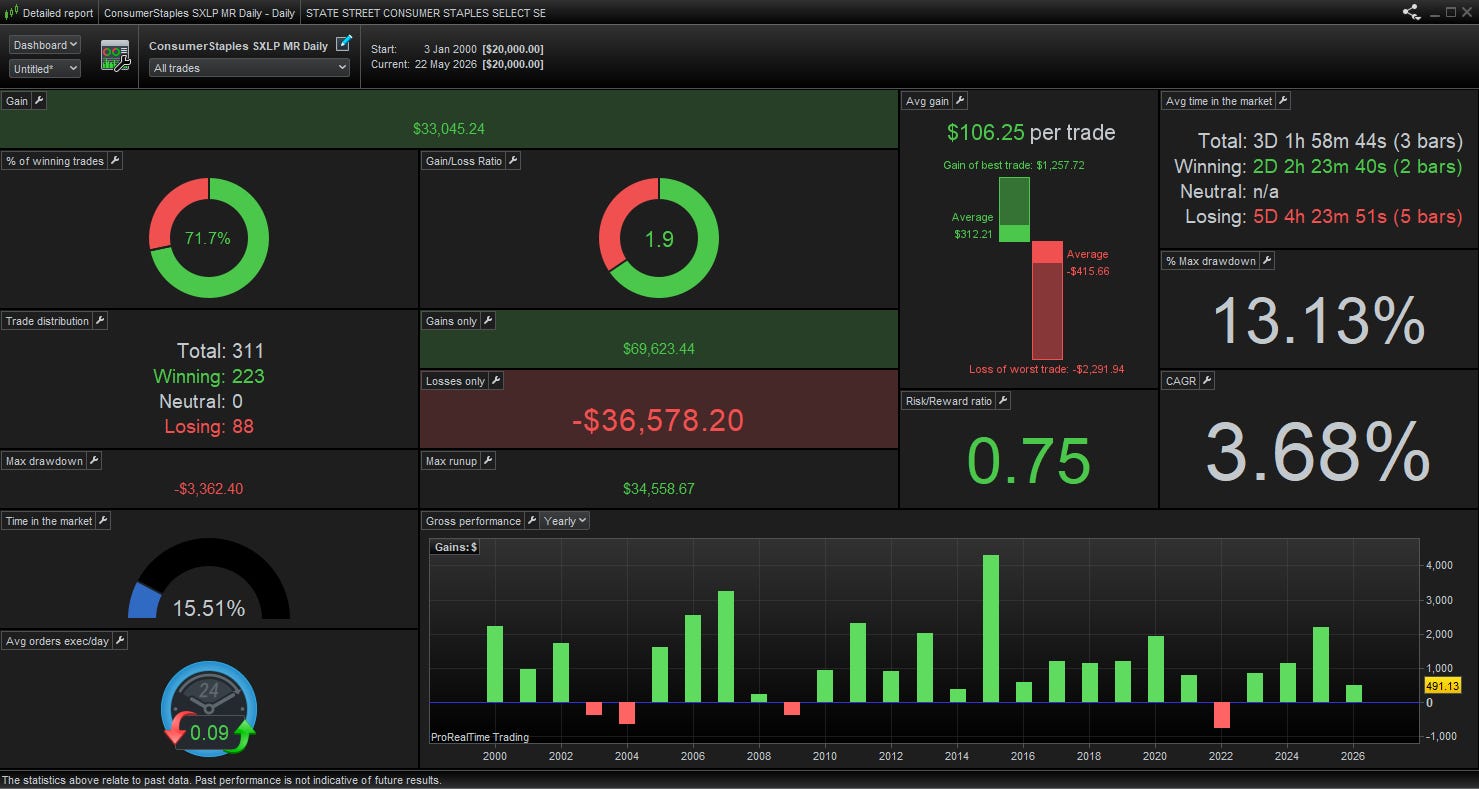
Total Gain: $33 045
Average Gain per Trade: $106
Total Trades: 311
Winners / Losers: 223 / 88
Win Rate: 71.7%
Max Drawdown: -13.13%
Risk/Reward Ratio: 0.75
Time in Market: 15.51%
Average Trade Duration: 3 days 2 hours
CAGR: 3.68%
MAR Ratio: 0.28
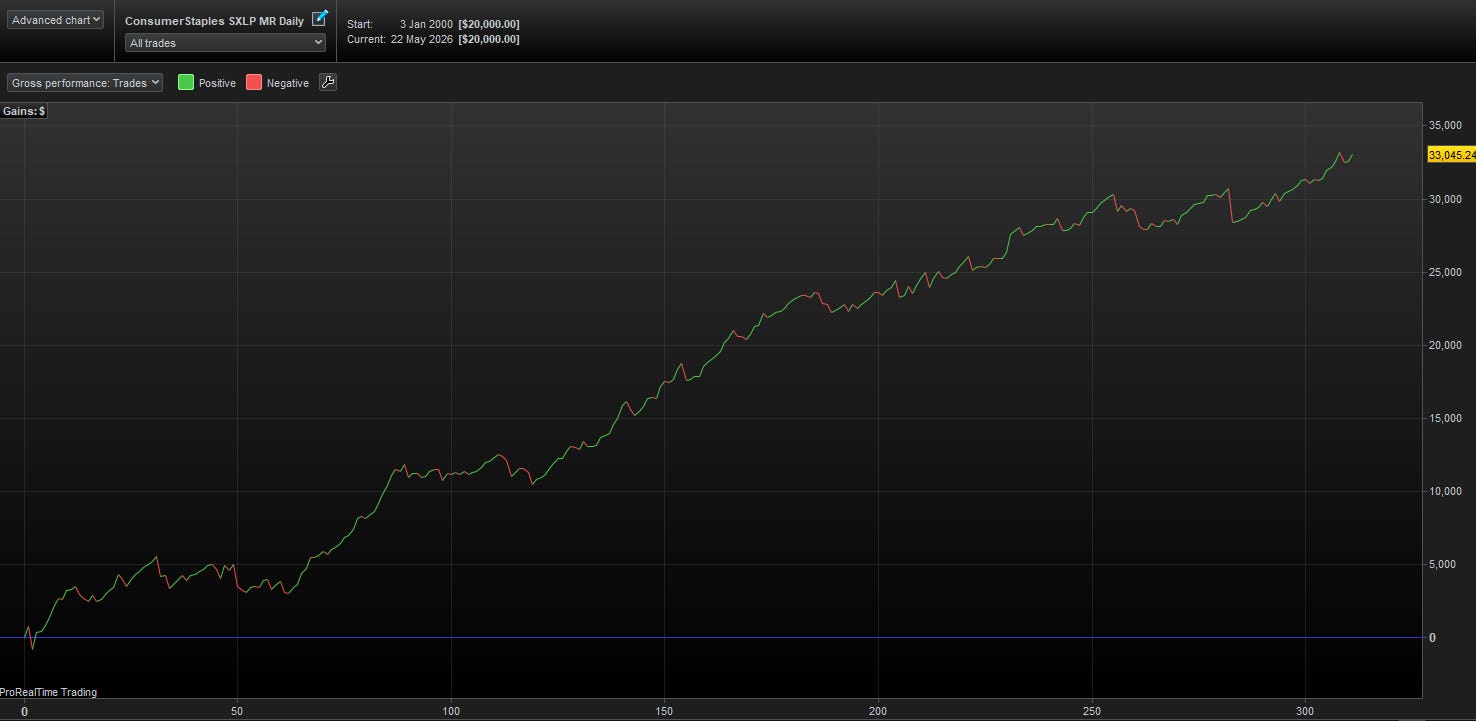
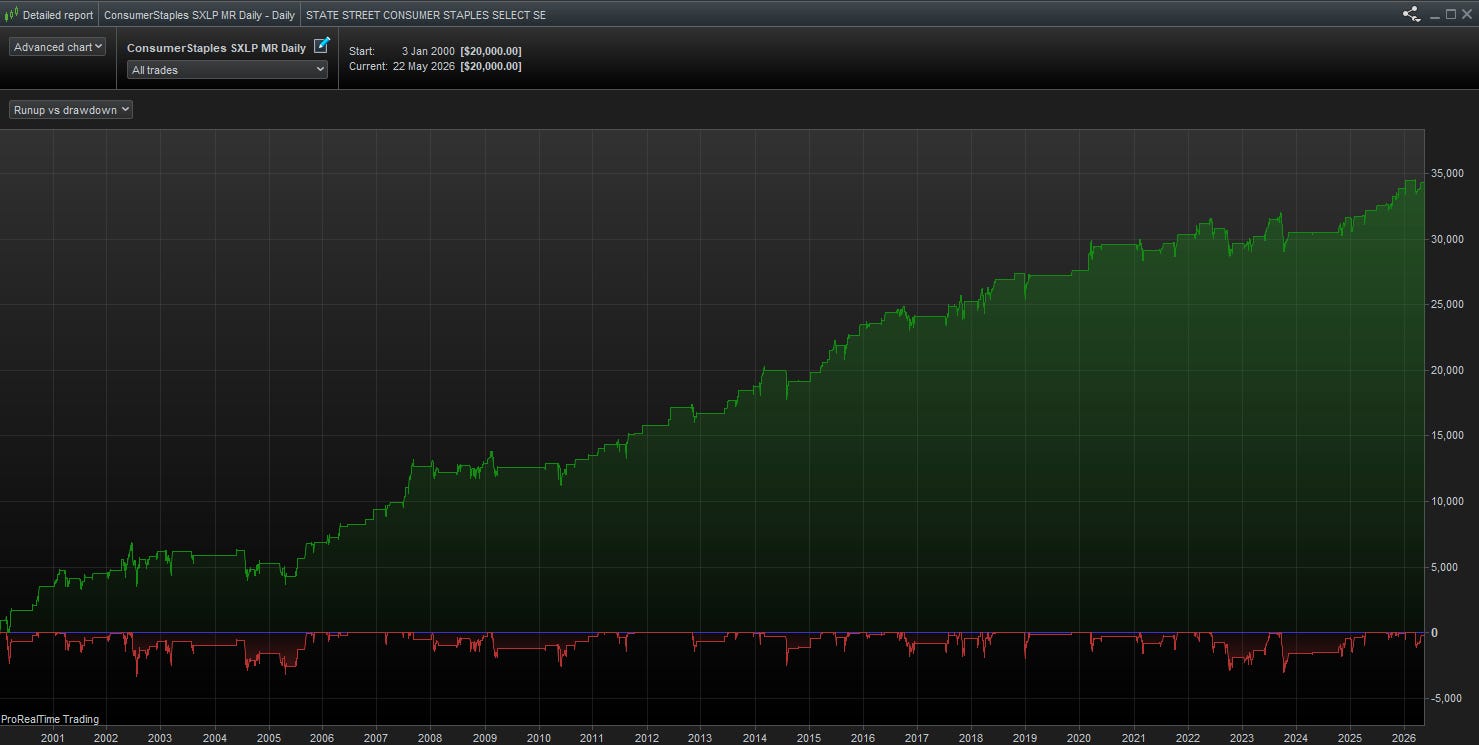
What stands out immediately is the consistency.
The raw returns are moderate but there’s a lot of room for improvement with this strategy, it’s extremely simple at this stage with only two entry conditions and one exit and the system is only in the market 15% of the time. That makes it more interesting as a portfolio component than as a standalone strategy.
The low time-in-market is also interesting. The system spends most of its life sitting in cash waiting for stretched conditions.
That’s something I personally like in mean reversion systems.
I didn’t just stop at US Consumer Staples.
I ran the same core idea on the European Consumer Staples market as well and honestly, I expected the results to weaken quite a bit.
They didn’t.
That’s usually a good sign with mean reversion concepts. When an edge survives across multiple regions without needing completely different logic, it suggests there may be something structural underneath the pattern.
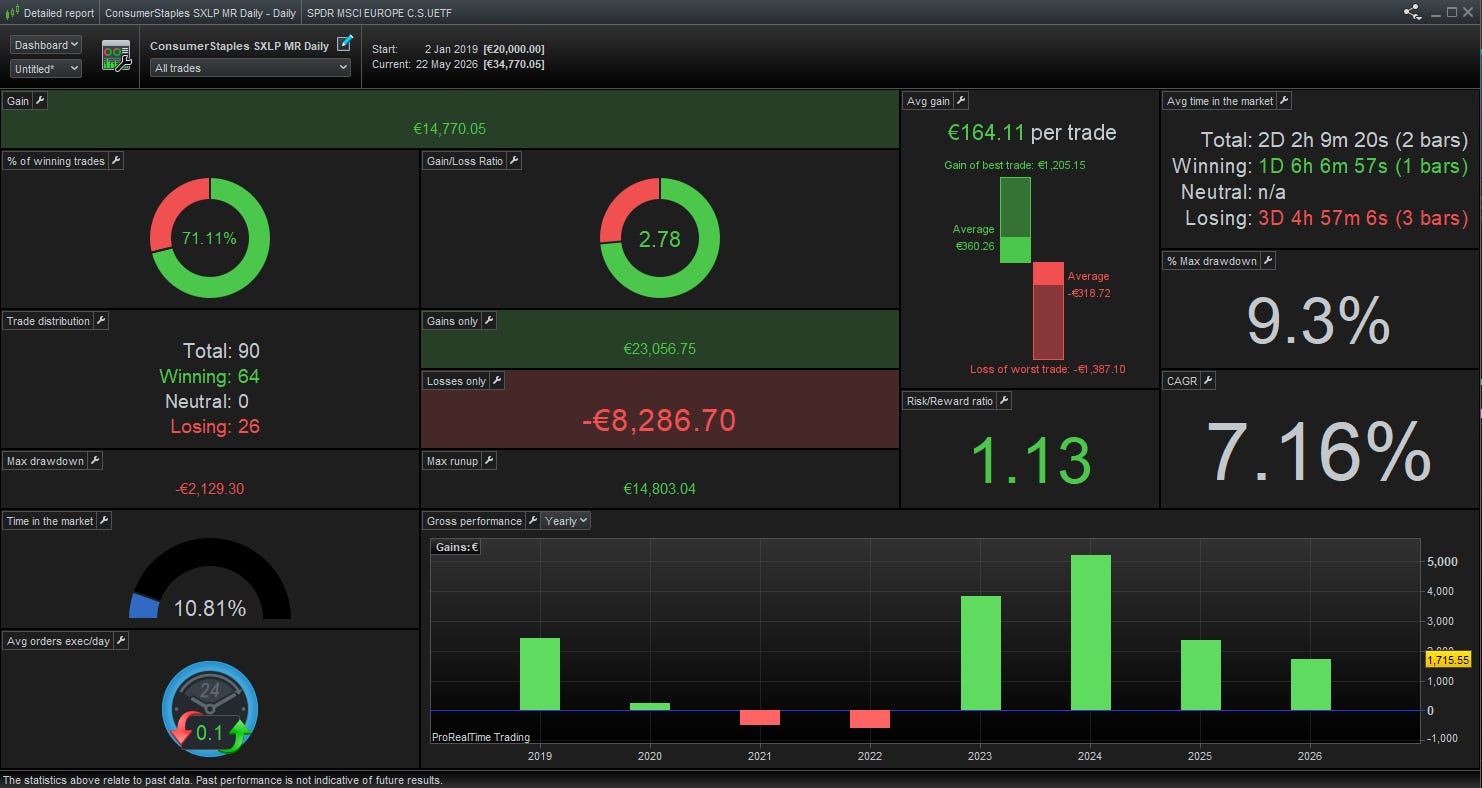
The data I had on SPYC was only from 2019, so here is the backtest from 2019-2026.
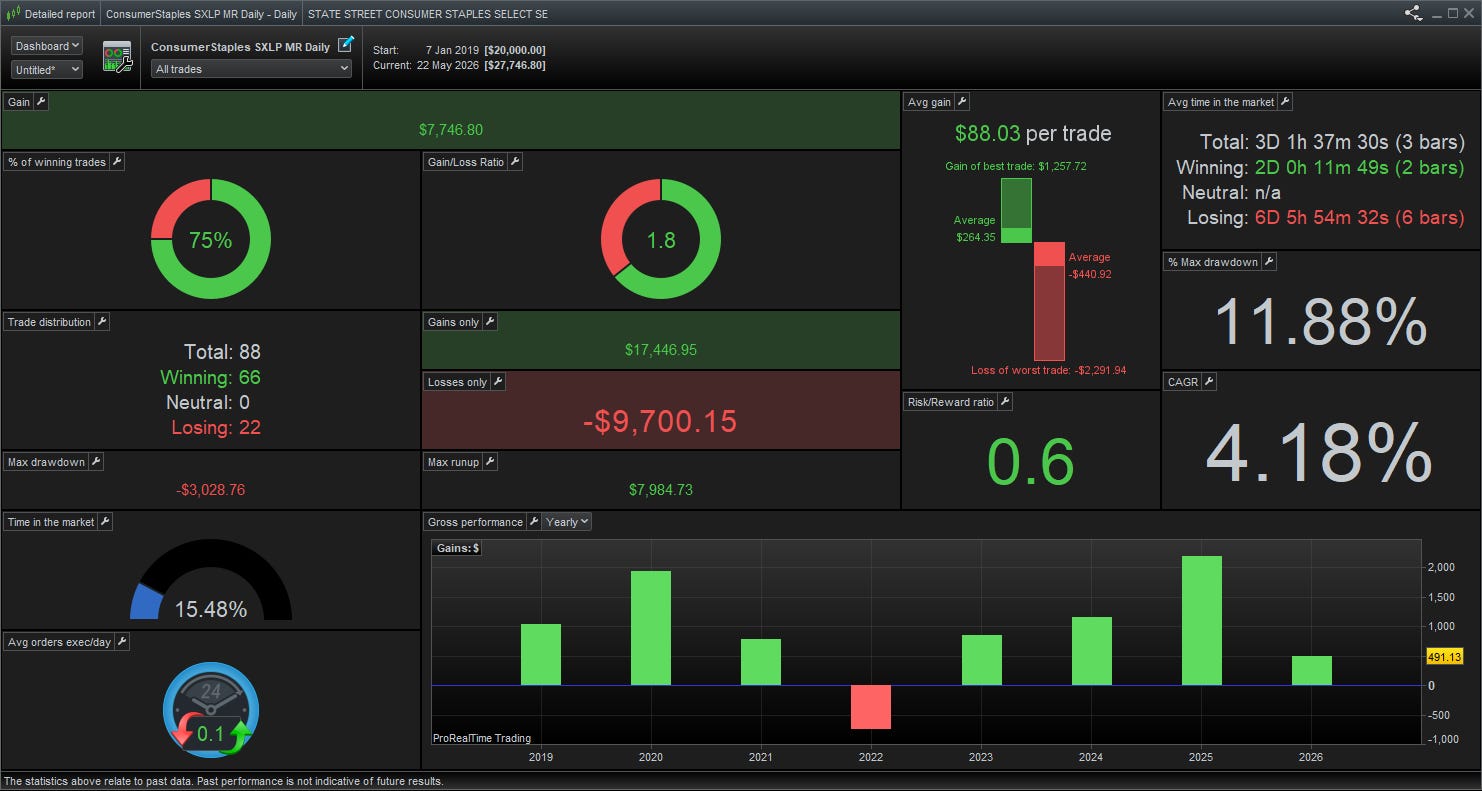
I expected this strategy to behave similarly to typical index mean reversion systems.
It didn’t.
The equity curve was noticeably smoother, and the rebounds tended to happen faster than I expected. Drawdowns were also shallower than most Nasdaq-focused reversal systems I’ve tested.
Want to see how this strategy (and all my others) are actually performing?
I’ve built a public tracker that shows the real returns of every strategy I’ve published.
👉 View the strategy tracker here
[Full strategy code including all parameters and detailed explanation for easy translation]
Comments
Nothing yet. Say the first thing.
Sign in to join the conversation.