
Before we get into the portfolio itself, it’s worth taking a step back.
Gold is not just another market.
It sits at the intersection of macro uncertainty, monetary policy, and global liquidity. Over the past years, we’ve seen a clear shift: higher structural inflation, increasing geopolitical tension and central banks becoming persistent buyers of gold.
That combination matters. Because it creates an environment where gold is no longer just a hedge, it becomes a core asset with sustained demand and could drive it into a longer-term bull trend. That is just me speculating though.
From a trading perspective, this is exactly what you want:
A market that trends when macro conditions align but also mean-reverts aggressively during volatility spikes and offers clean, liquid price action across timeframes.
That’s why I’ve increasingly focused on gold.
Not because it always goes up (it kinda does) but because it consistently produces tradable structure.
If you believe gold has a structural tailwind, the next question becomes:
How do you get exposure?
Most investors get exposure by:
Buying and holding
Timing discretionary entries
Or reacting to macro narratives
The problem is that all three of those approaches are psychologically difficult, really hard to consistently execute and often poorly timed.
This is where systematic trading changes the game.
Instead of guessing:
You enter on defined signals
You size positions based on volatility
You let multiple systems manage exposure dynamically
And importantly:
You stay long when the market rewards it and step aside when it doesn’t.
That’s why I personally believe that trading gold with structured, mostly long-biased systems is one of the most robust ways to gain exposure.
You capture the upside without being forced to sit through every drawdown.
In this article, we will be building a Gold-focused multi-strategy portfolio combining trend-following, breakout logic and mean-reversion across timeframes.
Strategy #17: Gold Trend Breakout (Daily)
A structured trend-following system using smoothed moving averages and breakout confirmation. It enters strong directional moves and rides sustained trends with ATR-based risk control.Strategy #8: Donchian Breakout (Daily)
A classic breakout system capturing momentum expansions. Works best during strong directional phases when price pushes beyond recent highs.Strategy #7: Gold Stochastic Extremes (2H)
A short-term mean-reversion system trading both long and short. Exploits overbought/oversold conditions and benefits from intraday volatility.Strategy #1: MACD Hook (Daily)
A momentum-based pullback system. Enters trends after temporary weakness, capturing continuation moves rather than breakouts.Upcoming Strategy (4H)
A short-term mean-reversion system that buys sharp dips using IBS readings within an established uptrend. It enters during short-term weakness and exits using a volatility-based trailing stop, capturing quick snapbacks in price.
When trend-following struggles in choppy markets, Strategy #7 and the unreleased strategy step in and captures mean-reverting moves.
When mean-reversion gets run over by strong trends, Strategies #17 and #8 take over.
When breakouts are late, Strategy #1 captures earlier trend continuation entries.
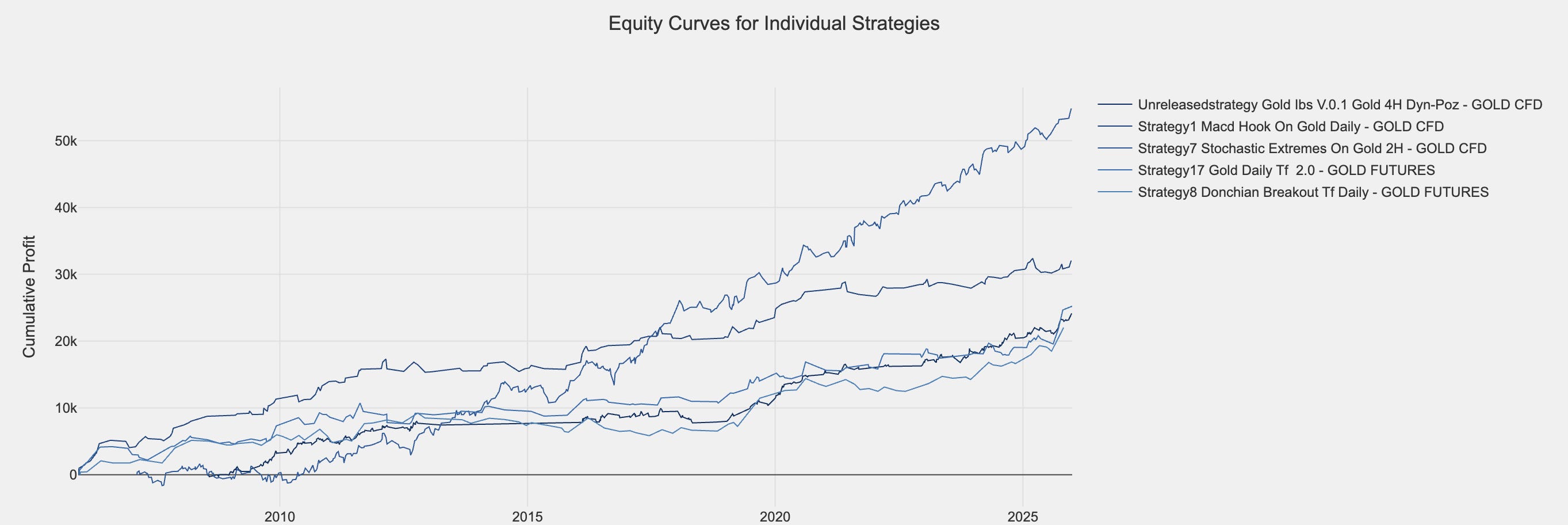
Each system has weaknesses but together, they cover each other’s blind spots.
1. Behavioral Offsets
Trend-following and mean-reversion naturally perform in opposite environments. Combining them reduces equity curve volatility.
2. Timeframe Diversification
Daily systems capture macro moves. Intraday systems extract shorter-term inefficiencies.
3. Market Structure Balance
Breakouts, pullbacks, and reversals are all represented, meaning no single market behavior dominates the portfolio.
4. Volatility-Aware Position Sizing
All systems use ATR-based sizing, ensuring consistent risk across changing market conditions.
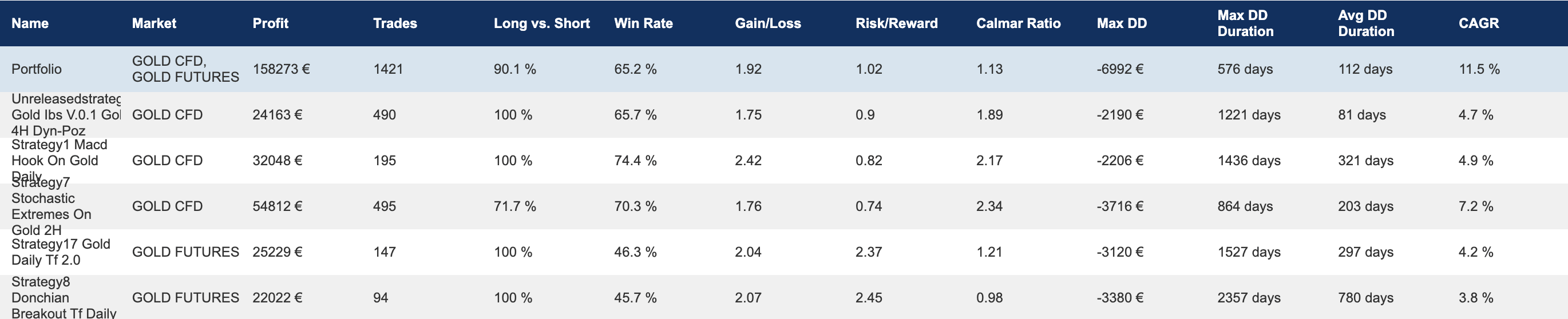
CAGR: 11.5%
Max Drawdown: -10.2%
MAR Ratio: 1.11
Win Rate: 65.2%
Gain/Loss Ratio: 1.92
Average Drawdown Duration: 112 days
Total Trades: 1421
Spread: 0.5 Points
Individually, each system may produce modest returns with uneven performance.
But when combined, something interesting happens:
Returns compound, while volatility compresses.
Drawdowns become shorter. Recovery becomes faster. And most importantly the portfolio becomes tradable in real life, not just on paper.
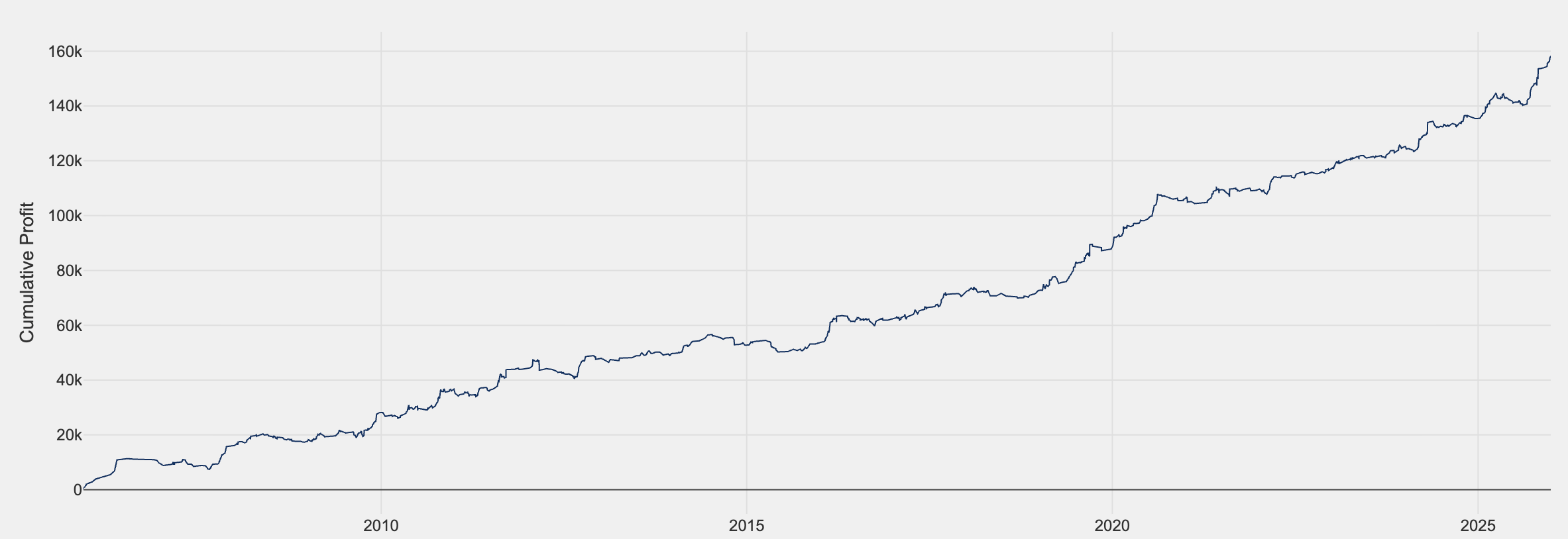
What stands out with this portfolio is how smooth the combined equity curve becomes compared to individual systems even if they all are trading just one asset.
You’ll notice clear regime rotation between these strategies:
Trending periods → breakout and trend systems dominate
Choppy/volatile periods → mean-reversion takes over
Transitional phases → pullback systems fill the gap
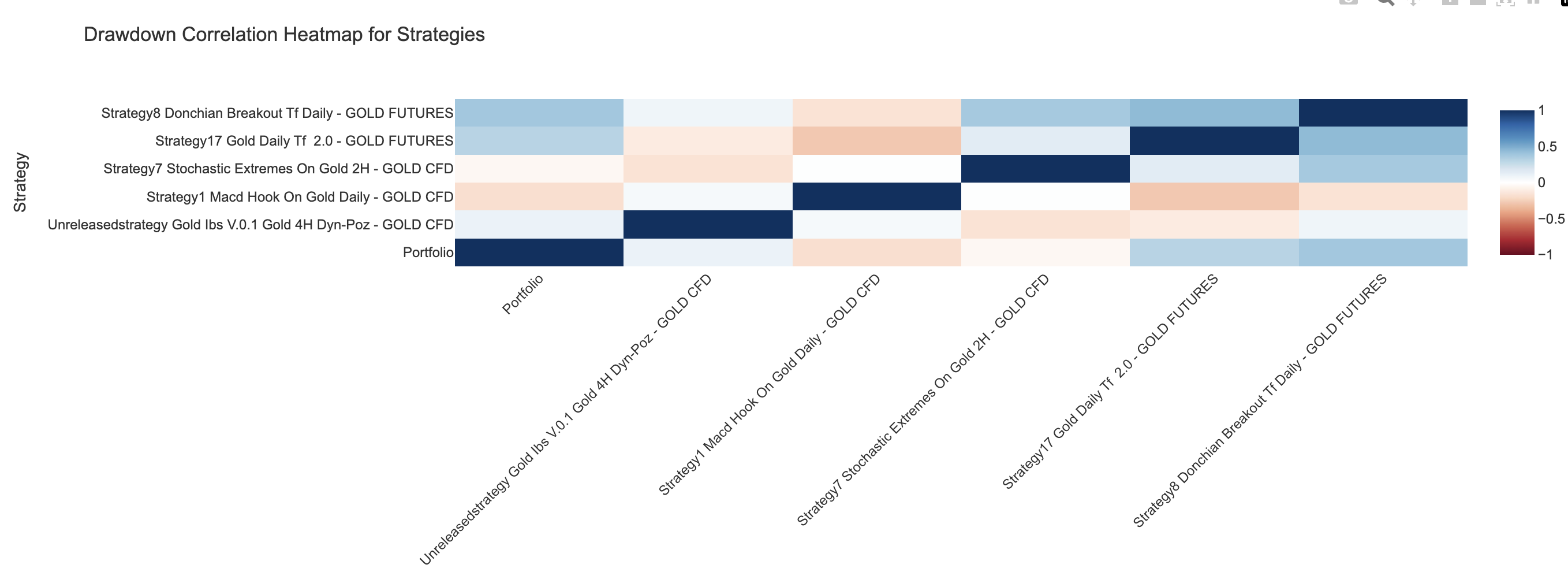
As you can see in the image above, the drawdown correlation looks pretty good for being on the same asset. This proves that different strategies, timeframes and methodologies can have a purpose even if they all are trading the same asset.
Imagine what kind of portfolios you could achieve trading different assets.
That’s why I created the Algomatic Trading Database, so you can pick and choose from a bank of strategies and decide which ones are perfect for your portfolio.
To celebrate the continued growth of Algomatic Trading and as a thank you to everyone following along I’m offering a 15% discount on the Premium Membership for one week, which means it’s now only 339€ instead of 399€.
This gives you:
Full access to all strategy code + parameters
The complete strategy library
All upcoming portfolio combinations and research
Continuous updates and live performance tracking
If you’ve been considering upgrading, this is the best time.
Diversification isn’t random, it’s logical
Small edges compound when combined correctly
Different market regimes require different systems
ATR-based sizing is key to stability
Portfolios > individual strategies
Upcoming Strategy: Internal Bar Strength - buying short-term dips
Disclaimer: I am not a financial advisor and I don’t recommend you to trade my strategies. This article is for informational and educational purposes only. Trading involves risk, and you can lose money. Always do your own research.
No posts
Comments
Nothing yet. Say the first thing.
Sign in to join the conversation.