
0:00
-14:10
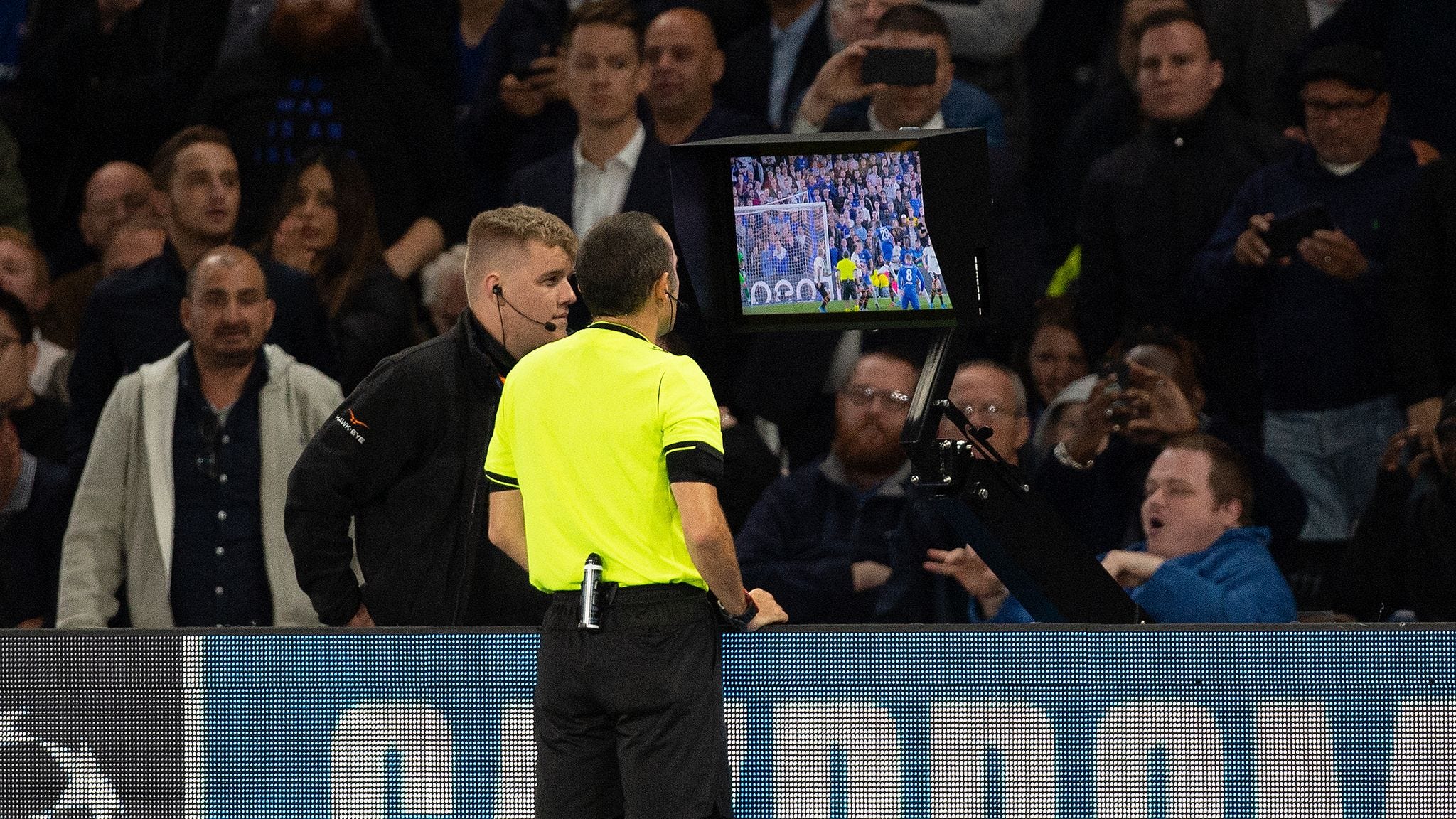
Soccer needed VAR because it was facing a crisis of correctness. The crisis did not emerge because players were committing more fouls or because referees were missing more of them, but because starting in the late aughts, every soccer fan on earth suddenly had their own personal replay center in their pocket.
Until then, missed calls had been bemoaned but accepted parts of the game. Maradona’s famous Hand of God goal, of course, had helped knock the English out of the 1986 World Cup quarter-final, just as Geoff Hurst’s ghost goal in the 1966 Final won England that year’s cup, and Rivaldo’s dive helped Brazil beat Turkey in the 2002 edition. Referees missed big calls that decided big games, but it never threatened the legitimacy of the game itself.
But that began to change once technology made it significantly easier to capture, clip, and share magnified, slow-motion versions of these incidents on social media. Those missed calls, which looked questionable live, looked abominable on the fifth or tenth replay. Incidents like Henry’s handball to knock Ireland out of the 2010 World Cup qualifiers and Lampard’s ghost goal against Germany in the tournament’s Round of 16 went viral and sat in the public discourse for weeks.
Up to that 2010 World Cup, soccer refereeing was charmingly analog. Despite sports like tennis, cricket, and American football successfully adding video replay systems as early as the 1980s, soccer steadfastly resisted. But as soccer fans got more access to replay technology, the pressure on soccer’s governing bodies became untenable, and ahead of the 2018 Russia World Cup, FIFA announced the implementation of Video Assistant Referee Technology, or VAR.
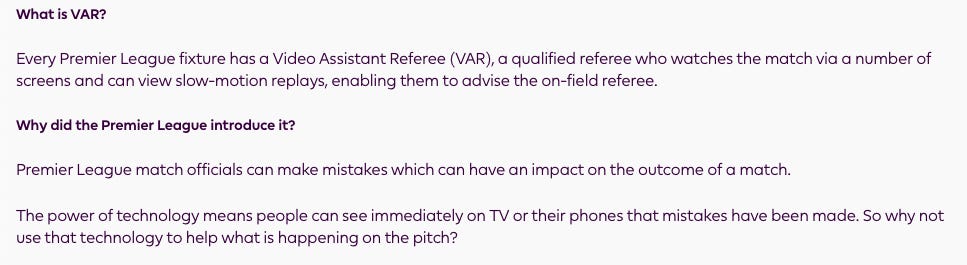
Since its widespread introduction in 2018, VAR has effectively solved soccer’s correctness problem by making decisions more accurate and the game more fair. In the 2018/19 season, the year before the Premier League introduced VAR, referees got 82% of key match decisions correct. Last season, that number was 97%. Except for a handful of high-profile misses1, soccer’s biggest decisions are now almost always correct.
So why then, when you ask a soccer fan, do they all seem to hate VAR? It’s because in soccer’s quest to solve its crisis of correctness with VAR, they sacrificed another key component of the game’s experience - its coherence.
The introduction of VAR was a reminder that the fans’ experience is the most important part of the professional game. You need only follow the money to understand why. Fans are so rapt by their favorite team’s game each week that it’s worth tens of millions of dollars for companies to put their name on that team’s shirt, and $8.4B for NBC to show the US audience Premier League games that start at 6:30 am. While it’s unsavory to think of your favorite soccer team as a corporation trying to maximize profit, it’s a useful structure for fans because the incentives of the clubs and their competitions are to serve you the most compelling experience to keep you coming back for more.
What makes an experience compelling is when you can lose yourself in it. In 2000, psychologists Melanie Green and Timothy Brock introduced their model of narrative transportation. At its core, Green and Brock’s model suggests that when we cognitively and emotionally engage with events, we feel “transported” into them from the world around us. The game feels like a story, with the players as characters whose actions contribute to the narrative. The hallmarks of transportation will feel familiar to soccer fans; you begin to lose track of time and feel like you’re in the game rather than watching it on TV. We deeply crave these transportive experiences, so what the governing bodies of soccer - or any company whose business includes serving long-form content to capture your attention - are trying to create is the most deeply transportive experience possible.
But while transportation is powerful, it’s also delicate. In Busselle and Bilandzic’s 2008 paper, which builds on the narrative transportation model, they show how inconsistencies or interruptions in the story can disrupt narrative transportation. When a movie character does something that doesn’t match their backstory, or an author wraps up the book with an ending that doesn’t feel realistic, that discontent you feel is the inconsistency pulling you out of the narrative. The most obvious example of inconsistencies in soccer is in the application of the laws. When we sit down to watch a soccer game, we expect the laws of the game to be enforced consistently, like the laws of physics in everyday life. When a referee makes a bad call, it presents an inconsistency that pulls us out of the game, making the experience seem less fair and less satisfying.
It’s the inconsistency and frustration caused by incorrect calls in high-leverage situations that soccer’s governing bodies introduced VAR to reduce. On this front, it has been an objective success. VAR has wiped incidents like Henry’s assist and Lampard’s ghost goal almost entirely out of the game. When you consider how both incidents violated the broader narrative of the 2010 World Cup, you can imagine how valuable the accuracy we’ve achieved with VAR and automated refereeing is to the fans’ experience.
But despite reducing these disruptive missed calls, VAR today is deeply unpopular with many fans. The reason also falls neatly within narrative transportation theory: the current implementation of VAR often creates more disruption to the narrative–even while getting the calls right–as we once did when we got them wrong.
Enjoying this piece? Share it with a friend?
The most obvious disruptions VAR introduced to each game’s narrative are to soccer’s straightforward, free-flowing nature. Because the game has a running clock with no timeouts or commercials to break up play, there aren’t any natural opportunities to insert a review as there are in sports like tennis, basketball, or American football. The VAR protocol is to note the incident to the referee when it occurs, begin checking it while the ball is still in play, and then halt the game at the next dead ball.
Those instances where VAR stops the game for a review are bizarre and disorienting. As the clock ticks on, the referee stands with his hand to his ear, listening in on VAR’s deliberations, while players mill around the field and fans in the stadium crane their necks to watch a stream of the check on the jumbotron2. All the characters in our soccer narrative go limp, like unmanned marionettes, waiting to be reanimated by a decision made miles away at the VAR center at Stockley Park. Often, when you ask soccer fans why they prefer it to other sports, they cite the lack of these very pauses. Viewed through the lens of narrative transportation theory, it shows the value of narrative continuity and the cost VAR incurs when it breaks that continuity to review decisions.
But VAR can do stranger things to the flow of the game than just interrupt it. In the standard case where VAR checks and clears the incident (agrees with the on-field decision), the referee simply restarts play and adds time onto the end of the half to compensate. But when VAR overturns an on-field decision, the game restarts from the point where that initial incident occurred. As a result, all the play that happened between the incident and the ball going out of play - which the Premier League calls the “post-incident period” - is treated like it never happened, and disappears into what Daisy Christodoulou, the author of the excellent book I Can’t Stop Thinking About VAR, calls ghost minutes.
While watching players await a decision is a strange disruption of the game’s narrative, watching them play minutes that we are told did not actually happen is even more disorienting. When Chelsea played their local rivals Fulham earlier this season, 19-year-old Fulham academy graduate Josh King latched onto a through ball, cut inside of the last Chelsea defender, and stroked the ball into the near post for his first Premier League goal. King ran to the corner flag in celebration, where his teammates and the away supporters went wild. A couple of minutes later, after the celebrations had ended and the Fulham players had made their way back to their own half, VAR reviewed the goal and disallowed it for a foul in the buildup. King held his head in disbelief. After presumably dreaming of the moment his entire life, he had scored his first Premier League goal, but because it occurred in the ghost minutes, he also had not.
Ghost minutes highlight the fundamental problem with our current VAR implementation: it’s an asynchronous system refereeing a game meant to be experienced synchronously. The consequence of using asynchronous VAR on top of the synchronous game is that stretches of the game taking place in front of us become tentative, contingent on the results of a VAR review. That tentative nature of events corrupts the viewing experience - how are we expected to be lost in a narrative when we can’t even fully believe what we’re seeing?
That’s a question the players are asking, too. In 2020, former West Ham striker Michail Antonio, known for over-the-top celebrations like the Worm or the Homer Simpson, began sheepishly jogging to the corner flag after scoring. When asked why his celebrations were so muted now, he told reporters that he didn’t want to look foolish if a VAR check overturned the goal.
By stopping and shifting the components of our narrative, VAR makes soccer games feel less coherent and less engrossing. But VAR’s effect on the game doesn’t stop there - it also changes which events become those key moments in strange, disorienting ways.
In Germany’s Euro 2024 Round of 16 match with Denmark, their left back, David Raum, picked up a loose ball on the left side of the area and looped a cross around Danish defender Joachim Andersen. The ball found another German on the other side of the box, who skied his shot over the bar. Both sides began to take up their positions for the ensuing goal kick when the referee raised his hand to stop play for a VAR check. Despite neither team protesting, VAR spotted the ball grazing Andersen’s hand in the box while he was defending the initial cross. The contact was so minimal that it needed to be confirmed with a snickometer, a tool that visually displays small changes in sound waves. The referee awarded the penalty, and Germany converted it, winning the game and knocking the Danes out of the tournament.
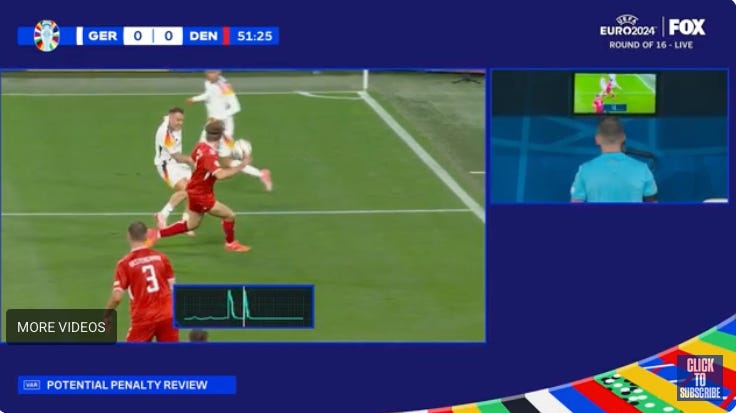
By design, VAR sees incidents that we do not. What we didn’t realize before its implementation, however, was how many incidents we weren’t seeing. What VAR has shown us is that even the most innocuous sequences regularly feature the ball grazing an arm, or falling a millimeter out of play, or rolling past an offside teammate who is interfering with the defense. Now that we have VAR, we can’t un-see those issues, and they go from being non-moments to the most important moments of all. The effect on the match’s narrative is similar to sitting through a 90-minute murder mystery, only to learn the killer was an extra with no lines and no motive. It’s no longer just the action we’re focused on that decides the game, but also seemingly peripheral events that we don’t even notice live.
We don’t notice those incidents because we experience a soccer game the same way that we experience our own lives - we take in an overwhelming amount of stimulus and filter out most of it so we can focus on what’s going on. But VAR isn’t limited by cognition as we are - it sees and processes every incident, regardless of whether that incident feels obvious or if the effect of it will be outsized. In that way, VAR is also making the game a lot more like the very random procession of our real lives, but perhaps that was exactly what we were looking to escape when we sat down to watch. Technology didn’t just spot all the imperfections in the game and enable us to fix them - it obliged us to, and sometimes the results we are left with are strange and unsatisfying.
Ironically, when you understand the limitations of the video assisted referee, you begin to appreciate the value of the human one. While he misses far more calls than his virtual counterpart, he also provides something that VAR cannot: pure human mediation. The referee experiences the game in real time, as we do, and can only focus on what is perceptible and central to the narrative, as we can. The referee, at his best, doesn’t call the game so much as he interprets it for us. As the game becomes more correct and less decipherable, that might be more valuable than we’d ever realized.
Edited excellently by Greta Gruber
The downside to VAR is that if it intervenes and makes the wrong call, it feels very bad. The quintessential case is the Luis Diaz incident from the 2024/25 season, where Diaz scored and the goal was wrongfully flagged on-field for offsides, the VAR identified the mistake, but then mistakenly communicated that the “check was complete,” sticking with the on-field decision.
The Premier League has taken steps in recent years to improve the VAR check experience, like adding the replays mentioned and referee explanations post-check, and even releasing the VAR deliberation audio for certain checks. As Daisy Christodoulou notes in her book I Can’t Stop Thinking About VAR, that transparency goes a long way towards improving the experience.
Comments
Nothing yet. Say the first thing.
Sign in to join the conversation.