

There is a cliché that the NFL is a game of inches. Patriots rookie Will Campbell may or may not be proof.
Campbell entered the draft process as an elite prospect at arguably the league’s most valuable non-quarterback position: left tackle. He was a consensus All-American at LSU and won the Jacobs Blocking award for best lineman in the SEC - the hardest place to play LT outside of the NFL. He built on that profile at the NFL Combine by running, jumping, and shuttling inhumanly fast for a 6’5”, 320 lb. man, ultimately posting the 15th-best composite athleticism score of the 1,500+ LTs ever measured at the event.
But despite showing all the credentials and athleticism a team would want in their left tackle, Campbell departed that combine performance as one of the most polarizing prospects in the draft. That’s because at 32 ⅝ inches from shoulder blade to finger tip, Campbell’s arms measured among the shortest of any LT hopeful in NFL history.
The effect of arm length on NFL tackle performance has been a topic of debate between draftniks for years, but never before has there been a case as mainstream or as polarizing as Campbell’s. In almost every way, Campbell is the perfect LT prospect, but at ⅜” below the 33-inch arm length minimum - a traditional LT standard referenced around the league - many believe that Campbell might not be fit to be an NFL LT at all, but rather a less valuable guard or center.
As the draft drew closer and the debate around Campbell grew more intense, the two sides of the argument polarized into personas. The arm length absolutists argued that no prospect under the 33-inch minimum could ever become an elite LT, while the arm length deniers countered that the ⅜” that Campbell was missing wouldn’t affect his career in the slightest, especially given that Campbell established himself as a top prospect while using those very same arms.
Campbell is now 15 weeks into his rookie season and has played well at LT thus far1, but we won’t know whether he’s the elite option the Patriots selected him to be for quite a while. Part of what makes great LTs so important, and in turn so valuable, is that a single mistake on the blindside can lead to a game-changing turnover or injury. The league’s very best tackles, like Trent Williams, Tristan Wirfs, and Jordan Mailata, go multiple seasons without giving up these kinds of splash plays. We’ll need to see a lot more of Campbell to know whether he belongs in that kind of company.
But whether Campbell excels at LT long-term or not, the absolutists and the deniers will more than likely be back again to debate a similarly short-armed prospect in the 2026 draft. And the 2027 draft. And for every draft in the foreseeable future, just as they have been for every draft in the recent past. That’s because the fundamental disagreement between the arm length deniers and absolutists isn’t just a question of interpreting the information at our disposal, but the assumptions both sides make about the crucial evidence that isn’t.
When people debate the importance of arm length to NFL LT performance, the evidence first takes the form of anecdotes. The arm length absolutists point at Jordan Mailata (35 ½” arms) or Tyron Smith (36 ⅜”) and say you need long arms to be a great LT, and the deniers counter with Rashawn Slater (33”) and Penei Sewell (33 ¼”). The deniers challenge the 33-inch minimum with Alaric Jackson (32 ½”) or Bernhard Raimann (32 ⅞”), and the absolutists respond with highly-ranked college LTs turned NFL guards like Joe Thuney (32 ½”) or Zack Martin (32 ⅞”). The absolutists and deniers go round and round like this forever, on sports talk shows and Reddit threads, arguing that arm length is either the least or most important quality in a left tackle.
This anecdotal deadlock might seem like a great time to turn to the data, but you face the same problem here: each side can point to different features and claim them as proof. Below, I’ve plotted the arm length and performance (measured by Kevin Cole’s NFL Plus/Minus) of the NFL’s 40 LTs who played a qualifying number of snaps in the 2024 season. Both the absolutists and deniers can use different statistical techniques to support their own narratives just as easily as they could use different anecdotes. The dotted red line in the figure below shows how the deniers could run a linear regression to argue that there is no statistically significant relationship between the performance of LTs and the length of their arms. The absolutists, on the other hand, could highlight the normal-ish distribution of the arm length across tackles (shown by the blue bars) and use a z-score to show how unlikely it is that Campbell’s short arms belong at the position.2
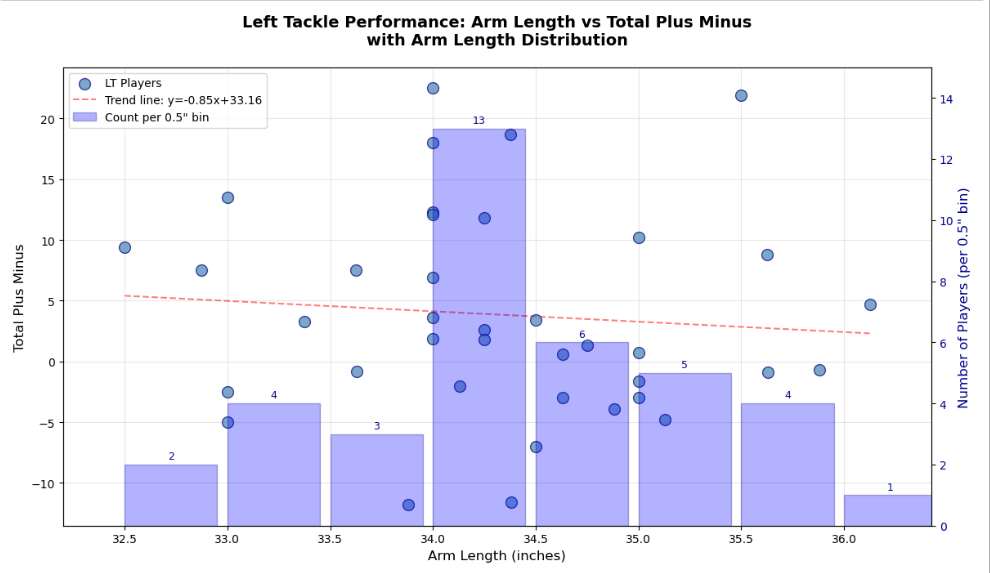
That both the absolutists and deniers can credibly use the same information to support their claims means that we are working with what statisticians call an ambiguous dataset. It also means that this set is missing a key scenario, a counterfactual, which is hiding the true relationship between arm length and LT performance. The trouble is that getting that counterfactual data is easier said than done - we need the arm length of the prospective left tackles who, because of their arm length or otherwise, didn’t make it into the league. Why? Because playing regularly at LT in the NFL necessarily means that you are one of the 32ish best options on the planet, and if having short arms has a negative effect on performance, it might be disqualifying players from that group entirely.
Consider an example: There is a hypothetical left tackle with 31” arms, much shorter than usual. If he played poorly and was the 32nd-best option in the league, we would have a data point supporting the absolutist argument about the importance of arm length. But what if in the next season he plays really poorly and is only the 65th-best tackle in the league? We would expect a data point showing even worse performance, but that isn’t what we’d get. Because this tackle is no longer playing above “replacement level” (better than his backup), he would be benched or moved inside to guard or center, leaving no data point at LT at all. The competitive dynamics of the league bound our observations to starting-level tackles, but if short arms are so important they could make a LT unstartable, the evidence is likely to drop out of our set entirely.
The disappearance of the poorly performing tackles is a textbook example of survivorship bias, a systematic tendency in certain samples for data points to be screened out before we can observe them. One problem with trying to analyze a sample afflicted with survivorship bias is that often the trends you observe in the survivors will mislead you when making predictions about a prospective entrant. Sometimes that means a set that suggests false causality. A famous example is how the public attributes risk-taking to successful startup founders, unaware of the graveyard of failed startups led by risk-taking founders who bet wrong. Other times, it means missing causality that helped create the set, but doesn’t necessarily create a visible trend within it. If you analyze the relationship between NBA players’ height and their performance, you actually find no correlation at all, but that’s partly because height is so important that no full-time player is under 6’0”, a full 4.5” taller than the average man.3
The only way to know whether arm length plays a significant role in LT success would be to resurrect this LT data graveyard to see whether shorter arms are associated with prospective LTs not making the NFL. This quickly drifts into a philosophical question as you consider where to draw the line for “prospective left tackle.” A player who loses a starting job and ends up converted inside or cut from the team is an obvious member of the graveyard, but less visible and potentially just as important to our question is the player who was never drafted at all. Does the graveyard include short-armed college players who opted for a consulting gig rather than the NFL? What about the High Schoolers who swapped football for debate?
Even if we resurrect the LT graveyard, we still have the most sinister implication of the LT survivorship bias problem to attend to: What if a disproportionate number of short-armed LTs are being excluded from the NFL, but their exclusion is driven by the belief that arm length is important, rather than any actual impact it has on performance? A short-armed tackle passed over by the NFL because of poor performance leaves the same datapoint as a promising prospect left out because of the 33-inch minimum. It’s here that we realize our causation is tied not only to the arm lengths of players not in the NFL, but also to their hypothetical NFL performance data - which, of course, doesn’t actually exist. The ambiguity of our dataset ensures that neither the absolutists nor the deniers are being proven right any time soon, or probably ever. But if that’s the case, then why does each side seem so convinced that they’re right?
The left tackle arm length question is a kind of NFL Rorschach test: how we respond tells us much more about ourselves than the likely fate of Campbell.
The absolutists and deniers staked out their extreme positions without sufficient evidence because, as humans, this is what we do. We did not evolve to shrug our shoulders and say, “I don’t know,” when faced with an ambiguous situation. Our ancestors were the ones who heard the rustling in the trees and made a run for it, even when it was just the wind. Their more inquisitive cousins, who stuck around to see the hidden evidence and avoid survivorship bias, eventually became lion food.
There are fewer lions for us to worry about today, but our human machinery is still very much tuned to find patterns and meaning long before we have enough information to know they are really there. Psychology research shows that our default mode for everyday thinking is to make snap judgments and assign causal relationships based on the most presently available information, whether that be the data currently in front of our eyes, that we’ve seen most recently, or, most compellingly for our case, that provides the most coherence with the other ideas we already believe.
Consider that final bias - coherence4 - in the context of our arm length question. In the previous section, I presented the problem as though both the deniers and absolutists weigh all available information and consequently make a judgment. That is how we think that we make decisions. However, it’s been shown in study after study that what we actually do is arrive with our years of ideas about how the world works - and how we would like it to work - pick the side whose implications fit nicely alongside those ideas, and rail against the alternatives. The difference between the absolutists and the deniers, then, isn’t just how they interpret the data, but the story about the role of arm length in left tackle success that best confirms what they already believed.
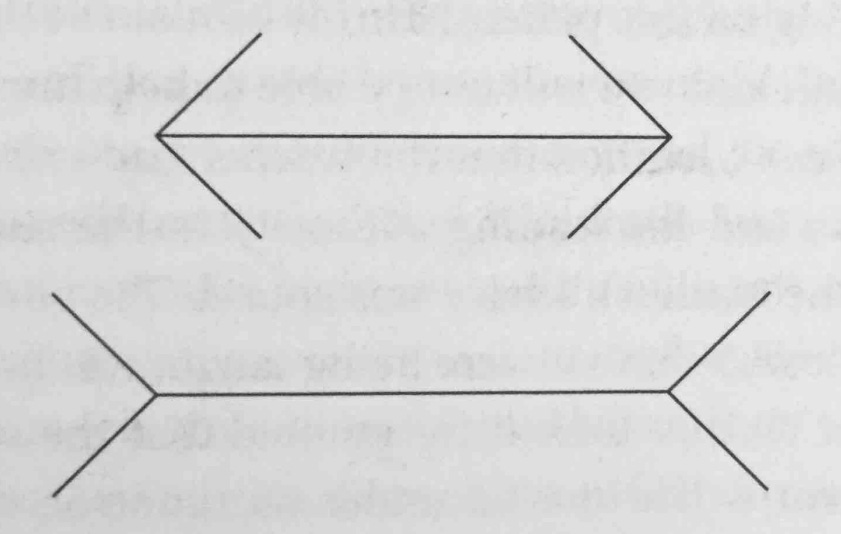
It’s no coincidence that the deniers are better represented in the media, on shows like First Take, Pardon My Take, etc. That Campbell’s fate at LT might not be determined by merit, but rather the random chance that he ended up with smaller arms than other LTs, is at odds with cherished ideas about how hard work and talent add up to success. The average sports fan - and especially the average American sports fan - would prefer to hear stories about people overcoming adversity or being rewarded for their efforts to ones about how the data shows half an inch of arm might damn a bright young prospect to the inside of the offensive line.
The most interesting place to see the deniers in action is when you see former players asked about the impact of Campbell’s arms. They tend to start by dismissing the notion that arm length (or even combine measurements generally) could predict NFL success, and then include a personal anecdote about a bad measurement they overcame - Andrew Whitworth was too lanky, Joe Thomas had short-ish arms (but much longer than Campbells) - as proof that the real secret to success is technique, attitude, or hard work. On the surface, these arguments frame Campbell’s career as something that’s within his control with the right amount of practice and determination - a story we would like to hear. But in the arguments from these hall of famers is the implication which might make that Campbell narrative so attractive to them: that their own success was strictly the product of the work they put in and the choices they made, and not that they randomly drew the right arms or legs or 350lb frame.
The absolutists are also looking for explainability and control, just at a different level. The 33-inch minimum is almost certainly an invention of NFL decision makers to quantify and simplify player evaluation, their most important and difficult task. If your job depends on picking the right 20-year-old LT to pay millions of dollars, then it’s important to believe that there are ways to tell the dozens of prospects apart come draft time, even if that is half an inch of arm on a 6’5” man. While the absolutists today are still in the minority, their numbers are growing as we plow headlong into a brave new world of big data. We are flooded with more information than ever before, and the opportunity to make decisions based on the data is no longer reserved for sports teams or corporate executives. The rise of prediction markets and our booming sports gambling epidemic industry has enabled everyone to play their own Moneyball, scouring the data for that hidden edge, the less intuitive the better.
It’s a short hop from considering the stories we tell ourselves about arm length to realizing that we’re all absolutists and deniers about almost everything. For the most part, that’s actually a good thing. If you spent the time and energy to grapple with each decision that comes with being a person, you wouldn’t make it past breakfast. That being said, for those few problems that are important enough - the ones where getting it right really matters - consider letting those trees rustle a little longer before you take off.
Edited excellently by Greta Gruber
16th among all eligible Ts (left and right). Campbell has also missed the last handful of weeks on injured reserve.
If you actually did these tests, you would also see the massive margins of error begging you not to draw a general conclusion. This exercise is mostly to illustrate that the trends you see in the data aren’t much different than extrapolating from anecdotes.
U.S average is around 5’9”. I once witnessed a woman claim that the average man was over 6’0” and the conviction she had sticks with me to this day.
In Kahneman and Tversky’s framework, coherence (they called it fluency) is probably a more general bias which encapsulates a lot of the others like recency and availability, but in Dan Gilbert’s excellent Stumbling on Happiness, he presents it as a more standalone concept for ideas that just seem to fit nicely alongside what you already believe.
Comments
Nothing yet. Say the first thing.
Sign in to join the conversation.