
Vermont Investigative transmitted a written questionnaire to Senator Steven Heffernan on June 1, 2026 — twelve master questions asked of all five declared candidates for Vermont Senate Addison District (ADD-1), plus three candidate-specific addendum questions drawn from his documented legislative record and public statements. The response deadline was June 13, 2026. The questionnaire was transmitted under identical conditions to all five declared candidates.
Senator Heffernan was in direct contact with this publication once before the questionnaire was transmitted. On May 19, 2026 — the same day as an on-record phone conversation documented in “Conduct Unbecoming” (Vermont Investigative, May 20, 2026) and prior to that piece’s publication — Heffernan sent a text message: “Very well said, thank you.” That communication predates both the published piece and the questionnaire and is not a response to either.
Of five declared candidates for ADD-1, one responded to the questionnaire: Andrea Treadway. Vermont Investigative will note that fact in every candidate profile in this series.
In the absence of written responses, Vermont Investigative reviewed Heffernan’s first-term legislative record: Senate floor statements, roll call votes as documented by the Vermont Conservation Voters scorecard, bill status records at legislature.vermont.gov, campaign finance filings, and news coverage of the 2026 session. What follows is what those documents show, organized by question. Where the public record addresses a question, it is cited. Where it does not, that absence is noted.
Vermont Investigative reviewed Heffernan’s 2026 campaign finance filings from the Vermont Secretary of State campaign finance database.
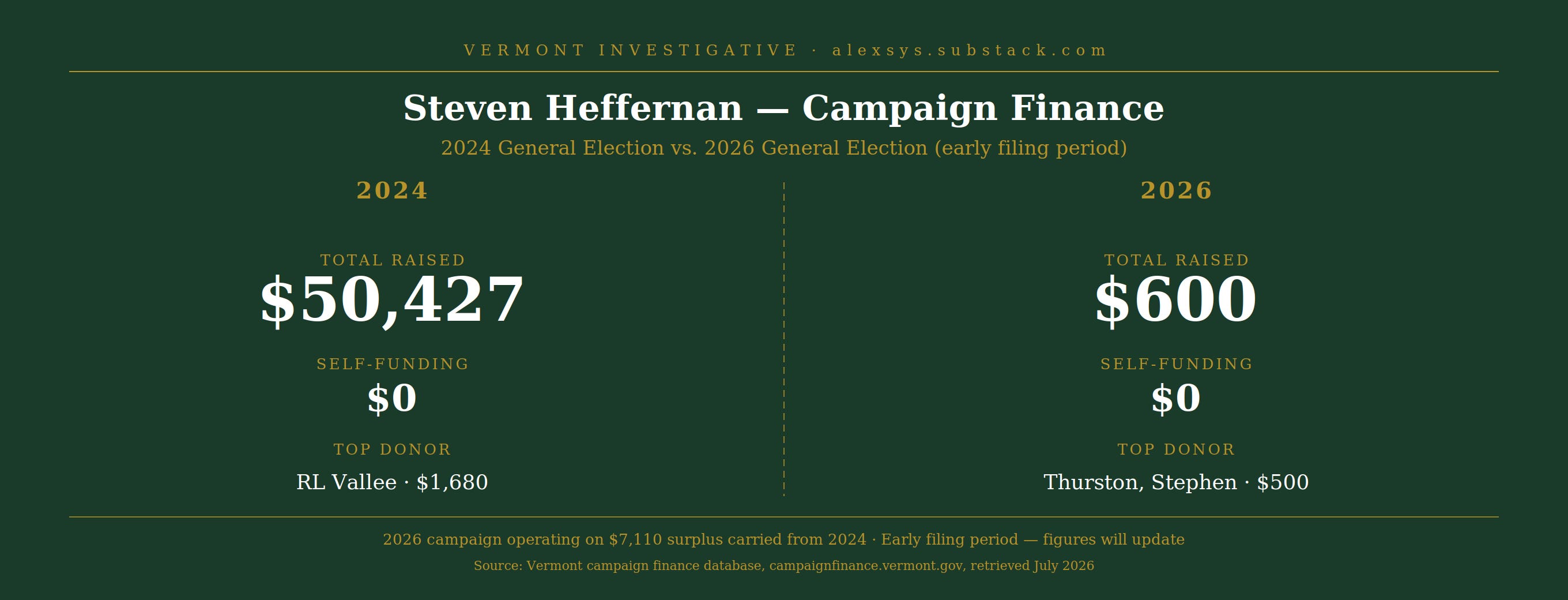
2026 cycle (General Election, as of last filed report):
Beginning balance (surplus from 2024): $7,110.37
Total monetary contributions: $600.00
Total expenditures: $44.29
Ending balance: $7,666.08
Self-funding: $0.00
Individual contributors: $600.00
Business/Organization: $0.00
Out-of-state contributions: $0.00
Top donor, 2026 cycle:
DonorAmountLocationThurston, Stephen$500.00Ferrisburg, VTUnder threshold (name withheld)$100.00—
2024 cycle (General Election, completed):
Total contributions: $50,427.37
Total expenditures: $50,241.24
Self-funding: $0.00
Individual contributors: $36,797.37
Business/Group/Organization: $13,630.00
In-state contributions: $12,480.00
Out-of-state contributions: $1,150.00
In-kind contributions: $1,944.81
Top donors, 2024 cycle:
DonorAmountLocationRL Vallee$1,680.00St. Albans, VTVallee, Denise$1,613.81Miami, FLVallee, Rodolphe$1,613.81Sheldon, SCRaulston, Paul$1,613.81Middlebury, VTLisman, Bruce$1,440.90Shelburne, VTBissonette Property Management$1,000.00Burlington, VTC.B. Properties$1,000.00South Burlington, VTWills Two LLC$1,000.00Burlington, VTG. Stone Commercial Division$1,000.00Middlebury, VTPolitically Active Contractors (PAC) — contractor industry political action committee$1,000.00Montpelier, VT
His 2026 campaign is in its early filing period. Detailed contributor breakdown for 2026 requires manual review at campaignfinance.vermont.gov, Entity search: HEFFERNAN, STEVEN.
Source: Vermont campaign finance database, campaignfinance.vermont.gov, retrieved July 2026.
He is a Republican incumbent running for re-election. He holds the endorsement of Governor Phil Scott. He serves as Clerk of the Senate Agriculture Committee and as a member of the Senate Education Committee.
He operates 802 Excavating, GHR Metal Recycling, and Heffernan Inspection and Repair. No foundation affiliations, think tank relationships, or organizational consulting arrangements requiring disclosure have been identified in his public record.
The following twelve questions were transmitted to Senator Heffernan on June 1, 2026, along with three candidate-specific addendum questions. No written response was received to any of them. Where the public record addresses a question, it is documented below. Where it does not, that absence is noted.
Q1. The Housing Demand Number
What the questionnaire asked: Which specific demand projection do your housing proposals use, and have you adjusted for two consecutive years of Vermont population decline and rising inventory? Is Vermont’s housing problem primarily a supply shortage requiring 40,000 new units, or primarily a pricing mismatch in existing inventory? If the demand assumptions are wrong, what does that do to your housing policy rationale?
What the public record shows:
Heffernan’s campaign website (heffvt.com) identifies housing affordability as a core issue and frames the solution as streamlining Act 250 and local permitting to increase supply. His stated framing is a supply shortage requiring permitting reform.
No public statement has been found adjusting that projection to reflect Vermont’s two consecutive years of population decline, the 16% year-over-year inventory increase, 22-day increase in days on market, or the $15,000–$30,000 price reductions increasingly common in the $200,000–$500,000 range documented in the questionnaire context.
No written response was received.
Q2. Revenue Projections for Non-Primary Residence Taxation
What the questionnaire asked: If you support increased taxation of second homes or vacation rentals, identify the fiscal analysis, the definition and identification mechanism, and the projected implementation timeline.
What the public record shows:
No documented public position found on second-home or nonhomestead taxation beyond general property tax opposition. During S.325 floor debate, Heffernan framed Act 181’s affordability impact around the capacity of wealthy second-home owners to absorb permit costs versus regular Vermonters — an affordability observation, not a tax policy position. No public record found addressing Act 73’s nonhomestead residential classification, its FY2029 implementation timeline, or the absence of legal definitions in Vermont tax code.
No written response was received.
Q3. Education Fund Revenue Risk
What the questionnaire asked: If increased tax rates on non-primary residences reduce those properties through sale, conversion, or market withdrawal, what is your contingency for the resulting Education Fund revenue gap? Provide a specific fiscal mechanism.
What the public record shows:
Heffernan voted NO on H.955 — the education finance foundation formula bill — one of only two senators to oppose it in a 27-2 final passage vote. No public statement explaining his no vote in fiscal detail has been identified in available reporting. His campaign website states property taxes climbed roughly 40% in the five years before his election and that he supports long-term systemic reform — but no specific fiscal contingency mechanism is identified for Education Fund revenue risk.
No written response was received.
Source: VTDigger, Valley News, May 26–27, 2026; heffvt.com
Q4. Noncitizen Voting in School Budget Elections
What the questionnaire asked: Do you support expanding noncitizen voting in school budget elections? How do you reconcile school budget votes directly affecting the statewide property tax burden paid by all Vermont property owners?
What the public record shows:
No documented public statement found on the Burlington charter amendment, the May 15, 2026 Vermont Supreme Court ruling upholding it, or the dissenting judge’s argument that school budget votes constitute statewide matters.
No written response was received.
Q5. Act 59, 30x30, and Conservation Finance
What the questionnaire asked: Do you support using carbon markets or biodiversity offset markets to fund Act 59 conservation goals? Which entities would be eligible to purchase or hold those credits? What restrictions would apply to foreign institutional investment in Vermont land or conservation easements?
What the public record shows:
No documented public position found on Act 59 conservation finance mechanisms, carbon market eligibility, biodiversity offset instruments, or foreign capital in Vermont land conservation structures.
No written response was received.
Q6. Natural Capital Valuation and the Monetization of Vermont Land
What the questionnaire asked: Do you support applying natural capital valuation frameworks to Vermont land? Who benefits when a Vermont wetland or forest becomes a tradeable credit? What protections would you support to prevent conservation finance from accelerating transfer of land stewardship from Vermont families to institutional investors or foreign capital?
What the public record shows:
No documented public position found. The vocabulary of natural capital accounting — ecosystem services markets, biodiversity credits, tradeable environmental assets — does not appear in Heffernan’s public record.
No written response was received.
Q7. Land Ownership, Absentee Control, and Easement Transparency
What the questionnaire asked: Does your definition of problematic land ownership extend to conservation easements held by out-of-state nonprofits or national land trusts? Would you support public disclosure requirements for conservation easement holders, including their funding sources and any foreign capital interests?
What the public record shows:
No documented public position found on conservation easement transparency or out-of-state nonprofit land control. Heffernan’s public framing on land consistently addresses state regulatory overreach on working lands — specifically Act 181 and Act 59 — but does not extend in the public record to easement holder disclosure or absentee institutional control through conservation instruments.
No written response was received.
Q8. Vermont Sovereignty Over Vermont Land
What the questionnaire asked: What mechanism ensures rural Vermonters have meaningful and binding input when international conservation frameworks shape Vermont land use policy? What is your specific and enforceable commitment to Vermont sovereignty over Vermont land?
What the public record shows:
No documented public position found on federal grant conditionality, international biodiversity framework influence on Vermont land use, or a specific enforceable sovereignty mechanism for rural Vermonters in the conservation planning process.
No written response was received.
Q9. Rural Vermont Policy Framework
What the questionnaire asked: What is your specific policy commitment to rural Vermont as a fiscal and regulatory framework — not as a talking point? What does your legislative work do differently for a town of 400 people in Addison County versus Middlebury? Does the current policy architecture — Act 181’s Tier 1 infrastructure requirements, Act 76’s payroll tax structure, education consolidation — serve rural Vermont towns equitably?
What the public record shows:
This is where Heffernan’s first-term record is most substantive. During S.325 floor debate, he stated: “We must ask ourselves…are we protecting Vermont’s lands, or pricing Vermonters out of it?” He framed Act 181’s impact around the affordability gap between wealthy second-home owners and working Vermonters, and his campaign website identifies rolling back the Road Rule and Tier 3 zoning as his most significant first-term legislative achievement.
His campaign website specifically identifies Act 181’s requirements — including zoning, professional planning staff, and infrastructure — as barriers that fall disproportionately on rural communities without the administrative infrastructure to comply.
No documented position found on Act 76’s payroll tax structure as a rural small employer burden, or a specific fiscal comparison between policy impact on a town of 400 versus Middlebury.
No written response was received.
Sources: S.325 floor debate, VTDigger/Valley News, March 27, 2026; heffvt.com
Q10. Data Centers — Energy, Land, and Rural Impact
What the questionnaire asked: Do you support H.727 as passed by the House, the stronger Senate version, or S.205’s moratorium approach? Should Vermont actively recruit data centers or establish a hard cap?
What the public record shows:
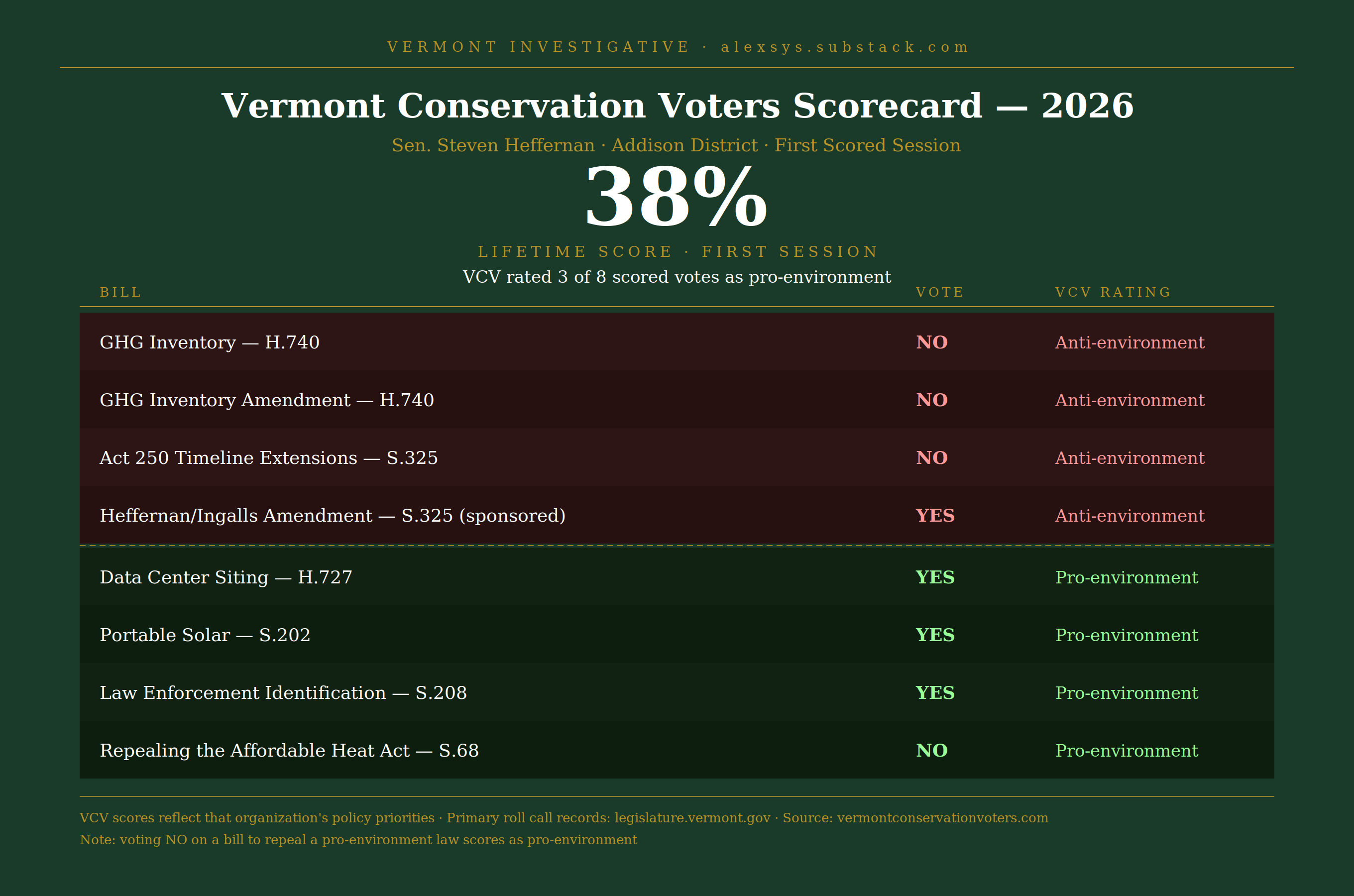
Vermont Conservation Voters scored Heffernan’s vote on H.727 (Data Center Siting) as a pro-environment vote — meaning he voted in favor of the data center regulation bill. H.727 passed the Senate 26-3 before Governor Scott vetoed it. The veto was sustained 83-52. His precise position within the 26-3 Senate vote requires verification against the Senate Journal roll call.
During Senate floor debate on H.710, Heffernan raised concerns that the bill would make it easier to site additional solar next to existing solar on prime agricultural land, though he acknowledged this was his reading of the bill. He and Senator Russ Ingalls are documented as involved in H.710 floor proceedings.
No documented public statement found on the moratorium approach (S.205) or a hard cap on data center scale and siting.
No written response was received.
Sources: Vermont Conservation Voters scorecard, vermontconservationvoters.com; H.727 bill status, legislature.vermont.gov; Good Governmont Substack, H.710 analysis, May 29, 2026
Q11. The Pricing Mismatch Question
What the questionnaire asked: Given inventory up 16% year over year, days on market up 22 days, price reductions of $15,000–$30,000 increasingly common, and a sale-to-list ratio of 96.3%, what is the evidence that Vermont’s housing problem is primarily a supply shortage rather than a pricing mismatch in existing inventory? Respond with data, not narrative.
What the public record shows:
Heffernan’s public framing on housing is consistently supply-side and permitting-focused. No data-grounded public response to the pricing mismatch question has been identified. His campaign website frames the problem as a permitting barrier, not a demand-side or pricing question.
No written response was received.
Q12. The $21,200 Question — Vermont’s Education Reckoning
What the questionnaire asked: Vermont spends $21,200 per pupil — among the highest in the nation — while 4th grade NAEP reading scores have dropped 11 points since 2013. Mississippi spends $9,300 per pupil and now ties Vermont’s performance. Act 139 passed but was not funded. H.955 requires the 2027 legislature to affirmatively vote before the foundation formula takes effect. What is your assessment of why the spending/outcome gap exists, and what specific changes would you prioritize? What criteria will you use to evaluate whether H.955’s contingencies have been met?
What the public record shows:
Heffernan voted NO on H.955 — one of two senators to oppose it in a 27-2 vote. His campaign website states a majority of Vermont students are falling short of basic standards in English and Math and identifies direct classroom investment as a priority. He identifies roughly 30,000 fewer K-12 students over three decades as evidence the current structural model is outdated.
No documented public statement found explaining his H.955 no vote in detail, his criteria for evaluating the foundation formula’s 2027 trigger, or his position on whether proficiency-based graduation requirements adopted in 2013 should be part of that evaluation.
No written response was received.
Sources: VTDigger, Valley News, May 26–27, 2026; heffvt.com
The following three questions were specific to Senator Heffernan’s documented legislative record. All are sourced to primary record. No written response was received to any of them.
A1. His Position on LGBTQ+ Vermonters — On the Record
What the questionnaire asked:
Do you believe LGBTQ+ Vermonters deserve equal protection under Vermont law? Yes or No.
Do you support Proposal 4? Yes or No, and why.
Do you see the H.578 floor statements and the Proposal 4 departure as separate inquiries? If not, what do they reflect collectively about your position as a senator representing all of Addison County?
What the public record shows:
Three documented events, all primary source:
H.578 floor remarks, May 15, 2026: During Senate floor debate on H.578 — an animal cruelty bill — Heffernan stated: “In these crazy times, what happens if the individual identifies as an animal having intercourse with an animal? How is the courts going to handle that?” He then referenced Proposal 4, adding: “Being that we voted through Prop Four, and if it does make it through this state, and I have a gender identity that I identify as a dog and had sex with my dog, is this law going to affect me?” These statements are in the official Senate floor record and were reported nationally. Source: PinkNews, May 21, 2026; Senate floor record.
Proposal 4 departure, March 26, 2026: Heffernan left the Senate floor before the chamber voted 29-0 on Proposal 4 — a constitutional amendment enshrining protections against discrimination based on sexual orientation, gender identity, and gender expression. He told VTDigger his departure was timed to pizza. Source: VTDigger; “Conduct Unbecoming,” Vermont Investigative, May 20, 2026.
On-record phone conversation, May 19, 2026: In a conversation documented in “Conduct Unbecoming,” Heffernan stated his stomach was bothering him and that he had not decided how to vote. He stated his concern is not about transgender people but about the legal definition of gender expression as a constitutional category. He stated he is open to education on gender identity and expression legal history and received resources from this publication following the conversation. He stated he could not yet support Proposal 4 but believes the people of Vermont should decide via the November ballot.
SR13: Heffernan was one of five senators to vote against SR13, a Senate resolution affirming due process protections for noncitizens. Source: “Conduct Unbecoming,” Vermont Investigative, May 20, 2026.
Text message, May 19, 2026: On the same day as the on-record phone conversation and prior to publication of “Conduct Unbecoming,” Heffernan sent this publication a text message: “Very well said, thank you.” Cited as source communication per Vermont Investigative standard practice.
No written response to Addendum A1 was received.
A2. Act 181 — His Position on the Record
What the questionnaire asked: What specific provisions of Act 181 should be fully repealed — not delayed, not modified, but repealed? What is your alternative framework for balancing housing production, property rights, and environmental protection in Addison County specifically?
What the public record shows:
Heffernan’s most substantive documented position on Act 181 is from S.325 floor debate. He stated: “We must ask ourselves…are we protecting Vermont’s lands, or pricing Vermonters out of it?” He framed affordability impact around wealthy second-home owners having more capacity to absorb permit costs than regular Vermonters can.
His campaign website states he led successful floor debate to roll back Act 181’s Road Rule and Tier 3 zoning provisions through S.325, calling it “a major victory for common sense” and stating the fight is not over.
Vermont Conservation Voters documents his S.325 votes: voted against Act 250 Timeline Extensions; sponsored and voted for the Heffernan/Ingalls Amendment. Source: vermontconservationvoters.com — VCV scores reflect that organization’s policy priorities; primary roll calls at legislature.vermont.gov
S.325 was signed by Governor Scott on June 16, 2026, formally repealing the Road Rule and Tier 3 provisions. Source: VTDigger/Vermont Public, Carly Berlin, June 16, 2026.
No documented public position found on which Act 181 provisions he believes should be fully repealed beyond what S.325 addressed, or an alternative regulatory framework for Addison County specifically.
No written response to Addendum A2 was received.
A3. Solar Development on Prime Agricultural Land — Where He Stands
What the questionnaire asked: Do you support PUC oversight of solar siting on prime agricultural land in Addison County? Do you believe a study adequately protects Addison County farmland? What specific legislation would you introduce or support to prevent the permanent conversion of prime Addison County agricultural land to energy generation?
What the public record shows:
During Senate floor debate on H.710, Heffernan raised concerns that the bill would facilitate additional solar development next to existing solar on agricultural land, though he acknowledged this was his interpretation of the bill. He and Senator Russ Ingalls are documented as involved in H.710 floor proceedings.
The Ingalls amendment — which would have expanded PUC jurisdiction over solar siting on prime agricultural land — was blocked by Senate leadership from reaching the Agriculture and Natural Resources committees. Senate Natural Resources Chair Anne Watson substituted a study directive for the regulatory proposal. No public statement found from Heffernan on Watson’s substitute or his position on whether a study is adequate protection for Addison County farmland.
Vermont Conservation Voters scored Heffernan’s vote on Portable Solar (S.202) as a pro-environment vote — he voted in favor. Source: vermontconservationvoters.com
Addison County is Vermont’s most productive agricultural county. No public statement found from Heffernan identifying specific legislation he would introduce to prevent permanent conversion of prime farmland to energy generation.
No written response to Addendum A3 was received.
Heffernan’s 2026 VCV score: 38% (lifetime score also 38% — first scored session).
Documented votes this session per VCV:
Note: VCV scores reflect that organization’s policy priorities. Primary roll call records are available at legislature.vermont.gov for independent verification.
Vermont Investigative transmitted fifteen questions to Senator Heffernan — twelve master questions asked of all five ADD-1 candidates and three candidate-specific addendum questions drawn from his documented first-term record. No written response was received to any of them.
Where the public record of his first Senate term addresses a question, this piece documents what it shows. Eight questions — Q4 through Q8, and portions of Q1, Q11, and Q12 — found no public record response after review: his position on noncitizen voting in school budget elections; his position on carbon markets and biodiversity offsets for Act 59; his position on natural capital valuation frameworks; his position on conservation easement transparency and foreign capital in Vermont land structures; his enforceable commitment to Vermont sovereignty over Vermont land; his data-grounded analysis of whether Vermont’s housing problem is supply or pricing; and his criteria for evaluating the H.955 foundation formula trigger in 2027.
The three addendum questions — on his position on LGBTQ+ equal protection, his specific Act 181 repeal framework, and his commitment to prime agricultural land protection from solar development — have partial public records documented above but no written responses.
This piece will be updated if written responses are received.
Campaign website: heffvt.com (accessed July 2026)
Vermont Legislature directory: legislature.vermont.gov/people/single/2026/40387
Ballotpedia: ballotpedia.org/Steven_Heffernan
Addison Independent, John Flowers, June 18, 2026 (race overview)
Vermont campaign finance database, 2026 General Election cycle and 2024 General Election cycle, campaignfinance.vermont.gov, retrieved July 2026
Politically Active Contractors (PAC) committee profile, campaignfinance.vermont.gov, retrieved July 2026
Vermont Conservation Voters Scorecard 2026: vermontconservationvoters.com/legislators/steven-heffernan/
H.955 bill status and passage: legislature.vermont.gov/bill/status/2026/H.955; VTDigger, Valley News, May 26–27, 2026
S.325 bill status, floor debate, and signing: legislature.vermont.gov/bill/status/2026/S.325; VTDigger/Vermont Public, Carly Berlin, June 16, 2026; VTDigger/Valley News, March 27, 2026
H.727 bill status and veto: legislature.vermont.gov/bill/status/2026/H.727
H.710 bill status and floor proceedings: legislature.vermont.gov/bill/status/2026/H.710; Good Governmont Substack, H.710/H.727 analysis, May 29, 2026
S.68, S.202, S.208, H.740: legislature.vermont.gov (bill status); Vermont Conservation Voters Scorecard 2026
“Conduct Unbecoming,” Vermont Investigative, alexsys.substack.com, May 20, 2026
PinkNews: H.578 floor remarks, May 21, 2026
VTDigger: Proposal 4 floor departure, March 26, 2026
Direct communication (text message): Heffernan to this publication, May 19, 2026 — cited as source communication per Vermont Investigative standard practice
Vermont Investigative Legislative Questionnaire, transmitted June 1, 2026; deadline June 13, 2026; no substantive written response received. Questionnaire on file.
If you find yourself reading, learning, or citing this work please consider supporting it with a Substack subscription (https://alexsys.substack.com/subscribe) or Ko-fi (https://ko-fi.com/alexsysthompson)
Comments
Nothing yet. Say the first thing.
Sign in to join the conversation.