
Vermont’s Lieutenant Governor presides over the state Senate, casts tie-breaking votes when the chamber deadlocks, and holds a public platform with no direct legislative power. The officeholder cannot introduce bills. The role is constitutionally narrow and structurally dependent on relationships with legislators who can.
That is the office four people are competing for in 2026. One holds it now. Three want it back — or for the first time.
Vermont Investigative applied the same framework to each candidate: sourced biography, documented record, campaign finance data from public filings, and a candidate questionnaire sent to all four campaigns. Right-of-reply status is noted inline for each candidate. Responses will be published in full as received.
The Vermont Lieutenant Governor presides over the Vermont Senate when it is in session. Beyond that, the role is largely what its holder makes of it — a platform, a tie-breaking vote when the Senate deadlocks, and the constitutional standing to assume the governorship if needed.
Since 1976, no Vermont Legislature has overridden the popular vote winner in a contested LG race — until 2025, when the General Assembly seated John Rodgers 158–18 after neither he nor incumbent David Zuckerman cleared 50% of the November vote. That procedural moment is part of the context voters carry into 2026.
The office’s limits matter for accountability. Promises made on the campaign trail about affordability, healthcare, housing, and workforce development can only be delivered through other legislators and through the weight of the platform itself. Voters assessing each candidate should ask not what they promise but what their record shows about how they work within constraints.
Who he is, sourced: Born July 29, 1965, St. Johnsbury, Vermont. Raised on a dairy farm in Glover that his family has worked since 1838 — fifth generation on that land. Stonemason, construction business owner, cannabis and hemp farmer, snow plower. Associate’s degree, New Hampshire Technical College, 1985. His first elected position was collector of delinquent taxes at the municipal level — “because that job wasn’t being done well,” he has said on record. (PEGTV Rutland.)
The party switch — in his own words, sourced: Rodgers served 16 years in the Vermont Legislature as a Democrat — House of Representatives 2003–2011, State Senate 2013–2021. He grew up in a Democratic family and had consistent electoral success in the Northeast Kingdom running as a Democrat. In 2020 he lost his Senate seat to Republican Russ Ingalls — not in a general election, but after missing a filing deadline.
Four years later he switched parties and ran for Lieutenant Governor as a Republican. His own words on why: “I don’t feel like I left the party. I feel like the party left me.” And: “The Democratic Party had shifted way too far to the left, and they don’t appear to understand blue collar Vermonters.” And: “I feel closer to Phil Scott than I do the leadership in the Legislature, and that’s what really made me say, ‘Maybe it’s time to just try something different.’” (VTDigger, May 24, 2024; Rutland Herald, December 31, 2024; Newport Daily Express, July 2024.)
Governor Phil Scott endorsed him and campaigned with him. Rodgers won the November 2024 general election by approximately 6,000 votes over incumbent Lt. Gov. David Zuckerman — the first time since 1815 that a sitting lieutenant governor was defeated in a general election. He received 46.2% of the vote — a plurality but not the majority required by the Vermont Constitution. The Vermont General Assembly seated him 158–18 on January 9, 2025. Vermont’s 85th Lieutenant Governor.
What he’s done with the office, sourced: On February 3, 2026, Rodgers cast the tie-breaking vote — 15-15 in the Senate — confirming veteran federal prosecutor Michael Drescher to the Vermont Supreme Court. He was the only Republican to speak at the April 2025 Statehouse “Hands Off” rally against Trump administration policies. He testified before the Legislature in favor of cannabis reform legislation. He hosted Rural Caucus listening sessions on Act 181 land-use concerns in March 2026. He has stated consistently and on record that he did not vote for Donald Trump. He describes constituent services work — connecting Vermonters to the tax department, the Department of Environmental Conservation, permits, and healthcare — as among the most rewarding parts of the role.
He ran explicitly on education property taxes as a defining issue, stating the Democratic supermajority raised them 13% in 2023 and 14% in 2024. Primary sources document the FY2024 education property tax increase at 13.8–13.9% — brought down from an initial projection of 18.5% through $118 million in general fund spending. Rodgers’ figures are approximately consistent with the documented record. (Vermont Business Magazine, December 2024; Seven Days, December 2025.)
What the record raises: Rodgers spent 16 years as a Democrat, lost his seat due to a missed deadline, then won the state’s second-highest office four years later as a Republican by channeling working-class frustration with Democratic governance. His record in office shows one documented consequential vote, cross-partisan dissent from his own party’s national leadership, and constituent engagement on rural concerns. The question the record surfaces: what has a Democrat-turned-Republican done with a constitutionally narrow office in year one — and does that match what Northeast Kingdom voters sent him there to do?
Campaign finance:
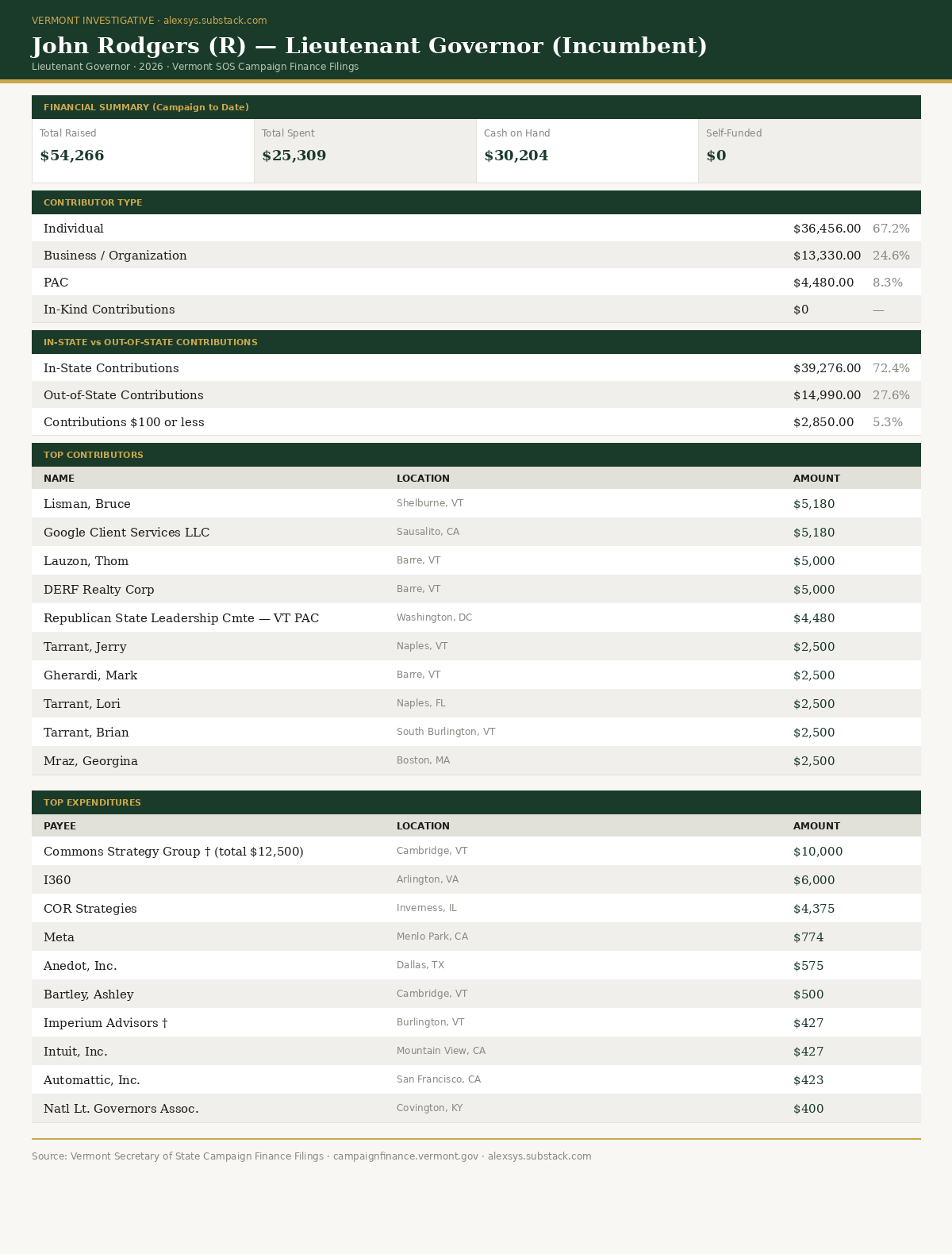
Notable from the filings:
Bruce Lisman ($5,180) — Shelburne — Vermont financier and former Republican gubernatorial candidate
Google Client Services LLC ($5,180) — Sausalito, CA — out-of-state business contribution
DERF Realty Corp ($5,000) — Barre — business contribution
Republican State Leadership Committee — Vermont PAC ($4,480) — Washington, DC — only PAC contribution in the field
Tarrant family — Jerry Tarrant, Naples VT ($2,500); Brian Tarrant, South Burlington VT ($2,500); Lori Tarrant, Naples FL ($2,500) — $7,500 from one family across two states
I360 — Arlington, VA — $6,000 — Republican voter data platform
COR Strategies — Inverness, IL — $4,375 — out-of-state political consulting
Flagged irregularity (Vermont Political Observer, March 2026; Vermont Secretary of State campaign finance filings, March 15 and July 1, 2026): Rodgers’ campaign finance filings show payments to Commons Strategy Group of Cambridge, Vermont totaling $12,500 across two reporting periods — $2,500 in the March 15 filing and $10,000 in the July 1 filing. Commons Strategy Group does not appear in the Vermont Secretary of State business registry. A separate payment of $427 to Imperium Advisors, Burlington, Vermont, whose business registry registration expired in 2022 and had not been renewed at time of filing, also appears in the March 15 report. Vermont law requires businesses operating in Vermont to register and maintain good standing with the Secretary of State. Right-of-reply was offered to the Rodgers campaign on both items. This piece will be updated if a response is received.
Right-of-reply and questionnaire status: Questionnaire sent. Right-of-reply on campaign finance irregularities sent July 17, 2026. No response received as of publication.
Who she is: Born March 18, 1984, Newbury, Vermont. Attorney. University of Vermont (BA, 2006), Vermont Law School (JD, 2014), Graduate Institute of International and Development Studies (LLM, 2016). Staffed Peter Welch’s congressional office following his 2006 election. Worked on human rights compliance for the International Committee of the Red Cross and an international private security contractor oversight body. Vermont Assistant Attorney General, Criminal Division, 2018–2021. Vermont’s 83rd Lieutenant Governor, 2021–2023 — first Democrat to hold the office in 18 years.
What her record shows: Gray was elected Lt. Governor in November 2020 and took office January 2021. Less than a year into her first term, she launched a congressional campaign for Vermont’s at-large House seat, vacated when Peter Welch ran for Senate. She lost that primary to Becca Balint by a significant margin in August 2022 and left the Lt. Governor’s office in January 2023. During her term she launched a “Recover Stronger” initiative touring all 14 Vermont counties, hosted a “Seat at the Table” meeting series on broadband, healthcare equity, and women’s economic well-being, and ran a virtual classroom program for schoolchildren at the Statehouse. She hired a full-time political staffer within months of taking office, which drew note from Vermont political observers at the time. Since leaving office, she founded and served as executive director of the Vermont Afghan Alliance, a Burlington-based nonprofit supporting Afghan resettlement across the state.
What the record raises: Gray is asking Vermont voters to return her to an office she left before completing her first term to pursue a congressional seat she did not win. She has stated publicly in this campaign that she will not leave the Lt. Governor’s role for higher office if elected. That commitment is on record and belongs to the record going forward.
On the record, Town Meeting TV forum, July 2026: Gray acknowledged she did not vote in the 2016 presidential election. Her own words: “I missed the election in 2016 where Clinton was not elected and Trump got elected and that will always be my cross to bear.” She confirmed she voted for Biden in 2020 and Harris in 2024. When pressed on corporate PAC money, Gray drew a distinction between corporate PACs — which she said she has never accepted — and trade association PACs, which she acknowledged accepting when she ran for Congress. Her exact words: “I did receive money from different associations.” That acknowledgment is consistent with FEC filings from her 2022 congressional campaign showing contributions from trade association PACs including the National Association of Realtors. (Town Meeting TV, July 2026; FEC filings, 2022.)
Campaign finance:
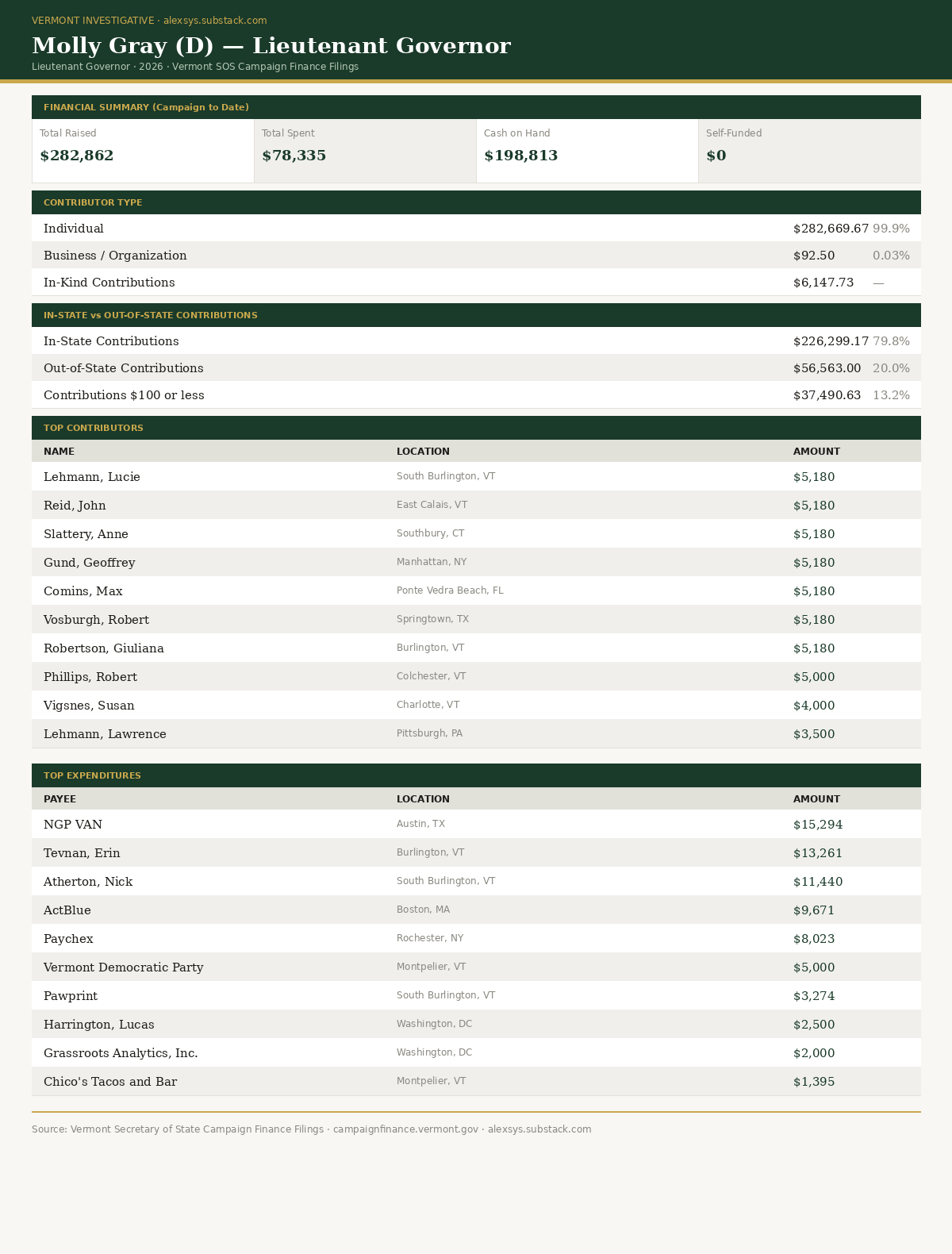
Endorsements and polling: Endorsed by Senate President Pro Tempore Phil Baruth, nine current state senators, 22 current House members, former Governor Howard Dean, and former Governor Madeleine Kunin. UNH poll (June 30, 2026): leads Democratic primary at 39%; leads Rodgers 45–29 in a hypothetical general election matchup with 26% undecided.
Notable from the filings:
Geoffrey Gund ($5,180) — Manhattan, NY — former president of the George Gund Foundation with documented Vermont grantmaking
Lucie Lehmann ($5,180) — South Burlington — former staffer to Senator Barbara Mikulski, board member Audubon Society of Vermont
Bruce Lisman ($1,006) — Shelburne — Vermont financier and former Republican gubernatorial candidate
Patricia Pomerleau ($2,500) — Vermont’s Pomerleau real estate family
Eric Farrell ($1,000) — Burlington developer
Howard Dean ($2,000) — former Governor
Four of her ten top donors are out of state
Largest expenditure: NGP VAN — Austin, TX — $15,294 (Democratic voter data platform)
Grassroots Analytics — Washington, DC — $2,000 out-of-state analytics firm
Right-of-reply and questionnaire status: Questionnaire sent. Response not yet received as of publication.
Who he is: Essex Junction, Vermont. Age 39. Married father of two. Born and raised in Essex Junction, the son of working-class parents who raised three kids in a 900-square-foot house. His parents never had the opportunity to go to college but bought a home for under $80,000 in Essex Junction and sent their children to Vermont public schools. McLaren grew up on Dr. Dinosaur — Vermont’s Catamount Health program for children — and received food assistance when his family needed it. He has been open about this history throughout the campaign: “My life was never guaranteed, but it was possible because it happened here in Vermont.” (Town Meeting TV, July 2026.) He attended college — the specific institution and degree are not documented in available public sources — and returned to Vermont afterward. (VTDigger, January 2026; Seven Days, January 2026.)
He was paralyzed in a skiing accident nine years ago and received a $10,000 ambulance bill. Both facts are on the record in his own words.
What his career record shows: McLaren’s professional life has been entirely in public service. His first job after college was as an AmeriCorps member for Everybody Wins Vermont, a reading mentoring program placing adults in elementary schools. He then worked five years in Governor Shumlin’s administration, where he helped design and implement Vermont’s first law allowing migrant workers to obtain driver’s licenses. He worked at the Vermont Department of Motor Vehicles to implement the program. He has served as a coach at Burlington High School for 15 years. He served on school boards. He has been a DNC Committeeman. For the past decade he has worked as a congressional aide in Senator Peter Welch’s office — constituent casework, federal grant navigation, and legislative support. Specific documented outcomes from that work: securing a $5.5 million federal housing grant for a low-income housing project in Middlebury; funding for Tri-Park mobile home park in Brattleboro; funding for Craftsbury Saplings childcare expansion in the Northeast Kingdom. (Town Meeting TV, July 2026; WAMC, April 2026.)
He has no elected office record beyond school board service.
Why Vermont, why now — in his own words, sourced: McLaren’s stated motivation is specific and documented across multiple interviews. Ten years in Welch’s office watching Vermont communities up close produced a particular observation he has articulated consistently: “There’s this creeping sense of hopelessness that I’ve felt over the last 10 years of my life in Peter’s office — of real fear and anxiety among communities and families all over Vermont that the future won’t be better for their kids. My motivation is that sense of hopelessness and nihilism, that nothing matters, and politics can’t answer these questions. I don’t believe that.” (Vermont Community Newspaper Group, April 2026.)
On Vermont’s trajectory: “We’re on the precipice of becoming a theme park or a retirement home. If you want to work and make a living and raise a family, it’s become too hard and too expensive.” (WCAX, July 2026.)
On the office itself: “The role of lieutenant governor, I think, for a long time has been used as a consolation prize or a stepping stone or a placeholder for some other political ambition.” He has stated he is running to do something with the office, not to use it as a launching pad. (WCAX, June 2026.)
He is endorsed by Senator Peter Welch, several Vermont labor unions, and former Governor Peter Shumlin. His senior adviser is Jake Perkinson, former chair of the Vermont Democratic Party. His fundraising chair is Jane Watson Stetson, former national finance chair of the Democratic National Committee. (VTDigger, January 2026.)
What the record raises: McLaren’s career record documents sustained community engagement across multiple roles and a decade of frontline constituent work. The tension the record surfaces: a decade inside Vermont’s Democratic congressional apparatus running on an outsider urgency framing. He leads the field in gross fundraising at $305,000+ but polls third among Democrats at 7% — behind both Gray at 39% and Charlestin at 11% — with 42% undecided as of June 30. The Vermont Political Observer characterized a campaign press release as “breathless” and “misleading” in its fundraising claims. (VPO, March 2026; UNH Survey Center, June 30, 2026.)
On the record, Town Meeting TV forum, July 2026: McLaren confirmed he has voted in all presidential elections. He stated his position on Act 181 explicitly: he supports making the Act 250 exemptions permanent. He described the Lieutenant Governor’s role as “the people’s lobbyist in the building — the one role that can advocate for working people across the board.” (Town Meeting TV, July 2026.)
Campaign finance:
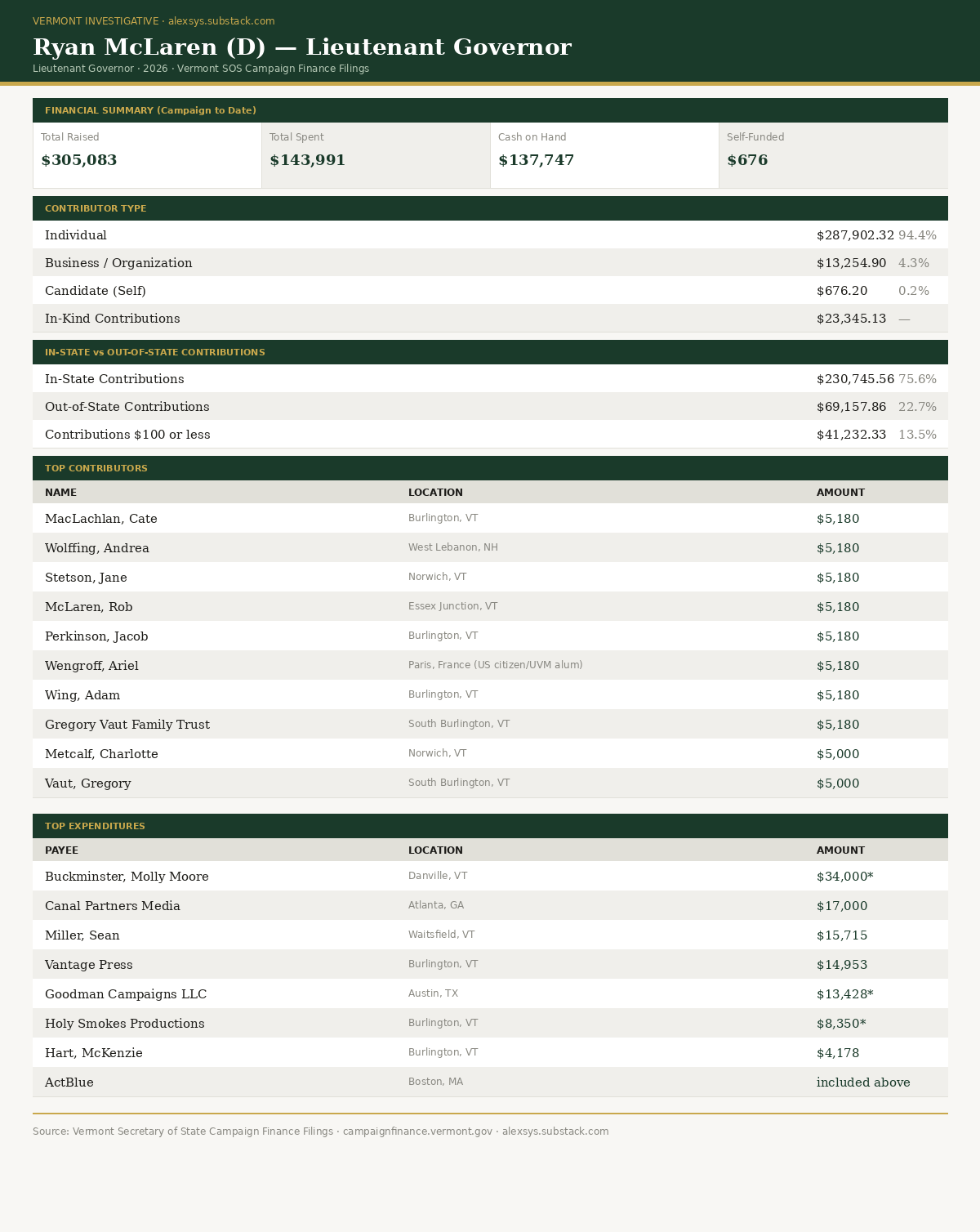
Notable from the filings:
Gregory Vaut ($5,000) and Gregory Vaut Family Trust ($5,180) — South Burlington — contribute $10,180 as separate legal entities
Ariel Wengroff ($5,180) — listed as Paris, France — UVM alum and US citizen currently based between Brooklyn and Paris
Former Governor Peter Shumlin — $1,000 donor
Largest expenditure: campaign manager Molly Moore Buckminster — $34,000 combined across two listings
Canal Partners Media — Atlanta, GA — $17,000 out-of-state media firm
Goodman Campaigns LLC — Austin, TX — $13,428 combined across two listings, out-of-state consulting
Right-of-reply and questionnaire status: Questionnaire sent. Response not yet received as of publication.
Who she is: South Burlington, Vermont. Educator, small business owner, consultant. Chair of the Vermont Commission on Women, a state body that advises the Legislature and the governor’s administration on issues affecting women and girls. Elected to the Middlebury Select Board; re-elected as top vote-getter. In 2024, became the first Black person Vermont’s Democratic Party nominated for statewide office, running for governor against incumbent Phil Scott. Lost the general election 74%–22%. (Ballotpedia; Seven Days, January 2026.)
What her record shows: Charlestin’s documented record is in community-level public service — Select Board, Commission on Women, education, and small business — rather than in the state Legislature or statewide executive office. Her 2024 gubernatorial campaign drew note for difficulty articulating a contrast with Scott, who won by the largest margin of his five terms. She is running for statewide office for the third time in three cycles.
What the record raises: Charlestin polls closer to Rodgers in a hypothetical general election matchup (35–30, 33% undecided) than either Gray or McLaren, suggesting crossover appeal the primary polling doesn’t yet explain. Her community-level record spans three cycles of statewide and local office-seeking — Select Board, gubernatorial, and now Lieutenant Governor. She is the only candidate in the Democratic field who has faced a general election statewide as a nominee.
On the record, Town Meeting TV forum, July 2026: When asked directly whether she voted for Clinton, Biden, and Harris in the 2016, 2020, and 2024 presidential elections, Charlestin declined to answer. Her exact words: “One, I am young and I’m declining to answer.” She did not clarify further. The moderator confirmed the non-answer on the record. (Town Meeting TV, July 2026.)
Campaign finance:
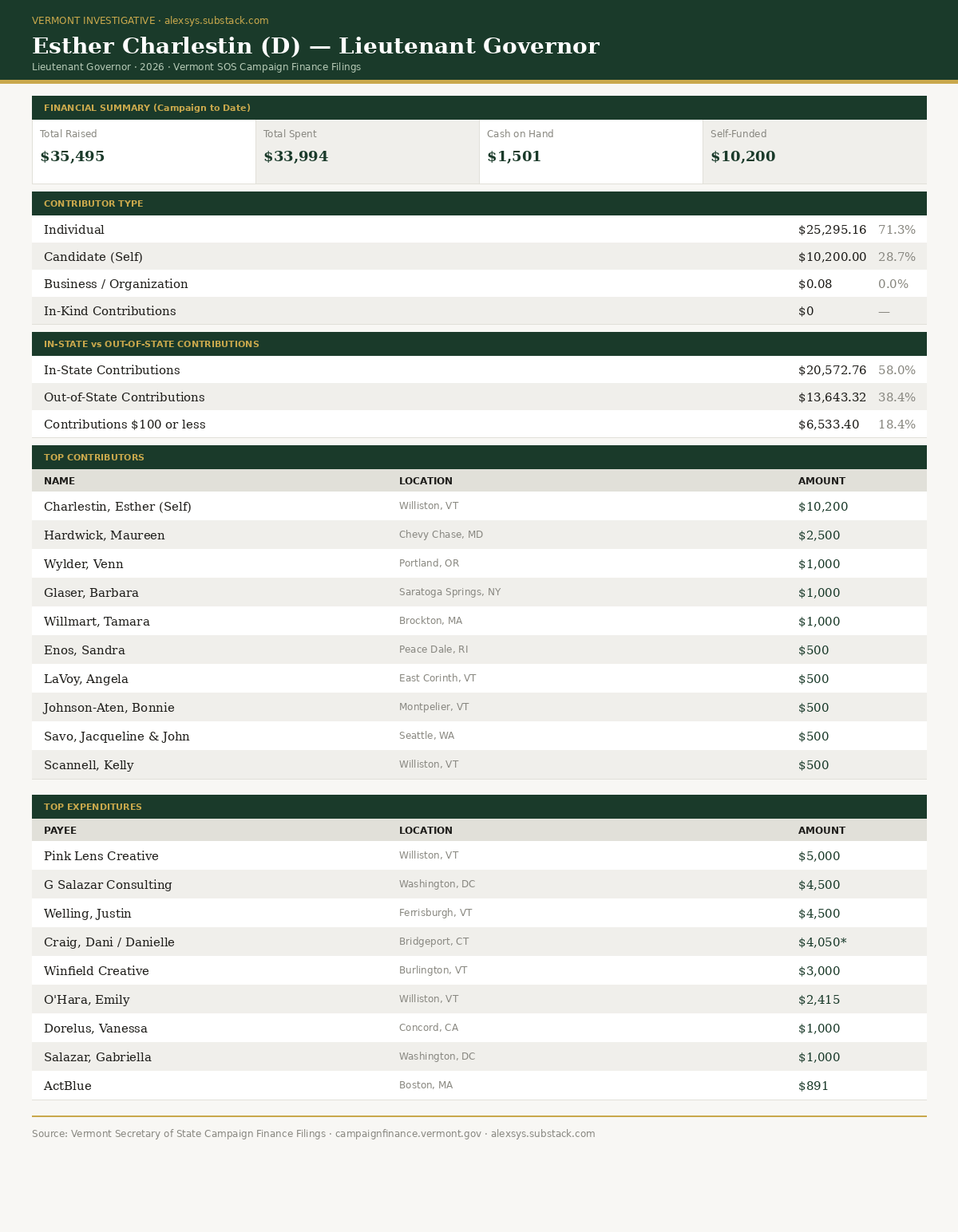
Notable from the filings:
Charlestin, Esther (self) — $10,200 — largest single contributor is herself, representing 28.7% of total raised
Hardwick, Maureen — Chevy Chase, MD — $2,500 — out of state
Six of her ten top non-self donors are out of state
Out-of-state contributions: 38.4% of total — highest out-of-state percentage in the field
Cash on hand as of July 1: $1,501
G Salazar Consulting — Washington, DC — $4,500 expenditure; Gabriella Salazar also appears as a $1,000 donor from Washington, DC
Largest expenditure: Pink Lens Creative — Williston, VT — $5,000
Right-of-reply and questionnaire status: Questionnaire sent. Response not yet received as of publication.
Vermont’s Lieutenant Governor race in 2026 involves one office with constitutional limits, four candidates with meaningfully different records, and a public ready to assess which of them can use a narrow platform to do something real.
John Rodgers, the incumbent, has one documented consequential vote in office and a record of cross-partisan dissent. His campaign finance filings carry unresolved irregularities — two expenditures to vendors not registered or no longer active in the Vermont Secretary of State’s business registry. Right-of-reply questions on those irregularities were sent and remain unanswered.
Molly Gray, the leading Democratic challenger, left the office mid-term once before and is asking for it back with a public commitment not to do so again.
Ryan McLaren, the highest-funded Democratic candidate, has no elected office record beyond school board service and a polling position that does not yet match his financial position. He leads the field in gross fundraising at $305,000+ but polls third among Democrats at 7% — behind both Gray at 39% and Charlestin at 11%.
Esther Charlestin, the third Democratic candidate, has the most sustained community-level record and the least financial support — $35,495 raised through July 1, with a late surge of $22,464 in recent weeks.
Campaign finance summary, sourced (VTDigger, July 2, 2026; WCAX, March 17, 2026):
McLaren: $305,000+ raised, $143,991 spent
Gray: $282,862 raised, $78,335 spent
Rodgers: $54,241 raised, uncontested Republican primary
Charlestin: $35,495 raised, $22,464 raised in recent weeks
Questionnaire responses from all four campaigns will be published in full as received. Readers who have information relevant to this reporting are welcome to reach out at alexsysthompson@pm.me.
Sources:
Ballotpedia
Wikipedia — John S. Rodgers; Molly Gray
VTDigger — July 2, 2026; March 16, 2026; January 5, 2026; January 28, 2026
WCAX — March 17, 2026; February 3, 2026
Vermont Public — January 9, 2025; May 1, 2025
Seven Days — February 3, 2026; January 30, 2026; December 2025
The Vermont Political Observer — March 16, 2026
WAMC — April 22, 2026; January 6, 2026
UNH Survey Center — June 30, 2026
Vermont Secretary of State campaign finance filings — campaignfinance.vermont.gov
FEC campaign finance filings — Molly Gray for Congress, 2022
Town Meeting TV — Democratic primary Lieutenant Governor forum, July 2026 (cctv.org/primary; youtube.com/watch?v=glsJjGzw61A)
PEGTV Rutland — John Rodgers remarks (YouTube)
Vermont Business Magazine — December 2024
If you find yourself reading, learning, or citing this work please consider supporting it with a Substack subscription (https://alexsys.substack.com/subscribe) or Ko-fi (https://ko-fi.com/alexsysthompson)
Comments
Nothing yet. Say the first thing.
Sign in to join the conversation.