
Every candidate on this ballot is asking Vermonters to trust them with real power over real lives. As a result, we seek to learn who they are, what they value, and how they will lead. We look at several key things: who do they associate with, who supports them and how, where does their funding come from and where does it go, and do their words and actions align. We will seek to answer these questions for each candidate, where the record is available.
When we look at who supports Molly in her most recent run for Lieutenant Governor, we find this: nine sitting state senators. Dozens of House members. Former Governor Howard Dean, writing a personal check. Former Senator Patrick Leahy’s own leadership PAC, cutting her a contribution. This shows us this is not a grassroots campaign. This is Vermont’s Democratic establishment, a well-oiled machine ready for deployment.
Following the money, it echoes the same Democratic depth: more of the same National Democratic donor networks. A repeat maximum donor going back to her 2020 race. It’s almost a rinse and repeat of her last campaign. This is a candidate the party already knows, already trusts, already invests in.
Gray won the Democratic primary for Lieutenant Governor on August 11, 2026. She faces Republican incumbent John Rodgers in November.
By her own account, her campaign website says she “grew up on a vegetable and small dairy farm in South Newbury still operated by her family today.” She was raised, she says, on the principle that “you take care of the land that has taken care of us.” That’s the frame she’s chosen for herself: rural roots, an inherited responsibility to the land, a personal claim to understanding what farmers and rural Vermonters need.
That’s how she describes herself. What follows is what the record shows.
On April 1, 2026, Gray’s campaign posted to Instagram asking for feedback on Act 181’s Tier 3 road rule, a road-maintenance standard that had become a flashpoint in rural parts of the state. The post staked out no position of its own. The caption told people to “complete the survey (link in bio),” alongside options to DM her or comment directly.
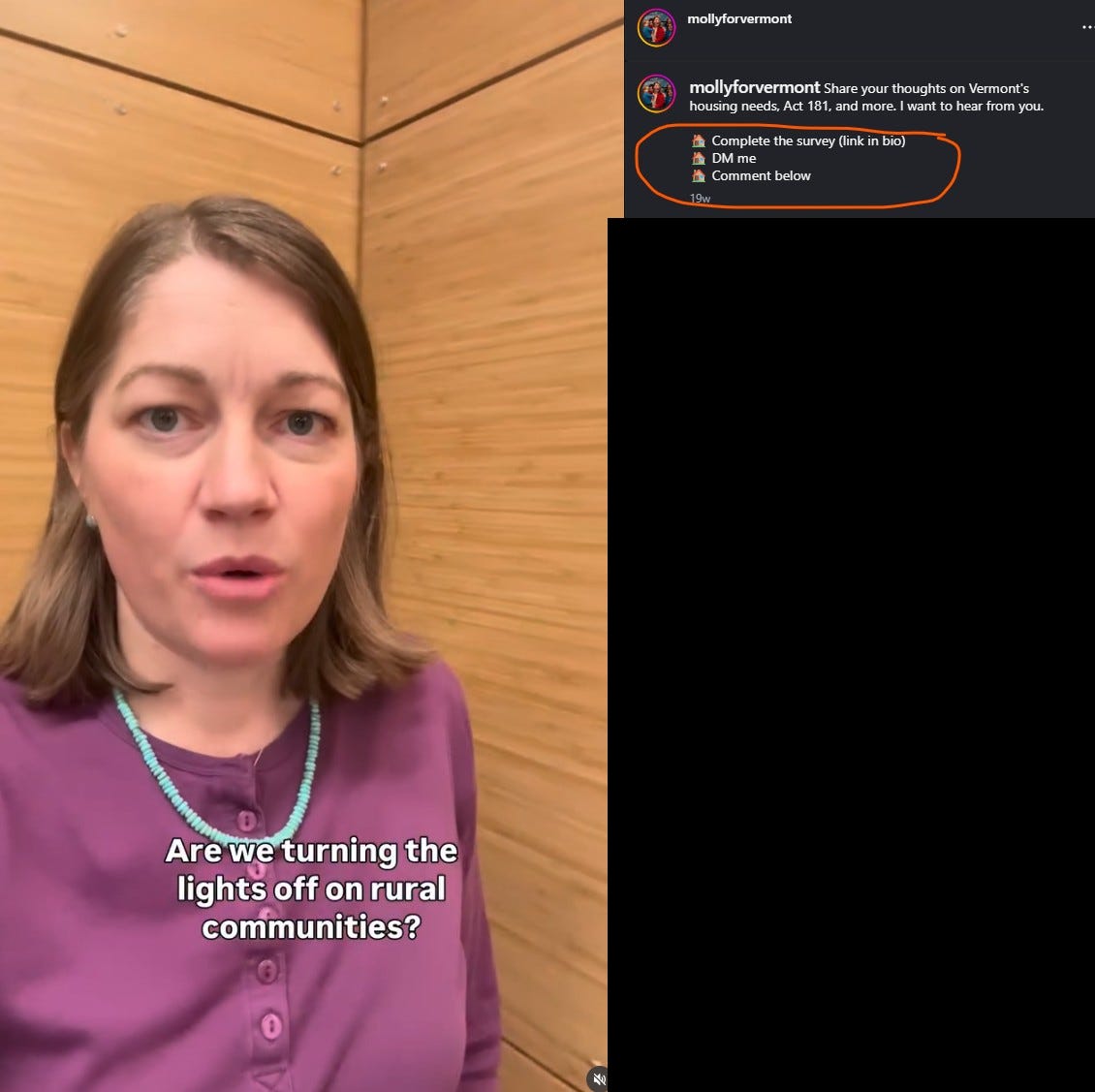
Sixteen days later, on April 17, she posted again, this time saying she’d “been calling for this for a couple of weeks,” referring to repeal of the Tier 3 rule. In the next breath, she switched focus to Democratic leadership’s success in this process. It’s unclear whether she’s referring to herself as part of that leadership or speaking from outside it. All in all, that’s neither here nor there. What’s in question is accountability, her actions versus her words on this topic. Todd Heyman, a commenter following the race, raised the same discrepancy publicly and said he couldn’t find any Gray statement calling for repeal before April 17, an account independently verified against the post itself.
When we look back in time for any evidence to support her claim, here is what we find. On March 27, 2026, Rep. Amy Sheldon, the House Environment Committee chair and Act 181’s own primary author, told Vermont Public/VTDigger she wasn’t open to rolling back the law, calling opponents’ arguments “overstated and misguided.” On April 8, the committee heard formal testimony from named farmers and advocates calling for repeal: a farmer from Corinth, the co-director of the equity oversight board Act 181 itself created, a longtime conservation attorney, a master logger. On April 15, nineteen days after her original position, Sheldon reversed, and Speaker Jill Krowinski issued a formal statement acknowledging the law’s problems. Gray posted her video two days after that, on April 17. (This outlet documented that 19-day reversal in detail at the time.)
Gray’s name doesn’t appear anywhere in the public record of that nineteen-day reversal. Not in the committee testimony. Not in the reporting. Not in the legislative correspondence or the press this outlet covered or could locate. She holds no seat on the House Environment Committee. She isn’t part of that system. There’s no vote, no way to be part of the record the way someone in a seat with a vote would be. Even as Lieutenant Governor, that vote wouldn’t carry much weight.
One day before her video, on April 16, Ryan McLaren, Gray’s chief rival in the primary, published his own Substack piece calling for repeal of the Road Rule. He went on to offer credit to the people on the ground making this issue visible, naming Neil Ryan among them, though at that point Neil hadn’t yet written anything about Gray or endorsed anyone in the race. Gray’s name doesn’t appear in McLaren’s piece either. Her chief rival was writing about who caused this change, in real time, the day before she claimed credit for it. He didn’t mention her.
That said, like all the Vermonters who showed up with no seat given at the table, yet became part of the record, she too could have done so.
Neil Ryan, the farmer who testified April 8, doesn't hold a seat either. Neither does Sam Lincoln, the logger who testified the same day. Private citizens without any institutional standing still left a public trail: testimony, a name on a witness list, a timestamp in the record. Despite checking, this outlet couldn't find one for Gray.
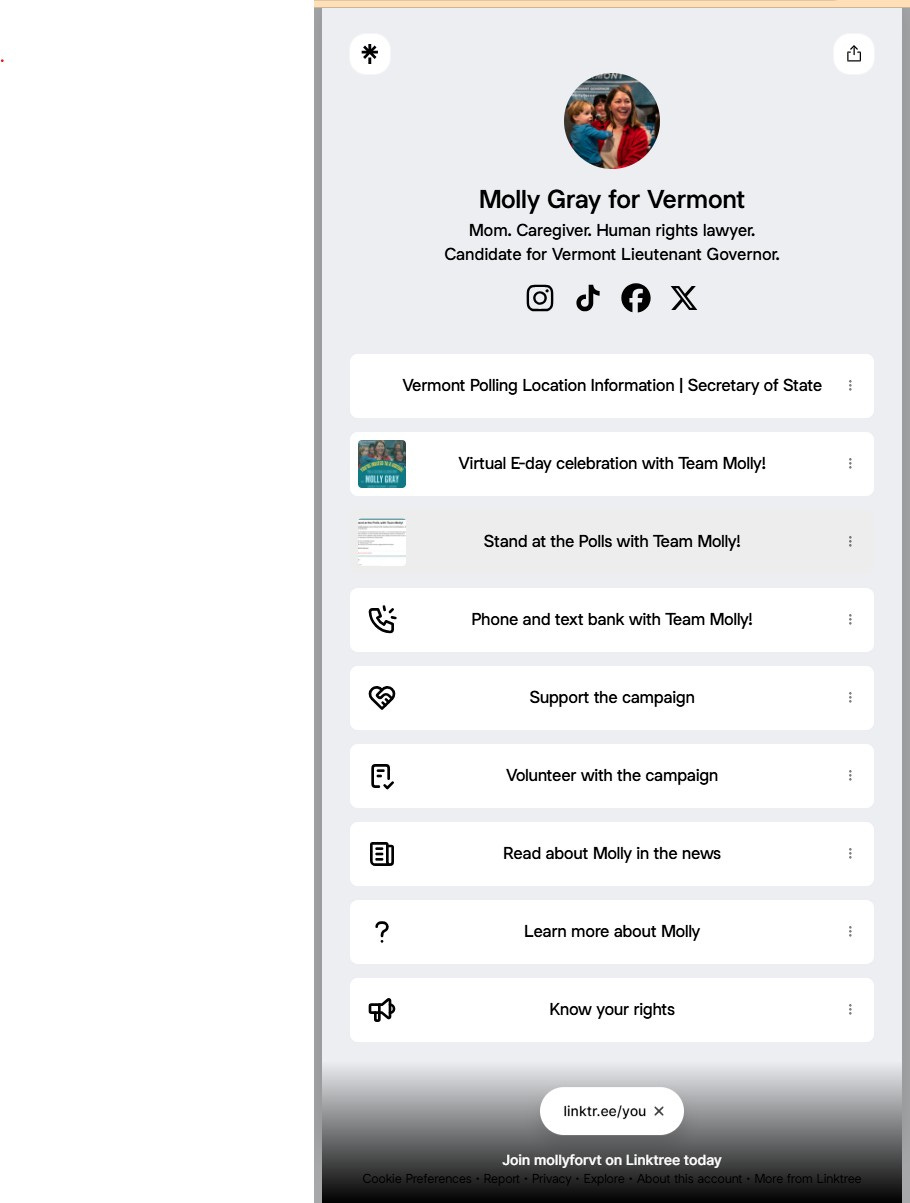
The April 1 post itself is real and easy to find. It’s sitting on her Instagram. That caption’s mention of a survey, with a link said to be in her bio, is the only documentation this piece has found that the survey ever existed at all. There’s no independent proof it was ever live: it’s not on her Linktree, and it’s not on her campaign website or press page. No results from it, a number, a theme, a single quote, appear to have been shared publicly anywhere either. When Gray posted her April 17 video, she wrote separately on Facebook that the outreach had drawn “dozens of thoughtful responses.” That’s a claim the responses existed. It isn’t a showing of what they said. No number, no theme, no quote from any of them has been made public.
The video did reach Rural Vermont Rising, but not through Gray’s own campaign. Colleen Geddis, the group’s moderator, posted it into the group herself on April 2, the day Gray’s page joined. It drew 121 comments, many of them pointed: readers asking why she hadn’t said “repeal,” debating what the post actually meant. This outlet reviewed all 121 comments and found no reply from Gray or her campaign, inside the group or anywhere else, and no sign that the survey results were ever shared with the people who showed up to answer it.
Colleen Geddis shared a second Gray video into the group on April 18, the day after the “been calling for this for a couple of weeks” post went up. That one drew 86 comments and was, by a wide margin, critical: readers invoking property rights, calling the video “insulting,” questioning her leadership. Again, this outlet found no response from Gray or her campaign anywhere in that thread.
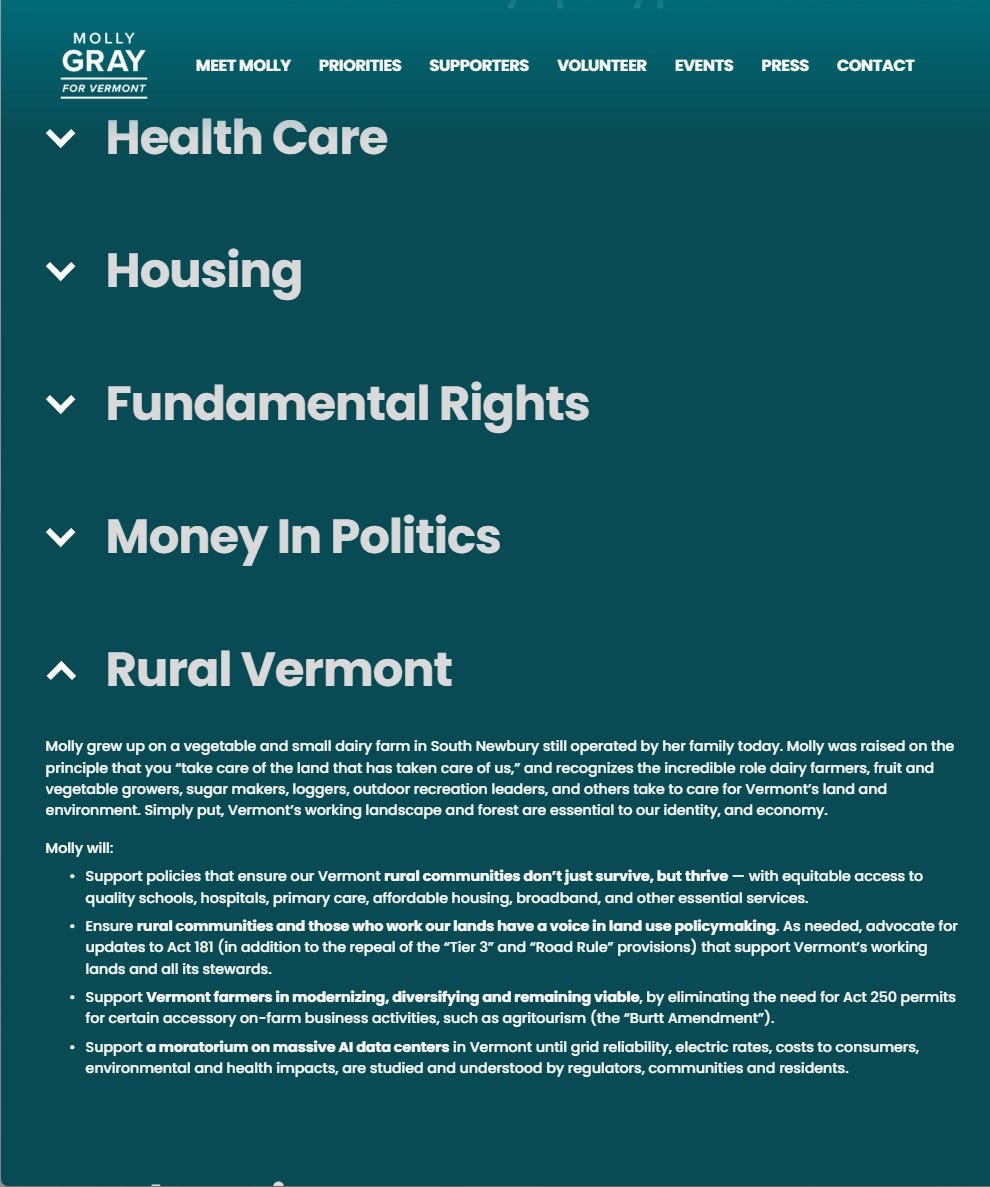
As of August 17, 2026, more than four months later, that’s still true. Her Linktree, reviewed that day, lists nine items: polling information, an election-day celebration, phone and text banking, ways to support or volunteer, a press page, and general campaign info. No survey. Her campaign website’s “Rural Vermont” section, also reviewed that day, names repeal of the Tier 3 and Road Rule provisions as a current stated priority. She’s still actively campaigning on the position, with no answer to where the survey went, where it was deployed, or what the results were.
Saying you support something and actually doing it are not the same thing.
Rural Vermont Rising is the Facebook group at the center of this: now more than 17,000 members, founded and moderated by Colleen Geddis. What's documented isn't a record with the group. It's a record with Colleen and it is very recent.
Gray’s campaign page joined the group on April 2, 2026. Whether anyone actively monitored that account between then and August 17 is unclear, and the reason for joining in the first place isn’t something we can speak to. What is clear: there’s been no activity, a fact supported by the group’s moderator. That account of lack of activity is corroborated from a separate, unconnected direction. On August 2, 2026, Joshua Pfeil says he spoke with Gray in person at the Winooski Farmers Market, where she was handing out campaign flyers. By his account, she told him she was a member of Rural Vermont Rising and frequented it regularly. When he asked her position on Act 181 and on TRORC, the Two Rivers-Ottauquechee Regional Commission, whose executive director sat on the steering committee that built Act 181’s framework, as this outlet has previously reported, she told him she felt strongly the law needed reform, but said she hadn’t heard of TRORC. Pfeil left the conversation understanding that she couldn’t have been an active member of the group and not know about TRORC, given how much the topic had dominated the group lately. Pfeil described the conversation publicly in the group itself on August 10.
Two independent sources land on the same gap: the group’s founder, checking her own records, and a voter who spoke with Gray directly, converging on a claim of active engagement with the group that doesn’t match any documented activity from her account.
Gray's campaign was silent with RVR until August 9, when deputy campaign manager Erin Tevnan messaged Colleen for the first time: thanked her for her work with the group, asked for a phone number. Colleen replied with her email address. Then five days of silence.
At 10:53 AM on August 14, Vermont Investigative sent Gray’s campaign a formal right-of-reply request. Sixty-six minutes later, at 11:59 AM, Erin emailed Colleen again, asking to set up a call.
Colleen’s reply, sent directly to Erin and shared with this outlet on the record, didn’t leave much to interpretation:
“I must admit I am a bit surprised to hear from you. After I provided my email address a week ago, communication went entirely cold. It makes me wonder if a recent nudge — perhaps from an investigative writer looking into how the campaign communicates with rural Vermonters — prompted this sudden renewal of interest... If rural Vermonters like myself are truly a priority for Molly’s campaign, you are welcome to reach out again once the campaign’s schedule aligns with a genuine, consistent effort to connect.”
Campaign manager Nick Atherton emailed her directly at 3:47 PM that same day, pressing for a date she’d be available.
Four months of nothing, then two outreach attempts inside one week: one the day after a post about the race went up, the other an hour after a reporter's questions arrived.
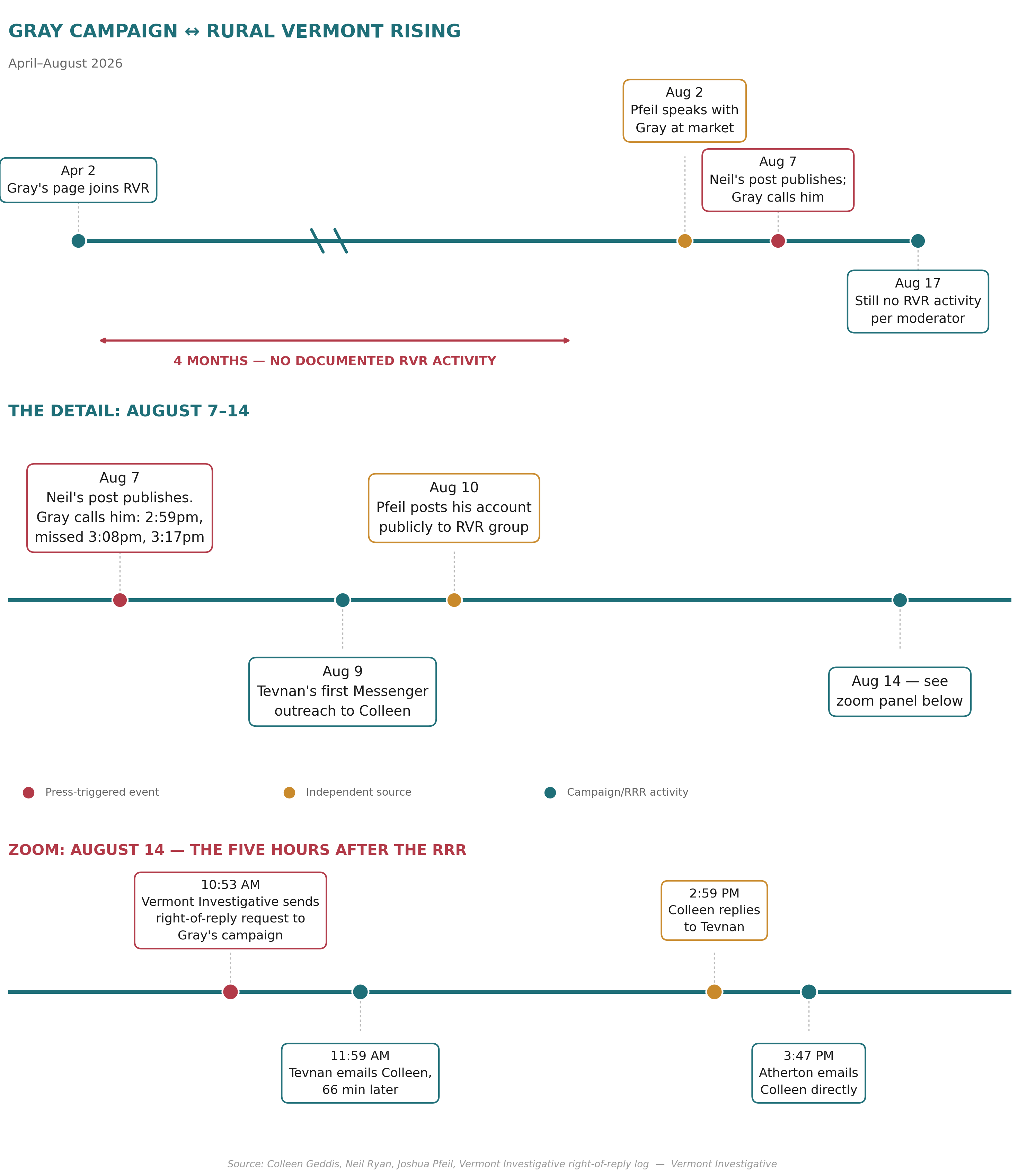
On August 7, 2026, Neil Ryan published a piece on the Lieutenant Governor race recommending Ryan McLaren and describing Gray as disconnected from rural and lower-income Vermonters. He writes the MacIsaac Highland Cattle Substack, and he’s the same Neil Ryan who testified before the House Environment Committee on April 8, described above: the Corinth farmer who told the committee “the process was the poison” and called for full repeal of the Road Rule and Tier 3. By August, he’d gone from testifying under his own name before the legislature to writing, under his own name, about the candidate now running to represent rural Vermonters like him.
Neil described what happened in an interview with this outlet on August 14.
On that first call, by Neil’s account, Gray pressured him to take the post down. Neil asked whether she’d read the article. She said she hadn’t. He encouraged her to go read it and call him back to discuss. She called a second time, by his account more insistent, saying the article contained misinformation. She raised her own record on unrelated issues, broadband, universal primary health care, that Neil says had nothing to do with what his post was actually about, or with what Rural Vermont Rising focuses on in the first place, which is land use and other economic and environmental justice positions. By Neil’s account, her stated reason for wanting the post removed was framed around the race itself: that McLaren represented the establishment, and she was the voice for rural Vermont. Neil’s phone log, carrier-verified, dates the exchange precisely: a call at 2:59 PM lasting four minutes, a missed call at 3:08 PM, and a second call at 3:17 PM lasting twenty-two minutes, all on August 7, the same afternoon his post went up.
Note: the documented and substantial connection to the establishment in the beginning of the Who is Molly Gray.
Neil has a declared stake in this race: his piece supported Gray’s opponent, and readers should weigh that. He’s not a disinterested source. But he’s also not a partisan operative with no independent standing: his name and his testimony on Act 181 are part of the public legislative record, months before he ever wrote about Gray specifically. Both things are true at once, and neither changes what happened on the calls themselves.
Vermont Investigative sent Gray’s campaign a written right-of-reply request on August 14, 2026, at 10:53 AM: five questions, a 48-hour window.
The 48-hour window closed on August 16 with no substantive response from the campaign.
The campaign’s outreach to Colleen happened inside that same 48 hours. That’s part of the record too. It isn’t an answer to the questions that were actually sent. This demonstrates they were reading the emails they received and chose a path forward, just not this one.
This outlet holds every candidate for public office to the same measure: not what they say when asked, but whether the record shows they were already engaging before anyone asked, whether they answer plainly once someone does, and whether their actions align with their words.
Gray’s record, on that measure, shows the same shape three times over: a public position that changed without being described as a change, a rural constituency of 17,000-plus that’s never publicly heard from her at all, and direct pressure on a citizen writer paired with silence toward a formal press inquiry.
Dated messages. Public posts. Named accounts, on the record. Laid side by side so the shape is visible. Three threads, one shape, five months. The data tells the story. What it means is yours to decide.
Gray’s campaign can still respond, on the record and in writing, if they choose. If they do, the piece gets updated to reflect it.
Sourcing note: All screenshots and correspondence from Colleen Geddis are used with her on-the-record permission. Neil Ryan’s account is used with his explicit consent, given by text message on August 11, 2026. Joshua Pfeil’s account, and the language drawn from his public Facebook post, are used with his approval. The Act 181 legislative timeline in this piece draws on this outlet’s prior reporting: “It’s Not a Theory Anymore. It’s on the Official Record”, “The Meeting You Weren’t Invited To”, and “Vermont’s Act 181: The Process Was the Poison”, where the underlying committee testimony, correspondence, and public records are cited in full. This piece is otherwise built on primary sources: dated posts, dated correspondence, and named on-record statements, throughout.
Comments
Nothing yet. Say the first thing.
Sign in to join the conversation.