
Two documents entered the public record in August 2026 that together describe where the Two Rivers-Ottauquechee Regional Commission’s draft 2026 Regional Plan stands and how it got there.
The first is a 51-page preapplication response from the Land Use Review Board, dated August 7, 2026, reviewing TRORC’s draft plan. The second is a formal Open Meeting Law violation notice sent to TRORC Executive Director Peter Gregory on August 10, 2026, by Neil Ryan of West Topsham.
Both documents are public. This is a summary of both and what they mean for the process going forward.
The LURB’s preapplication response covers TRORC’s draft plan section by section, rating each element as conforming, non-conforming, or requiring more information. The overall plan structure and required statutory elements are mostly present. The energy element passed with separate sign-off from the Department of Public Service. Economic development, transportation, utilities, childcare, and flood resilience each passed with minor exceptions.
The rural land use mandates did not.
Every rural land use category in the plan — Rural General, Rural Agriculture and Forestry, Rural Conservation — carries flagged provisions. The density caps, retail bans, paving restrictions, farm event limits, impervious surface caps, and subdivision limits are all unsupported. For each one, LURB’s direction is the same: demonstrate that the plan’s towns and residents actually support these restrictions, or remove them.
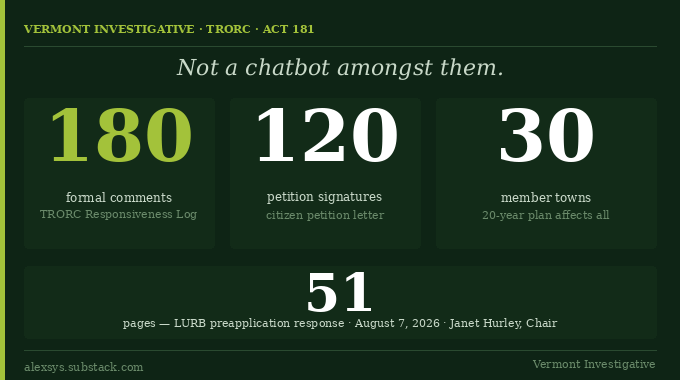
LURB found it “unable to determine” whether TRORC met the statutory outreach requirement at all, citing roughly 40 numbered public comment exhibits it had received from TRORC constituencies who felt they had not had adequate opportunity to weigh in. The full public comment record runs to 180 comments confirmed in TRORC’s own Responsiveness Log and 30 or more submitted directly to LURB, along with a petition letter signed by 120 individuals.
LURB also found it could not confirm the plan is compatible with its member towns’ own plans, “given extensive comments from municipalities and the public expressing concerns.”
The board raised constitutional questions directly, stating it questions “whether mandatory land use restrictions expressed throughout the plan infringe on constitutional property rights without adequate input from affected landowners.” LURB flags disproportionate impact on lower-income, senior, and rural residents.
The environmental justice section failed outright. TRORC reviewed its own policies for good intentions rather than analyzing whether regulatory burdens fall unevenly across its region today. LURB named three other regional commissions — NRPC, LCPC, and RRPC — as models that completed the required analysis correctly.
Additional findings: the fossil fuel ban and EV mandate were called “overly prescriptive” and “at odds with removing barriers to housing development and rural enterprises.” A transportation policy banning new development with truck traffic on gravel roads received the same finding. The 30-year affordability requirement conflicts with the state’s own 15-year statutory standard. A housing policy for elderly, disabled, and low-income residents was flagged as potentially discriminatory. Several of TRORC’s triggers for what constitutes a “substantial regional impact” appear to be municipal-level decisions, not regional ones.
Vermont Investigative filed a public records request with TRORC on July 9, 2026, requesting documentation of how Act 325 altered the maps distributed for public comment. Gregory responded the same day.
On the maps: Gregory confirmed that Act 325 did not change TRORC’s future land use maps. Tier 3 and the Road Rule were never incorporated into the maps — those were LURB rulemaking functions.
Vermont Investigative followed up with a question about TRORC’s mandatory plan language — specifically whether the same reasoning TRORC used to set aside the ambiguous 10 V.S.A. chapter 89 reference also informed how it approached the “shall” provisions elsewhere in the plan, including density caps, structure limits, the fossil fuel restriction, and the EV charger requirement.
Gregory’s response, forwarded from Chief Planner Kevin Geiger, noted that other RPCs also use mandatory language and that RPC boards have statutory authority to write policies they consider important in their regions. Geiger provided examples from three other regional plans — NWRPC, WRC, and MARC — showing “shall” language in rural siting and design requirements.
The examples Geiger identified are site-design and siting guidance: requirements that development minimize fragmentation, reduce site disturbance, and protect natural resources. They are not categorical use prohibitions, density caps, or energy technology mandates.
Vermont Investigative asked Gregory directly: given that other regional plans took a different approach on the same statutory mandate and the same deadline, what does he wish people understood about why TRORC chose this approach? Gregory’s response did not address that question.
Both Gregory’s and Geiger’s emails are noted as public records in their own footers.
On August 10, 2026, Neil Ryan of West Topsham filed a formal written notice with TRORC pursuant to 1 V.S.A. § 314(b)(1), alleging violation of 1 V.S.A. § 312(h) — Vermont’s Open Meeting Law requirement that the public be given a reasonable opportunity to express opinions on matters considered by a public body during an open meeting.
Ryan’s notice alleges that at TRORC’s March 25, 2026 board meeting, no member of the public was given any opportunity to discuss the land use rules under consideration, and that the violation was not cured at the April 8, 2026 Executive Committee meeting that followed.
Ryan requested that TRORC cure the violation by holding a full public meeting of the entire board to discuss the land use rules, allow public comment, and ratify the March 25 vote upon conclusion of that meeting. He further requested that TRORC adopt a new measure ensuring future compliance under 1 V.S.A. § 314(b)(4)(B).
Under 1 V.S.A. § 314(b)(2)(A), TRORC had until August 20, 2026 to acknowledge the violation and state its intention to cure within 14 days, or to state that it believes no violation occurred.
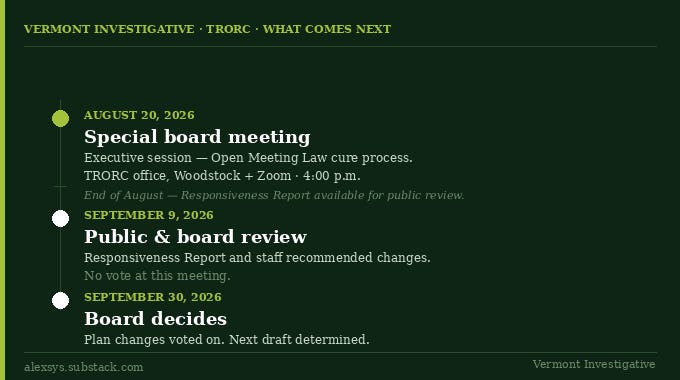
TRORC acknowledged the violation. A special board meeting was called for August 20, 2026 at 4:00 p.m. at the TRORC office in Woodstock and on Zoom. Discussion is to occur in executive session.
Under 24 V.S.A. § 4345a(a)(5)(A), a regional planning commission preparing a regional plan shall develop and carry out a process that will encourage and enable widespread citizen involvement and meaningful participation, as defined in 3 V.S.A. § 6002.
Under 3 V.S.A. § 6002(6), meaningful participation means that all individuals have the opportunity to participate in environmental decision making, including planning; that communities are enabled and administratively assisted to participate fully; and that the body operate in a transparent manner with regard to opportunities for community input.
Under 1 V.S.A. § 312(h), at an open meeting, the public shall be given a reasonable opportunity to express its opinion on matters considered by the public body during the meeting.
LURB found it could not confirm TRORC met the first standard. Ryan’s formal notice documents an alleged violation of the third. What the board does on September 30 is the record still being written.
Act 181 required TRORC to update two chapters: Chapter 3 (land use) and Chapter 8 (housing). TRORC’s own 2025 adopted plan contains a disclaimer confirming that scope.
The 2026 draft is a full rewrite of all chapters. Approximately 29% of its mandatory directives — roughly 76 sentences — have no counterpart in the 2025 plan. That is where the farm event caps, solar prohibitions, rural density limits, and commercial use bans live.
A four-cycle policy comparison prepared by Michelle Massa, Chair of the Vershire Planning Commission, documents the escalation from 2017 through the 2026 draft: mandatory directive density nearly doubled from 0.71 per page in 2017 to 1.32 per page in 2025, and the 2026 draft introduces prohibitory “shall not” language that appears in none of the prior plans.
The question the comparison raises is one the board has not yet answered on the record: Act 181 required two chapters. Who authorized the full rewrite — and when did the board know?
Primary Sources
Land Use Review Board, Preapplication Response RPC10-0001, Two Rivers-Ottauquechee Regional Plan, dated August 7, 2026; adopted at LURB’s August 6, 2026 meeting. Signed by Janet M. Hurley, Chair.
Michelle Massa, Summary and Analysis of LURB Preapplication Response RPC10-0001, August 2026. Accuracy confirmed by LURB Chair Janet Hurley by email, August 13, 2026.
Neil Ryan, formal written notice of Open Meeting Law violation, August 10, 2026, pursuant to 1 V.S.A. § 314(b)(1). Addressed to Peter Gregory, TRORC Executive Director. Public document.
Peter G. Gregory, TRORC Executive Director, email responses to Vermont Investigative public records request, July 13–14, 2026. Noted as public record in sender footer.
Kevin Geiger, AICP CFM, Chief Planner, TRORC, internal email forwarded to Vermont Investigative, July 13–14, 2026. Noted as public record in sender footer.
1 V.S.A. § 312(h) — Vermont Open Meeting Law, public comment requirement.
1 V.S.A. § 314(b) — Vermont Open Meeting Law, violation notice and cure process.
24 V.S.A. § 4345a(a)(5)(A) — Regional planning commission participation obligation.
24 V.S.A. § 4348(a) — Regional plan adoption process, solicitation requirement.
3 V.S.A. § 6002(6) — Definition of meaningful participation.
If you find yourself reading, learning, or citing this work please consider supporting it with a Substack subscription (https://alexsys.substack.com/subscribe) or Ko-fi (https://ko-fi.com/alexsysthompson)
Comments
Nothing yet. Say the first thing.
Sign in to join the conversation.