
Five candidates have declared for the Vermont Senate Addison District (ADD-1) seat. Vermont Investigative transmitted an identical 12-question legislative questionnaire — plus a candidate-specific addendum — to all five candidates simultaneously on June 1, 2026, under identical conditions and the same response deadline of June 13, 2026.
The questionnaire covered: housing demand projections and demographic data; education fund revenue risk; noncitizen voting in school budget elections; Act 59, carbon markets, and conservation finance; natural capital valuation; land ownership transparency; Vermont sovereignty over land use policy; rural policy framework; data center siting and energy impact; education spending and outcomes; and the pricing mismatch in Vermont’s housing market.
All five candidates were notified that responses — and non-responses — would be published under the same editorial standards on or after June 16, 2026.
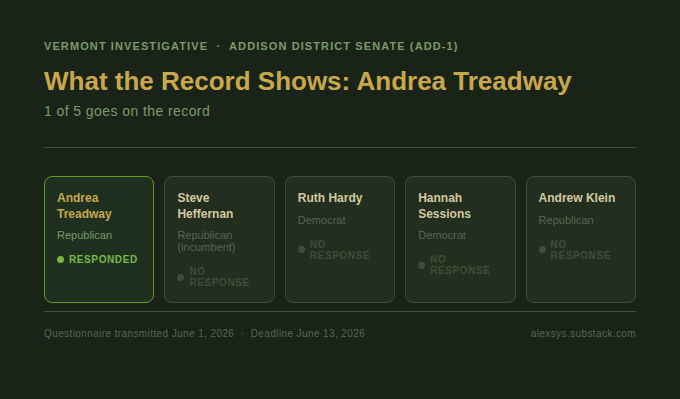
One of five candidates responded. That alone says something. You can decide what.
Andrea Treadway — responded in full, with noted areas of ongoing research.
The following four candidates did not respond so I will pull the answers from the public domain as best as I can.
Steve Heffernan (incumbent, Republican)
Ruth Hardy (Democrat)
Hannah Sessions (Democrat)
Andrew Klein (Republican)
Vermont Investigative will update this piece if responses are received after deadline.
The non-response record is itself a primary document. Addison County voters do not yet have documented, on-the-record positions from four of the five declared candidates on housing demand data, education fund structure, Act 59 conservation finance, land sovereignty, data center policy, or rural regulatory equity.
Andrea Treadway is a Republican candidate for Vermont Senate, Addison District, residing at 429 Mount Independence Road, Orwell. Her campaign finance disclosure statement, filed June 29, 2026 with the Vermont Secretary of State for the period ending June 28, 2026, shows total contributions of $3,311.87. Of that, $2,851.62 is self-funded — including $2,700 in personal loans to the campaign that remain outstanding as of the filing date. The sole outside monetary contributor is Timothy Buskey of Addison, Vermont, who contributed $260.25. Contributions of $200 or less account for an additional $200.00. No business, organizational, or out-of-state contributions are recorded.
Of $3,015.25 in total expenditures, $3,000.00 went to Cambium Group, LLC — a web design and digital marketing firm registered in Clermont, Florida, with a second office in St. Johnsbury, Vermont — in three payments for website development. Remaining expenditures include $10.25 in WinRed platform fees and $5.00 in KeyBank charges. Cash on hand as of the last filed report: $145.00.
Source: Vermont Secretary of State Campaign Finance Disclosure Statement, Filing Entity ID 301260, 2026 Jul 1 — Disclosures, filed June 29, 2026.
The questionnaire did not ask for opinions. It asked candidates to engage with documented data and to identify the fiscal mechanisms, sourcing, and specific policy positions underlying their public platforms.
Questions were built from primary sources: Census Bureau population data, Vermont Housing Needs Assessment projections, Vermont Department of Taxes disclosures, NAEP reading score data, the text of Acts 59, 73, 76, 139, 170, and 181, Vermont Supreme Court rulings, and Vermont Constitution Article 2.
Where a candidate’s response lacked data, sourcing, or fiscal specificity, this publication notes that characterization as the candidate’s own — not as an editorial judgment.
Andrea Treadway is a Republican candidate for ADD-1. She is a former chair of the Orwell Planning Commission, a small business owner (payroll and bookkeeping), and a resident of Orwell. Her responses are published below in full, edited only for minor typographical errors. Her words are her own.
Context: Vermont’s official housing target — 40,000 units by 2030 — is drawn from the 2025 Housing Needs Assessment, projecting a range of 27,867 to 41,185 homes. Census Bureau data shows Vermont lost population for the second consecutive year in 2024–2025, with net domestic out-migration of -726 and total population decline of 1,858 — the highest percentage decrease of any U.S. state. Vermont has had more deaths than births every year since 2016. Housing inventory is up 16% year over year; days on market have increased 22 days year over year; price reductions of $15,000–$30,000 are common in the $200,000–$500,000 range.
Treadway: I am still researching housing needs in Vermont and what we need to do to meet those needs.
Research in progress, per candidate.
Context: Vermont has no legal definition of “vacation home” or “second home” in its tax code. Act 73 of 2025 set in motion a new nonhomestead residential classification; the Department of Taxes has acknowledged Vermont lacks the infrastructure to implement it before fiscal year 2029.
Treadway: I do not support increased taxation of second homes, vacation rentals, or luxury properties. Act 73 doesn’t have a defined outline for implementation — the legislature left it to be studied by the Department of Taxes, with a plan submitted by December of 2025. The language does not adequately address how it will distinguish between a second home and a seasonal camp, which will have unintended consequences.
Context: Vermont’s Education Fund receives approximately 40% of its revenue from the nonhomestead property tax at a statewide rate of $1.703 per $100 of equalized property value.
Treadway: Increasing property tax rates on non-primary residences is not a stable way to fund education. The increased rate will reduce the number of non-primary residences in the state, creating an even bigger gap in the Education Fund.
I am still reviewing specific policies being used in other similarly sized states. I believe we need to look at other revenue streams besides property taxes to pay for education. A reduction in the use of property taxes to fund education and an increased use of broad-based taxes and fees — spread across a larger base of people, not just property owners — seems to be a more stable way to fund education.
Treadway’s response identifies a structural concern and a directional alternative. No specific fiscal mechanism or identified policy models were provided at time of response.
Context: On May 15, 2026, the Vermont Supreme Court upheld Burlington’s charter amendment allowing noncitizens to vote in local school elections. A dissenting judge argued that school budget votes constitute statewide matters because they are funded through the statewide Education Fund.
Treadway: I do not support expanding noncitizen voting for school budget elections.
We have approximately 80,000 students in our education system with 119 districts being supported by a fraction of the approximately 640,000 people in this state. We need to move away from property owners being solely responsible for educating our children and look at a broader solution than just property taxes. I am still gathering information and formulating a proposal which moves away from education being predominantly funded by property taxes. I am looking at broader-based taxes and fees as a way to pay for education without introducing new taxes.
Context: Vermont’s Act 59 sets goals of conserving 30% of the state’s land by 2030 and 50% by 2050. The Phase II Conservation Plan is funded in part by a $1 million federal grant tied to the Biden administration’s America the Beautiful initiative, aligned with international biodiversity commitments made at COP15 in 2022. The Act 59 inventory has identified carbon and biodiversity markets as potential funding mechanisms.
Treadway: I do not support using carbon markets or biodiversity offset markets to fund Vermont’s Act 59 conservation goals. Which means no one should be eligible to hold those credits. I support legislation restricting foreign institutional investment in Vermont land or conservation easements.
Context: International institutions including the UN have promoted “natural capital accounting” frameworks that assign monetary values to ecosystems, watersheds, forests, and soils as financial assets.
Treadway: I do not support applying natural capital valuation frameworks to Vermont land. I will not support legislation that constitutes a taking from private property owners. The only ones this benefits are businesses buying the credits.
The Vermont Constitution specifically states in Article 2 that private property ought to be subservient to public uses when necessity requires it; nevertheless, whenever any person’s property is taken for the use of the public, the owner ought to receive an equivalent in money.
I support legislation that limits and/or restricts conservation finance from accelerating transfer of land stewardship from Vermont families and working farms to institutional investors or foreign capital.
Context: Conservation easements held by out-of-state nonprofits, timber investment management organizations, and national land trusts increasingly govern how rural Vermont land is used regardless of who nominally owns it.
Treadway: Yes, my definition of problematic land ownership extends to conservation easements held by out-of-state nonprofits and national land trusts. I support public disclosure requirements for conservation easement holders, including funding sources and any foreign capital interests.
Context: Vermont’s Act 59 conservation planning process has received federal funding aligned with international biodiversity commitments. International economic frameworks are actively being applied in Vermont policy development.
Treadway: Act 59 was enacted during the 2023–2024 legislative session and became law without the Governor’s signature. It has a goal of conserving 30% of the land by 2030 and 50% by 2050. However, it required the Vermont Housing and Conservation Board, in consultation with the Secretary of Natural Resources, to develop an inventory of existing conserved lands and a plan on how to reach the goals. The VHCB left lands in current use out of the equation, since “conserved” in Act 59 means permanently protected. I believe we need to include Current Use as part of the goal of conserving land in Act 59.
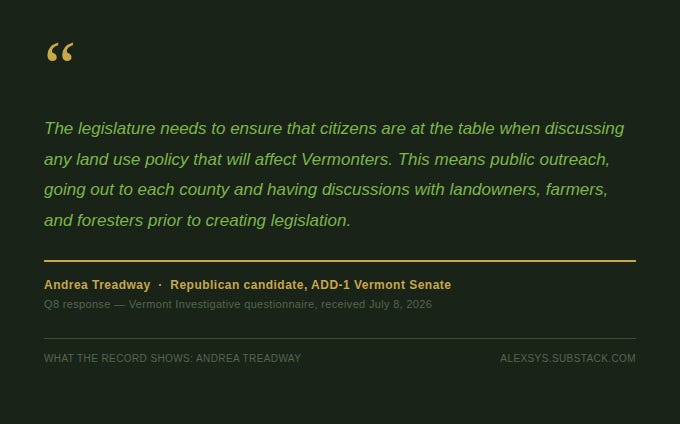
When discussing land use policy we need to focus on the people working and conserving the land — not lobbyists or special interest groups. The legislature needs to ensure that citizens are at the table when discussing any land use policy that will affect Vermonters. This means public outreach, going out to each county and having discussions with landowners, farmers, and foresters prior to creating legislation.
If elected to the Senate I will work to maintain open communication about any legislation which has the potential to negatively impact farmers, foresters, landowners, and working families. I believe we need to uphold the Vermont Constitution and not create laws which are in direct conflict with it.
Context: Vermont’s housing regulatory relief pathways under Act 181 require public water, public sewer, permanent zoning, and professional planning staff. Most rural Vermont towns have none of these. The childcare payroll tax under Act 76 falls hardest on rural small employers.
Treadway: As chair of a small rural town I will bring a different perspective to the Senate. I am also a small business owner of a payroll and bookkeeping business. I see every day the challenges and struggles rural Vermonters face living here. The legislature needs to discuss issues with constituents, not lobbyists. We need to make Vermont business-friendly so we can increase the tax base without increasing taxes. This can be achieved through an overhaul of permitting and zoning, creating a streamlined permitting process, and possibly tax incentives to entice economic growth.
When trying to craft legislation we need to take into account the impact depending on the size of the city or town. For example, a town like Orwell with 1,239 residents has mostly volunteer board members and part-time office staff with no town manager. Compare that to Middlebury with about 19,000 residents and a full town office staffed with paid employees — which one is better prepared for new or changed legislation? When crafting legislation there should be language introduced to address how the state will help with compliance. As for current legislation — Act 181 and Act 76 — I do not believe it serves towns equitably.
Context: Vermont’s legislature debated H.727 and S.205 to regulate or impose a moratorium on large data centers. A single large-scale data center can consume more electricity than entire Vermont cities, require up to 3,000 construction workers during build-out, create as few as 150 permanent jobs, and convert productive farmland to industrial use.
Treadway: I do not have enough information about this issue to determine if I support either of the versions. I am concerned about the impact to rural land being converted to industrial uses without proper consultation with towns and landowners.
Research in progress, per candidate.
Context: Vermont’s housing market shows inventory up 16% year over year, days on market up 22 days, price reductions of $15,000–$30,000 increasingly common in the $200,000–$500,000 range, and a sale-to-list ratio of 96.3%. The actual median Vermont home sale price ($370,000) is approximately $125,000 below the median listing price ($495,000). Vermont’s population is declining.
Treadway: I do not have a data-driven answer for this question. It is an area that I need to do more research in order to have an adequate response.
Research in progress, per candidate.
Context: Vermont’s per-pupil education spending has risen to $21,200 — among the highest in the nation. Vermont’s 4th grade NAEP reading scores have dropped 11 points since 2013. Mississippi, spending $9,300 per pupil, has gained 8 points and now ties Vermont’s performance. Act 139, requiring evidence-based literacy instruction, passed but was not funded. The foundation formula enacted in H.955 requires the 2027 legislature to affirmatively vote before it takes effect.
Treadway (on the spending-outcome gap): This gap exists because we have changed how we assess student learning. We need to have statewide requirements for each grade level and graduation. We need to prioritize reassessing proficiency-based learning requirements and move back to a more traditional structure with clearer benchmarks.
Treadway (on H.955 and the foundation formula): I am still getting up to speed on the foundation formula and how it is supposed to work for funding education. Act 170 is 152 pages and Act 73 is 147 pages of legislation which I am currently reviewing so I can make informed responses and decisions about it. I am not sure about including the current instructional framework into the evaluation at this time.
Orwell is exactly the kind of small rural Addison County town that Act 181’s Tier 1 designation cannot reach by default — no municipal water, no sewer in most areas, no professional planning staff.
Treadway: As the former chair of the Orwell Planning Commission I understand the implications Act 250, Act 181, and Act 59 have on our small community. Orwell has a sewer system that serves the village area and we meet the requirements of Tier 1B, but we did not sign on to it because it would have subjected the town to the rest of the requirements of Act 181 prior to the repeal of Tier 2 and 3. Specifically, I would pursue changes to current land use legislation so it relies more on local planning and permitting and less on state intrusion on our towns. Vermont’s government was formed by a grassroots, bottom-up approach and it has served us well. We need legislators in Montpelier who remember this and work with our rural towns when crafting new legislation.
The question asked Treadway to identify what specifically in Senator Heffernan’s record — his votes, his public statements, his conduct — she believes disqualifies him from continuing to represent Addison County. The question referenced Heffernan’s documented May 15, 2026 Senate floor statement comparing transgender identity to bestiality, and his departure from the chamber to avoid voting on Proposal 4.
Treadway: I don’t see myself challenging Senator Heffernan in the primary or in the general election. I am running for one of two positions to serve Addison County, Buel’s Gore, Huntington, and Rochester. I believe Senator Heffernan has supported legislation to reduce our property taxes, cost of education, and healthcare over the last two years. I don’t always agree with Steve, but I respect him and wish him well in our primary.
Treadway did not identify any element of Senator Heffernan’s record as disqualifying. Her response characterizes their relationship as collegial and distinguishes her candidacy as running for a seat rather than against an incumbent.
Proposal 4 — a constitutional amendment enshrining protections against discrimination based on sexual orientation, gender identity, and gender expression — will be on the Vermont ballot in November 2026.
Treadway: I was unaware of Proposal 4 being on the ballot for this year’s general election. Regardless, I believe we are all equal under the law regardless of race, religion, national origin, sex, gender, sexual orientation, etc., and I will work to make sure we are all treated equally. If elected I will work for all my constituents. If anyone in the LGBTQ+ community has an issue I want them to come to me and we will figure it out together.
Treadway did not state a position on Proposal 4 directly. Her response affirms a general equality principle and extends constituent access without a documented vote commitment.
As of publication, Addison County voters do not have documented, on-the-record positions from four of the five declared ADD-1 candidates — including the incumbent — on any of the following:
Whether the 40,000-unit housing target reflects current demographic data
Fiscal mechanisms for Education Fund stability as property tax revenue risk grows
Positions on Act 59 conservation finance and carbon market eligibility
Restrictions on foreign institutional investment in Vermont land
Data center siting policy under H.727 or S.205
Rural Vermont regulatory equity under Acts 181 and 76
Vermont sovereignty mechanisms when international frameworks shape land use policy
Proposal 4
Vermont Investigative will publish responses from additional candidates if and when they are received, under the same format and editorial standards.
Questionnaire transmitted: June 1, 2026. Deadline: June 13, 2026. Published: on or after June 16, 2026.
Source: Candidate email response from Andrea Treadway, received July 8, 2026. All other candidates: no response received by deadline.
If you find yourself reading, learning, or citing this work please consider supporting it with a Substack subscription (https://alexsys.substack.com/subscribe) or Ko-fi (https://ko-fi.com/alexsysthompson)
Comments
Nothing yet. Say the first thing.
Sign in to join the conversation.