
UPDATE: 7/7/26 An earlier version of this piece stated the Vermont Republican Party has no program to recruit and train women candidates, sourced to Seven Days October 2025. The Vermont Federation of Republican Women (VFRW), a state affiliate of the National Federation of Republican Women, operates with that stated mission. The relevant section has been updated to reflect the full record. The VFRW Facebook group describes itself as "in the early stages of organization" and was founded August 2025.
Vermont's 2026 election cycle carries visible fingerprints. Look at the names on the ballot — who they are, where they came from, how they got here — and three distinct threads emerge on the Democratic side. None of them are hidden. All of them are documented in the candidates' own words, in organizational records, and in publicly available filings. Together they tell a story about how a small state produces candidates, and what it looks like when that infrastructure matures over time. Other patterns are visible on the Republican side of the ballot and are documented separately.
This is a convergence piece. It documents patterns. It draws no conclusions about what those patterns mean. Readers bring their own values to what follows.
Convergence, as used in Vermont Investigative’s methodology, is the documented appearance of shared origin, shared training, shared relationships, shared resources, shared funding networks, or shared stated ideological frameworks across multiple actors in the same system. Convergence includes coordination — openly stated, publicly documented, and presented here without a verdict on what it means. It is not conspiracy. It is pattern — visible, sourced, and presented without a verdict.
Three convergence threads run through Vermont’s 2026 ballot. They are different in kind. One is geographic. One is relational. One is structural. They share one observation: with rare exception, they run through women.
Oxbow High School sits on Oxbow Drive in Bradford, Vermont. It serves grades 7 through 12, draws from the towns of Bradford and Newbury in the upper Connecticut River valley, and accepts tuition students from surrounding Vermont and New Hampshire communities. Its enrollment runs around 322 to 376 students. Its stated mission: “a family of empathetic, inquisitive, socially responsible learners who positively impact our world.” Civic engagement and community service are documented as part of its culture. In 2021, it celebrated its 50th anniversary.
In 2026, three women running for statewide office in Vermont share a documented connection to Oxbow and its supervisory union, Orange East Supervisory Union (OESU).
Molly Gray grew up on her family’s farm in Newbury — an OESU community. She attended Oxbow High School before transferring to Stratton Mountain School. Her own words, in multiple campaign interviews: “I went to the University of Vermont, to the Stratton Mountain School and to Oxbow to high school, as well as Newbury Elementary.” (Berkshire Eagle, March 2020.) Gray is running in the Democratic primary for Lieutenant Governor.
Aly Richards grew up in Newbury. Her father taught public high school for 35 years and was her history and English teacher at Oxbow High School. The Valley News reported she “served at age 15 on the State Board of Education while a student at Oxbow High School.” Her own campaign bio confirms: “My dad taught public high school for 35 years. He was my history and English teacher at Oxbow High School.” (alyforvt.com.) Richards is running in the Democratic primary for Governor.
Monique Priestley moved to Bradford at age sixteen and attended Oxbow High School. Her own biography: “I attended Oxbow High School in Bradford and moved there when I was sixteen.” (priestleyvt.com.) Priestley is running for Vermont State Senate, Orange County.
Three women. One school district. One election cycle. Their attendance at Oxbow spans roughly the mid-1980s through the early 2000s — they did not overlap. No single teacher, class, or moment connects them. What connects them is a community the record describes as tight-knit, civically oriented, and committed to service beyond academics.
The question the record surfaces without answering: what does a Title I rural school in Vermont’s upper Connecticut River valley produce, and what does it tell us that three of its alumni are on the 2026 statewide and legislative ballot simultaneously?
Ruth Hardy has represented Addison County in the Vermont Senate since 2018. In March 2026, she published a blog post on her campaign website announcing that Hannah Sessions would join her on the ticket for the Addison County Senate district.
Hardy wrote: “I met Hannah over 20 years ago on the East Middlebury playground where we both were chasing our toddlers around the play structures.” She described Sessions as a trusted advisor on agriculture through years of legislative work — including during COVID shutdowns when she “talked with Hannah regularly about what farmers needed to make it through the crisis.” She brought then-Congresswoman Balint to Blue Ledge Farm in 2023 to discuss flood recovery needs with Sessions directly.
Hardy also wrote: “Since Emerge Vermont, the program that trains Democratic women to run for office, I’ve been talking to Hannah about running for office. She was set to do the training program when her tractor broke down on the first day of class and she decided she couldn’t yet commit to running for office.” (ruthforvermont.com, March 22, 2026.)
This is the baton-pass documented in a sitting senator’s own words. Hardy — who served as Executive Director of Emerge Vermont from 2015 to 2019 before winning her Senate seat — recruited Sessions into Emerge training, watched her step back when her farm demanded it, and continued the conversation until Sessions was ready. Sessions announced her candidacy in February 2026. Hardy did not go through Emerge’s training program. She ran it. (ruthforvermont.com; Vermont Legislature official biography.)
Hannah Sessions is the daughter of Senior U.S. District Court Judge William Sessions. Her own campaign website notes her great-grandfather, Edward Bliss Doton, served in the Vermont Legislature in the 1940s. She has served on the Vermont Housing and Conservation Board and the Vermont Land Trust — two institutions with documented roles in Vermont’s land use and conservation infrastructure. She owns and operates Blue Ledge Farm in Leicester with her husband, producing award-winning goat cheese for 25 years. (hannahsessionsforvt.com.)
The Hardy-Sessions thread is not a hidden relationship. It is a documented mentorship that moved a working farmer from occasional advisor to Senate candidate over the course of years. The record shows how that transition happened and who guided it.
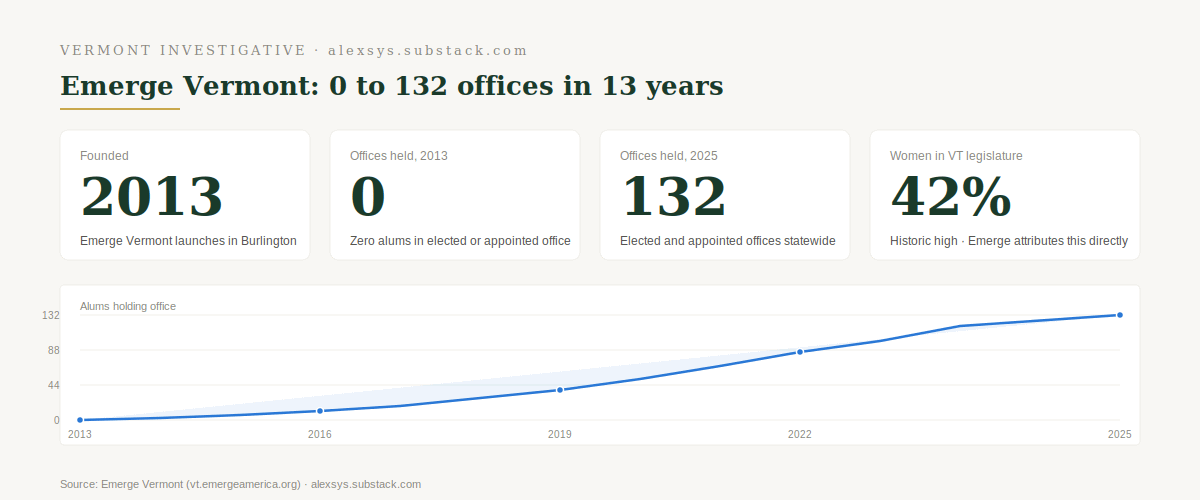
In 2002, a group of Democratic women in California founded an organization called Emerge America. Its purpose was explicit: recruit, train, and support Democratic women to run for public office. The curriculum they built — public speaking, fundraising, campaign strategy, voter contact, media and messaging — runs more than 70 hours over six months in its Signature Training Program. It has never been non-partisan. Its mission has always been Democratic women, specifically. (emergeamerica.org.)
In 2013, former Vermont Governor Madeleine Kunin brought that curriculum to Vermont. Kunin had served as Vermont’s first and only female governor, then as U.S. Ambassador to Switzerland under President Clinton. She had watched Democratic women struggle to enter Vermont politics without the structural support that would have helped her when she was finding her own way. She had been informally mentoring women for years.
Kunin called on then-State Representative Jill Krowinski and then-State Representative Kesha Ram Hinsdale to help build the Vermont chapter. They gathered as an impromptu board of directors and launched Emerge Vermont with a 200-person party in Burlington in September 2013. Kunin later said: “Its success has far outpaced anything I thought would happen.” (Seven Days, October 2025.)
What the program trains on is documented in its own materials. Participants learn fundraising mechanics, voter contact, public speaking, campaign strategy, and messaging from a team of Vermont campaign professionals. They also, critically, meet women already holding elected and appointed office — and become part of a network that connects them to those women going forward. The network is structural. It is also, by the record, how the pipeline sustains itself.
Emerge America’s own FAQ states the recruitment mechanism plainly: “Emerge recruits program members through political contacts, board members, alums, and relationships with other political organizations, labor unions, and community organizations.” (emergeamerica.org.) In Vermont, the Rutland Herald documented it in 2019 this way: “One way Emerge Vermont finds new participants is through their network of alumnae.” Alums recruit the next cohort. The pipeline feeds itself.
The results are documented in Emerge Vermont’s own published figures. In 2013: zero Emerge alums held office in Vermont. By 2025: 123 to 132 elected and appointed offices held by Emerge alums statewide. 42% of Vermont’s state legislators are women — a historic high. Emerge Vermont’s own materials attribute that figure directly to the program’s work.
Confirmed Emerge Vermont alums with documented connections to Vermont’s 2026 ballot:
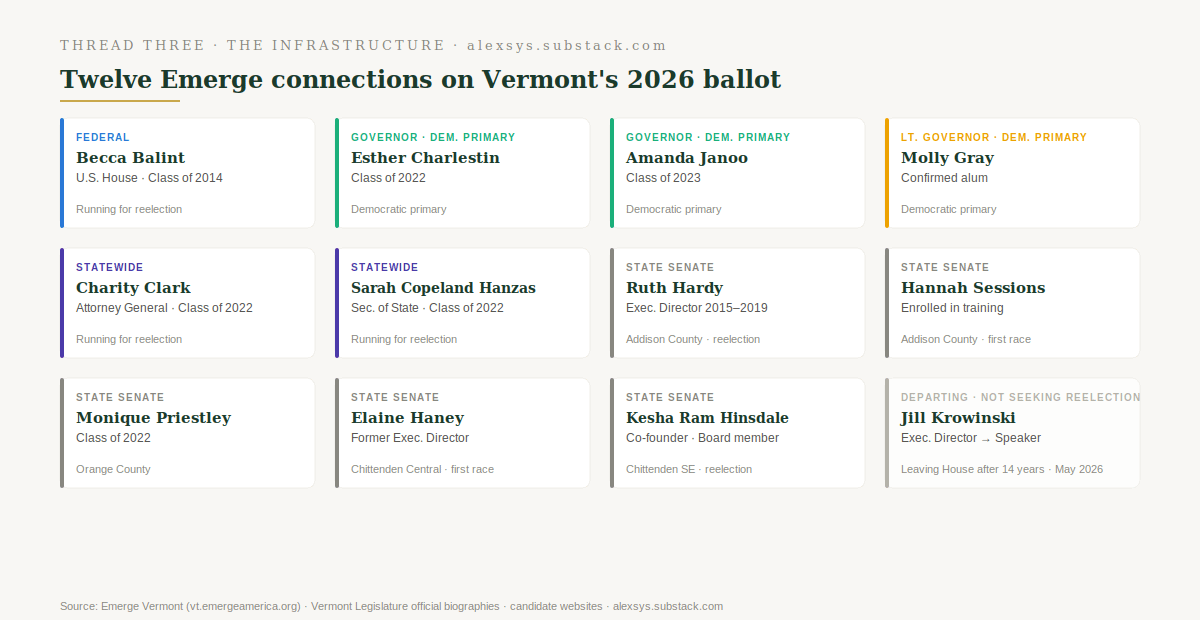
Becca Balint — Class of 2014. U.S. Representative, Vermont at-large. Running for reelection.
Molly Gray — confirmed alum, cited by name in Emerge Vermont’s 2022 primary press release. Running in the Democratic primary for Lieutenant Governor.
Monique Priestley — Class of 2022, documented on Emerge Vermont’s news page. Running for Vermont State Senate, Orange County.
Esther Charlestin — Class of 2022, documented on Emerge Vermont’s 2026 candidate list. Running in the Democratic primary for Governor.
Charity Clark — Class of 2022, documented on Emerge Vermont’s 2026 statewide candidate list. Vermont Attorney General, running for reelection.
Sarah Copeland Hanzas — Class of 2022, documented on Emerge Vermont’s 2026 statewide candidate list. Vermont Secretary of State, running for reelection.
Amanda Janoo — Class of 2023, documented on Emerge Vermont’s Class of 2023 page. Running in the Democratic primary for Governor.
Ruth Hardy — Executive Director of Emerge Vermont 2015–2019, documented on ruthforvermont.com and Vermont Legislature official biography. Ran for and won her Senate seat in 2018 while serving in that role. Running for reelection, Vermont State Senate, Addison County. Hardy built the pipeline’s modern infrastructure before stepping through it herself.
Hannah Sessions — enrolled in Emerge training before a farm emergency interrupted, documented in Hardy’s own words. Running for Vermont State Senate, Addison County.
Elaine Haney — former Executive Director of Emerge Vermont, documented in her role in VTDigger’s July 2, 2026 fundraising report. Running for Vermont State Senate, Chittenden Central — the same pipeline she directed.
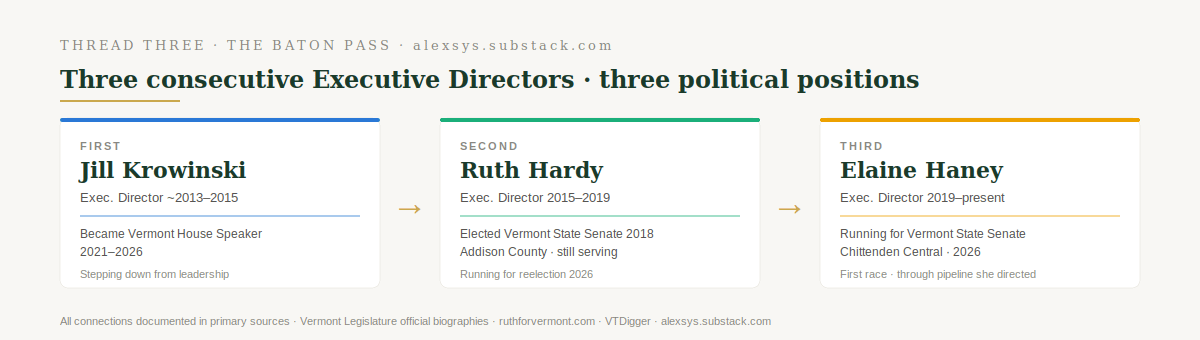
Jill Krowinski — Executive Director of Emerge Vermont before Hardy, confirmed on Vermont Legislature’s official biography. Served as Vermont House Speaker 2021 through 2026. On May 28, 2026 — hours before the filing deadline — Krowinski announced she would not seek reelection, ending 14 years in the House. The announcement was unexpected; her staff had earlier said she intended to run. Krowinski ran the pipeline, then became Speaker. Hardy ran the pipeline after her, then became a senator. Haney ran the pipeline after Hardy, and is now running for the Senate herself. Three consecutive Executive Directors of Emerge Vermont. Three elected or candidate positions. All documented in primary sources. (VTDigger, May 28, 2026.)
Kesha Ram Hinsdale — co-founder of Emerge Vermont’s Vermont chapter alongside Kunin and Krowinski. Now Senate Majority Leader, running for re-election to the Vermont State Senate, Chittenden Southeast District. Board member of Emerge Vermont, confirmed on her official Vermont Legislature biography.
That is twelve women. Twelve women with documented Emerge connections active in Vermont’s 2026 election cycle — as candidates, as outgoing leaders, or as the infrastructure stepping into candidacy itself.
The funding structure behind this is also documented in Emerge Vermont’s own materials. 80% of Emerge Vermont’s budget comes from individual contributions, most under $100. The remaining 20% comes from program fees, tuition, and sponsorships. Emerge is structured as a 527 political organization — donations are not tax-deductible. It does not endorse candidates and does not coordinate spending with candidates or parties. (vt.emergeamerica.org.)
Madeleine Kunin, as a private individual and former governor, has endorsed Molly Gray — in 2020, in 2022, and again in 2026. That endorsement is personal, not organizational. The distinction is documented and consistent with Emerge’s stated policy. Their relationship predates Emerge entirely: Kunin taught Gray in her “Women and Politics” class at UVM in 2005. Gray has said on record: “If not for Governor Kunin’s mentorship and helping me see what could happen and what would come next, I know I wouldn’t be where I’m at today.” (VTDigger, 2020.) Kunin built the infrastructure that formalized what she had been doing informally since at least 2005.
The broader network — documented beyond the ballot:
Emerge Vermont’s own 10th Anniversary Celebration donor and supporter list, published on vt.emergeamerica.org in September 2023, documents a wider network of Vermont political figures connected to the organization. Among those listed: Sue Minter, the 2016 Democratic gubernatorial nominee and current Vermont State Treasurer Climate Superfund Specialist; Anne Lezak, former Chair of the Vermont Democratic Party who oversaw the historic 2022 Democratic sweep; and Alex MacLean, former Shumlin campaign manager, Deputy Chief of Staff, and now Partner and President of Public Relations and Issue Campaigns at Leonine Public Affairs, whose lobbying clients have included Let’s Grow Kids, Green Mountain Power, and Anbaric Transmission. (vt.emergeamerica.org, September 2023; VTDigger, September 2014; VTDigger, January 2023.)
One additional documented connection runs through Vermont’s Act 181 implementation landscape, which Vermont Investigative has covered extensively. Samantha Sheehan, Municipal Policy and Advocacy Specialist at the Vermont League of Cities and Towns, has testified before multiple legislative committees on Act 181 and Section 248a telecommunications regulation. VLCT’s own Fall 2024 Advocacy Update describes her background as “an experienced advocate and policy communications professional” who previously served in the office of former Burlington Mayor Miro Weinberger. Her LinkedIn profile describes her as an “experienced campaign and political communications professional.” The pipeline from political operative to policy advocate, documented in her own public record, is a thread the record surfaces without drawing a conclusion about what it means. (VLCT.org, Fall Advocacy Update, October 2024; Vermont Legislature testimony records, January–March 2026.)
The same record that documents what Emerge Vermont built also documents what it did not build — and what no one else built either.
A Republican women's training infrastructure does exist in Vermont. The Vermont Federation of Republican Women (VFRW), the state chapter of the National Federation of Republican Women founded in 1938, explicitly offers campaign training, policy knowledge, leadership development, candidate forums, and networking. Their own published language at vfrw.net mirrors Emerge Vermont's stated mission directly: recruit, train, and elect Republican candidates; empower women as leaders in political and civic arenas. The VFRW Vermont Facebook group, a public group with 297 members, was founded August 2, 2025. The group's own About section describes itself as "in the early stages of organization." The VFRW does not appear in the Vermont Secretary of State business registry as a registered entity — it operates as an unincorporated state affiliate of the national organization. No named officers appear in Vermont public records
The documented result: Republican women held seats in the Vermont Senate as recently as 2018. They chose not to run for reelection. No replacements came. There have been no Republican women in the Vermont Senate since. In the Vermont House, 14 women hold seats among 53 Republican members. (Seven Days, October 29, 2025.)
Representative Carolyn Branagan (R-Georgia) put it in her own words to Seven Days in October 2025. When she first ran for the Vermont House in 2002, she said, she had no mentor and received little financial assistance or training from the Vermont Republican Party. “You learn on your own, because there’s no one there to help you.” After her 2016 election to the Senate, Branagan said she explored creating a program similar to Emerge with the Vermont Republican Party. State and county leaders showed little interest. (Seven Days, October 29, 2025.)
Democratic women: 42% of the legislature. Republican women: absent from the Senate entirely, a small minority in the House. Both figures flow from the same upstream cause — one side built infrastructure, one side did not.
This is not a character claim about the Vermont Republican Party or its members. Representative Branagan is not a cautionary tale. She is a documented voice describing a structural gap in her own words. What voters make of that gap is their own decision to make.
The three threads documented in this piece run almost entirely through women and through explicitly built infrastructure. That observation raises a natural question: what does the Democratic male pathway look like?
The record surfaces no formal equivalent. No training program. No structured cohort. No named pipeline. The documented pathway for Democratic men in Vermont runs through party committee relationships, legislative staffer proximity, labor union networks, and personal mentorship through existing officeholders. Ryan McLaren spent a decade staffing U.S. Senator Peter Welch before entering his first statewide race. Phil Baruth built relationships inside the chamber over years before becoming Senate President Pro Tempore. Peter Welch moved from Vermont House Speaker to Congress to the Senate through a sequence of party relationships and timing. The pathway exists and has always existed.
Emerge Vermont’s own FAQ names the dynamic directly: “Men in politics often tell women to wait their turn, take a smaller role, run for a lower office, or not seek leadership positions.” (vt.emergeamerica.org.) The Democratic women in this piece did not wait. They built infrastructure, trained through it, recruited through it, and ran through it on their own timeline through their own network.
Three threads. One geographic — a rural Upper Valley school district that produced three statewide candidates across thirty years of attendance. One relational — a sitting senator who spent years mentoring a farmer into candidacy through documented conversation and a shared training program. One structural — a California-designed national curriculum adopted by a former governor in 2013 that now holds documented connections to twelve women active in Vermont’s 2026 election cycle.
None of it is in the shadows. All of it is documented in the candidates’ own words, in organizational materials published openly, and in public filings.
The observation the record supports: Vermont’s 2026 ballot carries the visible fingerprints of networks built over years — in some cases decades. Those networks are almost entirely Democratic. They are almost entirely women. One party built the infrastructure. The other did not. The consequences of both choices are measurable and documented.
What those consequences mean for Vermont’s democracy — whether the concentration of one pipeline’s graduates across one cycle’s ballot represents health or imbalance, progress or consolidation — the record does not answer. That question belongs to readers.
Sources
Emerge Vermont (vt.emergeamerica.org) — elected alums list, class pages, FAQ, recruitment materials, training curriculum, news page, 2025 application announcement
Emerge America (emergeamerica.org) — FAQ, 2026 statewide candidates list
Seven Days — Hannah Bassett, “Emerge Vermont Has Helped Dozens of Women — All Dems — Get Elected,” October 29, 2025, including on-record statement from Rep. Carolyn Branagan; April 8, 2026
VTDigger — July 2, 2026; April 6, 2026; July 21, 2020
Vermont Public — April 6, 2026
Valley News — April 6, 2026
WCAX — April 6, 2026
Rutland Herald — July 10, 2019; August 12, 2024
Vermont Business Magazine — December 1, 2025; June 3, 2022
Vermont Cynic — November 3, 2020
Berkshire Eagle — March 2020
UNH Survey Center — June 30, 2026
Ruth Hardy campaign website (ruthforvermont.com) — campaign blog post, March 22, 2026
Ruth Hardy campaign website (ruthforvermont.com) — About Ruth biography
Hannah Sessions campaign website (hannahsessionsforvt.com)
Molly Gray campaign website (mollyforvt.com)
Aly Richards campaign website (alyforvt.com)
Monique Priestley campaign website (priestleyvt.com)
Vermont Legislature official biography — Ruth Hardy; Jill Krowinski; Kesha Ram Hinsdale
Ballotpedia — Molly Gray; Jill Krowinski; Vermont elections 2026; Vermont Lieutenant Governor election 2026
Wikipedia — Molly Gray; Jill Krowinski; 2018 Vermont Senate election
Emerge Vermont 10th Anniversary Celebration donor/supporter list (vt.emergeamerica.org, September 23, 2023)
Vermont League of Cities and Towns (vlct.org) — Fall Advocacy Update October 2024; Samantha Sheehan staff page; testimony records January–March 2026
VTDigger — Alex MacLean joins KSE Partners, September 25, 2014; Anne Lezak stepping down as VDP chair, January 17, 2023
Seven Days — Montpelier Lobby Shop Hires Ex-Shumlin Aide, September 25, 2014
LinkedIn — Samantha Sheehan public profile; campaign and political communications professional, formerly Weinberger office
If you find yourself reading, learning, or citing this work please consider supporting it with a Substack subscription (https://alexsys.substack.com/subscribe) or Ko-fi (https://ko-fi.com/alexsysthompson)
Comments
Nothing yet. Say the first thing.
Sign in to join the conversation.