
Vermont’s forest carbon programs operate in the voluntary carbon market — a private, unregulated system in which companies purchase credits to meet self-imposed emissions goals, with no government mandate or public oversight beyond the standards set by private registries.
That market is not a future proposal in Vermont. It is an operating infrastructure, built over the past decade by a range of organizations — conservation nonprofits, for-profit developers, universities, and thousands of individual landowners. Here is what the record shows.
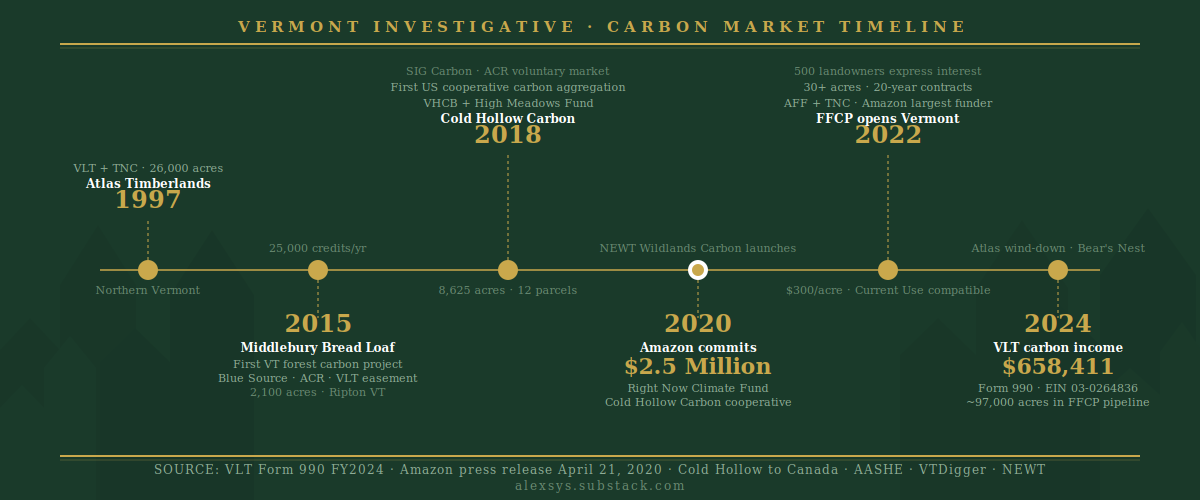
The Nature Conservancy assumed ownership of Burnt Mountain together with the Vermont Land Trust in 1997, as part of the original Atlas Timberlands acquisition of 26,000 acres. Two decades later, TNC designated the 5,487-acre parcel as Vermont’s first forest carbon project.
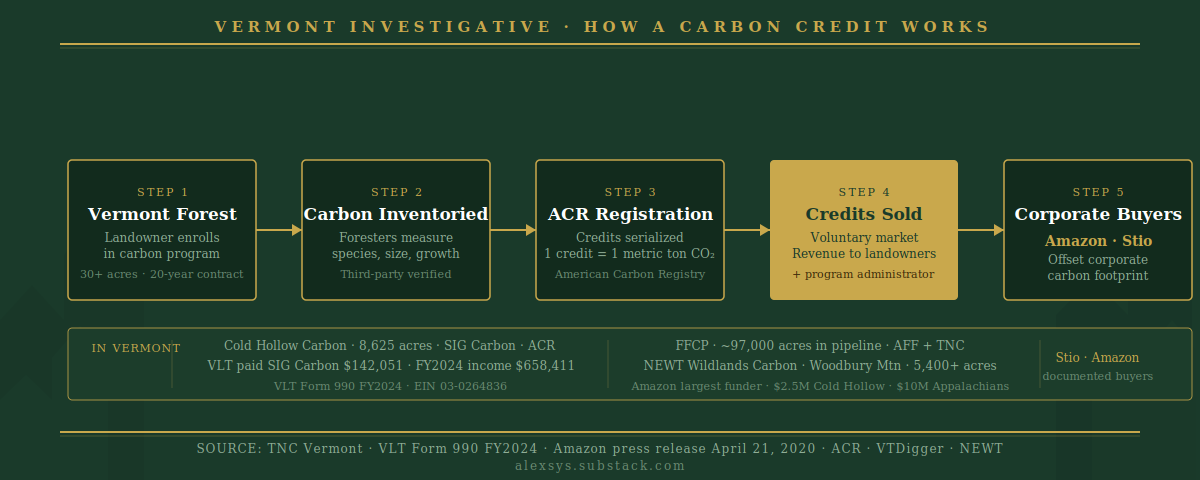
When TNC enrolled Burnt Mountain into the American Carbon Registry, foresters established a grid of permanent inventory plots, measured tree species, size, and growth rates, and submitted results to an independent third-party auditor before credits were issued.
Early estimates projected the parcel would yield more than 236,772 credits in the first decade — one credit per metric ton of carbon, equivalent to removing 38,000 cars from the road.
The California compliance market did not work as planned. After foresters measured the trees, there wasn’t enough carbon above the regional average to meet California’s cap-and-trade threshold. TNC shifted to the voluntary market instead, bringing in approximately $400,000 less than originally anticipated. Credits were sold on the voluntary market. TNC designated net proceeds toward future forest conservation efforts in Vermont
The project was designed by Bluesource, a for-profit carbon project developer that structures and registers forest carbon credits on behalf of landowners and conservation organizations. Credits were sold on the voluntary market. TNC designated net proceeds toward future forest conservation efforts in Vermont.
TNC invested $65,000 in Vermont Land Trust to help build a parallel carbon market effort with willing landowners.
In 2018, VLT — with public funding from the Vermont Housing and Conservation Board and philanthropic support from the High Meadows Fund, a formerly independent Vermont environmental funder now operating as a charitable fund of the Vermont Community Foundation — commissioned a feasibility study on whether Vermont landowners could sell carbon credits by aggregating their parcels. The study used real stocking data from the Cold Hollow to Canada region and was completed by UVM’s Carbon Dynamics Laboratory.
The result: the Cold Hollow Carbon project, spanning 8,625 acres across 12 parcels, became the nation’s first cooperative carbon aggregation project enrolled in the voluntary market under the American Carbon Registry standard. Among the enrolled landowners are Jessica Boone of Hi Vue Maples, whose family has sugared in the Cold Hollows since 1903, and Everett McGinley — both of whom have spoken publicly about their participation. Vermont Land Trust president Nick Richardson, UVM professor Bill Keeton of the Carbon Dynamics Lab, and consulting forester Charlie Hancock — board chair of Cold Hollow to Canada — developed the project together with TNC support. The project is managed by SIG Carbon, a California-based carbon project firm. VLT paid SIG Carbon $142,051 in fiscal year 2024 to administer the program and reported $658,411 in forest carbon income that same year, documented in its Form 990 filed with the IRS.
In April 2020, Amazon committed $2.5 million specifically to the Cold Hollow Carbon cooperative as part of a broader $10 million grant to TNC for Appalachian forest conservation — the first project from Amazon’s Right Now Climate Fund, launched as part of the company’s Climate Pledge to reach net zero carbon by 2040. Amazon, TNC, the American Forest Foundation, and Vermont Land Trust are all named as partners in the April 21, 2020 Amazon press release.
As of the time of publication, VLT continues to sell Cold Hollow Carbon credits from vintage years 2022–2024.
In 2022, the American Forest Foundation and TNC jointly launched the Family Forest Carbon Program in Vermont. Amazon — which committed $10 million to Appalachian forest conservation programs including FFCP — was named as the program's largest funder in the April 2020 Amazon press release. The program offers landowners with 30 or more acres up to $300 per acre over a 20-year contract to enroll in carbon sequestration management. The American Forest Foundation administers payments to enrolled landowners from credit sales.
The program was designed to be compatible with Vermont’s Current Use program, which taxes undeveloped land at its use value rather than market value — a tax structure most private forestland owners in Vermont depend on. Compatibility is determined on a case-by-case basis; the Vermont Department of Forests, Parks and Recreation has confirmed that enrollment in both programs is not always possible and that landowners should evaluate carefully before signing. For a closer look at how that tension plays out on the ground for one Vermont family, see Before Act 181, Vermont Had Act 59. Voluntary? Really?
By mid-2024, close to 500 landowners had expressed interest, with 38 contracts fully signed covering approximately 7,500 acres. About 97,000 acres of Vermont land were in the process of coming under the program.
Running parallel to the VLT and FFCP programs is a separate carbon aggregation initiative called Wildlands Carbon, sponsored by the Northeast Wilderness Trust (NEWT)— a Montpelier-based organization that holds forever-wild conservation easements across New England and New York. The Wildlands Carbon program was launched with startup capital from the Inlandsis Fund, a private capital firm with involvement in more than 40 carbon projects globally. Under the structure, land trusts enroll permanently conserved, forever-wild parcels into the voluntary carbon market under the American Carbon Registry’s Improved Forest Management protocol. The project manager is SIG Carbon — the same California-based firm managing VLT’s Cold Hollow Carbon project. Land trusts receive a prepayment and an ongoing revenue share as credits are issued and sold, with proceeds designated for additional land acquisition and conservation.
NEWT’s first Vermont carbon project — Woodbury Mountain Wilderness Preserve, covering more than 5,400 acres — is listed with the American Carbon Registry and generating credits. The forever-wild conservation easement on Woodbury Mountain is held by the Vermont River Conservancy.
Vermont’s forest carbon market did not begin with large conservation organizations. The first documented forest carbon project in Vermont was Middlebury College's Bread Loaf campus in Ripton — 2,100 acres conserved in 2015 through a conservation easement held by Vermont Land Trust. The project was funded through the Bread Loaf Preservation Fund, established with support from the Moore Charitable Foundation, chaired by Louis Bacon, a Middlebury College trustee. The project was developed by Blue Source — the same for-profit carbon project developer that designed TNC's Burnt Mountain project — and listed on the American Carbon Registry under the Improved Forest Management protocol. Under the agreement, Blue Source developed, registered, and marketed the credits, with proceeds split between Blue Source and the College. Middlebury generates approximately 25,000 carbon credits per year from the Bread Loaf forest, retains roughly 10,000 annually toward its own carbon neutrality accounting, and sells the remainder on the voluntary market.
The Vermont Department of Forests, Parks and Recreation maintains a public guide to forest carbon markets for landowners and tracks multiple registry standards — ACR, Verra, and the Climate Action Reserve — as viable pathways for Vermont properties. The infrastructure is not owned by any single organization. It is a market, and it is open.
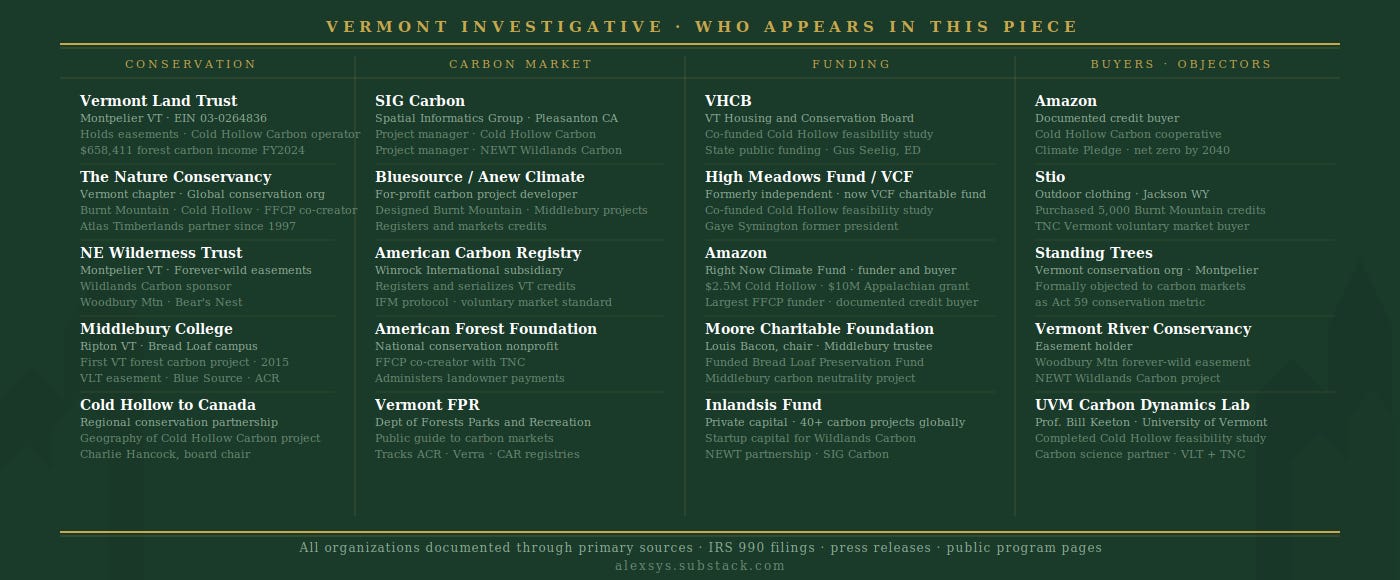
The carbon market’s growth in Vermont has not been without scrutiny. Standing Trees, a Vermont conservation organization, formally objected to carbon and biodiversity markets being considered as funding sources for conservation efforts or as a metric qualifying land toward Act 59’s 30x30 conservation goals, citing fraud investigations in other states and concerns about the commodification of nature. Vermont state foresters have also noted publicly that carbon management and forest resilience are not always compatible goals — maximizing carbon storage can in some cases reduce a forest’s ability to adapt to climate change — and that landowners should evaluate carbon program enrollment carefully before signing 20-year contracts.
Vermont’s forest carbon market is already operational and spans multiple programs, registries, organizations, and landowner types — from a liberal arts college in Addison County to family woodlot owners in the Northeast Kingdom to permanently conserved wilderness parcels in the Northern Greens. It involves conserved land originating from the Atlas Timberlands, public funding through VHCB, philanthropic funding through the High Meadows Fund, private capital through the Inlandsis Fund, and a major corporate funder and buyer in Amazon. Twenty-year contracts are now running across nearly 100,000 acres of private Vermont forestland. The same organizations central to Act 59 and the 30x30 conservation network — VLT, TNC, Cold Hollow to Canada, NEWT — built significant parts of this market. So did a college sustainability office, a state working group, and thousands of individual landowners making their own decisions about their own land.
The infrastructure is here. What Vermonters make of it is still being decided.
Sources
The Nature Conservancy Vermont — forest carbon program page (nature.org)
Vermont Land Trust Form 990 FY2024 — EIN 03-0264836 — ProPublica Nonprofit Explorer
Cold Hollow to Canada — carbon program page (coldhollowtocanada.org)
Amazon press release — April 21, 2020 — Business Wire
Vermont Sports Magazine — Vermont Forests Part of Amazon Carbon Pilot Project
SIG Carbon — Cold Hollow case study (sigcarbon.com)
Vermont Sustainable Jobs Fund — Can Vermont’s Forests Help Save the Planet?
Times Argus / Central Vermont Reader — Wilderness is also a carbon management project
VTDigger — Program to store carbon in forests grows in the Green Mountain State (May 2024)
VTDigger — New program offers funds to landowners who manage forests for carbon (July 2022)
Vermont Public — New program pays small landowners to let their trees grow old (September 2022)
Seven Days — Family Forest Carbon Program Helps Vermonters Build a Greener Legacy (September 2025)
Addison Independent — Owners of small woodlands get incentives to sequester CO2 (April 2023)
American Forest Foundation — FFCP Vermont enrollment announcement (July 2022)
Northeast Wilderness Trust — Wildlands Carbon program page (newildernesstrust.org)
Wildlands and Woodlands — Northeast Wilderness Trust carbon finance partnership
Vermont Community Foundation — High Meadows Fund Chapter Three announcement (2021)
Standing Trees — public record of Act 59 carbon market objection
Vermont Department of Forests Parks and Recreation — Forest Carbon Markets page (fpr.vermont.gov)
Middlebury College Office of Sustainability — Carbon Neutrality 2016
AASHE Campus Sustainability Hub — How Middlebury College Achieved Carbon Neutrality
American Carbon Registry — IFM protocol documentation (acrcarbon.org)
Moore Charitable Foundation — Middlebury College Carbon Neutrality announcement (December 2016)
Inlandsis Fund — named as Wildlands Carbon startup capital provider in NEWT Wildlands Carbon program page (newildernesstrust.org) and SIG Carbon featured projects page (sigcarbon.com) — REPORTED via secondary program documentation, not primary Inlandsis source
If you find yourself reading, learning, or citing this work please consider supporting it with a Substack subscription (https://alexsys.substack.com/subscribe) or Ko-fi (https://ko-fi.com/alexsysthompson)
Comments
Nothing yet. Say the first thing.
Sign in to join the conversation.