
For those of you who prefer to read on paper (or e-reader) rather than in your Substack or email app, I have converted this essay into an easily printable PDF.
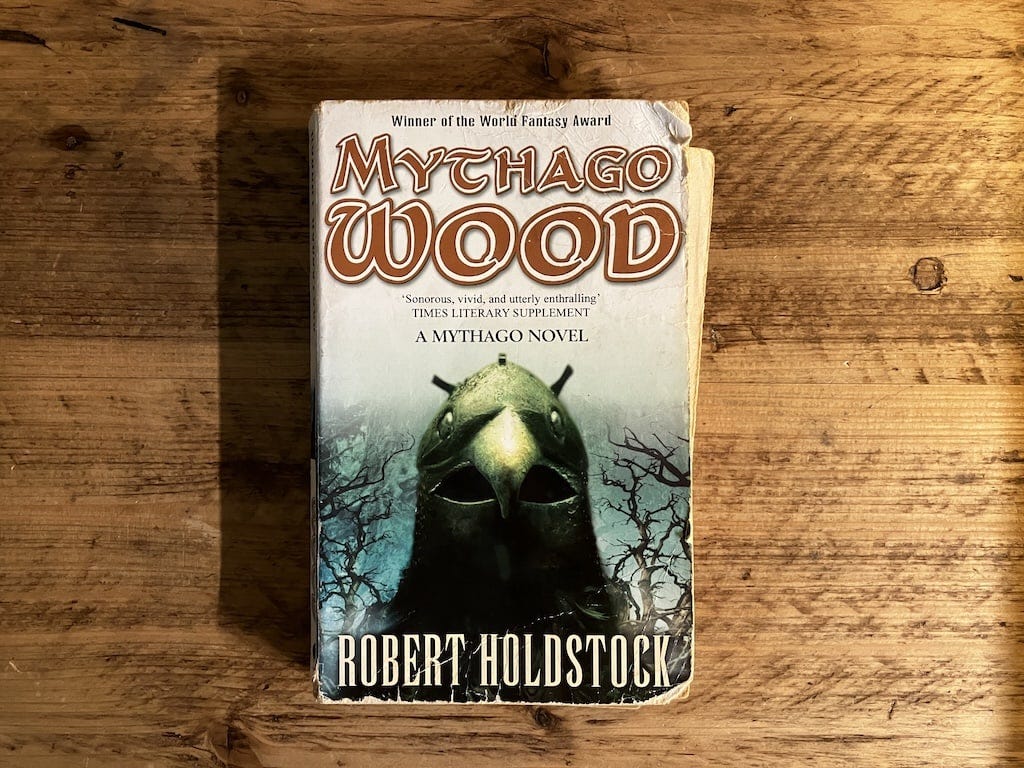
When I was a child, one of the books that made an indelible impression on me was Mythago Wood by Robert Holdstock. In the claustrophobic, pungent world of the novel a researcher named George Huxley becomes drawn into a small scrap of forest that has learnt to defend itself. Ryhope Wood is a remnant of primordial post-glacial wildwood in which figures of myth are drawn out of the deep recesses of the human mind, made flesh and bone. A place far, far bigger on the inside than the outside. A place where time loses all meaning, and journeys into the deep past become possible.
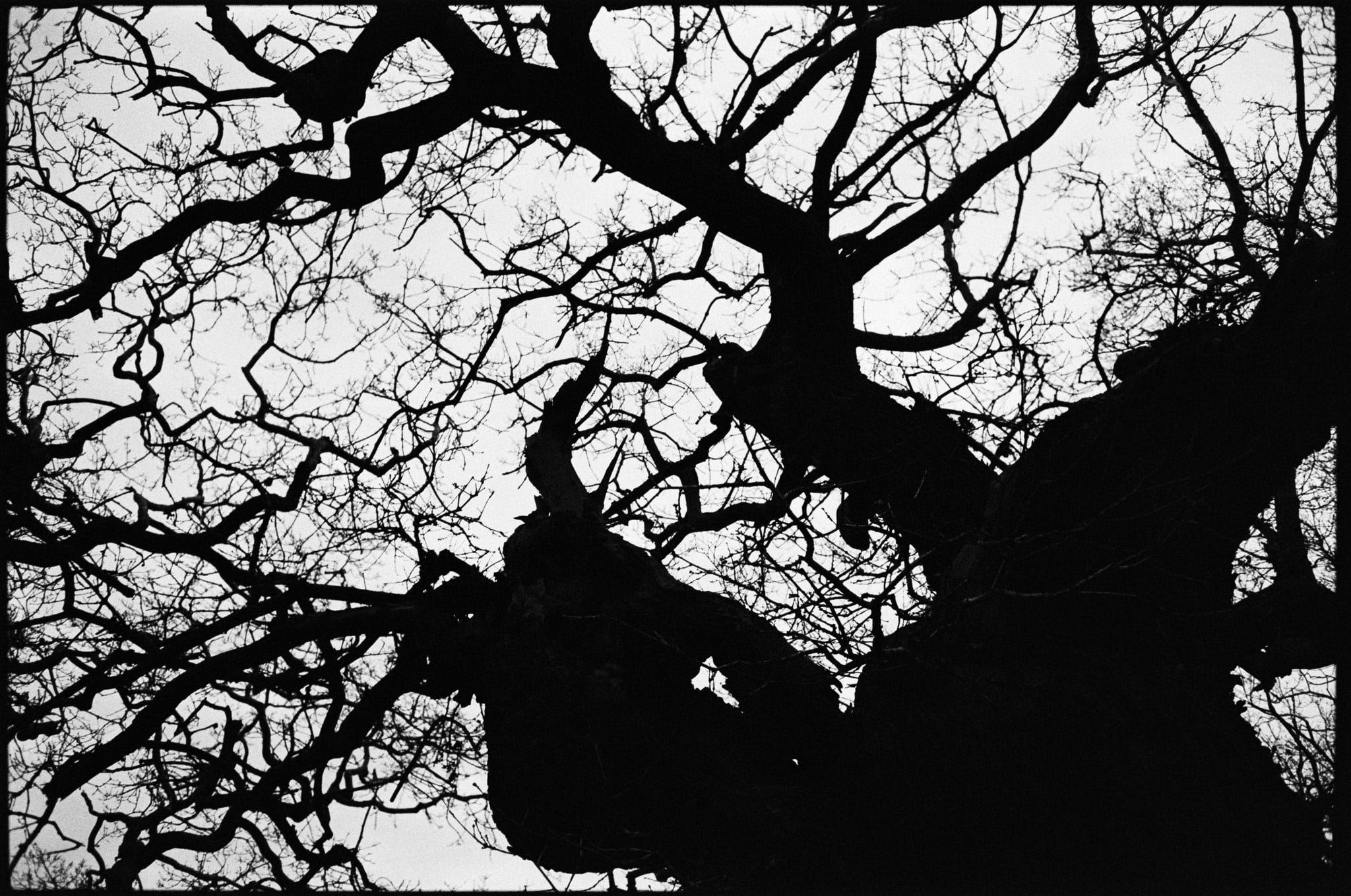
The book is vivid in its imagery and subtlety of emotion. So often, it seems, the characters are standing on the edge of the wood at dusk, looking in and trying to penetrate the maze of branches backlit by a swiftly setting sun. Or they find themselves suddenly in a clearing where every dark trunk around them is heavy with meaning and the canopy shivers with a sighing voice of its own. In Mythago Wood, the wood itself is the central character.
More than 20 years ago, I found my own version of Ryhope Wood, and I became obsessed.
Staverton Thicks is an ancient oak woodland deep in the Suffolk countryside. I lived nearby from 2002 until 2008, and in my countless long-distance walks throughout the Sandlings I’d often gravitate back towards the Thicks. I came to know it well. While the Thicks certainly don’t date back to the last ice age in their current form, it’s thought this woodland is an overgrown medieval deer park, and contains around 4,000 ancient oak pollards. Many are over 400 years old; some are over 900. There are also hundreds of magnificent holly trees, including some of the biggest in the country.
Looking through my photo library from back then, the images from the Thicks are often brooding and mysterious. This is where I first became sensitive to the sheer weirdness of certain landscapes; where I learnt to quieten my mind and hear the spirit of the place.
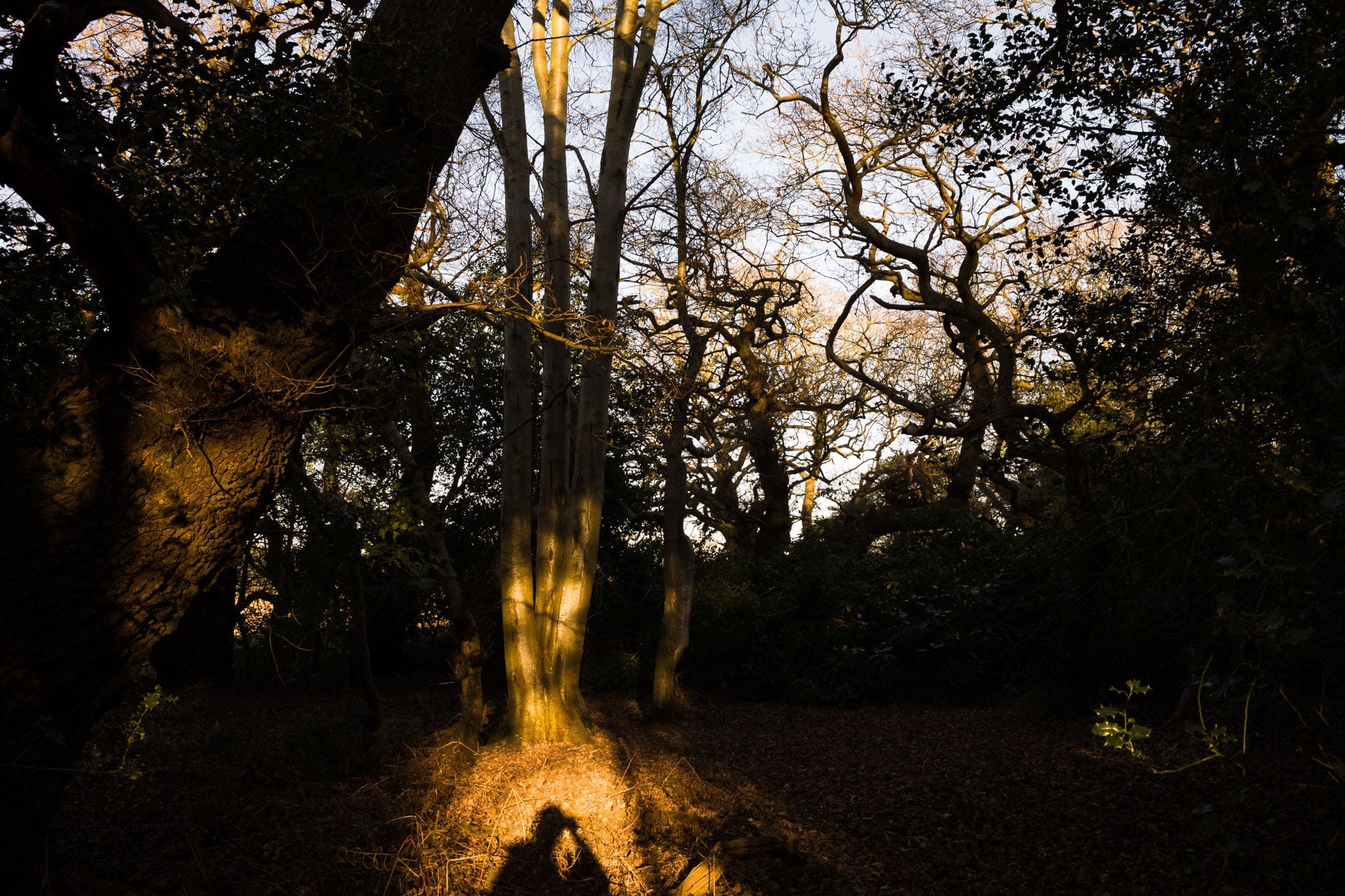
Always when I found myself in the Thicks it would be dusk, or dusk soon coming on. Always the light would be slanting through high branches and illuminating some fabulously gnarled branch or trunk in vivid chiaroscuro, all else in deep shade. Always there would be the sharp bark of a muntjac nearby. Always the vivid feeling of awareness. And always the tension would be broken by a clatter of crows taking flight, only for it to gradually build again as I crept from tree to tree, trying to keep as quiet as I could – an impulse I could neither explain nor deny.
Although I never saw a mythago in the Thicks, time and space did seem to warp there. Its interior was dense and trackless (except for a single public footpath) and led the walker in confused spirals. To enter the Thicks was to pause; only when you emerged, confused and bitten by brambles, did the universe exhale again. I’ve never known another wood with such a richly textured character, such an intensely focused awareness.
Later, I learnt that these woods are not in good health. Most of the trees are very old and no longer productive. The forest lacks an understorey of young trees, and (at least back then) grazing pressure from fallow deer was heavy. Large areas had become taken over by bracken and many of the old trees were slowly dying.
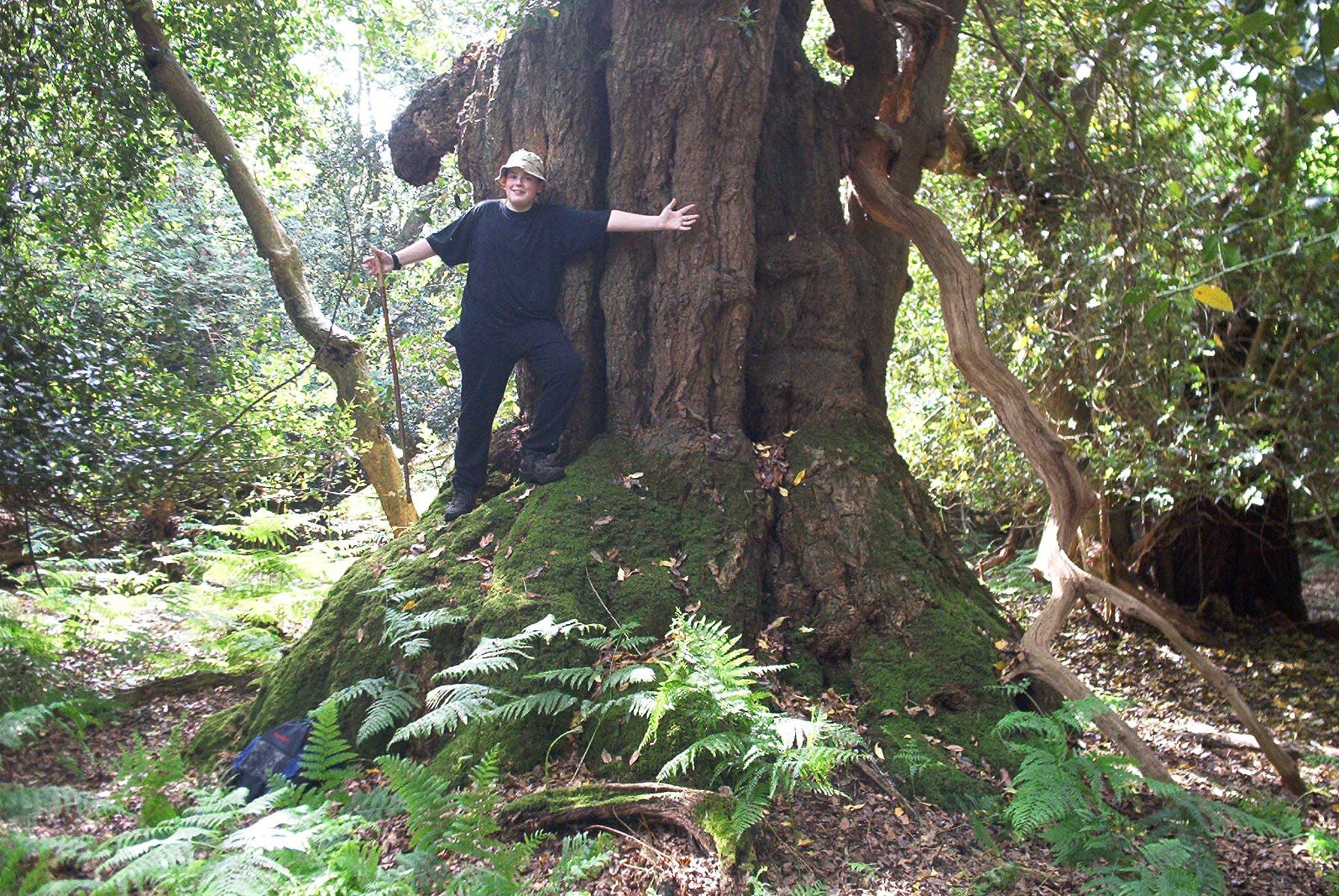
One day (on a rare summer visit) my brother James and I discovered a truly vast oak. Its circumference was many metres, and I took a picture of James standing on its conical base, looking amazed at its sheer scale. This tree was deep in the interior and hard to find, but its memory always stuck with me.
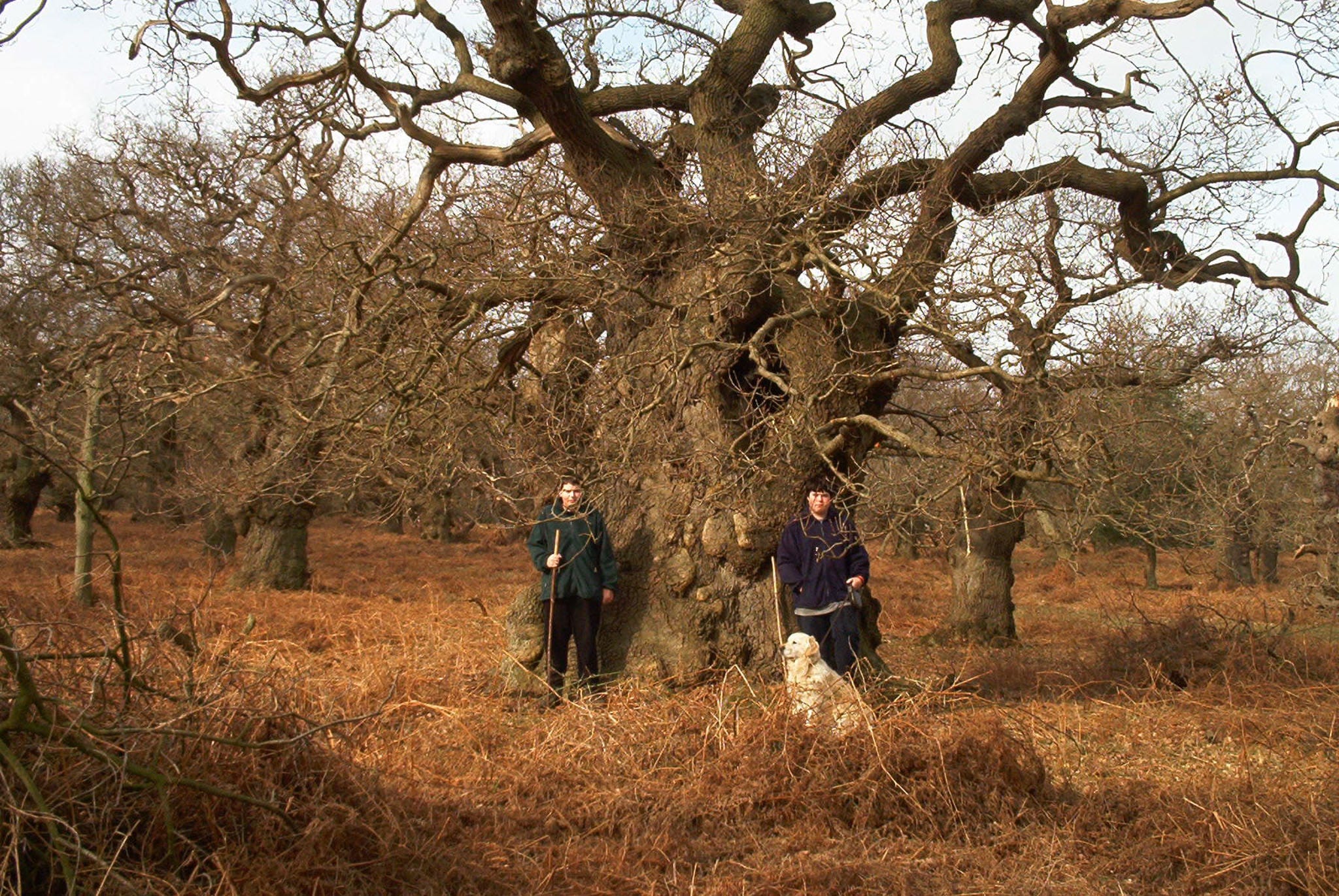
A second particularly impressive oak was to be found in Staverton Park – the larger section of woodland to the north that is less wild, more managed, but still contains some impressive trees. I have a picture from March 2003 showing myself, James, and our dog Amber standing in front of it.
Since 2008, I’ve visited the Thicks only a handful of times. My parents moved away from Suffolk in 2014, which meant no visits at all for several more years, but I hiked the Sandlings Walk in its entirety in 2023, and passed through Staverton Thicks on day two.
It was just a fleeting encounter. A straightforward crossing via the public right of way, no time for wanderings in the inner mazes, but – yes – it was dusk, and the same feelings came back. The same imperative to keep quiet, keep the senses open. The same sense of stepping outside time.
I didn’t get the chance for a proper return visit until Christmas 2025. Mum has moved back to Suffolk after years away, so James and I decided to head out for an afternoon walk to help the turkey go down.
It was me who suggested a walk in the Thicks, but it was James who suggested trying to find the champion oak.
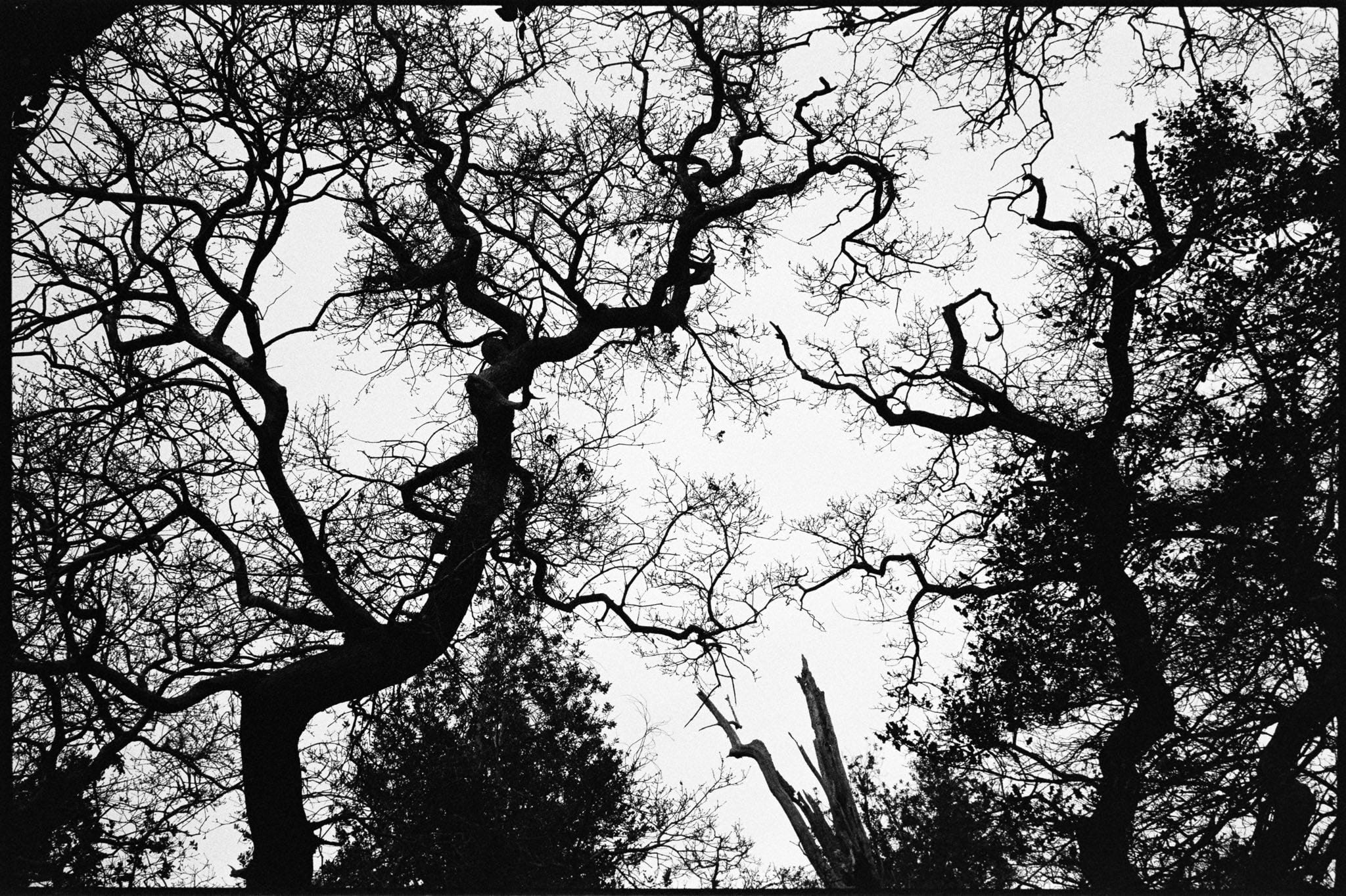
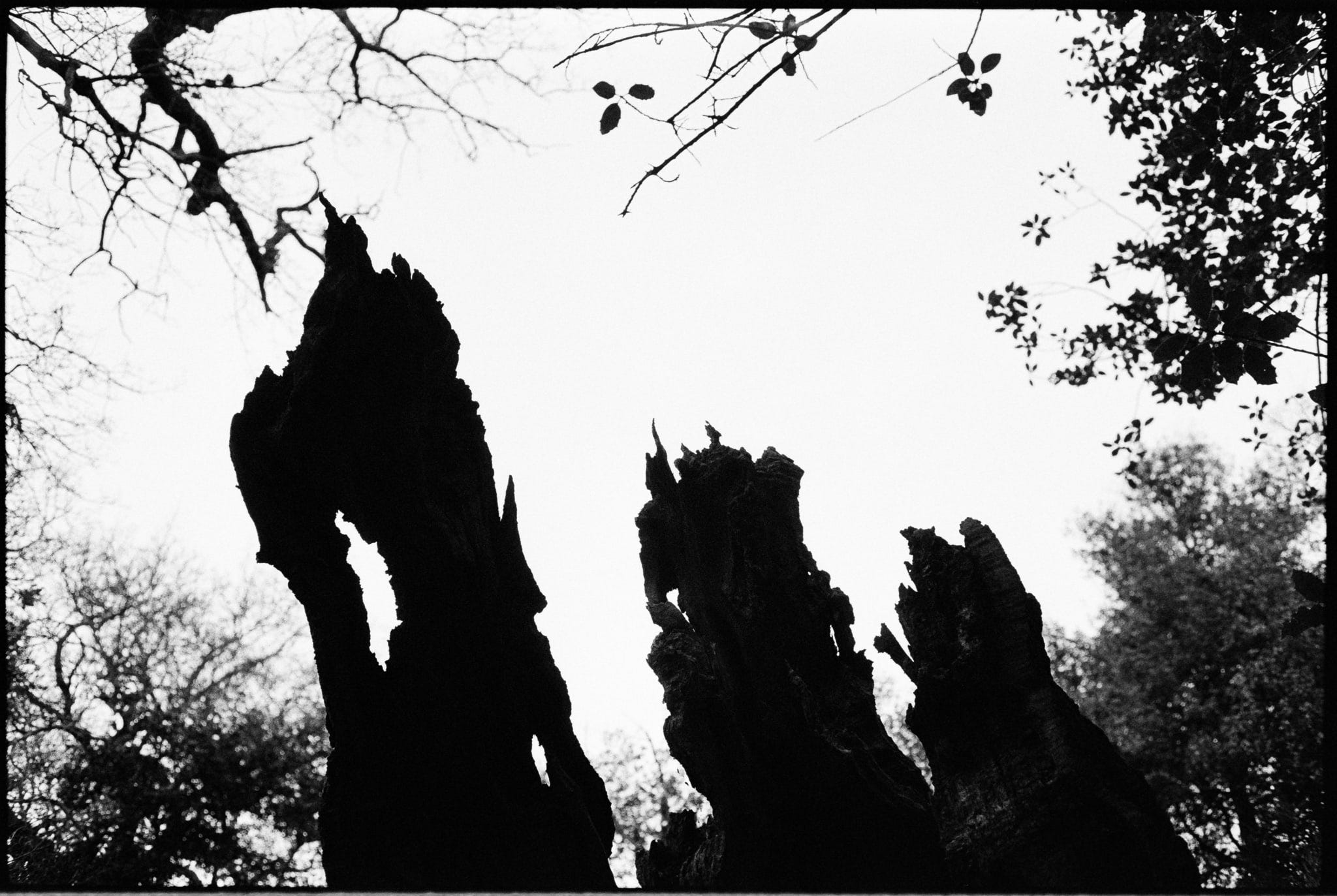
The light was already beginning to fail as we struck straight into the interior, guided by nothing but James’s hunches. Deer paths looped and meandered erratically, and we were soon stooping under branches, stepping over rotten carcasses of felled trees. ‘How old must that be?’ James whispered, pointing at a hulk of rotting wood returning to the leaf litter. ‘Well over a thousand years.’
A muntjac barked. A crow took flight. This place had not changed at all.
However, that impression didn’t last long. James pointed out that many of the deer wallows had dried up, and impenetrable walls of holly now sprawled across entire areas. He told me that deer numbers were lower than they had been more than 20 years ago. However, we still saw no young oak trees.
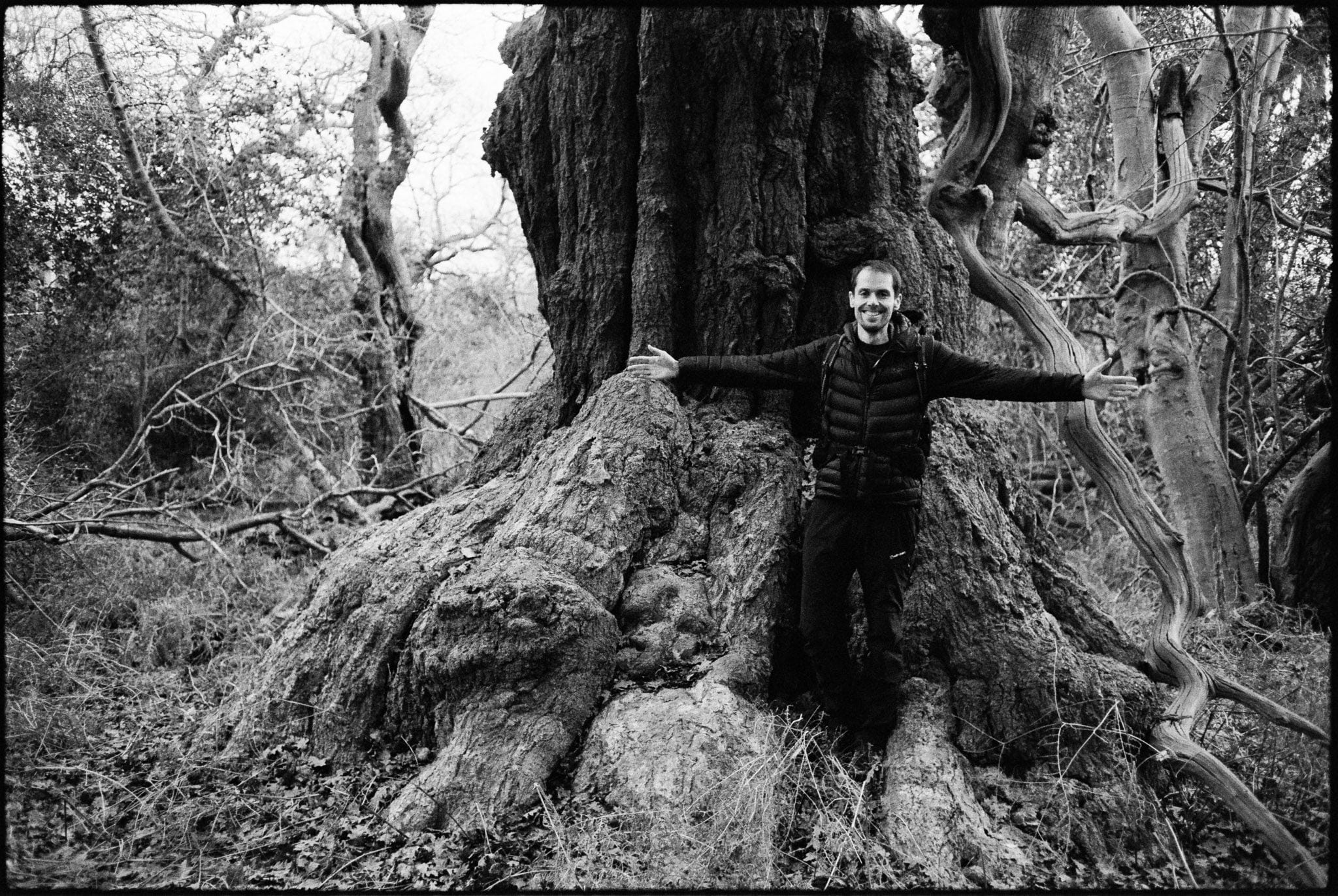
To my amazement, James led us right to the champion oak. It loomed ahead in its own clearing, and looked more like some kind of stone monument than a tree. Or, to be more precise, the conical dome of its lower trunk looked bulbously organic, the straight upper trunk like marble columns in a church. Or perhaps something older and pagan, such as a standing stone. I was amazed to see that the twisting branch of dead holly that seemed part of the oak itself, visible in the 2003 photo, was still present.
We walked around the tree, looked at it from all angles. I was surprised to see that the thick coating of moss (clearly visible in the 2003 photo) was totally gone. We speculated that it might have been worn away or eaten by deer, but James concluded that climate change was the more likely culprit; the climate is much drier now than it was 22 years go.
I couldn’t resist taking a photo of James standing beside the tree with arms spread, just like in the original shot.
On our way through Staverton Park to the north, we easily found the second champion tree. I thought back to the time when the three of us – me, James and Amber – had stood next to that tree, and our dad had stepped back to take the picture. Amber had died in 2009; Dad had died in 2018. James and I are more than half a lifetime older. Yet the tree lives on.
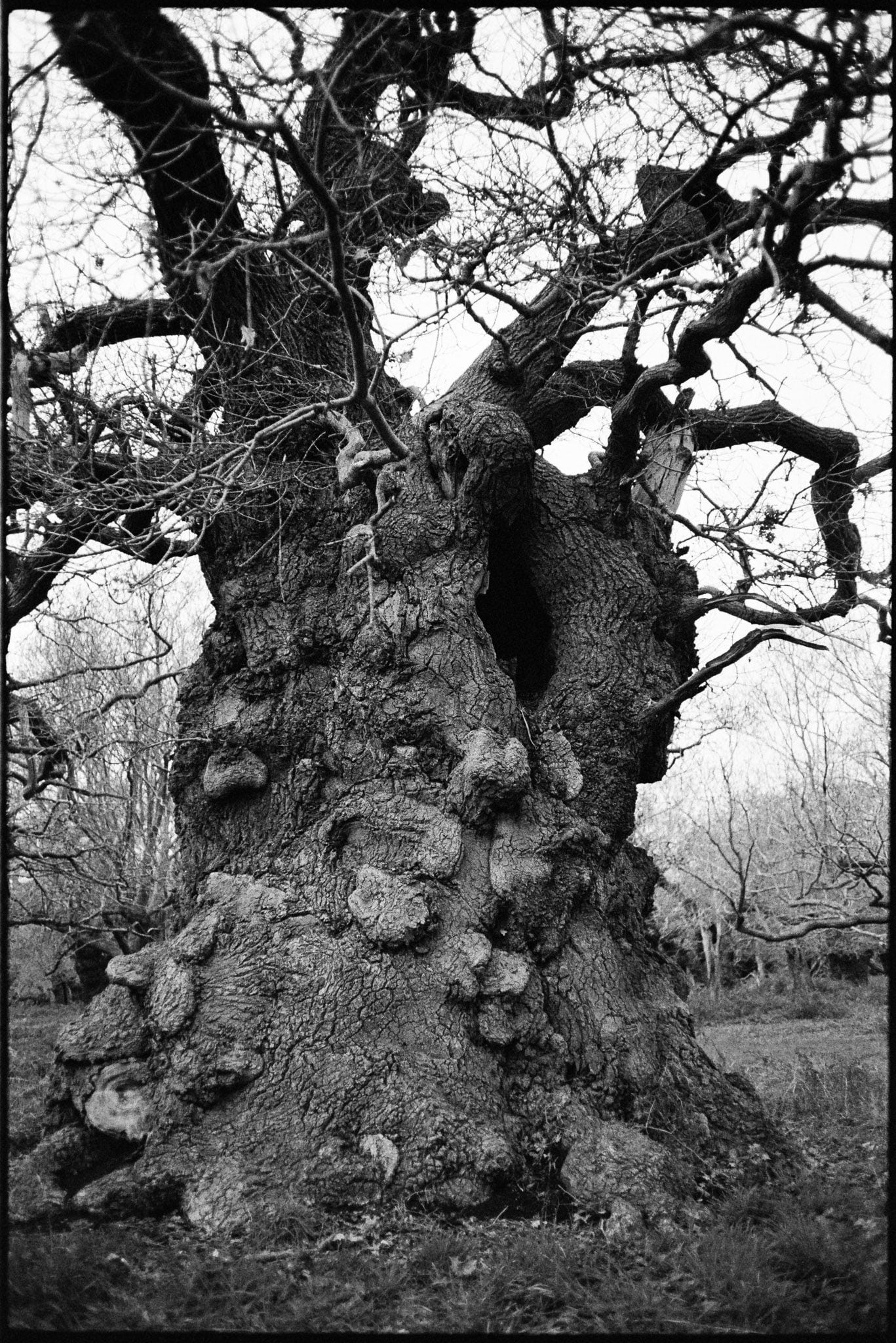
Back through the Thicks we walked as the December afternoon light merged into a dull evening smudge. You might think from my description above that I find this a menacing place, but that couldn’t be further from the truth. To me it has always felt watchful, yes, and certainly of itself. It is unyielding and old and probably knows far more than we do. Some of these trees sprouted from acorns in the 12th century. My mind tries to grasp that span of time witnessed by a single living thing and fails.
But menacing? No. If anything, to me it feels like a gaunt and uncompromising kind of comfort, like the shocking beauty of a buzzard’s eye. A thing that cannot be denied. In acknowledging its reality perhaps we can surrender some of our human doubt, give ourselves over to something that simply is. I’ve always felt the strong urge to be quiet and attentive there, listen to the voice of the wood, and perhaps that is all it asks. Is that faith? Maybe it is. But faith in what? In the wood? In the trees? In the part of me that responds uniquely to this environment? I don’t know.
When will I go back? I can’t answer that either. But I can be sure that it will be dusk, the branches will be tracing a score against the sky, and an evening spotlight will lance through the canopy for just a moment as a bird takes flight. Some things are as inevitable as they are eternal.
“If you don’t first accept the gift as it is – if you change what you hear, or change what you learn – doesn’t that make it weak somehow?” “Why should it?” Mr. Williams asked softly. “As I believe I’ve said to you before, the gift is not what you hear, or learn… the gift is being able to hear and learn.”
—Robert Holdstock, Lavondyss
Your support enables me to keep publishing Alpenglow Journal. I don’t earn a living from this work, but these words, images and feelings are the most personal I will ever share. It takes a lot of time and effort to put it all together. Please consider becoming a monthly paid subscriber to support me directly – or you can always drop me a one-off tip via Ko-Fi. Thank you.
Images and words © Alex Roddie. No AI has been used in the creation of any work on this page. All Rights Reserved. Please don’t reproduce this material without permission.
Comments
Nothing yet. Say the first thing.
Sign in to join the conversation.