
In this series on deconvergence, I ask a simple but difficult question: what can we gain if we reduce our reliance on the smartphone, especially in the great outdoors? And what tools can we use to do this?
The deconvergence series to date:
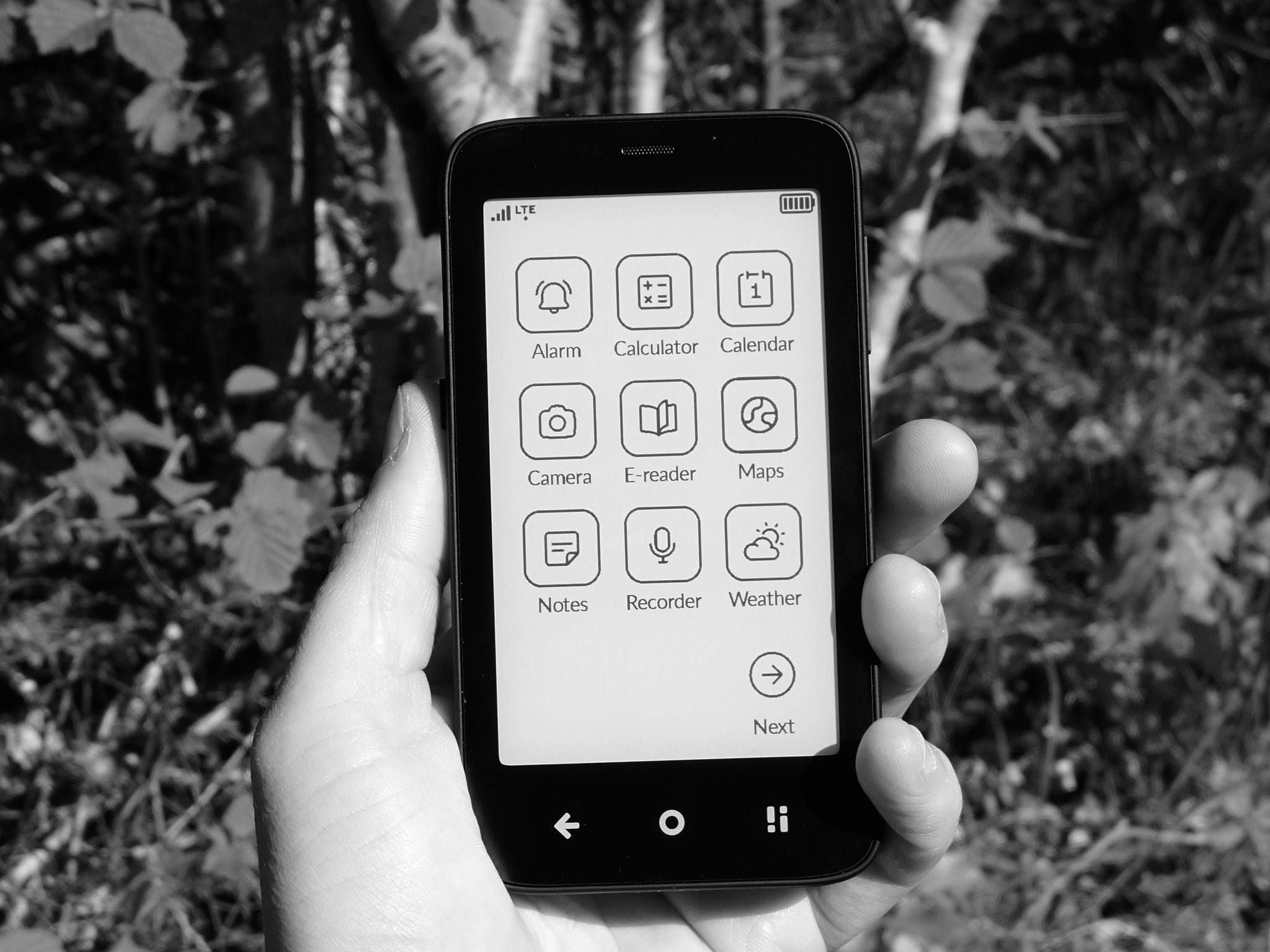
Today I’m taking a look at smartphone alternatives. This is a review of the Mudita Kompakt, marketed as a ‘minimalist E Ink phone for less screen time, and fewer distractions’. Despite some iffy marketing spin, the device itself is interesting: it’s small, has a monochrome e-paper screen like your Kindle, and comes with a very basic Android installation without any bloatware. Out of the box, there’s not even any way to access a web browser, and no app store. But the reason it attracted me is that you can sideload key apps, which presents a tempting prospect for someone who is looking for just enough smartphone functionality without the downsides.
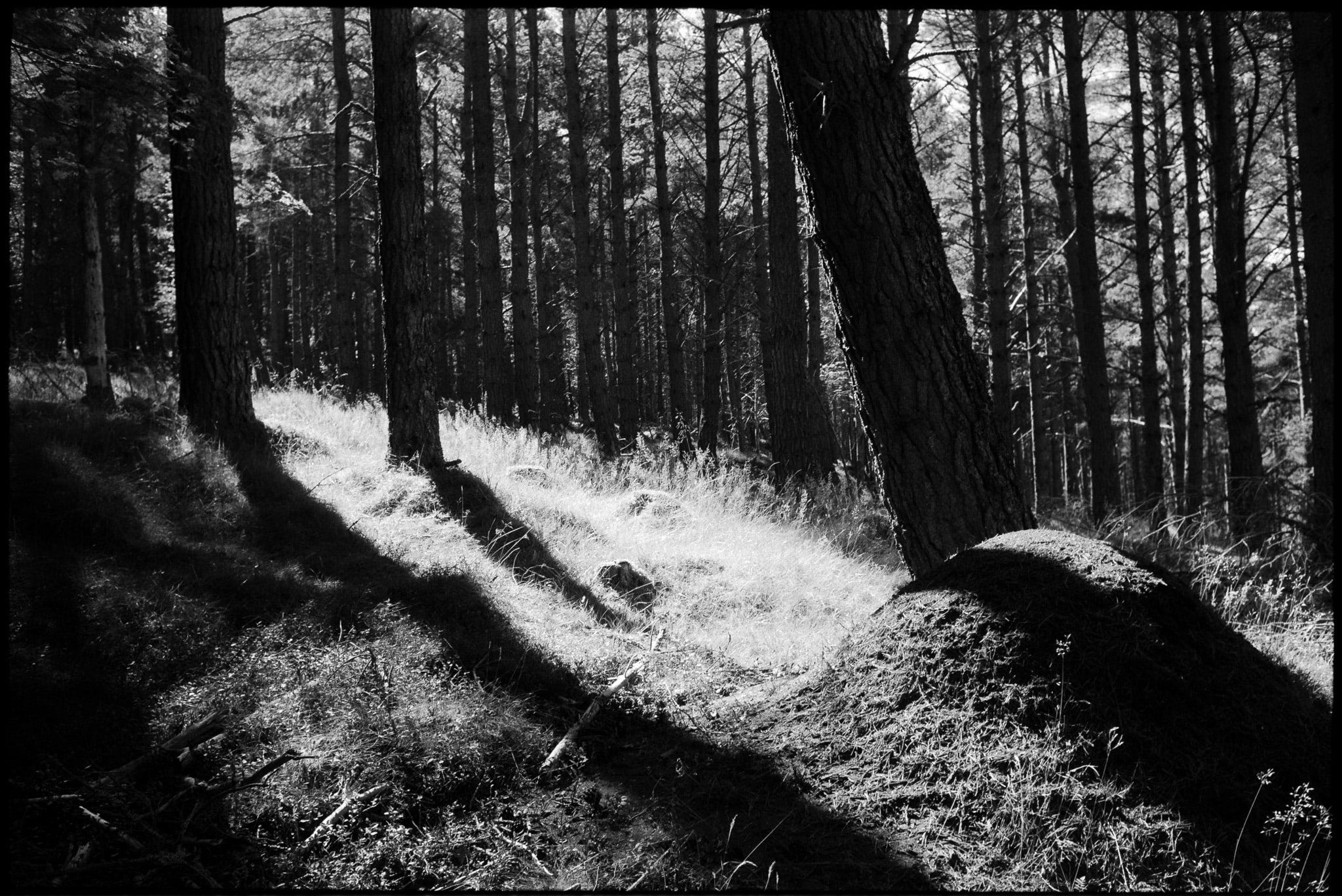
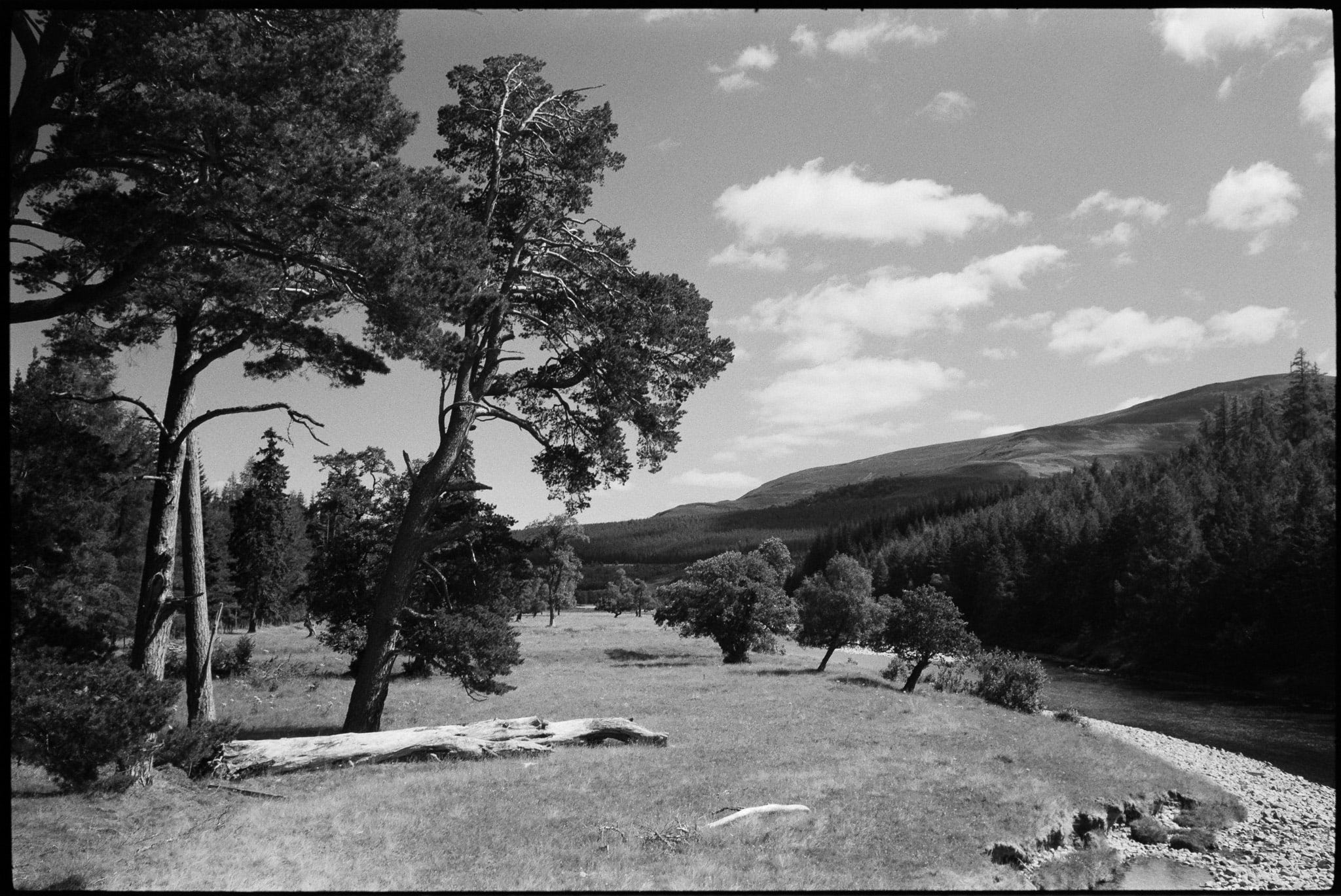
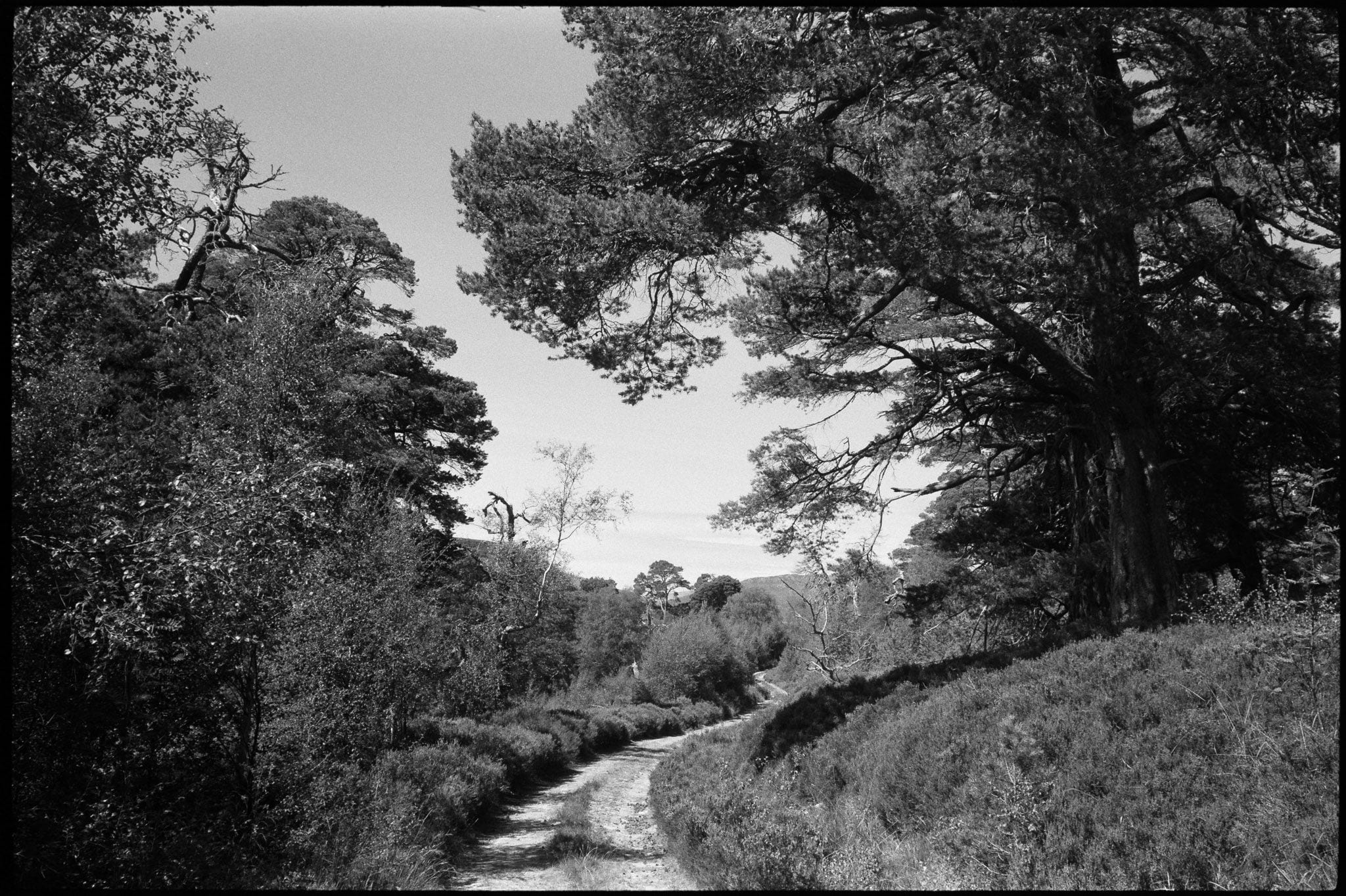
So how did it go? Here’s my review. The photos were shot on my Leica M3 and were not taken with the device being examined.
For those who prefer to read on paper (or e-reader) rather than in your Substack or email app, I have converted this essay into an easily printable PDF.

This account was recorded on the trail in real time, so it’s less polished than my typical work. If you would prefer to listen instead of read, the full audio is embedded below. The written version has been lightly edited for clarity, with subheadings added.
0:00
-22:53
Day one
It’s the second of August, 2025, and I’m just walking out of Braemar in the Scottish Highlands. A beautiful sunny day, not too hot, although there’s a bit of warmth in the sun, and the heather is blooming. The day started well. There’s a new bus service that heads directly from Blairgowrie to Braemar in an hour, and costs about £5.50. Hannah dropped me off in Blairgowrie on the way to her craft fair and I got the bus to Braemar.
Previously Braemar was very difficult to get to by public transport from where we live. You had to get the train all the way round to Aberdeen, then a different bus into Braemar. This new service is going to open up so many adventure opportunities in an area I’ve only been to a handful of times before.
When I got to Braemar, I sent Hannah a text to let her know I’d arrived, and that’s when things started to go a bit awry – or possibly well depending on your point of view!
In recent years, as many of you know, I have been on this quest to investigate smartphone alternatives, particularly in the mountains. A slightly more lightweight experience without the mental heaviness of a smartphone. My latest experiment is the Mudita Kompakt.
I’ve had it on test for a few months now, and in general it’s been pretty good… although the built-in stock apps are not great, with very limited functionality. If there are specific tasks that you want this device to do, then you do have to sideload Android apps. The ability to do that is great. I’ve got WhatsApp on there, Trainline, a couple of other essentials.
But the problem is that doing this introduces bugs. A Mudita software update came along in the last couple of weeks, and at first all was fine, but things started to go south fairly quickly. At first it was just random crashes, then the camera app would crash, and I’d get black screens and I’d have to restart.
This morning, I tried to send Hannah a picture of a sign on the side of a building with a red squirrel painted on it (she likes red squirrels). I tried to send this using the camera feature within WhatsApp, which crashed and the screen went completely black. None of the controls responded. I pressed and held the power button on the side, and I was able to restart.
When it restarted the e-ink screen was not behaving. Rather than just presenting a nice white sunlight-readable screen like a Kindle – because that’s the whole idea behind this phone, as there’s no glaring backlight, which also gives you longer battery life – it was very grey and with heavy ghosting.
I opened the settings app – completely black screen. Same with any of the built-in system apps. That’s obviously not great! If I can’t go into the settings app, I can’t force-quit any third-party apps I’ve sideloaded that may be causing misbehaviour. It could be WhatsApp itself or something running in the background.
I tried restarting again; same problem. And then a call came through, which was forwarded from my iPhone sitting at home in a drawer. This is the way I’ve got this thing set up: it gets calls forwarded from my main number. When the call came in and the phone rang, again the screen went completely black. I wasn’t able to answer the call, which is a fairly basic feature for any phone.
I could, however, still launch WhatsApp, and weirdly that worked just fine – apart from the camera functionality.
So I texted Hannah and said, look, I’m off into the hills for a couple of days as we’ve discussed, but my phone’s misbehaving, so if you don’t hear from me again, I’ll see you tomorrow. Then I put the phone in airplane mode and shoved it in my rucksack. At this point it’s essentially unable to do anything other than access WhatsApp.
When I get home, I’ll plug it into my computer, launch the debugging tools, and see what the issue is. I’ve made a few customisations, such as deactivating the built-in launcher so I can use a third-party one, so something has possibly gone wrong there somewhere.
It’s got to be said, this has dented my confidence in the product. I really enjoyed using it on the Fife Pilgrim Way. It just sat in my pocket not doing anything; I didn’t even have to charge it once for the whole week we were away. It’s genuinely fantastic when it works. You just don’t think about it until you need it for something, whereas a smartphone’s always got that psychic tug on your mind. However you use a smartphone, it is designed to attract your attention, whereas this thing isn’t. Unless it all goes wrong! And then it lives rent-free in your head, just like a regular smartphone does.
On the plus side, this does mean that I’m effectively without a phone of any kind as I’m about to head into the Cairngorms, which is kind of the whole point of why I’m doing this: to get more presence, reduce my reliance on screens.
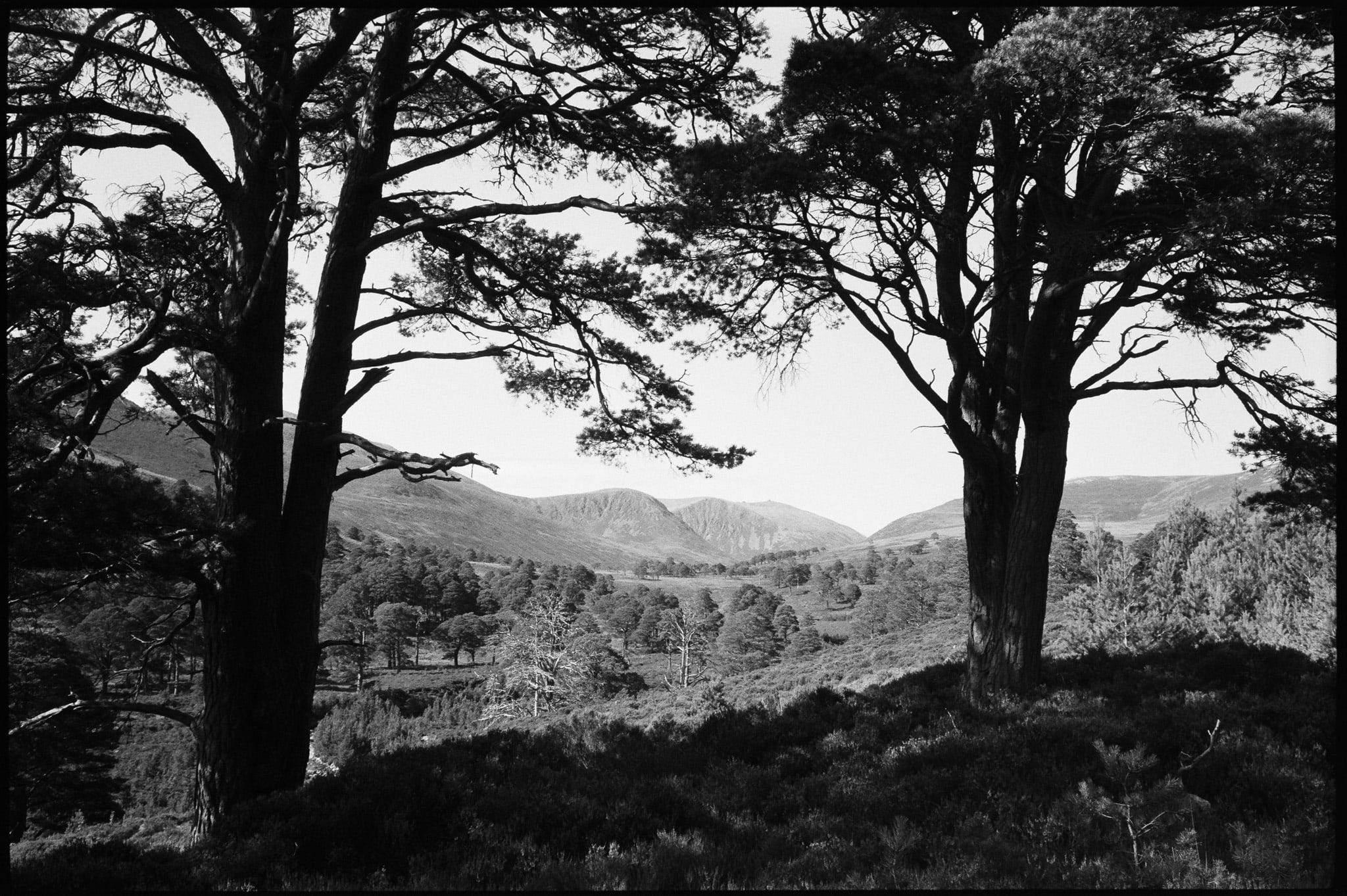
So we shall see, but it has thrown my plans in question for the Alps later this month, because I did fully intend to take the Mudita Kompakt as my sole device. I don’t think I’ll be doing that now, because I have to be able to rely on it for essential communications, emergencies, things like that. The basic functions that you actually need when you’re travelling. And it has to be said, much as I dislike carrying an iPhone, iPhones are reliable. They don’t crash or go wrong in my experience.
Maybe it’s back to using the good old iPhone SE in a switched-off, intentional manner with as few apps as possible, and stick it in my rucksack rather than my pocket. I’ve done that on many a trip over the years, and it does work. Maybe that’s just the simplest solution. Maybe looking for another device is not the answer.
I’ll make another entry later on, perhaps at the end of the trip when I’ve assessed how this has affected my experience in the mountains. But if it’s going to go wrong, it’s better to happen at the start of a short, local trip like this in nice weather, rather than in some other country where I really need reliable comms.
Later
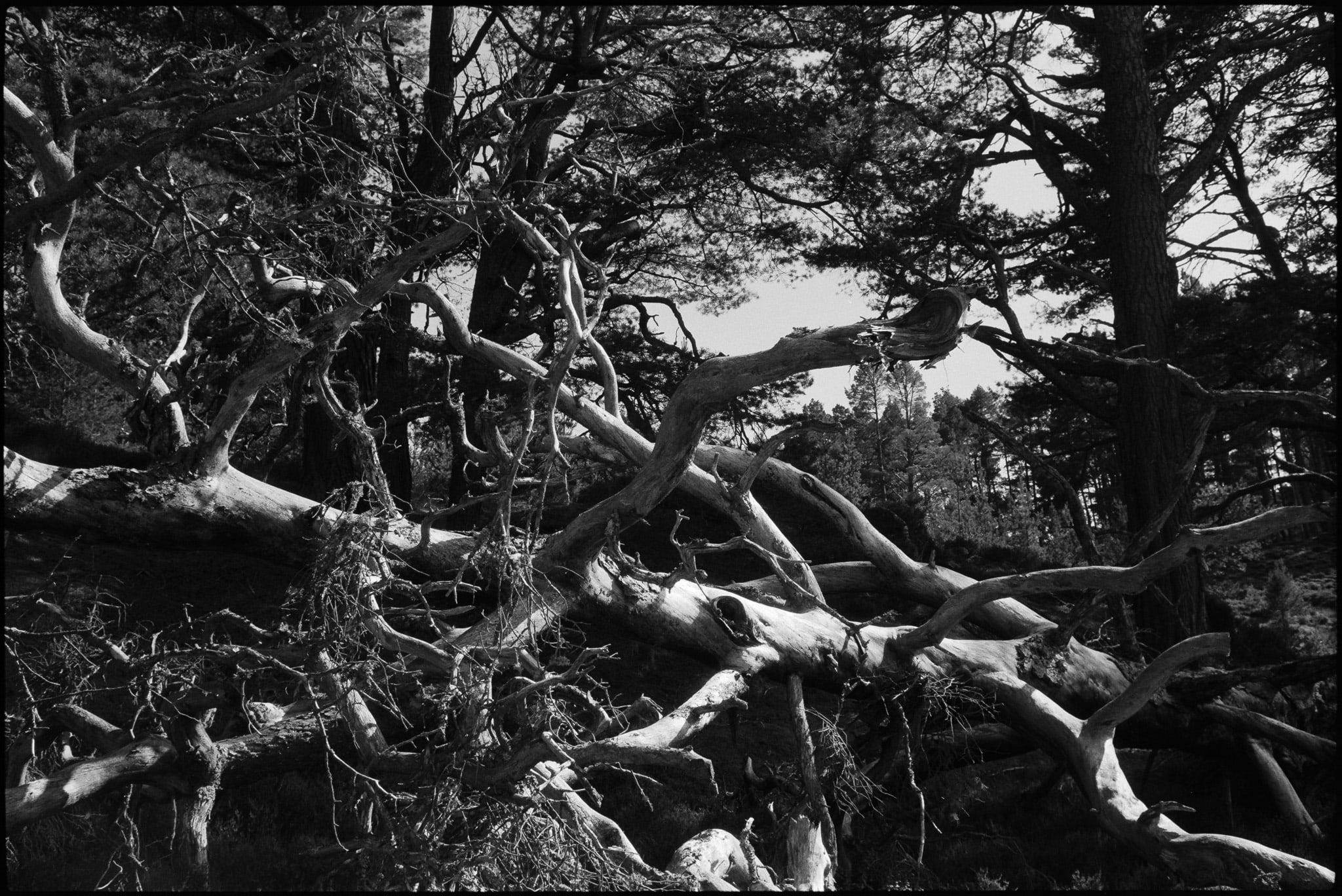
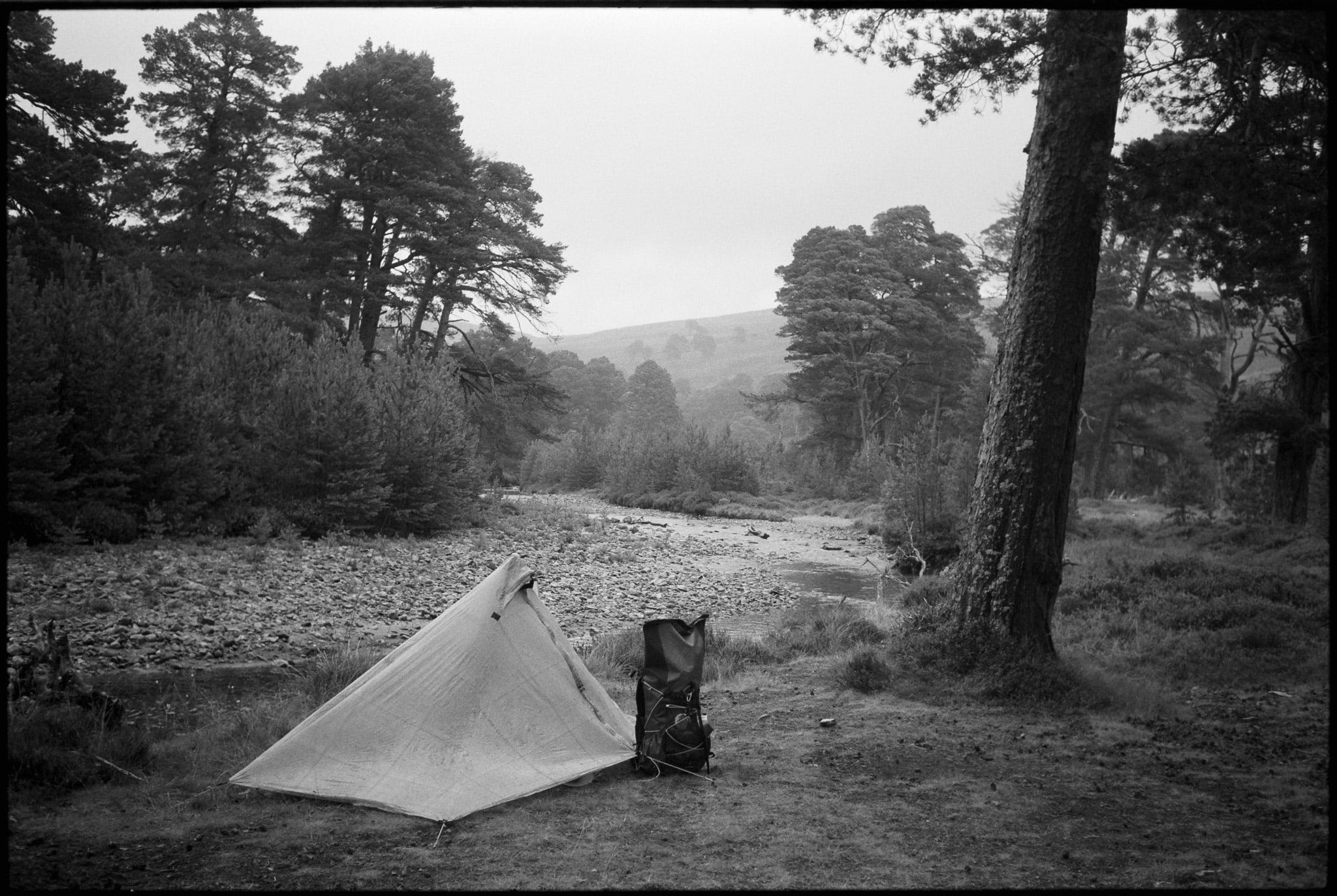
I’m on my way down Beinn Bhreac, the summit I was aiming for today. It’s 7pm, and the weather has certainly turned. It was quite hot and humid on the way up, but when I got to the summit, looking into the higher Cairngorms you could see the cloud coming in waves, and it looked quite ominous. The wind’s getting up and it’s feeling cooler. It’s forecast to rain a bit overnight, so I’ll probably find somewhere to camp in the forest.
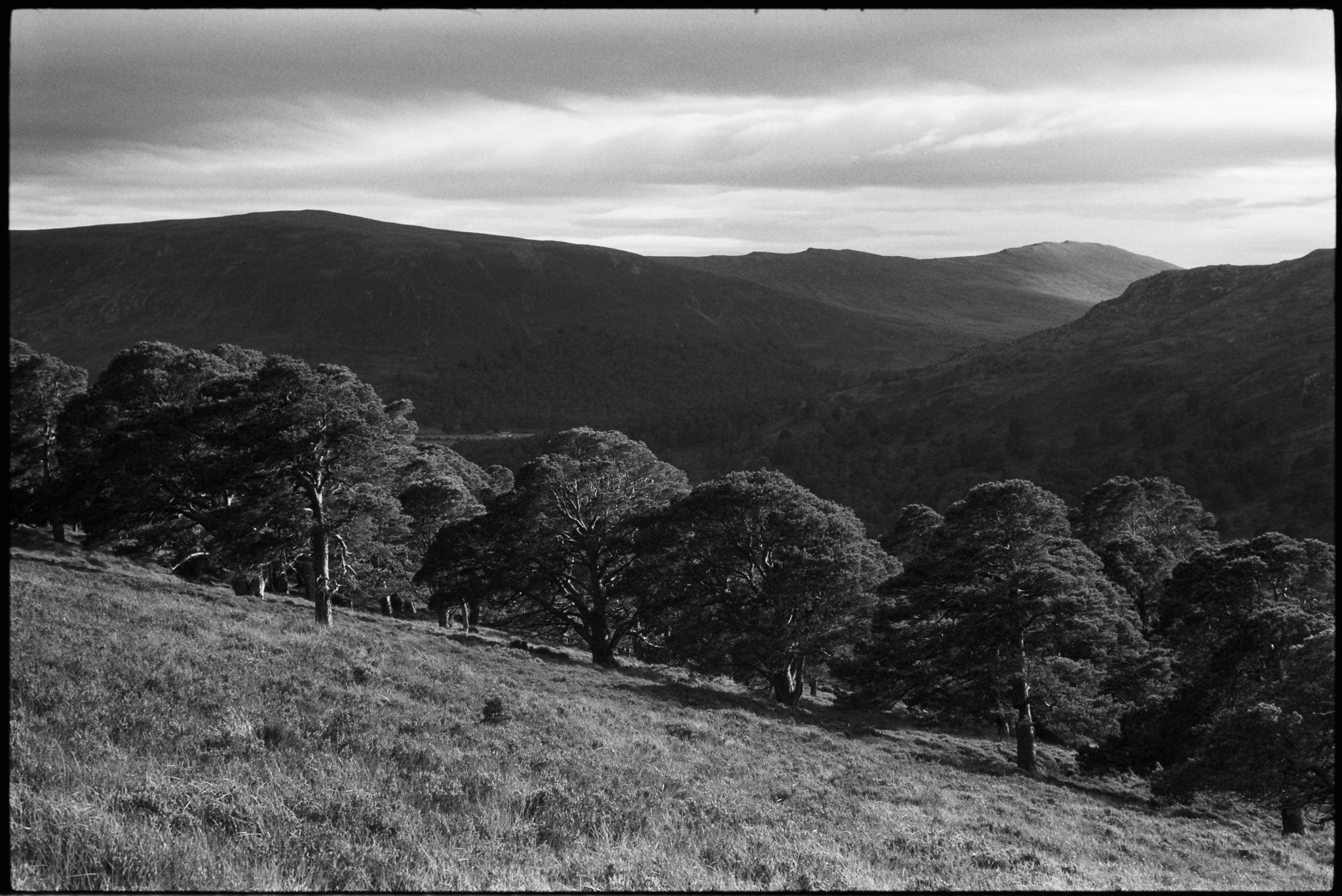
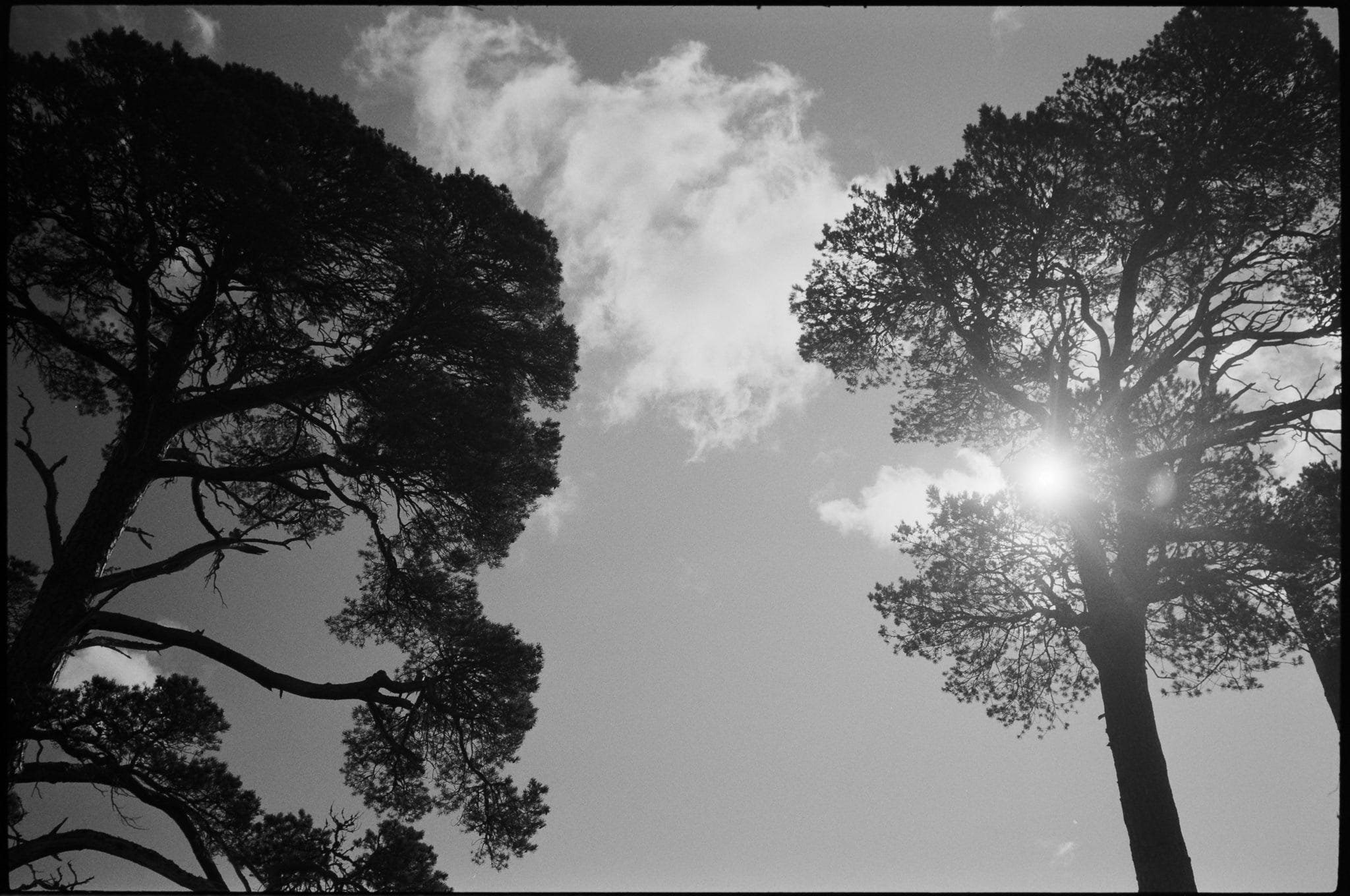
It’s been a great trip. Really nice to explore Glen Derry, which I had never visited before. I think this just goes to show the opportunities that good public transport actually opens up, because I’d rarely explored this side of the Cairngorms. I’ve been here maybe four or five times before and that’s that. There is a wealth of new areas for me to explore here. Glen Derry is a revelation – full of spectacular regenerating forest with amazing ancient pines everywhere. I’ve shot an entire roll of Ilford FP4+ today because there have been so many picture opportunities.
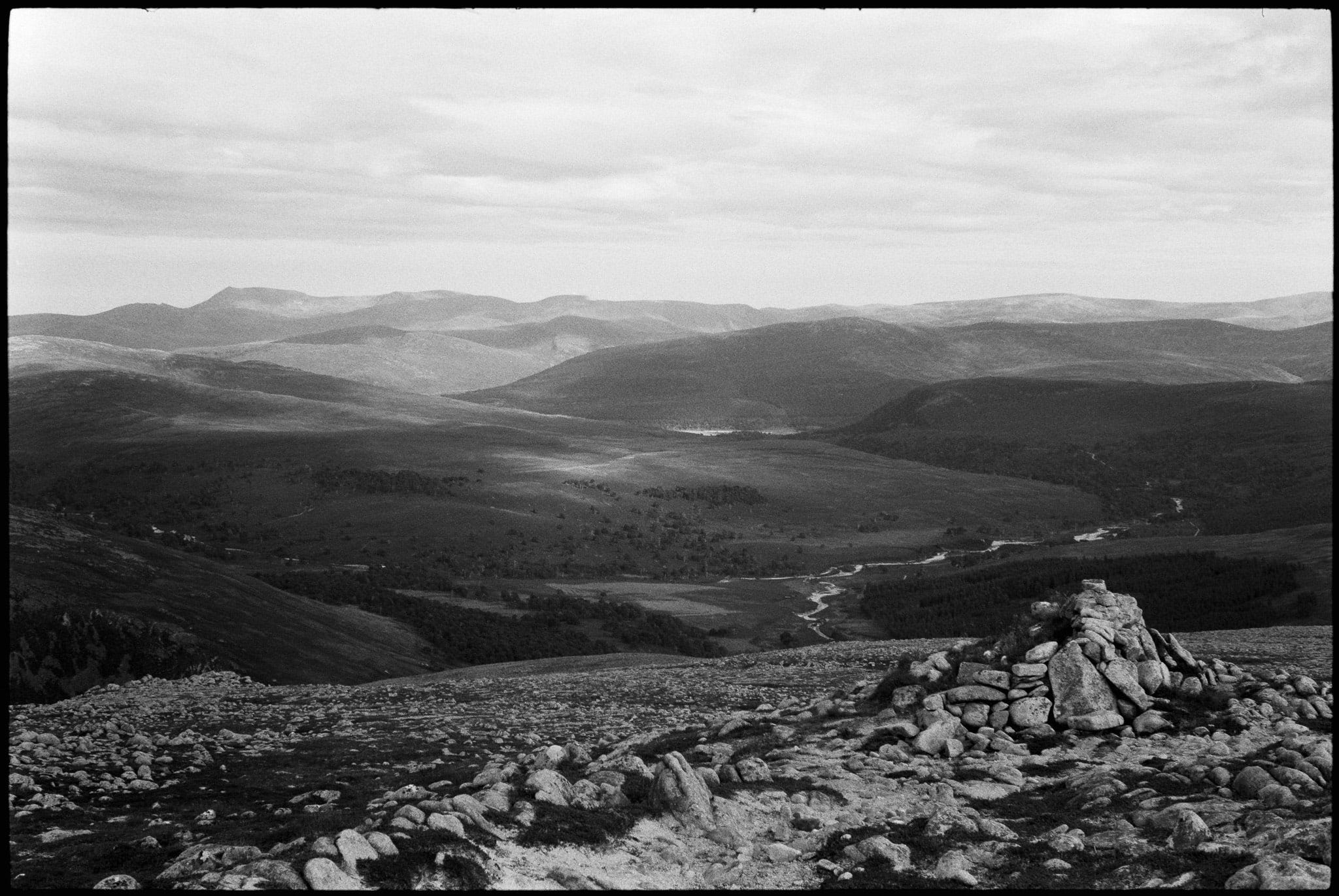
I have climbed most of the mountains around here before, but in most cases from the other side. So I’m looking up to Beinn Mheadhoin, Beinn a’ Chaorainn, Beinn MacDui; these are mountains I know, but I’m seeing them from a new angle. I’m so excited about other adventures I could have from Braemar. The opportunities are as abundant as they are from Aviemore. The walk-ins are similarly long, but that’s part of the fun – I like to go out and bivvy or camp.
I’ve been having a few more thoughts about the phone situation, what with the Mudita Kompakt being on death’s door. I will obviously try and fix it when I get back home, but my confidence in the device has definitely been knocked, and the thing about a phone is that it has to be reliable. So this leaves me with a question. Do I go back to a dumbified iPhone, which is what I’ve been rocking for years?
One of the things about this experiment, about deconvergence, is trying to see if I can lift a lot of the burden off the smartphone. This way, the device has less of an imprint on your mind, so you can be more present. That’s the idea, and it does actually work. I’ve tried so many different methods, and the less you use your phone, the more present you are. That’s simply a fact, for me anyway.
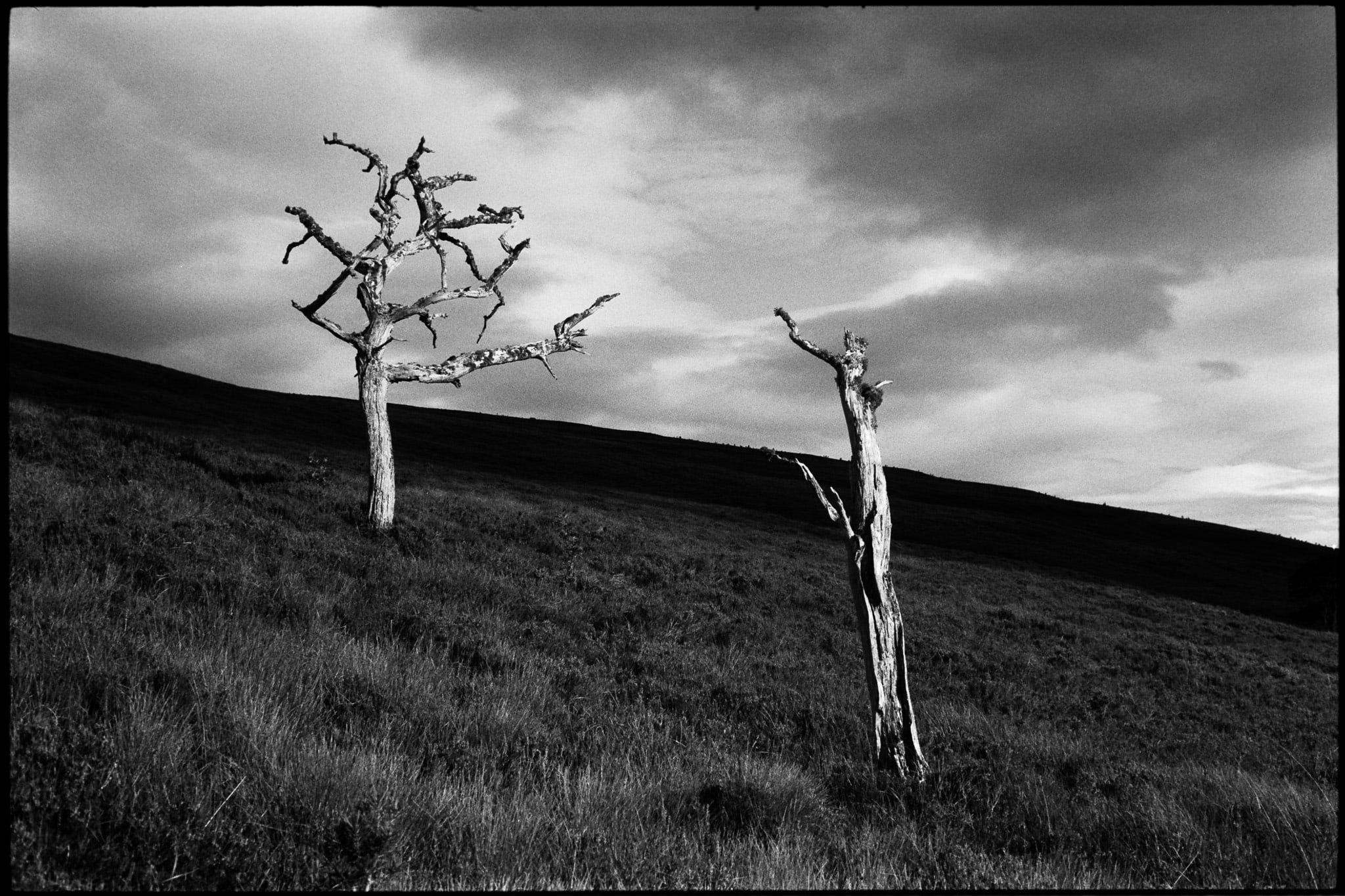
But a Mudita Kompact is still a smartphone, even though it has an e-ink screen, and you can access the web (there is a basic browser exposed by third-party launchers). The potential for sitting down and scrolling is always there. Of course, I’m not sitting and scrolling on timewasting websites on the Mudita Kompakt, but fundamentally it’s not that much different from a dumbified iPhone, is it?
But it feels a bit like a statement of defeat. In addition to trying the Mudita Kompakt, I’ve also tried using an Apple Watch as a dumbphone in a little handheld case, and again that experiment didn’t last very long, because you run into dealbreakers. There are scenarios in which it just doesn’t work, or the reliability isn’t there, or any number of problems.
I guess this is why the smartphone has reached such saturation in society, because it’s just incredibly useful – let’s not deny that!
I’m thinking about my big Alps trip in a couple of weeks. I had planned to take the Mudita Kompakt and use it as little as possible; it was supposed to be my acid test to see if it was possible to travel internationally with such a lightweight device. But I can’t in all conscience take it with me. What if it packs in again when I need it?
The other option I’m thinking of is placing further artificial restrictions on the iPhone. One of the things that enabled the digital transformation in backpacking and mountaineering is the invention of lightweight power banks. You can carry power for pretty much as long as you want; I’ve been able to stretch a 16,000mAh one to two weeks before, easily. If you’re using your phone a lot for navigation and so on, or social media, then yes that does take a hit, but the fact is that if you’re carrying a power bank then you’re liberated from power concerns. This encourages less restricted phone use. In the past I have carried a solar panel as well.
But what if I don’t take those? What if I just take a wall charger, and tell myself I’ve got what’s in my phone battery until I get to the next place where I can recharge, be it an alpine hut or cafe or campsite? So power is a limited resource again. This is something I remember from many of my early backpacking trips; the careful rationing of resources is one of the main things you learn while on the trail. Back then a lot of my electronics ran off AA/AAA batteries, so you have to eke them out, but with a power bank that frugality is lost.
That’s an idea – maybe I just don’t take a power bank. That way, I’ve always got the idea in the back of my head that if I sit and scroll then my phone dies, and I’m not texting Hannah to let her know I haven’t fallen off a mountain, or I’m not accessing my train tickets. I have to keep the power for essential utilities.
Part of me thinks, am I overcomplicating all this? I am a chronic overthinker. But nobody else is really thinking about this stuff, or at least not many people. For most it’s about using the phone to its full capabilities, and that doesn’t work for me. Going with the flow and using the phone as it was designed to be used just sucks my brain into the screen and I’m not present where I am, so that’s why I’ve got to go through all of these experiments to find a solution that works without being so inconvenient it makes me want to jump off a mountain.
Yes I’m willing to trade a bit of convenience for this – I’ve written before about how once you let go of the sacred cow of convenience you’ll realise it was never all it’s cracked up to be – but at the same time there is a limit. So it’s all about finding a balance, finding a solution that works and that encourages you to use your grey matter rather than opting for the digital default.
Day two
It’s Sunday the third of August and the second day of my little Cairngorms trip from Braemar. Last night I camped next to the river near Derry Lodge. A beautiful place – but of course the midges came out as soon as the sun went down. Wasn’t too bad, maybe 5/10 in terms of midge pressure. I’ve had it a lot worse.
It did rain a fair bit overnight, probably more about dawn to be honest, but the weather soon cleared and I walked back over the Clas Fhearnaig, which is the pass between Glen Derry and Glen Quoich. I’d never been across that pass before. It’s really beautiful, with lots of surprise lochans and intricate little views.
Then I went down to Glen Quoich with its grand granny pines. Again, I’d never visited Glen Quoich before – an absolutely amazing place. Quieter than Glen Derry, I suspect because the track is harder to cycle; I did see a lot of cyclists yesterday.
Anyway, I’m almost back at the Victoria Bridge now, so just a few kilometres back to Braemar. It’s been a fantastic trip, it really has. As I said yesterday, it’s opened my eyes to the adventure possibilities that come with this new bus, and I’m already dreaming about coming back in winter – especially winter trips up onto Beinn MacDui. There’ll be easier access to Beinn a’ Bhuird and Beinn Avon as well, which I’ve only climbed once before in very poor visibility.
Walking through the woods now, hoping I get to see a red squirrel!
When I got home, I went through the usual debugging rigmarole, which included a reset, but the problem persisted. I ended up contacting the manufacturer with a long report on the issues I’d experienced, and they were very helpful, writing a long and detailed response. Here’s the key bit:
This crash is almost always linked to an issue with how the microSD card is configured. We suspect that one of your sideloaded applications has reconfigured your SD card to act as “internal memory” (a feature sometimes called ‘Adoptable Storage’). MuditaOS K does not support this feature, and when it’s enabled, it can lead to instability and prevent built-in apps like Maps from accessing storage correctly.
I went through their troubleshooting instructions. Here’s the solution:
The only way to recover the phone in such bad state is to perform a factory reset from the boot menu. A normal factory reset would not fix this, as the “adoptable storage” setting on the SD card is not cleared through the standard reset process.
The problem did clear after a factory reset from the boot menu, but I decided to sell the device and move on.
I do not recommend the Mudita Kompakt as anything but a curiosity. It has so much potential, but comes with frustrating downsides, buggy software, and is not reliable enough for use in the mountains.
Disclaimer: I bought this product with my own money and have had no contact with the brand beyond reporting details of the faults I experienced.
If you like what you’ve read, please subscribe to receive updates in your inbox and Substack app. Thanks for your support. And if you’ve enjoyed what you have read, please tell someone else about it!
Images and words © Alex Roddie. No AI has been used in the creation of any work on this page. All Rights Reserved. Please don’t reproduce these images without permission.
Comments
Nothing yet. Say the first thing.
Sign in to join the conversation.